

As business owners of SaaS firms, navigating the world of SOC compliance and regulations can be challenging due to its complex legal language, audits, and other requirements. Nonetheless, data security is paramount; therefore, it is beneficial to explore this landscape with a thorough understanding of the SOC (Service Organization Control) reporting framework.
In this article, we compare SOC 3 vs. SOC 2 compliance, discussing their similarities and differences.
What is a SOC 2 report?
A SOC 2 report is a detailed description of your SOC 2 audit process. It is an evaluation by an independent certified auditor of whether your business provides a secure, available, confidential, and private solution to your customers. The auditor releases the report after examining your organization’s control over one or more of your chosen Trust Services Criteria (TSC). A SOC 2 Type 2 report evaluates the effectiveness of your security controls against a wide range of security issues over a period of time.
The SOC 2 report contains the auditor’s detailed opinion on the design and operational effectiveness of your organization’s internal controls. It is, in essence, a testament to the strength of your information security practices. It is meant to enable the report users (your customers and customers’ customers) to assess and address the risks arising from their relationship with your organization.
What is a SOC 3 report?
A SOC 3 report is a public account of your organization’s internal controls over the chosen TSC (Security, Availability, Confidentiality, Processing Integrity, or Privacy). While it shares similarities with SOC 2 in scope, it offers a relatively general overview of how your organization approaches data security. Therefore, organizations use them for marketing purposes to amplify their security readiness to prospective customers.
According to the American Institute of Certified Public Accountants (AICPA), a SOC 3 report is, ‘designed to meet the needs of users who need assurance about the controls at a service organization relevant to data security, availability, processing integrity, confidentiality, or privacy, but do not require or the knowledge necessary to make effective use of a SOC 2 Report.
Difference Between SOC 2 and SOC 3 Compliance
The key difference in the SOC 2 vs SOC 3 reports is in the reporting, whereas in general, SOC 3 reports are less exhaustive than SOC 2 reports.
1. Scope of the report
SOC 2 reports offer a detailed and comprehensive view of your audit. They include the auditor’s opinion, management assertion, system description, control testing, and the test results. This level of depth is often regarded as the gold standard for vendor assurance, as customers rely on it during the onboarding process.
SOC 3 reports, on the other hand, offer only a summarized view. They confirm that your controls meet the Trust Services Criteria but exclude all control descriptions and testing details.
2. Intended use of the report
SOC 2 reports are restricted-use documents intended for internal teams, customers, and customer auditors. They are typically reviewed during vendor risk assessments.
SOC 3 reports are designed for general use. They can be shared publicly, and many organizations publish them on their website to highlight their security posture. This is why SOC 3 is often referred to as a marketing-friendly version of SOC 2.
3. SOC 3 report vs SOC 2 type
SOC 2 reports are categorized into Type I and Type II. Type I offers a point-in-time view of control design, while Type II evaluates how those controls operated over a period.
SOC 3 reports are issued only in Type II format. They follow the same Trust Services Criteria as SOC 2 but present the results in a simplified, public-facing format without disclosing any testing evidence.

SOC 2 vs SOC 3: Price Differences
The primary cost difference between SOC 2 and SOC 3 primarily stems from the audit effort and the depth of reporting.
A SOC 2 audit is far more detailed, requires extensive evidence collection, and involves rigorous control testing, so it naturally costs more. SOC 3, being a summarized version of SOC 2, doesn’t require a separate full audit, which keeps the cost lower.
In most cases:
- SOC 2 is the primary cost driver. A SOC 2 Type I audit typically ranges from $5,000 to $25,000, while a SOC 2 Type II audit ranges from $7,000 to $50,000. When you factor in readiness work, tooling, internal time, and hidden costs, the total SOC 2 compliance investment typically ranges from $30,000 to $150,000.
- SOC 3 is usually an add-on deliverable derived from your SOC 2 audit. Because no additional testing is required, the incremental cost is minimal—often bundled or charged as a small administrative fee by the auditor.
For most organizations, the real investment is in SOC 2; SOC 3 becomes an optional, public-facing summary report built upon it.
SOC 2 vs SOC 3 Report Similarities
To best appreciate the differences between SOC 2 vs SOC 3 report, let’s first dive into their similarities.
Audit Scope
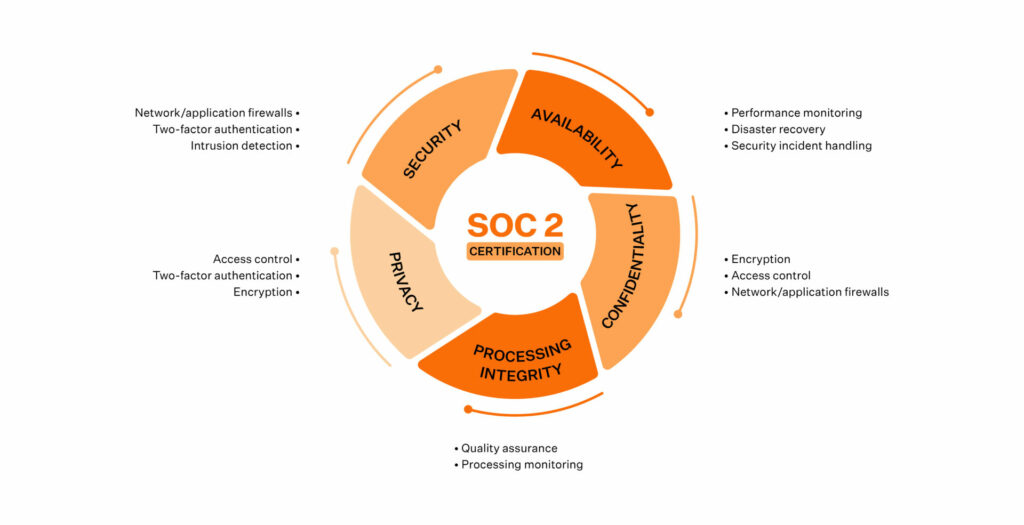
The two frameworks are based on the five principles laid down by the AICPA’s Trust Services Criteria – data security, confidentiality, availability, privacy and processing integrity. The organization chooses the TSCs based on the services it provides to its customers.
Here’s a quick overview of the five Trust Services Criteria.
- Security
It must be in scope for every SOC 2 audit and is, therefore, referred to as the common criteria. It requires you to enable access the SOC 2 controls, entity-level controls, firewalls, and other operational/governance controls to protect your data and applications. This TSC takes substantial effort and will require participation from your IT Development, IT Infrastructure, HR, senior management, and operations teams.
Case Study:
How Ripl achieved SOC 2 compliance while spending 1/3 of the expected effort
- Availability
The Availability criteria in SOC 2 focus on minimizing downtime and requires you to demonstrate that your systems meet operational uptime and performance standards. It includes network performance monitoring, disaster recovery processes, and procedures for handling data security incidents, among others. Business continuity, data recovery and backup plans are critical pieces here.
- Confidentiality
This principle requires you to demonstrate the ability to identify and safeguard confidential information throughout its lifecycle by establishing access control and proper privileges (to ensure that data can be viewed/used only by the authorized set of people or organizations). Confidential data includes financial information, intellectual property, and any other form of business-sensitive details specific to your contractual commitments with your customer.
- Processing Integrity
This principle assesses whether your cloud data is processed accurately, reliably, and on time and if your systems achieve their purpose. It includes quality assurance procedures and SOC tools to monitor data processing. This is relevant for businesses that execute critical customer operations such as financial processing, payroll services, and tax processing, to name a few.
- Privacy
It requires you to protect Personally Identifiable Information (PII) from breaches and unauthorized access through rigorous access controls, two-factor authentication, and encryption. Privacy is relevant to you if your business stores customers’ PII data such as healthcare data, birthdays, and social security numbers.
Must Read: SOC 2 Certification: A Comprehensive Guide to Compliance and Benefits
Automate your SOC 2 and SOC 3 compliance with Sprinto
SOC 2 vs SOC 3 Audit Standard
Both audit processes are based on the same standards (AT-C Sections 105 and AT-C Section 205) and guidance. For that matter, you cannot generate a SOC 3 report without first complying with the requirements for a SOC 2 report.
Check out a detailed guide on SOC 2 for small business
Also, checkout: SOC 2 report example
Bonus: Here’s a SOC 2 Compliance Checklist for you
Who can perform the audit?
When it comes to the auditing process, there isn’t much difference between SOC 2 and SOC 3. Both SOC 2 and SOC 3 audits must be performed by an independent CPA firm that specializes in security and compliance assessments. The auditor should have proven experience in evaluating information security controls and must remain fully independent, meaning they should have no ties to your board of directors or executive team.
Once you select your SOC 2/SOC 3 auditor, you can onboard them directly into Sprinto’s secure dashboard for a streamlined audit experience. This allows you to grant role-based access, share SOC 2 and SOC 3 evidence, respond to queries, communicate with the audit team, and track audit progress from a single location.
Also checkout: SOC 2 for startups
How to choose between the SOC 2 vs the SOC 3 Report
In our experience, organizations typically begin with a SOC 2 Type 1 or SOC 2 Type 2 report before proceeding to a SOC 3 report. This is because a SOC 3 report cannot be generated without first complying with the requirements for a SOC 2 report. Additionally, SOC 3 requires the same level of planning and audit process preparation as a SOC 2 Type II report. Many organizations, therefore, decide to add SOC 3 only after getting their SOC 2 Type II reports.
Get SOC 2 audit-ready in weeks, not months
Get SOC 2 Compliant with Sprinto
Achieving SOC 2 shouldn’t be complicated. Sprinto automates the heavy lifting so your team can focus on shipping, not chasing evidence. Here’s how Sprinto helps you get (and stay) SOC 2 ready with far less effort:
- AI-powered questionnaire responses: Accurately auto-suggests answers to security questionnaires based on your controls, policies, and past responses.
- Auto-map controls to SOC 2 criteria: Automatically aligns your existing controls with SOC 2 requirements, eliminating manual mapping and speeding up readiness.
- Continuous control monitoring: System checks are automatically mapped to controls, helping you maintain real-time compliance instead of preparing for point-in-time audits.
- Evidence gap analysis: AI or weak evidence, reducing audit friction and preventing last-minute scrambles.
- Vendor due diligence automation: Upload vendor documents or questionnaires, and Sprinto analyzes risks, exceptions, and gaps automatically.
Frequently Asked Questions
The main difference lies in the level of detail and the intended audience. A SOC 2 report provides a detailed description of the auditor’s opinion, management assertion, controls, test procedures, and results. It is known as a restricted-use report meant for internal management, customers, and their auditors.
A SOC 3 report provides only a high-level summary of the auditor’s opinion and a brief description of the system. It does not list the controls tested or the test results. This is why SOC 3 is referred to as a public-facing report, often shared on company websites to demonstrate the company’s security posture.
SOC 3 is a security framework designed by the AICPA to meet the requirements of users who need assurance about the controls at a service organization relevant to the five TSCs of security, availability, processing integrity, confidentiality, or privacy, but don’t need the knowledge necessary to make effective use of a SOC 2 Report (which is more detailed).
SOC 1 reviews your company’s internal controls over financial reporting, or, simply put, a SOC 1 looks at how well you keep your books. SOC 2 examines your organization’s control over one or more of the Trust Services Criteria – Security, Availability, Processing Integrity, Confidentiality, and Privacy.
SOC 3 reports also test your organization’s internal control over one or more of the TSC. Still, these are essentially marketing tools that can be used by you to showcase the effectiveness of your internal controls. You can post it on your website and even use it in your various collaterals, as these reports are tailored for a general audience. Unlike a SOC 2 report, this report isn’t private and is always available in Type II only. And since the SOC 3 report doesn’t go into as much detail as the SOC 2, you really cannot rely solely on a SOC 3 for your customers. A SOC 2 is a must.
Yes, very much so. For larger companies that need to demonstrate their security posture to customers, it’s a layman-friendly report. For instance, AWS has made its whitepaper for its SOC 3 report public. Google Cloud also made its SOC 3 compliance report available. Anyone interested in these companies can read the reports. SOC 3, therefore, also serves as a nifty marketing document.
Both SOC 2 and SOC 3 audits must be performed by an independent CPA (Certified Public Accountant) firm that specializes in SOC examinations and information security audits. The auditor should be qualified, experienced in evaluating internal controls, and fully independent with no ties to your leadership or board.
SOC 2 is significantly more expensive because it requires detailed evidence collection, control testing, and auditor review. A SOC 2 audit typically ranges from $5,000 to $50,000, and the total cost, including readiness and tooling, can range from $30,000 to $150,000. SOC 3 is much cheaper because it’s derived from the SOC 2 audit. Since no additional testing is required, it’s usually a low-cost add-on or bundled with the SOC 2 engagement.
The short answer is no. This is because a SOC 3 report is based on the same criteria as a SOC 2 report and cannot be generated unless you have completed the SOC audit first.

Srividhya Karthik
Srividhya Karthik, is a Content Lead at Sprinto, she artfully transforms the complex world of compliance into accessible and intriguing reads. Srividhya has half a decade of experience under her belt in the compliance world across frameworks such as SOC 2, ISO 27001, GDPR and more. She is a formidable authority in the domain and guides readers with expertise and clarity.
Go beyond the surface and uncover the governance, risk, and compliance insights that actually matter.


Win digital goodies for boardroom success


Explore more SOC 2 articles
SOC 2 Compliance Overview
SOC 2 Preparation and Documentation
SOC 2 Audit and
Reporting
SOC 2 Differences and Similarities
SOC 2 Updates & Management
SOC 2 Industry-Specific Applications
research & insights curated to help you earn a seat at the table.