TL,DR:
| SOC 2 Type 1 evaluates whether controls are suitably designed at one point in time. |
| It helps early-stage SaaS and cloud providers prove readiness quickly, often before Type 2. |
| The guide covers scope, Trust Services Criteria, readiness assessment, auditor selection, benefits, and costs. |
SOC 2 Type 1 is often the fastest way to demonstrate to customers that your security controls are properly designed and ready for review. It’s useful when a prospect, investor, or enterprise customer requests SOC 2 proof before your team has completed the longer Type 2 observation period.
A Type 1 report doesn’t prove that controls worked consistently over several months. It validates control design at a specific point in time. That makes it a strong starting point for early-stage SaaS companies, cloud service providers, and teams that need to keep sales conversations moving while preparing for a SOC 2 Type 2.
Compliance is increasingly becoming a buyer requirement, not just a security milestone. In Sprinto’s Business ROI of Compliance 2026 report, 40% of organizations said over half their customers now consider compliance non-negotiable.
In this guide, you’ll learn what SOC 2 Type 1 covers, how it differs from Type 2, who needs it, how much it costs, and how to prepare for the audit.
What is SOC 2 Type 1?
SOC 2 Type 1 is an independent audit report that evaluates whether your organization’s controls are suitably designed to meet the AICPA Trust Services Criteria at a specific point in time.
It answers one core question: do the right controls exist today?
A SOC 2 Type 1 report can cover security, availability, confidentiality, processing integrity, and privacy, depending on your scope. Security is the mandatory Trust Services Criteria. The others apply based on your product, customer commitments, data flows, and business model.
SOC 2 Type 1 isn’t required by law, but it’s often requested by enterprise customers, procurement teams, investors, and partners before they share sensitive data or sign a contract.
“Our clients want to know that any information they share with us is secure.”~ Rafael Urgilés, Chief IT-S Consultant at Kin Analytics. They pursued SOC 2 after clients started asking for assurance around shared data, and Sprinto helped Kin Analytics team complete its SOC 2 Type 1 audit in 3 days.
SOC 2 Type 1 vs Type 2: What’s the difference?
SOC 2 Type 1 and Type 2 differ in what they test and over what period. Type 1 evaluates whether your controls are designed correctly at a single point in time. Type 2 evaluates whether those controls also operated effectively across a 3-12 month observation window.
Type 1 indicates to a customer that the right controls are in place today. Type 2 tells them those controls held up over time, which is why it carries more weight in mature enterprise sales cycles.
“Point-in-time audits show compliance on a given day, while Type 2 evidence gives auditors a clearer picture of how the posture was maintained across a period.” ~ Abir Dey [An excerpt from Crafting a Compliance Engine That Runs Itself webinar]
Use this to decide which one fits your situation right now:
| Choose SOC 2 Type 1 when… | Choose SOC 2 Type 2 when… |
|---|---|
| You need faster proof for an active deal or customer request | Customers need proof that controls operated over time |
| You’re starting your SOC 2 journey | You already have controls running and monitored |
| You want to validate audit readiness before Type 2 | You need stronger assurance for enterprise procurement |
| You need a point-in-time report | You can support a 3-12 month observation period |
Should you skip Type 1 and go straight to Type 2?
If no customer is waiting for a report right now, it’s worth asking whether Type 1 is the right first step. Going Type 1 first and Type 2 later means engaging an auditor twice, which adds an audit fee you could avoid by starting with Type 2. Teams that already have controls in place and no hard deadline often skip straight to Type 2 for that reason.
Type 1 helps when the timing is real: a prospect asks for SOC 2 during procurement, an investor wants proof of security maturity, or you need something to show while the Type 2 observation window runs. In those cases, a point-in-time report unblocks the conversation now, and you then move to Type 2. If none of that pressure exists, the cheaper path is usually one Type 2 audit rather than two.
Who needs SOC 2 Type 1 compliance?
You should consider SOC 2 Type 1 if you:
- Sell to enterprise customers that ask for SOC 2 during procurement
- Handle sensitive customer data in a SaaS, cloud, AI, analytics, fintech, healthcare, or B2B platform
- Need security proof quickly but aren’t ready to complete a Type 2 observation period
- Want to test whether your controls, policies, and evidence process are ready for a Type 2 audit
- Need a structured starting point before expanding into SOC 2 Type 2, ISO 27001, HIPAA, or other frameworks


Kin Analytics
What are the benefits of a SOC 2 Type 1 compliance report?
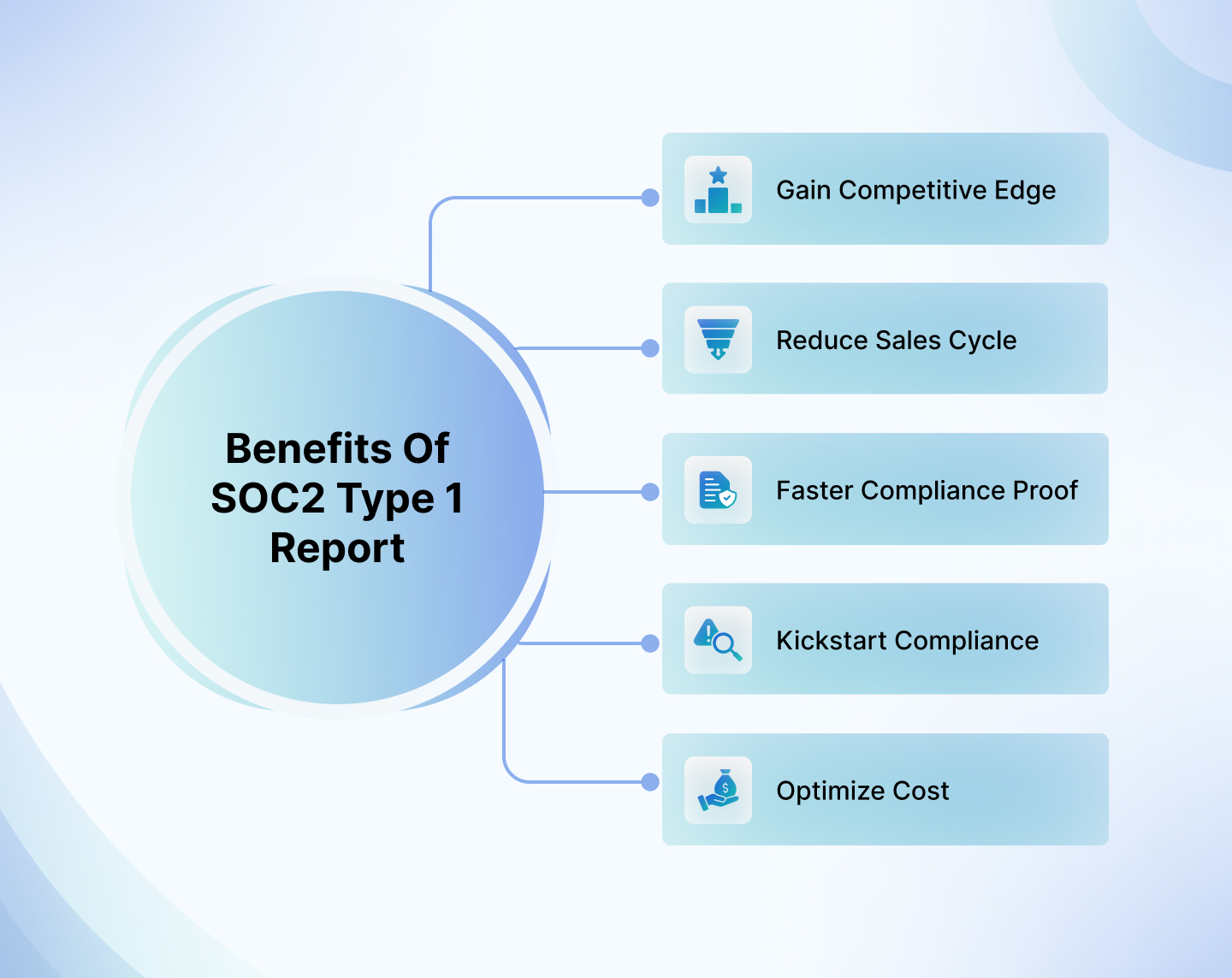
As previously outlined, the SOC 2 report is not a must-have but a good one. Below are the 5 reasons to get SOC 2 Type 1 for your organization.
- Competitive edge for startups
- Shorter sales cycle
- Immediate requirement
- Cost-effective
- Kickstarts compliance
1. Competitive edge for startups
As a SaaS vendor, customer acquisition and retention can be daunting. With many new vendors offering the same service, you must square up to survive an ever-expanding B2B space. As a new player in the market, you won’t have the time to wait months to get Type 2 to show security compliance.
At this stage, you should consider Type 1 compliance. It is a unique selling point (USP) for your business and provides a competitive edge against other new players.
Zipy, a software debugging and observability platform, began receiving requests from customers for independent auditors to review and verify their policies and practices, with SOC2 compliance being a primary concern, particularly in North America. Without this, they lost some deals to customers.
However, once they integrated themselves into Sprinto, Zipy realized that if they could achieve SOC2 compliance, other compliances would fall into place quite easily – SOC2 coverage is comprehensive that way.
Since achieving SOC2 compliance, Zipy has experienced a noticeable increase in customer interest. More people are willing to talk to them now. Hence, having a SOC 2 Type 1 attestation report clearly builds confidence in the business and the platform.
63% of early-stage organizations unlocked new TAM post-certification, while the proportion rose to 83% among larger organizations. [Source: Sprinto’s Business ROI of Compliance 2026 report]
2. Shorter sales cycle
With growing security concerns, your prospects can keep going back and forth on infosec controls before finalizing the deal. A SOC 2 report here can help you answer security questionnaires easily and shorten your sales cycle.
At Sprinto, customers often find that answering “no” to “Are you SOC 2 certified?” leads to an avalanche of about 160 additional questions.
“Companies no longer pursue SOC 2 only because existing contracts require it; they pursue it so they can enter sales cycles where SOC 2 is required.” ~ Ricky Waldron, GRC Leader [An excerpt from Crafting a Compliance Engine That Runs Itself webinar]
This can significantly slow down the sales process. However, once they achieved SOC 2 readiness within just 4 weeks of implementation, the sales cycle accelerated, and trust with customers increased more than ever before.
3. Immediate requirement
Many SaaS organizations don’t implement security protocols without an immediate requirement. If your client wants proof of good security practices and you don’t have one, Type 1 will come to your rescue.
This is because a SOC 2 report, irrespective of the Type, is the primary document to demonstrate your overall data security efficiency. It is an industry-standard report accepted by organizations of all sizes.
Recruit CRM, a cloud-based Applicant Tracking System (ATS) and Customer Relationship Management (CRM) solution, faced issues closing large enterprise deals due to a need for SOC 2 certifications. Initially, they chose a security assessment vendor that couldn’t help them achieve compliance, so they began searching for an implementation partner.
They discovered Sprinto, and within an hour of the first call, they had admin users appointed, alerts for potential spikes were set up, and a Slack channel was created for communication with the Sprinto team.
Sprinto oversaw a control-based compliance program across various security standards. They linked the compliance evidence to controls associated with multiple standards, creating a comprehensive audit evidence library.
Ultimately, Recruit CRM achieved SOC 2 audit readiness in under 10 sessions with Sprinto’s assistance.
4. Kickstarts compliance
If you are considering security compliance, Type 1 is a good option to start with. This is because it is ideal to check if you are ready for Type 2 and can handle more rigorous security protocols.
5. Cost-effective
Security compliance is important if you are a startup or small business, but budget restrictions may keep you from getting one. While both types of SOC 2 audit reports are costly, Type 1 costs between $8000 and $30000, while Type 2 will set you back anywhere from $20000 to $50000.
However, Sprinto can save your costs by up to 60%, and you can get the report within your budget. Investing in compliance automation platforms like Sprinto can save you money over time. Audits and compliance come with ongoing expenses, which rise as you expand into new regions and adopt more frameworks.
Automating SOC 2 Type 1 will strengthen security by continuously adhering to best practices. Also, with Sprinto, collecting evidence is much easier and makes the process efficient, accurate, and swift.
“The 200+ native connectors (like AWS, Jira, and Slack) make it incredibly fast to pull data without manual uploads. Because it integrates directly with our stack, it captures audit-ready evidence automatically, which saves us hundreds of hours during SOC 2 or ISO 27001 prep.” ~ Sunil C., Head of Data & Operations, Small-Business, in a G2 review.
How do you prepare for a SOC 2 Type 1 audit?
A SOC 2 Type 1 audit evaluates whether your controls are suitably designed at a specific point in time. Preparation is mostly about getting the scope right, implementing the required controls, organizing evidence, and fixing obvious gaps before the auditor reviews your environment.
Here’s how to approach it:
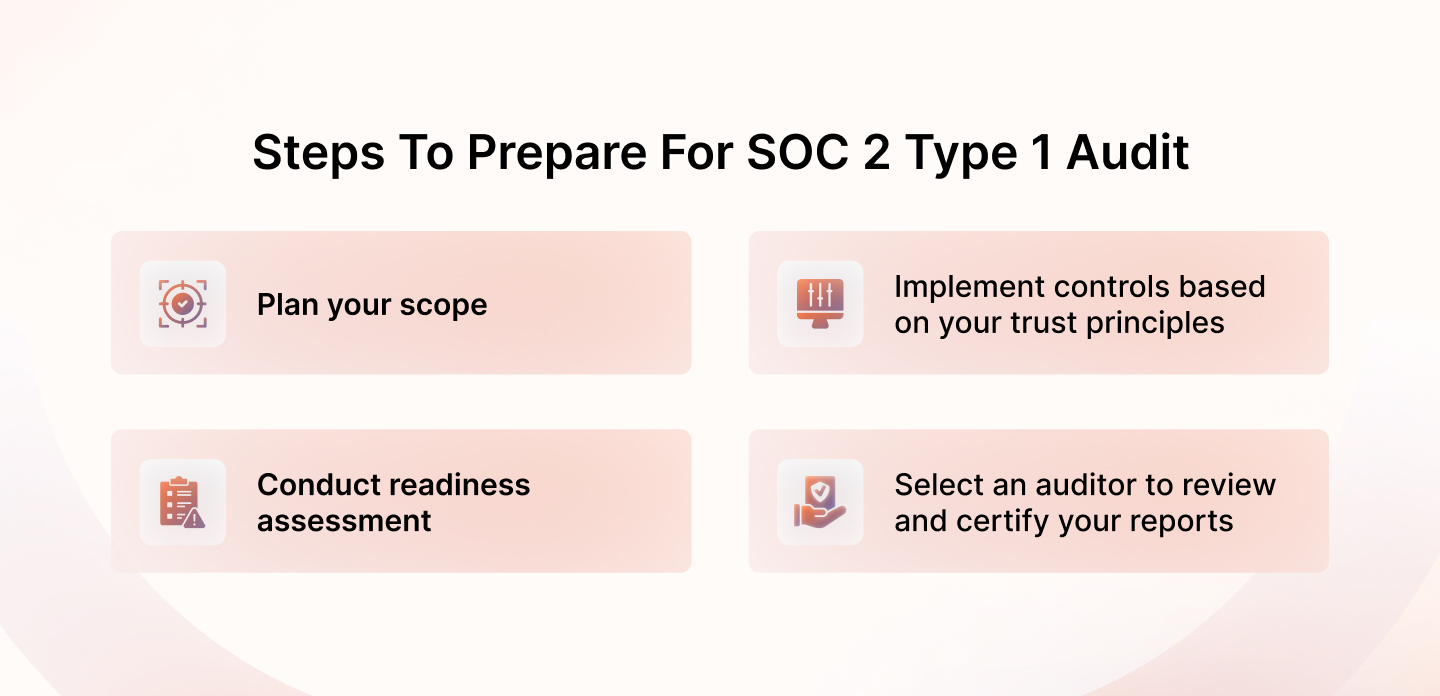
1. Plan your SOC 2 scope
Start by deciding which systems, products, teams, locations, vendors, and data flows are in scope. This keeps the audit focused and prevents your team from collecting evidence for systems that do not affect customer data or the service being audited.
At this stage, define:
- The product or service covered by the report
- The customer data and sensitive information in scope
- The cloud infrastructure, applications, repositories, and devices that support the service
- The employees, contractors, and service accounts with relevant access
- The Trust Services Criteria you need beyond security, if any
- The internal owners for evidence, policies, access reviews, vendor reviews, and technical controls
Security is mandatory for SOC 2. Availability, confidentiality, processing integrity, and privacy depend on your customer commitments and how your product handles data.
2. Implement controls based on your trust principles
It is time to set up administrative and technical security policies across your IT environment. This will be based on the trust criteria. Here are the controls for each:
- Security: It has nine common criteria (CC), of which five are compulsory. These are control environment, risk assessment, communication and information, monitoring of control, and design of controls.
- Availability: Possible control to meet this requirement may include Incident Response Planning (IRP) and Distributed Denial of Service (DDoS) protection.
- Confidentiality: You should have internal controls like data encryption, access control, and network firewall to meet this criteria.
- Processing integrity: Controls related to policies and procedures to maintain operational efficiency and data accuracy. Endpoint security and server safety are important if you work with a Cloud Service Provider (CSP).
- Privacy: Comprises eight controls related to data management, security, use and disposal, and more. Possible internal controls to meet this requirement include encryption, two-factor authentication, and access control.
While this is a much-needed step to identify cybersecurity gaps, don’t strive for perfection at this stage. Instead, let the small gaps be and keep testing the procedures. Resolve issues as they arise and document them.
With Sprinto
Sprinto makes quick work of control mapping, saving you from long manhours and manual processes. With Sprinto, you can automate the process of mapping controls.
Simply designate your production and non-production assets and specify the security criteria for each.
For example, you have the flexibility to exclude certain non-production assets from the audit scope with ease.
3. Conduct readiness assessment
A readiness assessment helps you find gaps before the formal audit begins. It checks whether your scope, policies, controls, and evidence are strong enough for auditor review.
During readiness, your team should confirm:
- Whether each control has an owner
- Whether evidence exists for each control
- Whether policies are approved and acknowledged
- Whether access, vendor, incident, change management, and risk processes are documented
- Whether any failed checks need remediation before the audit
- Whether manual evidence is acceptable for systems that are not integrated
You can do this internally, with a consultant, or through a compliance automation platform. The goal is to avoid discovering major gaps during the audit itself.
4. Select an auditor to review and certify your reports
You finally did it. Phew!
Look for a reputed third-party auditor who has previously worked with organizations of similar size and complexity. Verify the reviews from various sources and ask questions about their process and approach. Your SOC 2 auditors will:
- Set a date to conduct the test
- Demand a list of evidence for your controls
- Test the processes, document them, and work on issues
- Create and deliver the final report
With Sprinto, you gain access to a network of experienced auditors tailored to your needs. Once the SOC 2 Type 1 audit is complete, you can publicly showcase the results using Sprinto’s Trust Center feature.
The Sprinto Trust Center offers a personalized and customizable portal where you can easily display policies, documents, reports, and other essential resources.
What’s more, you can integrate control information to show the real-time status of your selected security and privacy controls on your page. With just a few clicks, you can publish your certifications for the world to see.
Note: Sprinto does not directly associate with any auditors. Instead, it facilitates connecting you with relevant auditing professionals or firms.
How much does SOC 2 Type 1 cost?
SOC 2 Type 1 audit costs depend on your company size, audit scope, number of Trust Services Criteria, control maturity, auditor fees, and whether you need readiness support.
For smaller organizations with a clear scope, Type 1 auditor fees often start around $7,500-$10,000. For larger or more complex environments, costs can rise to $25,000 or more, especially with multiple Trust Services Criteria or significant prep work.
Your total cost may include:
- Auditor fees
- Readiness assessment or consultant support
- Compliance automation software
- Penetration testing or vulnerability assessment, if required
- Internal time spent on policies, evidence, remediation, and control ownership
A lower-cost auditor isn’t automatically the better choice. If your customers are enterprise, healthcare, financial services, or regulated organizations, auditor credibility and experience with companies like yours matter during procurement.
Compliance automation can reduce internal effort by centralizing evidence, mapping controls, and tracking remediation. It doesn’t remove auditor fees or your team’s responsibility for control design and approval.
How Sprinto helps teams prepare for SOC 2 Type 1
Sprinto helps teams move from scattered compliance work to a structured SOC 2 readiness process. It connects with your cloud, HR, identity, device, code, and ticketing systems to collect evidence, monitor controls, and show where action is needed.
“Sprinto integrates with everything that we use, and collects evidence automatically. Centralizing evidence in one place is critical for us, so it’s nice that Sprinto does this out-of-the-box.”~ Deepak Balasubramanyam, CTO at Rocketlane.
With Sprinto, your team can:
- Define SOC 2 scope across systems, employees, vendors, and assets
- Map controls to the relevant Trust Services Criteria
- Automate evidence collection from connected systems
- Track failed checks, exceptions, and remediation tasks
- Maintain policies, approvals, and acknowledgments in one place
- Prepare auditor-ready evidence without relying only on screenshots and spreadsheets
- Continue monitoring controls after the Type 1 audit as you prepare for Type 2
Sprinto does not replace your auditor or make compliance fully hands-off. Your team still owns the scope, control decisions, risk acceptance, and final approvals. Sprinto reduces the manual work around evidence, tracking, and readiness so you can get to the audit with more confidence.
Need SOC 2 proof for an active customer request? See how Sprinto helps teams move faster from scoping to Type 1 audit readiness.
FAQs

Author
Anwita
Anwita is a cybersecurity enthusiast and veteran blogger all rolled into one. Her love for everything cybersecurity started her journey into the world compliance. With multiple certifications on cybersecurity under her belt, she aims to simplify complex security related topics for all audiences. She loves to read nonfiction, listen to progressive rock, and watches sitcoms on the weekends.Go beyond the surface and uncover the governance, risk, and compliance insights that actually matter.


Win digital goodies for boardroom success


Explore more SOC 2 articles
SOC 2 Compliance Overview
SOC 2 Preparation and Documentation
SOC 2 Audit and
Reporting
SOC 2 Differences and Similarities
SOC 2 Updates & Management
SOC 2 Industry-Specific Applications
research & insights curated to help you earn a seat at the table.