Chances are, you’re reading this article because the recent Substack about Delve has you reconsidering your Compliance Automation vendor. That reaction is reasonable. The incident has pushed many teams to look beyond ‘faster compliance’ and ask genuine questions, such as whether the audit model is defensible and whether Auditor Independence can be assured.
| 👉 Auditor Independence is non-negotiable. Sprinto’s operating model is structurally different from Delve’s. You contract with Sprinto for the platform and separately with your chosen auditor. Sprinto does not employ auditors, route payments through audit firms, or issue audit opinions. Auditors work independently, define their own testing strategy and sampling methodology, and are free to request evidence beyond what the platform surfaces. |
This comparison goes beyond speed and AI features. The real question is what kind of compliance program you are building and whether it will hold up under close scrutiny. To answer this, I will compare the two platforms across factors such as audit integration and experience, framework depth, onboarding speed, support quality, and fit for where you are in your compliance journey.
What is Sprinto?
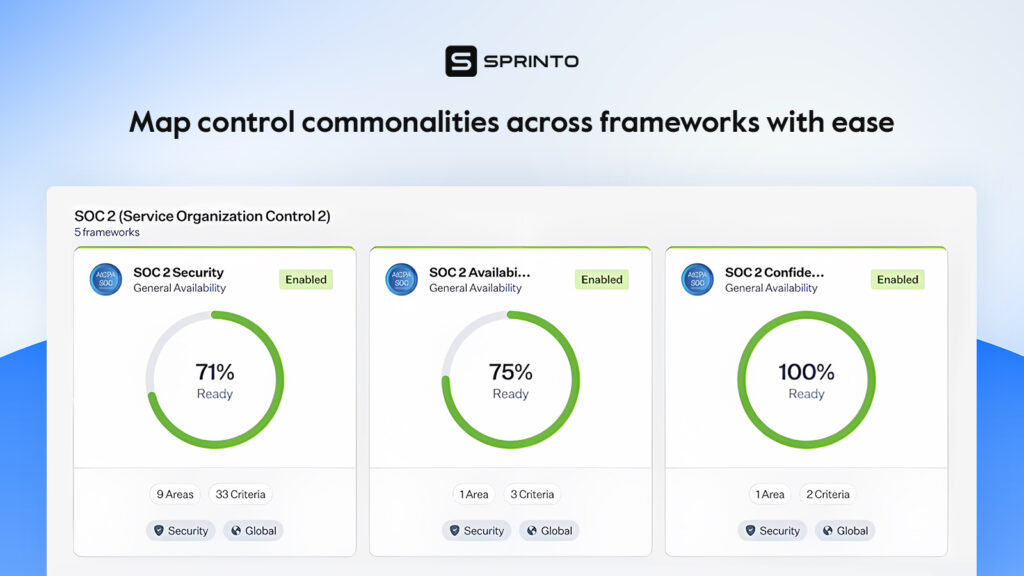
Sprinto is a cloud-native Autonomous Trust Platform built for SaaS and other cloud-hosted companies. It integrates with 200-plus services, like AWS, Azure, GitHub, Okta, Google Workspace, Jira, and more, so it can inventory assets, test controls, and pull time-stamped evidence with almost no manual work.
Setting up with Sprinto usually takes hours, instead of weeks, because the platform auto-discovers configurations as soon as each integration is authorised.
Here are some of Sprinto’s best features:
- Common control mapping: Map a control once and reuse evidence across SOC 2, ISO 27001, HIPAA, GDPR, and more.
- Trust Center: Showcase your security posture with real-time controls, policies, and reports, all auto-synced from your compliance program.
- Auditor workspace and async audits: Invite auditors to a secure portal and run 100% asynchronous audits from the dashboard.
- Continuous monitoring: Real-time dashboards and alerts track control health and flag drift for fast fixes.
- Multi-framework coverage: Support for 20+ compliance frameworks with centralized risk and control management.
How to use Sprinto AI for vendor due diligence?
What is Delve?

Delve is a modern, AI-first GRC platform. Its promise, “compliance in days, security that lasts,” is driven by small AI agents that crawl code, cloud, and SaaS tools to grab screenshots, scan configs, autofill questionnaires, and propose fixes before an auditor even asks.
Those agents send data to a risk dashboard that covers SOC 2, HIPAA, ISO 27001, GDPR, PCI-DSS, and the new ISO 42001 standard for AI governance, which makes the platform attractive to fast-moving AI startups facing fresh oversight.
Anyways, these are Delve’s biggest features:
- Agentic AI automation: Browser and platform agents handle screenshots, questionnaire autofill, and infrastructure/code scans.
- Fast compliance motion: Rapid compliance in a week with end-to-end audit management and bundled audit costs.
- Broad framework support: SOC 2, HIPAA, ISO 27001, GDPR, PCI-DSS, plus ISO 42001 for AI governance.
- AI code and infrastructure scanning: Scan compliance issues in code and catch misconfigurations in your cloud.
Sprinto vs Delve: Feature comparison table
Sprinto is a program-operations platform built around reusable controls, deep integrations, and an in-app auditor hub. Delve is an AI-first compliance product that tries to make you audit-ready in days, often with a bundled auditor.
They overlap on control monitoring and evidence automation, but they optimize for different outcomes: Delve for speed-to-badge, Sprinto for long-term, multi-framework scale. Read the head-to-head with that lens.
With that said, take a look at the table below to get a sense of how they compare:
| Feature | Sprinto | Delve |
| Who it’s built for | Cloud-hosted teams and startups that want automation and scale across many standards | Modern AI-first GRC aimed at scalable organizations |
| Multi-framework handling | Cross-mapping of controls to reuse evidence across 250+ frameworks | Broad catalog, including SOC 2, ISO 27001, HIPAA, GDPR, PCI, ISO 42001, but no control sharing |
| Integrations and evidence collection | 200+ integrations; automated, time-stamped evidence collection. | Integrates with popular tools (like AWS, GitHub, Slack, Zoom) |
| AI and automation | Automates up to 90% of evidence collection; continuous testing and alerts | Agentic AI handles screenshots, questionnaire autofill, code scanning, and more |
| Auditor independence | Separate contract with auditor; independent auditors; Sprinto does not employ auditors or issue opinions | Delve says customers can bring their own auditor or work with one from its network; given recent reporting, buyers should verify how auditor independence is maintained in practice |
| Auditor network | Vetted network of 40+ registered auditors across major regions, or bring your own. | Coordinates audits; no open auditor marketplace |
| Async audit capability | Built-in 100% async audit mode to run audits without meetings and long email threads | Markets bundled audit help; async audit workflow not documented |
| Time-to-pass messaging | Publishes realistic timelines in line with observation windows | Front-and-center “Compliance in days” positioning and fast onboarding |
| Public feedback signal | High rating and volume on G2 | No G2 footprint; mixed reviews |
| Evidence control | Plan, prepare, and sample evidence on a secure auditor dashboard; granular sharing | Basic evidence control |
Sprinto vs Delve: Key differences explained
Now that we are familiar with the basics of both Sprinto and Delve, let’s see how these two compliance automation platforms stack up against each other:
1. Audit integration and experience
This is the first question you should pressure-test when evaluating Delve alternatives. A strong audit experience is not just about faster coordination, it is about keeping a clear distinction between the platform and the auditor. When that line holds, the audit is easier to trust and defend.
Delve says customers can work with an auditor of their choosing or with one from Delve’s network, and that final reports are issued solely by independent, licensed auditors. But recent public reporting has put Delve’s audit model under heavier scrutiny, which means buyers should verify the structure for themselves: who the auditor contracts with, how independence is maintained, who defines testing procedures, and how much of the audit workflow is controlled by the platform.
Sprinto’s structure is clearer by design. You sign one contract with Sprinto for the platform. You sign a separate contract directly with your auditor. Two distinct relationships, by design. Auditors on Sprinto work their way, not ours. Sprinto does not employ auditors, route payments through audit firms, or issue audit opinions. Auditors remain free to follow their own methodology, request their own IRL and DRL, define their own sampling approach, and reach their own conclusions independently.
The separation doesn’t come at the cost of convenience. Sprinto’s Audit Hub offers auditors a dedicated workspace to review evidence, sample controls, and collaborate asynchronously within the platform. The evidence they see is gathered from your actual systems via integrations and continuous monitoring, and they can ask for more beyond what the platform surfaces. That gives your team visibility into the audit without turning the auditor into an extension of the software.
Winner: Sprinto. If you want an audit experience that is efficient without becoming opaque, Sprinto gives you a cleaner structure and better visibility.
2. Depth of compliance frameworks
Sprinto is built for multi-framework programs with common control mapping. This means that you map controls once and reuse across standards. That reduces duplicate work when you add, say, ISO 27001 after SOC 2. Sprinto also offers 200+ integrations to auto-collect evidence and config data.
Sprinto also supports over 250+ compliance frameworks, including SOC 2, ISO 27001, ISO 42001, NIST, GDPR, HIPAA, CMMC 2.0, ISO 27017, CIS, CSA STAR, FCRA, OFDSS, and CCPA.
Delve, on the other hand, has a starter catalog, and supports the six most commonly used standards — SOC 2, HIPAA, ISO 27001, GDPR, PCI-DSS, ISO 42001. And you won’t find a cross-framework control-mapping engine like Sprinto’, so adding each new standard might feel like a fresh project. Integrations are 100+.
Winner: Sprinto. If you expect to keep adding frameworks over time, Sprinto’s control-reuse and broader, disclosed program library make it the safer bet for scaling without rework. Delve’s day-one menu is solid, especially for AI-focused teams, but it lacks Sprinto’s depth.
3. Time to onboard and implement
Sprinto publishes auditor-aligned timelines: ~1 month for SOC 2 Type I and 3 to 6 months for Type II (because of the required 3 to 12 month observation window). Sprinto focuses on automation and running audits asynchronously inside the app.
Delve, conversely, markets itself on speed. It claims “compliance in days.” Public case studies and testimonials show 1 week (Bland), 2 weeks (Wispr), and <20 days with <20 team hours (Lovable). The company also has a 4-week-or-less SOC 2 program.
Winner: Delve. When a deal is blocked and the fastest time-to “audit booked” is the priority, Delve’s claimed and proven timelines are the stronger fit. Sprinto sets expectations that align with auditor realities, but on sheer speed, Delve takes this round.
4. Quality of customer support
Sprinto’s public footprint is large: 1,405 reviews on G2 with a 4.8/5 average, and “Customer Support” ranks among the top five cited pros.

Via G2
Reviewers praise quick answers from compliance specialists and proactive nudges during audit windows. These are useful signals for lightweight security teams.

Via G2
Delve doesn’t have many reviews on G2. You do get 1:1 Slack access to security experts with a <5-minute response SLA, and customer stories on its site echo that responsiveness.
Independent feedback, though, is thinner.

Via Slashdot
A recent Slashdot review calls the platform “decent” for fast wins but labels deeper security questions “rather shallow,” and notes that policy templates are shipped without explanation.
Winner: Sprinto. It has broad, review-verified evidence of high-touch support. Though Delve markets speed and white-glove access, pressure-test its depth by running your own scenarios through support.
5. SMB / startup friendliness
Sprinto comes with an SMB hub that frames compliance as a growth amplifier: one control foundation that can be repurposed as you add frameworks, plus powerful automations that reduce manual load.

Real-world proof backs that up: G2 shows 790 reviewers from companies with ≤ 50 employees. This signals traction with early-stage teams that needed structure, not just speed.
Delve, on the other hand, explicitly segments journeys by company size, starting with a “Startup” track. Startups would appreciate 1:1 support with Delve’s compliance experts, and the simplification of processes made possible with AI automation.
All this benefits you if you want immediate momentum with minimal headcount.

Winner: Sprinto. Although there’s no documented proof on how efficient Delve is for startups, we’re sure it helps them achieve certifications quickly. But if you want a system that survives as frameworks pile up, Sprinto scales better and offers documented evidence of being successful for startups.
Final scores- Sprinto: 4, Delve: 1
So, this was the comparison.
Sprinto takes the edge where programs start maturing: audit structure, framework reuse, support quality, and repeatability over time.
So we’ll offer a verdict this way:
If you want a platform that matches audit reality, brings auditors into the loop, and reduces duplicate work across frameworks, Sprinto is a better pick for growing teams.
Delve, with its promises of compliance in weeks, is also worth a demo; just validate depth where it matters to you.
Read more: Sprinto vs Drata and Sprinto vs Vanta
Sprinto vs Delve: Which is better for your business?
Choose based on where you are today and where you’ll be in a year. If you’re an early-stage, cloud-hosted SaaS company trying to unlock pilots or pass a vendor security check this quarter, both products can help.
The difference, actually, is in operating style:
- Delve leans into speed and concierge help.
- Sprinto emphasizes durable automation, cross-framework reuse, and an auditor-friendly workflow.
We’ve tried to make the disparity clearer for different types of organizations and businesses below:
For SMBs and startups
For very small teams with a single buyer stalling on SOC 2 or ISO 27001, Delve’s speed can reduce friction.
But if you’re a SaaS company planning to add frameworks in the next 6–12 months, Sprinto is the better fit. Its shared control framework lets you map once and reuse evidence as you scale to ISO 27001, HIPAA, or regional privacy laws.
For mid-market firms
Mid-market teams with growing complexity value predictability over one-time wins. Sprinto’s monitoring, integrations, and expert-backed support ensure fast, repeatable audits that scale to multiple frameworks — making it the better choice.
For enterprises
Choose Sprinto if you want integration depth, audit transparency, and a workflow your security team can actively participate in.
Choose Delve if you prefer a vendor-managed, hands-off audit experience with less involvement from your internal team.
So, after all this discussion, where do we arrive?
Sprinto is the better choice for growing, security-conscious teams, regardless of size
Sprinto gives cloud teams a more structured path from a first audit to multi-framework scale. If you need a platform that can support today’s preparation work and keep pace as your program grows, Sprinto is a strong fit. It helps lean security teams centralize evidence, reduce manual effort, and keep recurring audit work more manageable over time.
If you need a platform that moves quickly today and compounds that effort over the next year, Sprinto is the perfect fit for you. It supports lightweight security teams, keeps engineers focused on high-value changes, and turns audits into a steady, predictable pace. That translates to faster deals now and fewer surprises later.
Book a Sprinto demo to map your frameworks, preview the auditor workspace, and see how Sprinto supports preparation and review.
Frequently asked questions
1. What’s the difference between Sprinto and Delve?
Sprinto is a compliance automation platform. It focuses on durable automation, reusable controls across frameworks, and an auditor workspace built for independent collaboration.
If speed is your main priority, pressure-test how the audit model works in practice. An auditor workspace for async reviews with your chosen independent auditor.
2. Is Delve only for SOC 2?
No. Delve supports SOC 2 along with ISO 27001, HIPAA, GDPR, PCI-DSS, ISO 42001, and others. Ask Delve to show the full list you need, plus how evidence is reused across those standards and how auditors review that evidence.
3. Which is easier to implement?
Delve is built for speed and markets “compliance in days,” so teams often get moving quickly. Sprinto also onboards fast, and it tends to stay easy as you add more frameworks because controls can be mapped once and reused.
If your goal is one framework, Delve will feel very quick. If your aim is several frameworks over time, Sprinto usually stays simpler.
4. What makes Sprinto better for SaaS startups?
These are a few reasons why Sprinto is better:
- Common controls that let you reuse evidence when you add new standards.
- Broad integrations that cut manual collection and keep systems in sync.
- An auditor workspace for async reviews and a network of vetted firms.
- Clear timelines and strong support that help small teams move without rework.
5. How does Sprinto handle multi-framework compliance?
Sprinto uses a Common Control Framework. You map a control once, link it to multiple standards like SOC 2, ISO 27001, HIPAA, and GDPR, then monitor continuously. When you add a new framework, much of the evidence is already in place, gaps show up early, and changes propagate without rebuilding your program.

Author
Pansy
Pansy is an ISC2 Certified in Cybersecurity content marketer with a background in Computer Science engineering. Lately, she has been exploring the world of marketing through the lens of GRC (Governance, risk & compliance) with Sprinto. When she’s not working, she’s either deeply engrossed in political fiction or honing her culinary skills. You may also find her sunbathing on a beach or hiking through a dense forest.Go beyond the surface and uncover the governance, risk, and compliance insights that actually matter.


Win digital goodies for boardroom success


Explore more






research & insights curated to help you earn a seat at the table.