| Healthcare compliance software helps you stay continuously audit-ready by centralizing risk assessments, policies, safeguards, vendor oversight (BAAs), and evidence, so you’re not rebuilding proof during HIPAA audits or customer due diligence. |
| The best tools in 2026 fall into three buckets: 1. Automation-first GRC for healthtech/security controls (continuous monitoring, evidence, readiness) 2. Clinical workforce + credentialing compliance (training, licensing, exclusions) 3. Enterprise ethics, hotline, and governance (policy + investigations + defensibility) |
| Platforms covered in this guide: Sprinto, NAVEX One, MedTrainer, VComply, Compliancy Group, HealthStream, Healthicity, Drata, Ruya, and Healthcare Compliance Pros. |
You need healthcare compliance software if:
- You handle Protected Health Information (PHI)
- You’re preparing for a HIPAA audit or customer due diligence
- You operate under SOC 2, ISO 27001, HITRUST, or PCI requirements
- You want real-time visibility into safeguards instead of reactive audit prep
Healthcare compliance software helps covered entities, business associates, and digital health companies centralize risk assessments, policy management, access control monitoring, vendor oversight, and audit evidence. Instead of manually managing compliance in spreadsheets, the right platform operationalizes safeguards and maintains continuous audit readiness.

To build this guide, I analyzed leading healthcare compliance platforms across G2 reviews, analyst commentary, vendor documentation, and real-world implementation feedback to evaluate automation depth, regulatory coverage, and operational usability.
Top 10 healthcare compliance tools evaluated as per usability
Modern healthcare organizations seek compliance ecosystems that automate evidence collection, manage provider credentialing, and provide real-time risk visibility. Choosing the right tool now depends on where you sit in the healthcare landscape, whether you are a healthtech startup, a multi-site clinical practice, or a massive hospital system managing thousands of medical licenses.
Considering all scenarios, here are my best options:
| Platform | Best for | G2 rating |
| Sprinto | HealthTech SaaS & telehealth startups: Rapidly achieving HIPAA and other frameworks for continuous trust. | 4.8 / 5 |
| NAVEX One | Integrated Delivery Networks (IDNs): Managing Whistleblower Hotlines and Ethics/COI disclosures. | 3.8 / 5 |
| MedTrainer | Multi-site ambulatory & dental groups: Automating Provider Credentialing (PSV) and OSHA/HIPAA training for high-turnover clinical staff. | 4.4 / 5 |
| VComply | Specialty care: Implementing a “ComplianceOps” task-tracking system for internal audits across Radiology or Oncology centers. | 4.6 / 5 |
| Compliancy Group | Private practices & physical therapy: Solo or small group owners needing a Guided “Seal of Compliance” to survive a CMS or OCR spot-check. | 4.8 / 5 |
| HealthStream | Acute care hospitals: Managing Clinical Competency (NRP/ACLS) and JCAHO-ready nurse training in high-stakes inpatient environments. | 4.2 / 5 |
| Healthicity | Billing & Revenue Cycle Management (RCM): Performing Medical Coding Audits to mitigate risks of Medicare/Medicaid clawbacks and fraud. | 4.3 / 5 |
| Drata | Digital health infrastructure: Continuous Technical Control Monitoring for AI-driven diagnostic tools or medical device manufacturers. | 4.8 / 5 |
| Ruya | Hospital facility management: Navigating Life Safety Plans and Mobile Environment of Care (EOC) inspections during physical facility rounds. | N/a |
| Healthcare Compliance Pros | Outpatient surgical centers: Organizations lacking a full-time CCO who need Fractional Compliance Support for SRA and BAA management. | N/a |
1. Sprinto
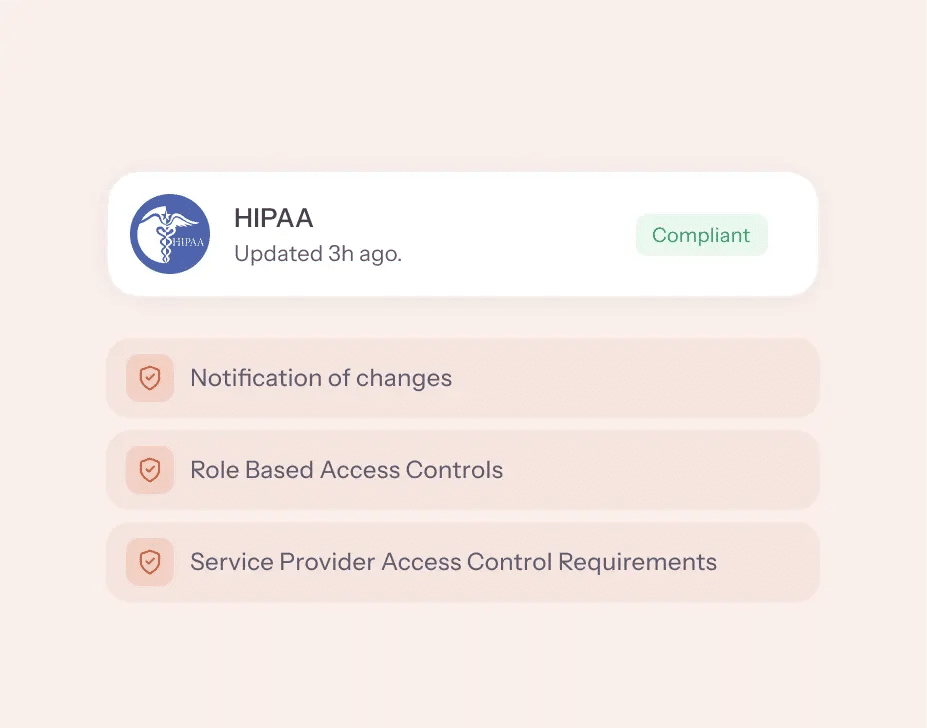
Sprinto is an autonomous trust platform that serves as the “bridge” between technical infrastructure and clinical compliance through GRC automation. While many legacy tools require you to upload a PDF to prove you are compliant, Sprinto plugs directly into your cloud (AWS/Azure) and HRIS (Gusto/Workday) to verify compliance in real time.
Key differentiator: One thing that genuinely stands out to me is Sprinto’s ability to absorb new regulations or contractual requirements. Sprinto’s AI engine maps it directly to existing controls and live system checks. It shows you a real-time readiness score and highlights precise gaps.
Instead of starting compliance from scratch every time a customer or regulator adds a clause, you immediately see where you stand and what needs to change.
Key features:
- Healthcare-aligned policy and risk library: Pre-mapped controls, policy templates, and structured risk assessments aligned to HIPAA Security and Privacy Rules.
- Vendor risk and BAA tracking: Centralized oversight of third-party vendors, BAA documentation, and risk posture monitoring.
- Access and identity governance checks: Automated validation of least-privilege access, MFA enforcement, and user lifecycle hygiene.
- Incident and remediation workflows: Structured issue tracking with ownership, SLAs, and documented corrective actions for audit defensibility.
- Multi-framework mapping: Reuse controls across HIPAA, SOC 2, ISO 27001, and other standards without duplicating effort.
| Pros | Cons |
| Speed to certification: Can reduce the time to achieve compliance readiness by 70-80%. | Tech-centric: Most effective for companies with a cloud-based tech stack; less “out-of-the-box” value for physical clinics. |
| Live support: Provides a dedicated compliance expert to guide you through the audit process. | Alert fatigue: The “Continuous” nature means your team will receive frequent notifications for minor configuration drifts. |
90% HIPAA compliant in under three months: Superbio’s Berke Buyukkucak, Co-founder and CEO, notes: “We are moving at a comfortable pace, but we’re happy to see we’re above the 90% compliance mark on Sprinto. This reassures us that we’re on the right track.”
Navigate complex healthcare obligations with minimal effort | Book a demo
2. Navex One
NAVEX One is an Integrated Risk Management (IRM) platform that unifies ethics, policy, and third-party risk into a single “source of truth” for large-scale health systems. While other tools focus on technical “scrapers,” NAVEX manages the human and ethical risk inherent in massive, distributed workforces.
Key differentiator: NAVEX bridges its whistleblower hotline (EthicsPoint) with policy management. A “speak-up” report regarding a privacy breach can automatically trigger a mandatory policy re-attestation or a targeted training module for that specific department, creating a documented “corrective action”.
Key features:
- AI policy summarizer: This tool uses LLMs to generate “plain-language” summaries of dense clinical policies, significantly increasing employee comprehension and attestation rates.
- Healthcare disclosure management: Automated workflows for managing physician Conflict of Interest (COI) and Sunshine Act disclosures, critical for maintaining CMS eligibility.
- Benchmarking intelligence: Access to anonymized data from global customers to compare your incident reporting rates and “culture of health” against industry averages.
| Pros | Cons |
| Highest legal defensibility: Their audit trails and frameworks are trusted by federal investigators and DOJ regulators. | Implementation-heavy: Deployment across a multi-site health system is an enterprise-scale project requiring months of configuration. |
| Massive global support: Supports 150+ languages for hotlines. | UX complexity: The interface is incredibly powerful but can feel clunky and “non-intuitive” for non-administrative clinical staff. |
3. MedTrainer
MedTrainer is a specialized all-in-one clinical compliance suite that consolidates learning management (LMS), provider credentialing, and facility safety into a single portal. It digitizes clinical tasks that typically reside in separate physical binders or siloed spreadsheets.
Key differentiator: MedTrainer uses agentic workflows to “handshake” with the OIG, SAM, and state licensing boards. It doesn’t just store a license; it actively verifies it daily and flags a provider the moment an exclusion or expiration occurs, preventing “billable events” by non-authorized staff.
Key features:
- Healthcare LMS: A pre-vetted library of 1,000+ courses (HIPAA, OSHA, CMS) that satisfy both regulatory and accreditation (The Joint Commission) requirements.
- Incident reporting with AI triage: A module that allows staff to report “near-misses” or patient falls, using AI to categorize the severity and alert the correct Risk Manager immediately.
- Credentialing form mapping: AI that recognizes fields in medical forms and auto-fills complex credentialing packets with verified provider data.
| Pros | Cons |
| All-in-one value: Merges clinical HR (credentialing) with compliance (HIPAA), removing the need for two separate vendors. | Limited technical GRC: It is not a security tool; it will not scan your AWS servers or check for technical IT vulnerabilities. |
| Clinical UX: Highly intuitive for nurses and doctors; requires almost zero “tech training” for end-users. | Reporting speed: Users have noted that generating very large, complex custom reports can cause lag. |
4. VComply
VComply is a GRC (Governance, Risk, and Compliance) operating system that uses a “ComplianceOps” approach to turn regulatory requirements into trackable, everyday tasks. It is best for organizations that want a “Kanban” approach to accountability and risk management.
Key differentiator: VComply assigns every regulatory control to a specific human “Owner” with defined frequencies (Daily, Monthly, Quarterly). It uses a system to visualize accountability; if a manager fails to upload evidence of a monthly “MFA check,” the task turns red and automatically escalates to the Compliance Officer.
Key features:
- Centralized evidence vault: A repository where every regulatory requirement is linked to its timestamped evidence (screenshots, logs, signatures).
- Compliance calendar: A unified view that synchronizes with Outlook/Google, ensuring that “Compliance Tasks” appear on staff calendars.
- Multi-framework crosswalking: Map a single “Security Control” (e.g., encryption) once and have it satisfy HIPAA, SOC 2, and the Joint Commission simultaneously.
| Pros | Cons |
| Eliminates spreadsheet chaos: Dramatically reduces manual follow-up time by automating reminders and escalations. | Lack of pre-built content: Unlike MedTrainer, it does not come with a massive library of training courses; you often have to bring your own. |
| Rapid implementation: Often fully functional within weeks rather than months. | Limited incident management: While it tracks “issues,” its case management is less mature than NAVEX’s enterprise suite. |
5. Compliancy Group
Compliancy Group is a high-touch HIPAA compliance platform that combines guided software with human coaching. It is designed for organizations that want a definitive, “lawyer-approved” methodology to prove a good-faith effort to regulators.
Key differentiator: Compliancy Group assigns a human expert to verify your work. You only receive their “Seal of Compliance” once a live coach has audited your self-assessments, ensuring your documentation actually meets the legal standard.
Key features:
- The guard dashboard: A centralized “task-master” that tracks remediation plans, employee attestations, and incident logs in one view.
- Remediation workflows: When a gap is identified in a risk assessment, the tool provides specific, pre-written action plans to bridge the violation.
- Seal of compliance: A recognized trust signal you can display on your website, which is often used as a competitive advantage to win B2B contracts.
| Pros | Cons |
| Audit “Guarantee“: They claim no client has ever failed an audit after following their methodology, providing high peace of mind. | Manual data entry: It is a “documentation” tool rather than a “technical” tool; it doesn’t automatically pull logs from your cloud. |
| Low barrier to entry: Perfect for non-technical administrators who need a “Compliance for Dummies” guided path. | US-Centric: Primarily focused on HIPAA; less effective for global organizations needing GDPR or ISO 27001 mapping. |
6. HealthStream
HealthStream is a massive ecosystem for clinical workforce development and credentialing. It is the enterprise standard for hospitals that need to manage high-stakes medical certifications (BLS, ACLS) alongside mandatory HIPAA and OSHA requirements.
Key differentiator: HealthStream’s 2026 platform allows for “Interoperability of Competency.” It enables a nurse to carry their verified certifications (e.g., NRP or RQI) from one hospital system to another, drastically reducing redundant “Day 1” training and ensuring that every provider’s clinical skills are instantly verifiable by compliance officers.
Key features:
- hStream for learning: Access to 1,000+ pre-vetted clinical courses (NALS, OB-ALS) developed by medical associations.
- Automated CVO (Credentialing Verification): A “single source of truth” for providers onboarding, linking training completion directly to privileging.
- Resuscitation Quality Improvement (RQI): Integrated “HeartCode” training that tracks hands-on skill proficiency for life-saving procedures.
| Pros | Cons |
| Clinical depth: “Hands-on” medical compliance and clinical skill-building. | Legacy UI: Despite recent updates, the interface can feel “dense” and corporate compared to agile startups. |
| Industry standard: Used by the majority of US health systems, making it the common language of hospital compliance. | Cost: High enterprise pricing; often overkill for a small, 10-person private practice. |
7. Healthicity
Healthicity is an all-in-one GRC and auditing platform built for healthcare organizations that need to manage billing integrity (Medicare/Medicaid fraud prevention) alongside HIPAA. It is the “Analyst’s Choice,” designed to turn complex data into actionable risk heatmaps.
Key differentiator: Healthicity features an integrated compliance hotline that uses AI to provide real-time transcripts, sentiment analysis, and two-way anonymous messaging. This allows the compliance team to “triage” whistleblower reports with clinical context much faster than traditional manual intake.
Key features:
- Audit manager: A specialized module for performing medical coding and billing audits (ICD-10, CPT) to prevent fraud penalties.
- Exclusion monitoring: Proactive, daily screening of all staff and vendors against federal (OIG) and state-specific exclusion lists.
- AAPC-certified training: Employee training modules that are specifically certified for healthcare coding and administrative accuracy.
| Pros | Cons |
| Billing integrity: Exceptional for organizations concerned with “Fraud and Abuse” and professional fee auditing. | Update friction: Frequent feature and UI updates can sometimes confuse staff who only log in once a month. |
| Mobile-responsive: Optimized for auditors to record findings directly from a tablet during facility walkthroughs. | Set-up intensity: Mapping financial and billing data for the audit module requires a heavy initial IT lift. |
8. Drata
Drata is a security-first platform that focuses on compliance automation. It serves as the digital engine for HealthIT and SaaS-based healthcare companies that need to achieve SOC 2 and HIPAA compliance simultaneously by integrating with their tech stack.
Key differentiator: Drata has a technical bot that connects to your cloud (AWS/Azure), identity provider (Okta/Google), and dev tools. It continuously monitors for “control failures”, such as a database being left unencrypted or a developer not having MFA, and alerts you instantly before an auditor ever finds the gap.
Key features:
- Automated evidence collection: Drata “scrapes” proof (logs, screenshots) automatically, eliminating the need to manually gather evidence for annual audits.
- Trust center: A real-time, shareable security report that healthcare companies can use to prove compliance to prospective hospital partners.
- Framework cross-mapping: Map a single security control (e.g., password complexity) once and have it automatically satisfy HIPAA, SOC 2, and NIST requirements.
| Pros | Cons |
| Technical efficiency: Can reduce the manual work of an audit for tech-heavy organizations. | IT-heavy: Not designed for clinical tasks like medical credentialing or OSHA safety checklists. |
| Rapid scaling: The best choice for healthcare startups that need to prove security to enterprise buyers quickly. | Cost for non-tech: Smaller practices may pay for “automation” they don’t have the IT infrastructure to use. |
9. Ruya
Ruya is a purpose-built facility compliance and hospital management platform designed to bridge the gap between physical infrastructure and regulatory safety. Unlike digital-first GRCs, Ruya is built for the Environment of Care (EOC) and Life Safety standards required for hospital accreditation.
Key differentiator: Instead of just listing an asset in a spreadsheet, the tool pins its real-time compliance status directly onto a digital architectural layout. This allows facility managers to walk through a hospital with a tablet and visually identify “hot zones” where safety inspections are overdue.
Key features:
- Mobile inspection engine: Native iOS/Android apps for running mobile-first Life Safety and ICRA (Infection Control Risk Assessment) checklists.
- Vendor network security: A unique “vendor-lite” portal that allows third-party contractors (plumbers, HVAC) to upload proof of certification without granting them access to the hospital’s internal IT network.
- Standard-specific workflows: Pre-built templates for NFPA (Fire Protection) and CMS physical environment audits.
| Pros | Cons |
| Physical world focus: The only tool on this list that solves the “Safety Survey” nightmare for facility directors. | Hyper-specific: It is not a HIPAA tool for data privacy; it is a tool for physical safety and maintenance. |
| Mobile-first UX: Designed for hands-on workers who are on their feet, not sitting at a desk. | Data integration: While great for facilities, it requires a “connector” to sync its data with broader enterprise GRC systems. |
10. Healthcare Compliance Pros (HCP)
Healthcare Compliance Pros is an “Outsourced Compliance” hybrid platform that combines user-friendly software with a team of human specialists. It is best for organizations that want to offload the “Compliance Officer” role entirely, moving from a software subscription to a Fractional Compliance Partnership.
Key differentiator: HCP doesn’t just provide a help desk; every client is assigned a dedicated team. This team acts as your outsourced department, conducting your annual Security Risk Analysis (SRA) and actually reviewing your Business Associate Agreements (BAAs) for you.
Key features:
- All-in-one compliance dashboard: Unified tracking for HIPAA, OSHA, HR, and Corporate Compliance in one simplified view.
- Virtual SDS binder: A digital Safety Data Sheet repository that ensures clinical staff are always compliant with OSHA chemical safety standards.
- 7-Element Corporate Plan: Pre-built programs that follow the OIG’s “Seven Fundamental Elements” for effective compliance.
| Pros | Cons |
| High personalization: Ideal for practices that want to “outsource the headache” and have a human to call during an audit. | Manual inputs: Lacks the “continuous automation” (cloud scrapers) found in tech-heavy tools like Sprinto. |
| Accredited training: Features SCORM-compliant courses specifically tailored to clinical roles. | US-only focus: Does not comply with international standards (GDPR/PIPEDA) because its core expertise is US federal law. |
How did I evaluate the above tools?
Healthcare compliance software in 2026 can’t be judged solely by feature lists. The real question is whether the platform reduces regulatory risk, supports continuous readiness, and aligns with how healthcare organizations actually operate, from small clinics to multi-entity hospital systems.
Here’s how the evaluation was done:
- Integration and automation depth: I assessed how the tool collects and validates evidence. Platforms that integrate with cloud, HRIS, IAM, or EHR systems and automate monitoring ranked higher than those relying heavily on manual uploads and annual attestations.
- Operational fit: I mapped each tool to real healthcare roles like clinic managers, CISOs, compliance officers, and healthtech founders. Clear persona alignment mattered more than broad “all-in-one” claims.
- Regulatory maturity: I prioritized platforms built for continuous monitoring, audit defensibility, and modern risks like AI governance. Tools designed for point-in-time audits ranked lower than those supporting real-time compliance visibility.
- Market validation and real-user sentiment: I reviewed G2 reports, Gartner commentary, Capterra feedback, Reddit discussions, and vendor documentation to understand usability, deployment complexity, and real-world adoption.
What should you consider when choosing healthcare compliance software?
Before comparing features, check whether the vendor offers a free trial or a live demo. In healthcare compliance, you’re not buying a dashboard; you’re buying audit defensibility. If you can’t see how the system works in action, you’re relying on marketing claims.
If a trial is available, test real workflows: upload a policy, assign training, simulate a failed safeguard, or generate an audit report. If there’s no trial, insist on a demo that uses scenarios that match your environment, including PHI handling, vendor tracking, access reviews, and risk assessments.
Take control of the demo
Don’t let it stay high-level. Ask operational questions like
- How does the platform detect and flag control drift?
- Can you show a full audit trail for one safeguard?
- How are BAAs and vendor risks tracked?
- What happens if we terminate the contract? How is the data exported?
What to ask them to show live:
- Evidence being pulled from a real integration
- A failed control triggering a remediation workflow
- Risk assessment tracking and readiness scoring
- The auditor-facing or regulator-ready export view
If the platform cannot clearly demonstrate monitoring, remediation, and reporting within a single workflow, it will struggle during real audits.
Map features to your healthcare environment
Don’t stop at “Does it support HIPAA?”. Evaluate whether it fits your actual workflows. The platform should integrate with your cloud, HRIS, and identity systems, track employee training and access lifecycle events, and centralize vendor oversight and BAA documentation.
It should also support expansion into frameworks such as SOC 2, ISO 27001, or HITRUST as your organization grows. Tools that operate in isolation create blind spots, and it’s in those blind spots that compliance gaps surface.
Assess automation, scalability, and cost transparency
Look closely at how much manual effort the platform requires. Tools that automate evidence collection, risk mapping, and safeguard monitoring significantly reduce compliance fatigue. Also review implementation timelines, pricing models (per-user vs. per-entity), and any hidden consulting or module costs.
Finally, compare at least 2-3 vendors side-by-side on automation depth, integration coverage, reporting quality, and total cost over 2-3 years. The goal is to build a system that keeps you continuously ready without overwhelming your team.
Why do companies need healthcare compliance software?
In 2026, healthcare compliance software is no longer a luxury but a critical operational necessity, driven by the industry-wide shift toward Perpetual Survey Readiness. Regulatory bodies like the OCR and OIG have moved away from “point-in-time” audits to a model of continuous oversight, where organizations must prove their adherence to HIPAA, HITECH, and new AI governance rules every single day.
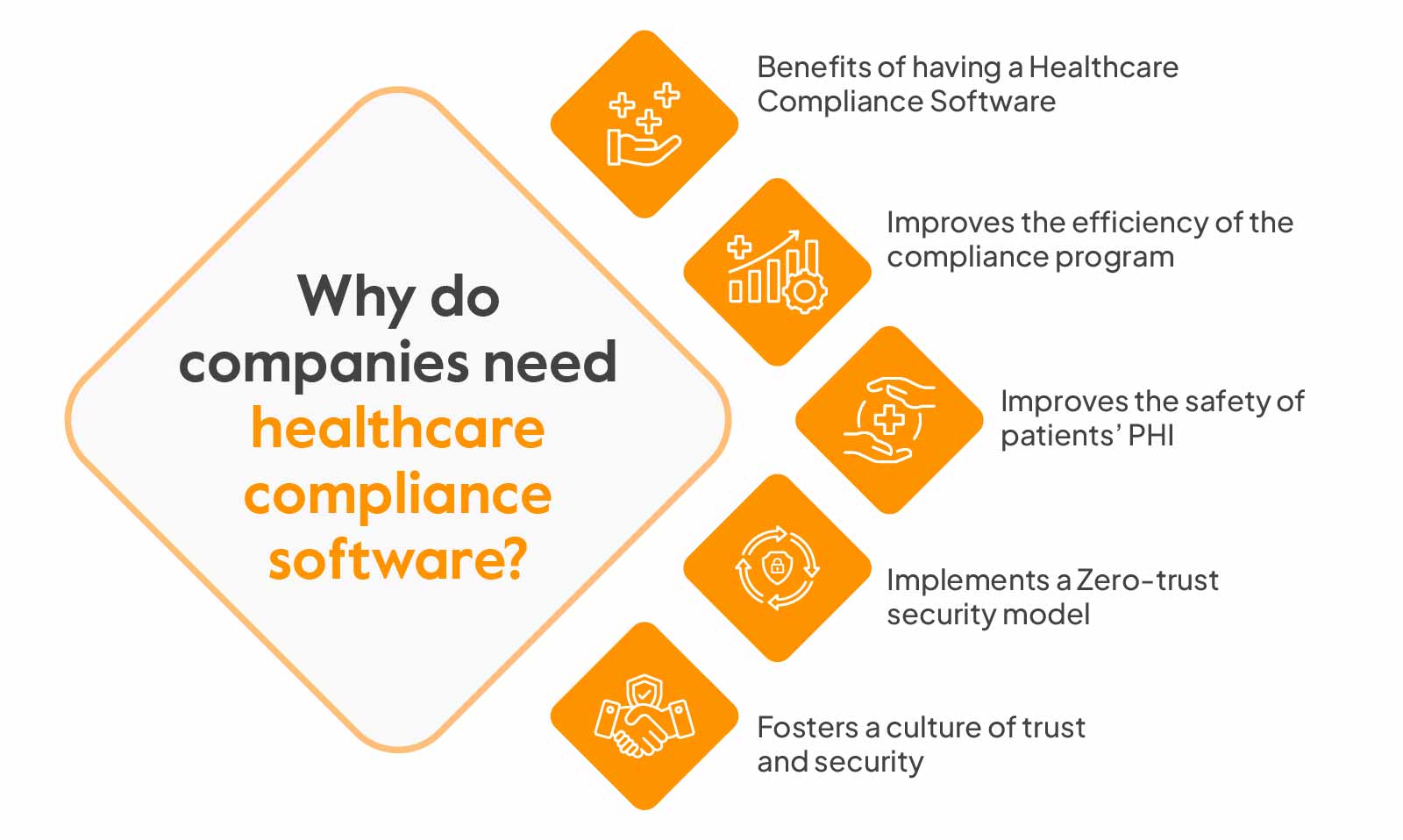
Software automates the Herculean task of “evidence scraping”, pulling real-time logs from cloud environments and HR systems to ensure that security controls, such as encryption and multi-factor authentication, never drift into non-compliance.
Download a healthcare CISO guide for ransomware resilience
Beyond avoiding devastating fines, which, under the most severe “Willful Neglect” tier, are capped at an inflation-adjusted $2,134,831 annually per violation category, this software serves as a vital shield against the escalating threat of cyberattacks.
Modern platforms use AI-driven monitoring to detect unusual access patterns in Electronic Health Records (EHR) and automate the grueling process of provider credentialing and exclusion screening. This not only protects patient privacy but also significantly reduces “administrative burnout” for clinical staff.
The future of healthcare compliance is autonomous trust
Most tools help you document compliance. A few help you monitor it. Very few actually help you operate in a constant state of readiness.
That’s where Sprinto represents the next generation.
Sprinto is not just a compliance tracker. It’s an intelligent trust platform designed to bridge technical infrastructure and regulatory expectations. Its agentic AI doesn’t wait for annual assessments. It continuously maps your safeguards to healthcare obligations, ingests new contracts or regulatory clauses, auto-maps them to existing controls, generates real-time readiness scores, and highlights precise gaps before regulators or customers do.
For healthcare organizations handling PHI, expanding into SOC 2 or ISO 27001, or navigating AI governance pressures, this shift from reactive documentation to intelligent, autonomous oversight is critical.
If your goal isn’t just to pass audits, but to build durable, defensible trust, Sprinto is built for that reality.
See how Sprinto keeps your healthcare organization continuously ready | Build intelligent trust
Frequently asked questions
Several brands are widely recognized for healthcare compliance, depending on the use case. Sprinto and Drata are known for automation-driven HIPAA and multi-framework compliance in cloud-native environments. MedTrainer and HealthStream are strong in clinical training and in compliance with credentialing requirements. NAVEX and Healthicity are recognized for enterprise ethics, hotline management, and oversight of billing integrity.
For healthcare startups, especially healthtech or SaaS companies, the best HIPAA compliance software is typically automation-first and cloud-integrated. Tools like Sprinto connect directly to infrastructure and identity systems to automate evidence collection and continuous monitoring. Startups benefit from platforms that reduce manual effort, provide audit-ready documentation, and scale into SOC 2 or ISO 27001 as the company grows.
Healthcare compliance software benefits covered entities, business associates, digital health startups, multi-site clinics, hospitals, and even medical billing organizations. CISOs gain continuous visibility into safeguard health, compliance officers centralize risk tracking, clinic managers streamline training and credentialing, and founders accelerate enterprise deal cycles by demonstrating audit readiness.
Healthcare compliance software is important because regulators expect continuous oversight. With increasing OCR scrutiny, ransomware threats, and AI governance pressures, organizations must prove that safeguards are active and monitored daily. The right platform reduces audit fatigue, strengthens defensibility, and protects patient trust while lowering the risk of fines and reputational damage.

Author
Pansy
Pansy is an ISC2 Certified in Cybersecurity content marketer with a background in Computer Science engineering. Lately, she has been exploring the world of marketing through the lens of GRC (Governance, risk & compliance) with Sprinto. When she’s not working, she’s either deeply engrossed in political fiction or honing her culinary skills. You may also find her sunbathing on a beach or hiking through a dense forest.Go beyond the surface and uncover the governance, risk, and compliance insights that actually matter.


Win digital goodies for boardroom success


Explore more




research & insights curated to help you earn a seat at the table.