Compliance Posture: How to Assess & Improve It



TL,DR:
| Compliance posture measures the effectiveness of controls against regulatory framework requirements during an observation period, tracking implementation progress, control effectiveness, and performance based on predefined compliance metrics |
| Assessment follows a 3-step process: measure implementation progress (percentage of systems with controls deployed), evaluate control effectiveness (how well controls perform against requirements), and quantify control impact (measurable reduction in risk or incidents) |
| Compliance posture is an objective measure of security program maturity. As programs mature, controls and policies become more standardized, measurement becomes more sophisticated, and continuous monitoring replaces periodic manual reviews |
Managing compliance posture is like a circus—most parts work in harmony until one day, they just don’t. When one component slips, it doesn’t just stop, it creates a domino effect. Before you know it, you’re putting out fires, giving you less time to spend on business-critical tasks like managing compliance. It is a situation no one wants to be in. But how do you avoid it?
This article explores how to assess your compliance posture, overcome common challenges associated with it, and run end to end compliance activities smoothly.
What is compliance posture?
Compliance posture measures control effectiveness against framework requirements. A continuous compliance solution helps organizations maintain and improve their posture by automating control monitoring throughout the observation period. It measures the effectiveness of controls, the gap between the requirements and current level of adherence, and the performance of controls based on predefined compliance metrics.
Compliance posture is an objective measure of the maturity of your security posture. As your security program matures, a policy management platform ensures controls and policies evolve in lockstep with your compliance posture. This also indicates how standardized and effective processes are as more data is fed into the system. Maturity also dictates that as data increases, the more sophisticated performance measurement gets.
Compliance posture vs security posture
Compliance posture and security posture are related, but they do not measure the same thing.
Security posture is the broader view of how prepared an organization is to prevent, detect, and respond to security threats. It includes asset visibility, vulnerability management, access controls, incident response, employee training, vendor risk, and the overall maturity of the security program.
Compliance posture is narrower. It measures how well your controls, policies, evidence, and processes align with specific regulatory or framework requirements such as SOC 2, ISO 27001, HIPAA, PCI DSS, GDPR, or NIST.
| Area | Compliance posture | Security posture |
| Primary focus | Meeting framework, regulatory, and audit requirements | Reducing cyber risk across systems, people, vendors, and processes |
| Main evidence | Control status, audit logs, policies, risk assessments, training records, and evidence artifacts | Threat detection, incident response, vulnerabilities, asset exposure, access risk, and security operations data |
| Measured against | Compliance frameworks and regulatory obligations | Risk tolerance, threat exposure, business impact, and security maturity |
| Audience | Auditors, compliance teams, customers, regulators, and leadership | Security teams, IT teams, risk owners, executives, and customers |
| Question answered | “Can we prove we meet this requirement?” | “How exposed are we, and how quickly can we respond?” |
How to assess your compliance posture?
Assessing compliance maturity requires tracking implementation measures and control effectiveness. Dedicated compliance audit software automates this tracking and surfaces gaps before they escalate its overall performance.
Here is the three step process to access your compliance posture:
Implementation measures
These measures are used to track a number of progress metrics in implementing certain aspects of your security program such as policies, procedures, controls, tools, and more. Some examples of implementation compliance metrics to keep track of are:
- Percentage of critical or sensitive systems that have password policies in place
- Percentage of servers that are configured correctly
- Percentage of encrypted PII (Personally Identifiable Information) or CUI (Controlled Unclassified Information)
When your compliance program has not reached full maturity, the percentage can be lower than 100. As you progress, the value of implementation should be at a cent percent maturity – anything lower, your security controls wont be considered fully implemented.
Effectiveness or efficiency of controls
The efficacy or effectiveness measurement evaluates if the controls are working as intended or meeting the expected outcome.
These measures evaluate two key aspects of security compliance—efficacy addresses the timeliness of the result while effectiveness is concerned with the results.
To calculate the effectiveness, conduct a risk assessment and use its findings to calculate the gap between the requirements and the actual level of compliance. You can use a number of data points based on your objectives or regulatory requirements.
Examples of the effectiveness metric include:
- Percentage of vulnerabilities that have been mitigated using patches
- Number of instances where unauthorized individuals accessed password-protected files and systems, resulting in a security breach
- The percentage of systems components scheduled for regular maintenance
The efficiency and effectiveness measures enable security and IT teams to evaluate the result of existing policies and data sources for continuous monitoring.
These insights can be used to improve the performance of security programs and prioritize corrective actions. For example, if any vulnerability arises due to a failing control, you have to address it to minimize the risk.
Impact of controls
The impact measure evaluates the effect of your security compliance program on critical business operations. Based on your unique goals and objectives, impact measures helps to quantify:
- The financial impact of maintaining a security compliance program on your bottom line in terms of cost saved by minimizing incidents
- The increase in customer trust and brand visibility gained by demonstrating a better compliance posture
- Any other business-critical impacts such as improvements in business operations.
The impact measure works by combining the result of security control implementation and a number of data points from resources such as time saved due to reduced number of incidents. This equips security and IT teams with vital insight that can help them develop and improve their compliance programs.
For example, the percentage of the agency’s information system budget devoted security relies on information regarding the implementation, effectiveness,following NIST SP 800-53 security controls
Benefits of maintaining a compliance posture
Your compliance posture is tied to several growth factors, such as operational efficiency, financial health, and the length of sales cycles.
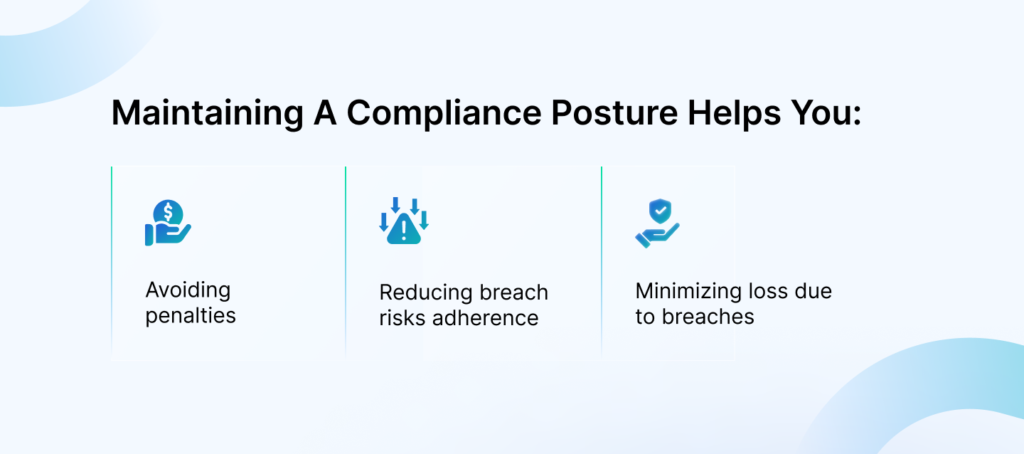
Avoiding penalties
Depending on the nature of the data you process and the type of service you offer, one or multiple regulatory frameworks may be mandatory.
If you fail to comply with its requirements, you are opening yourself up to the possibility of penalties and legal liabilities. The severity of the reprimands depends on the nature and type of violation. A few examples are:
- If you violate HIPAA, civil penalties from $100 to $50,000 and criminal penalties up to $250,000 apply.
- Non-compliance with NIST 800-53/CSF leads to loss of contract and federal funding
- Fines range from $5,000 to $100,000 a month for not complying with PCI DSS
- Organizations that violate the regulation may face GDPR fines of up to €20 million or 4% of annual global turnover, whichever is higher.
Reducing breach risks
Security breaches, depending on how sophisticated, can severely impede key operational initiatives. Recovering from breaches and restoring impacted systems may take weeks or even months.
The toll on your operations and engineering bandwidth can be severe to the point that it seriously cripples your ability to achieve goals. A strong compliance posture helps you minimize the chances of a compromise by helping you reduce vulnerabilities and gaps that may escalate into an incident.
Minimizing loss due to breaches
Apart from the loss of bandwidth due to operational disruptions, the financial impact of breaches is evaluated in terms of the cost of tools and loss of customer trust.
Once your systems are compromised, the next step is to take corrective action. This generally involves implementing a suite of incident recovery tools and corrective measures that were not present in the first place to prevent the damage from occurring in the first place.
Secondly, there’s the invisible or indirect cost. Incidents = poor reputation. And loss of reputation = compromised bottom line.
Moreover, a growing number of businesses refuse to sign a contract unless their vendor can demonstrate a strong compliance posture through certifications like ISO 27001 or SOC 2. If you are compliance-certified, you can expand to new markets faster.
Note: Let’s dispel a common myth about compliance. The misconception is that compliance means you’re immune to breaches. While compliance is a crucial piece in the posture puzzle and a factor that adds to resilience, it is technically wrong to conflate the two.
Compliance simply means that you have the right controls and measures in place to minimize the possibility of an incident. It is an enabler rather than a guaranteed shield against incidents.
Challenges of maintaining a compliance posture
Challenges of maintaining a compliance posture include a lack of visibility into the gaps, continuously monitoring every granular component, and checking off every requirement in the audit checklist.
So if you are new to compliance, here’s a heads up – it’s far from a smooth journey. Let’s understand these issues in detail:
Where am I lagging behind?
A common challenge management faces is the lack of comprehensive insight into the key functions of the compliance posture – the overall progress, what’s working, what’s failing, which parts require attention, and new requirements.
Poor or inadequate insight makes compliance posture management somewhat intuitive and disconnected. This leads to unforeseen risks and incorrect decisions around compliance strategy.
The solution to identify gaps lies in risk assessments, which introduces another set of challenges. Unless you assign scores accurately and make decisions that reflect the business context, it becomes an intuitive and assumptive activity.
Meeting audit requirements
For most businesses, compliance is a checklist to meet regulatory obligations or a customer asking to demonstrate a strong posture.
As a result, management tends to see compliance as a cost center and therefore, tackles audit-readiness by allocating resources which can often be disorganized.
While manual compliance may seem to work at first, in the long run, engineering and IT bandwidth becomes stretched thin. Even more so when you are trying to manage multiple audits at once.
“Excel files and offline tools are not scalable for compliance, especially when expanding into new geographies and adhering to multiple frameworks. Continuous evidence maintenance and production are essential, and automation provides a feasible solution that allows engineering teams to focus on product development and feature enhancement.”
Swapnil Tripathi, PCI QSA, ISO LA, and Green belt LSS at Sprinto
Monitoring every component
Continuous monitoring is a critical component of maintaining compliance status. It helps teams identify gaps and remediate them quickly to avoid falling out of compliance.
However, most management teams, in an effort to manage all aspects manually, end up breaking workflows, complicating processes, and eating up bandwidth. A common scenario involves leaving bits of compliance unchecked and focusing only on specific parts at certain times.
Managing compliance sans focus can leave you with compliance blind spots, hidden vulnerabilities, and a sense of rush and panic as the audit deadline gets closer.
How to improve compliance posture
Improving compliance posture isn’t about passing a single audit it’s about maintaining confidence that your controls remain effective as your business grows, systems change, and regulatory requirements evolve.
Many organizations start with periodic reviews and manual evidence collection. While this may work initially, compliance posture can quickly deteriorate when controls are monitored only during audit season. Missing evidence, outdated policies, configuration drift, delayed access reviews, and unresolved risks often go unnoticed until an assessment is already underway.
To strengthen compliance posture over time, organizations should:
- Map controls to the compliance requirements they support
- Continuously monitor control effectiveness across systems and teams
- Prioritize remediation efforts based on risk and business impact
- Assign clear ownership for controls, policies, and evidence collection
- Maintain audit-ready documentation throughout the year
- Reassess posture after significant business, technology, or regulatory changes
Continuous monitoring is particularly important. Compliance is not static, and neither are the environments organizations operate in. New employees join, vendors are onboarded, infrastructure changes, permissions evolve, and regulations are updated. Without ongoing visibility, control gaps can emerge long before an audit identifies them.
This is where compliance posture management becomes critical. Instead of treating compliance as a periodic project, organizations should manage it as an ongoing process tracking control health, evidence readiness, risk exposure, and remediation progress in real time.
However, maintaining this level of visibility manually can be challenging. Teams often spend significant time chasing evidence, validating controls, coordinating stakeholders, and preparing for audits across multiple frameworks.
In essence, Sprinto is the ChatGPT to a CISO; it is automated to the extent that human effort is negligible. – Sunil Sarda, Head of Engineering at HubEngage
Sprinto connects with your cloud stack and continuously evaluates control health across infrastructure, code repositories, and applications. But the goal isn’t to give you more dashboards or more notifications. It’s to give security and compliance teams a single view of what’s passing, what’s drifting, and what needs attention first. This way, your posture becomes a real-time trust signal for auditors, customers, and leadership.
Security and compliance teams can quite easily test and align controls against the requirements of any framework. It alerts teams of anomalous behavior or when controls are about to fail so such instances can be remediated on time. Additionally, you get:
- Built-in security training courses with the ability to track progress
- Pre-built and fully customizable policy templates with in-app acknowledgments
- Pre-mapped controls and checks for sweeping compliance coverage
- Customizable risk library to help you scope security risks across your business’s assets and processes
Reduce manual overhead with Sprinto’s autonomous GRC capabilities. Talk to our experts now.
Frequently asked questions
Author
Anwita
Anwita is a cybersecurity enthusiast and veteran blogger all rolled into one. Her love for everything cybersecurity started her journey into the world compliance. With multiple certifications on cybersecurity under her belt, she aims to simplify complex security related topics for all audiences. She loves to read nonfiction, listen to progressive rock, and watches sitcoms on the weekends.Go beyond the surface and uncover the governance, risk, and compliance insights that actually matter.


Win digital goodies for boardroom success


Explore more




research & insights curated to help you earn a seat at the table.