

GDPR is the gatekeeper to one of the world’s largest markets. If you want to do business in Europe or work with European customers and their data, GDPR is not optional. It is the price of admission.
And the scale of its impact is unmistakable. Ever since the GDPR took effect, over half a million organizations in Europe have formally appointed Data Protection Officers. This number shows just how deeply the regulation has reshaped day-to-day operations.
Many founders begin in the same place as Noosa’s Co-Founder, Idan Deshe. He once said, “We hired an external consultant who gave us an idea about the implementation, but it was very, very high level.” The law is tough, the expectations are high, and the guidance can often feel abstract.
In this blog, we aim to explore the list of GDPR requirements and demystify them in simple, easy-to-grasp language.
- Any organization processing the personal data of EU citizens must comply with GDPR, regardless of where the company operates, including during international data transfers.
- Organizations must have a legal basis for collecting and using personal data and communicate clearly about how it’s processed.
- Individuals’ rights are central to GDPR; Data subjects have rights to access, correct, delete, restrict, and transfer their data, as well as to object to certain processing activities.
- At its core, the GDPR requires organizations to be transparent and fair about how they use data, limit what they collect and how long they retain it, and ensure that information remains accurate and secure.
- It also expects teams to run DPIAs when risks are high, integrate privacy into systems from the start, establish clear processor contracts, facilitate easy access to exercise rights, appoint a DPO when necessary, safeguard data that crosses borders, and expedite breach detection and 72-hour reporting.
What is GDPR and when does it apply?
The General Data Protection Regulation (GDPR) is the European Union’s data privacy law that governs how organizations collect, use, store, share, and protect personal data of individuals in the EU and EEA.
GDPR emerged because the EU saw a growing need for stronger privacy and data protection. By 2016, the digital landscape had evolved so quickly that the EU recognized the need for a clear standard governing how its citizens’ data should be handled.
So GDPR requirements outline a set of principles and best practices for how organizations should collect, use, and protect personal information.
Global Scope
One of the most important aspects of GDPR is its extraterritorial scope. GDPR applies:
- To organizations established in the EU, regardless of where processing takes place
- To organizations outside the EU if they:
- Offer goods or services to individuals in the EU, or
- Monitor the behavior of individuals in the EU
In other words, it is not enough to say “we are not based in Europe.” If you touch EU personal data in a way that falls within the scope of GDPR, its requirements will apply.
When GDPR applies to US companies (and other non-EU organizations)
GDPR applies to US companies and other non-EU organizations when they:
- Have EU customers or free users
- Run websites or apps that target EU markets (currencies, languages, localized offers)
- Track EU visitors for analytics, profiling, or advertising
- Provide services to EU businesses that involve processing EU personal data
Examples of common scenarios where it applies
Here are a few typical cases where GDPR applies:
- A US-based SaaS platform offering a freemium plan to users in Germany and France
- A UK or US e-commerce store that ships products to EU addresses
- A B2B software vendor processing EU customer data on behalf of EU clients
- An Australian marketing agency running retargeting campaigns for EU-based visitors
Who needs to comply with GDPR obligations?
GDPR requirements apply to any company or entity whose core activities include the collection or processing of personal data of EU citizens. Regardless of a business’s location, if it handles the data of people in the EU, it must comply with the GDPR.
This makes the regulation relevant to almost every modern business that interacts with European users. GDPR classifies organizations into main buckets:
- Controllers who identify the purpose of data collection and take decisions on the means to collect it.
- Data processors who process the personal data of individuals.
While all companies must follow GDPR, smaller businesses with fewer than 250 employees are granted a bit more flexibility. They don’t have to keep detailed records or appoint a Data Protection Officer, but they must still adhere to the main principles of the regulation.
Learn how Noosa.io became GDPR-ready in just 14 sessions with us.
On the other hand, failing to meet GDPR requirements can result in heavy penalties. The video below explains more:
The core GDPR principles
Before you dive into operational requirements, it is helpful to ground everything in the seven core GDPR principles. They shape how every other obligation should be interpreted:
1. Lawfulness, Fairness, Transparency
Processing must have a valid legal basis, be fair toward individuals, and be communicated clearly.
2. Purpose Limitation
Personal data must be collected for specific, explicit, and legitimate purposes and not used in a manner that is incompatible with those purposes.
3. Data Minimization
Only the data that is necessary for the stated purpose should be collected and processed.
4. Accuracy
Personal data must be accurate and kept up to date. Inaccurate data must be corrected or erased.
5. Storage Limitation
Data should not be kept for longer than necessary for the purposes for which it was collected.
6. Integrity and Confidentiality
Personal data must be protected against unauthorized or unlawful processing, accidental loss, destruction, or damage.
7. Accountability
Organizations are responsible for complying with GDPR and must be able to demonstrate their compliance.
Also find out: Detailed list of GDPR principles
10 key GDPR requirements
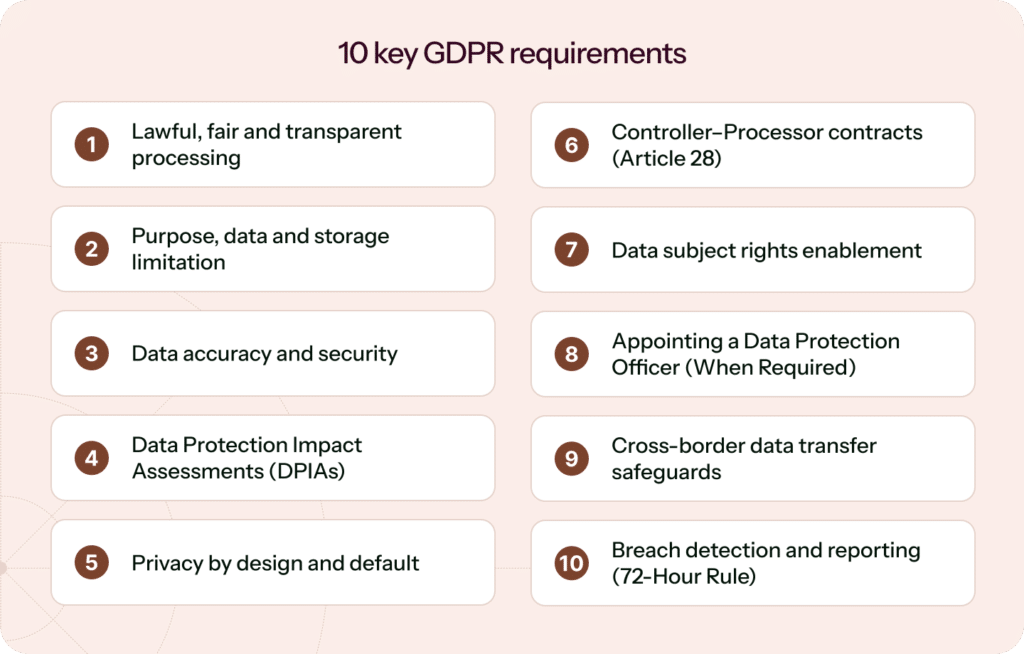
The obligations under the GDPR are distributed across many articles and recitals, but grouping them in a structured manner (as we’ve attempted to do) offers a practical framework for implementation. These ten areas reflect the key responsibilities organizations must address to translate the principles into day-to-day compliance.
If you’re already prepping for an audit, here’s a simple GDPR audit checklist that can be handy:
1. Lawful, fair, and transparent processing
Organizations must have a documented lawful basis for collecting personal data. And that basis must be clearly communicated to data subjects in plain language, not obscured by legal terminology or buried details.
The lawful basis might be explicit consent, contractual necessity, or another recognized legal ground. But regardless of the method, data subjects must clearly understand what information is being collected, why it’s needed, and how it will be used.
2. Purpose, data, and storage limitation
GDPR restricts data collection to only what is necessary for an explicitly stated purpose. Therefore, if data is collected for one purpose, it cannot be repurposed without obtaining new legal justification.
Additionally, data should not remain in systems indefinitely. Therefore, organizations must periodically review stored datasets and remove or anonymize outdated information to enforce proper data lifecycle management.
3. Data accuracy and security
Organizations storing personal data of EU residents bear dual responsibility. First, they must ensure the accuracy and completeness of the data. And second, they must implement protective security measures to prevent unauthorized access or breach.
This requires establishing mechanisms to correct inaccurate or outdated records. But it also requires robust security infrastructure, including access controls and encryption, to safeguard data from compromise.
4. Data Protection Impact Assessments (DPIAs)
When processing sensitive information or monitoring individuals at scale, GDPR mandates a DPIA. This assessment forces teams to evaluate potential risks, determine whether processing is truly necessary despite those risks, and identify safeguards to mitigate harm.
Therefore, DPIAs must be integrated into early planning with clear triggers, rather than being treated as a checkbox exercise after development is complete.
5. Privacy by design and default
Building with a privacy-first focus from the ground up is now widely recognized as best practice. GDPR reinforces this by mandating “privacy by design.” This means that privacy protections must be embedded into systems from their inception.
This principle means that default settings should collect as little data as possible, and users should choose to share more only if they want to. Security should be built with this in mind, using design reviews and technologies that naturally limit data collection.
6. Controller–Processor contracts (Article 28)
When third-party vendors process customer data on behalf of an organization, a formal Data Processing Agreement (DPA) must be executed prior to any data transfer. This DPA should define what processing the vendor may perform, what security standards they must maintain, and how liability is allocated.
Therefore, organizations must maintain an inventory of all data processors. They should verify that DPAs are in place before granting access and periodically reassess whether vendors continue to meet the required security standards.
7. Data subject rights enablement
One of the core tenets of the GDPR is to give individuals complete control over their personal data. This means they can see what information is collected, fix errors, delete it if they choose, or limit and object to how it’s used. But these rights have value only if organizations make them practically easy to exercise.
Organizations must establish workflows that handle requests efficiently within strict legal timeframes. They must also verify accessor identities before disclosing data, track requests to ensure deadlines are met, and maintain records documenting how each request was processed.
8. Appointing a Data Protection Officer (When Required)
Organizations that monitor people at scale or process sensitive personal data as a core business activity must appoint a Data Protection Officer (DPO).
The DPO advises on compliance, oversees data protection practices, and serves as the primary point of contact for regulatory matters. However, for this role to function effectively, organizations must clearly define the DPO’s responsibilities. The DPO must operate with genuine independence and have direct access to senior leadership, allowing the DPO to raise concerns without interference.
9. Cross-border data transfer safeguards
Personal data transferred outside the EU/EEA requires additional safeguards because not all jurisdictions provide equivalent legal protection. Organizations typically rely on Standard Contractual Clauses (SCCs), Binding Corporate Rules (BCRs), or adequacy decisions to establish legal frameworks.
But legal agreements alone aren’t enough. Organizations must also evaluate whether the destination country’s laws create risks that outweigh the business benefits. This involves preparing thorough transfer documentation, applying SCCs correctly, conducting Transfer Impact Assessments to understand the legal environment, and utilizing technical safeguards such as encryption to minimize exposure if data is transferred to unsafe jurisdictions.
10. Breach detection and reporting (72-Hour Rule)
The GDPR imposes strict reporting and disclosure requirements on organizations. Under these rules, organizations must rapidly detect breaches, assess their impact, and notify regulators within 72 hours when necessary. This short window reflects a core principle: both individuals and regulators have the right to know when private user data has been breached.
As a result, organizations cannot afford a reactive approach to incident response. Monitoring systems must be capable of surfacing breaches at the earliest sign of compromise, and escalation paths should route potential incidents to the right teams without delay. It’s also essential to maintain detailed documentation that captures both the circumstances of the breach and how it was handled.
GDPR consent requirements
Under GDPR, consent is only valid when it is freely given, specific, informed, and unambiguous. In simple terms, people must understand what they’re agreeing to, and they shouldn’t feel pressured into saying yes. The request itself must be explicit, so individuals can see exactly what type of data use they are accepting.
Consent also needs to be granular. So instead of one broad “accept everything,” users should be able to choose which types of processing they allow, like turning on analytics but not marketing cookies. This gives people absolute control instead of forcing a single choice.
Users must also be able to easily withdraw their consent. And once they do, the related processing must stop immediately. Withdrawal should be as simple as giving consent in the first place, not hidden behind lengthy menus or complex steps.
When processing children’s data, the GDPR provides additional protection. Many EU countries require parental consent for users under 16, although the exact age may vary. Therefore, organizations need to design consent flows that recognize when a child is involved and ensure that a parent or guardian is the one providing permission.
GDPR security requirements (Article 32)
Article 32 takes a risk-based approach to security. Instead of instructing every organization to use the same controls, GDPR requires you to select protections that are tailored to the type of data you handle and the associated risks.
Organizations must protect the confidentiality, integrity, and availability of personal data. This means keeping information away from unauthorized individuals, ensuring it isn’t changed or damaged, and made available when it needs to be used.
GDPR also encourages encryption and pseudonymization when they help reduce risk. Encryption protects data if someone gains unauthorized access to it, either by accident or through an attack, and pseudonymization separates identifying details from the data, making it harder to link back to a person.
Good incident response is another expectation. Therefore, organizations should have tools that help detect suspicious activity, maintain useful logs for investigations, and follow a clear response plan in the event of an incident.
And these controls can’t stay static. GDPR requires regular testing and evaluation to ensure that security measures evolve as the organization grows or new threats emerge. This helps ensure protections stay effective rather than becoming outdated.
Need to meet GDPR standards? Our “GDPR Data Processing Agreement” is here to help. Download this essential document to ensure your data processing aligns with regulations.
Automate GDPR compliance with Sprinto
GDPR is a complex regulation to navigate. With over 90+ articles, numerous sub-requirements, and evolving best practices, achieving compliance can feel arduous and challenging. And this is precisely where Sprinto can help.
Sprinto for GDPR Compliance
- AI-Driven Control Mapping: Automatically maps GDPR Articles to required controls, simplifying setup and reducing manual effort.
- Automated Evidence Collection: Continuously gathers and updates evidence as your systems change to keep you audit-ready.
- Vendor & Risk Management: Monitors vendors, supports DPIA workflows when risks appear, and enables quick action.
- Data Discovery & Lawful Basis Tracking: Scans systems for sensitive data and documents lawful bases for processing to maintain GDPR alignment.
Centralized Compliance & Reporting: Consolidates all compliance activities, making reporting and audits faster and easier to manage.
FAQs
Depending upon the severity of the data breach, GDPR has divided penalties and fines into two tiers.
Tier 1: Up to €20 million or 4% of worldwide annual turnover, whichever is higher. Tier 1 breaches are related to basic principle violations, such as lawfulness and transparency.
Tier2: Up to €10 million or 2% of worldwide annual turnover, whichever is higher. Tier 2 breaches relate to specific circumstances, such as GDPR certifications and the data processor’s obligations.
Any information that is personally identifiable comes under the scope of GDPR. This can be basic personal information like name, email, phone, etc., financial information, online identifiers like IP address, employee records, or any such other sensitive data.
Yes, GDPR compliance is necessary for any entity that collects or processes the personal data of EU residents. Hence, any organization that deals with such personal data must comply with GDPR data privacy requirements.
A data breach is a criminal offense only if you knowingly or recklessly disclose or obtain personal data without.

Author
Payal Wadhwa
Payal is your friendly neighborhood compliance whiz who is also ISC2 certified! She turns perplexing compliance lingo into actionable advice about keeping your digital business safe and savvy. When she isn’t saving virtual worlds, she’s penning down poetic musings or lighting up local open mics. Cyber savvy by day, poet by night!Go beyond the surface and uncover the governance, risk, and compliance insights that actually matter.


Win digital goodies for boardroom success


Explore more








research & insights curated to help you earn a seat at the table.