


Compliance risk is similar to being completely lost in a maze of rules and regulations. One misstep, and bam! You’re in trouble, dealing with legal issues and financial difficulties. This risk sneaks up on organizations for a variety of reasons.
Imagine inexperienced staff members baffled by obscure regulations or unclear policies that perplex everyone. A crazy and dynamic regulatory environment and forgettable training sessions are a recipe for compliance disasters. So, does compliance risk management come in handy?
There’s no need to panic. You can easily get past this difficulty if you develop a strong compliance program, educate your employees, and keep an eye on the always-changing environment.
Let’s take a deep dive into compliance risk management now.
What is compliance risk management?
Compliance risk management is the practice of identifying, assessing, and mitigating risks from non-compliance with laws, regulations, and policies to prevent legal, financial, and reputational losses.
Effective compliance risk management requires:
- The identification of applicable regulations and assessment of risk associated with compliance gaps
- The assignment of roles and responsibilities for managing various compliance risks
- The implementation of risk-based controls to ensure continuous readiness
- The establishment of a monitoring mechanism aimed at continuous improvement
What happens if compliance risk is not managed?
Unmanaged compliance risk can trigger cascading failures across regulatory compliance and corporate governance, from audit findings and fines to lost certifications and delayed deals. Weak internal controls, poor compliance monitoring, and a lack of continuous compliance increase incident likelihood and remediation costs.
- Financial impact: penalties, legal fees, clawbacks, and higher insurance premiums
- Operational impact: disruptions, forced process changes, halted product launches
- Commercial impact: failed audits, customer churn, longer security reviews, lost revenue
- Strategic impact: damaged brand, reduced market access, board scrutiny
Control maturity impact: control gaps widen, testing fails, risk management framework effectiveness declines
What are the components of compliance risk management?
A well-run compliance program starts with a clear set of components everyone can use consistently. Define each component up front. This means stating what it means, how you will measure it, and who owns it. Apply the same definitions consistently across policies, controls, and reporting so everyone evaluates risk similarly. Here are the main components of a risk management program:
- Exposure mapping: Describe where regulatory and policy obligations intersect with your operations. Specify the processes, data types, geographies, vendors, and systems that could trigger non-compliance.
- Likelihood calculation: Estimate the probability of a non-compliance event occurring within a defined period. Use historical incidents, control testing results, change velocity, and human error factors to inform the estimate.
- Business impact assessment: Define the severity if the event occurs. Document financial, legal, operational, contractual, and reputational consequences using clear, consistent scales.
- Risk identification: Map applicable laws, regulations, contracts, and internal policies to business processes. Record the concrete threats and scenarios that arise from each obligation.
- Risk prioritization: Rank risks by combining likelihood and impact while accounting for time sensitivity and dependencies on critical systems or sensitive data.
- Ownership and accountability management: Assign a named owner and approver for each risk and its controls: set service levels, testing cadence, evidence requirements, and escalation paths.
- Inherent risk baseline: Record the risk level before any controls are applied. Note drivers such as data sensitivity, external exposure, transaction volume, and process complexity.
Residual risk analysis: Measure the level of risk that remains after controls and mitigations are in place. Compare it to risk appetite and schedule improvements if it exceeds defined thresholds.
Compliance risk management process
Having a compliance risk management framework in place will provide you the confidence that you are successfully managing your compliance and avoiding any liabilities.

Knowing and understanding your external and internal compliance duties and the risks involved can be overwhelming. So, here are some of the key steps to take towards risk management and compliance:
1. Measure your compliance maturity Understand your current standing
Assess the maturity of your compliance architecture. Assess your key systems and processes while understanding the industrial regulations, operational complexity, and regulatory requirements that apply to your organization. So how do you measure compliance maturity? Use a simple 1 to 5 scale where 1 is ad hoc and 5 is optimized and continuously improved. Score each area below, then average the scores and note gaps.
- Metrics and reporting: regular reporting on findings, SLAs, and trend lines to leadership.
- Governance and ownership: The named program owner, roles, RACI, and meeting cadence are in place.
- Policies and procedures: current, approved, version-controlled, mapped to controls.
- Control design and coverage: documented controls with scope, frequency, and evidence defined.
- Control operation and testing: pass rates, exception handling, and remediation timeliness.
- Evidence and audit readiness: centralized evidence, traceable to controls, audit trails intact.
- Training and awareness: role-based training completion and effectiveness checks.
- Risk and vendor management: risk register quality, treatment status, and third-party reviews.
- Monitoring and automation: integrations, alerts, and automated checks in production.
2. Perform a risk assessment
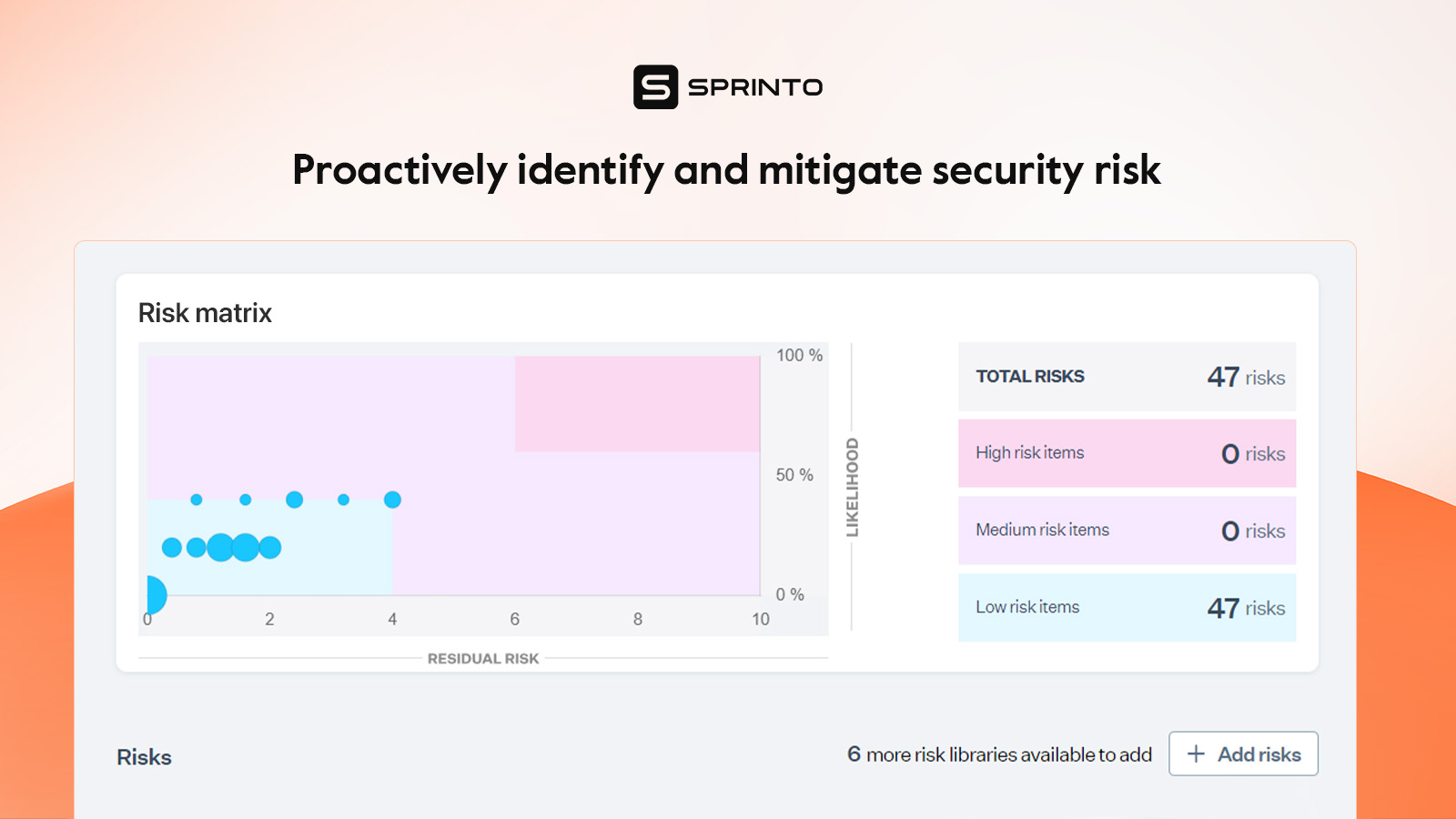
Conduct qualitative and quantitative risk assessments to evaluate the types of compliance risk to your company. As part of this process, you’ll be able to prioritize your compliance activities based on severity. A risk matrix is a great way to understand the likelihood, impact, and severity of each type of risk.
With Sprinto you can manage risks with precision with an in-built risk library, quantitative assessments and role-based remediation. Get real-time and comprehensive visibility into risks unique to your business.
3. Assess and prioritize gaps
Assessing gaps is essential to compliance risk management because it enables organizations to pinpoint areas where their internal policies fall short of industry standards, or regulatory obligations. Compare your current practices, procedures, and controls against compliance requirements in order to pinpoint the areas of non-compliance. Categorize these risks based on severity and create a prioritized plan of action to fix these gaps.
So, how do you identify compliance gaps?
- Inventory applicable laws, regulations, contracts, and internal policies with a clear scope.
- Map each requirement to specific controls, owners, and evidence.
- Test control design and operating effectiveness using samples and walkthroughs.
- Review incidents, audit findings, and customer questionnaires for missed obligations.
- Inspect third-party coverage to confirm vendor-related requirements are in scope.
- Produce a gap list with severity, recommended fixes, and assigned owners.
4. Put policies and procedures in place
Create a tactical mitigation plan to remediate the risks identified by the risk assessment exercise. Draft new policies and procedures or update the existing ones to address the compliance gaps. Conduct a security training program to ensure employees and stakeholders are aware of the changes in policies and protocol.
5. Implement the required controls
Use a short, prioritized checklist of baseline controls, and document the owner, frequency, and evidence for each before rollout.
- Access management: Implement single sign-on, multifactor authentication, and least privilege. Establish a clear joiner, mover, leaver process so access changes are approved and tracked.
- Privileged access management: Require approvals for elevation and set time-bound privileges. Review privileged sessions regularly to confirm appropriate use.
- Endpoint security: Maintain an accurate device inventory and enforce full-disk encryption. Deploy EDR, keep operating systems current, and verify patch compliance.
- Vulnerability and patch management: Scan on a defined cadence and rate findings by risk. Apply patches within SLAs and verify remediation with follow-up scans.
- Change management: Use tickets for every change, require peer review, and test before deployment. Keep approvals and rollback plans on record.
- Logging and monitoring: Centralize logs and define clear alert rules. Set retention periods and staff on-call response so alerts are triaged quickly.
- Incident response: Maintain runbooks with severity tiers and escalation paths. Conduct short reviews after incidents to capture lessons and close actions.
- Data protection: Encrypt data in transit and at rest and manage keys securely. Add data loss prevention where sensitive data moves across systems.
- Backup and recovery: Back up critical systems on a set schedule and keep offsite copies. Test restores routinely to prove recovery works.
- Secure development: Follow a secure SDLC with code reviews and dependency checks. Store secrets safely and prevent exposure in repositories.
- Network security: Segment networks and restrict administrative interfaces. Keep firewall rules reviewed, documented, and tied to business need.
- Vendor risk management: Perform due diligence before onboarding and include security clauses in contracts. Reassess vendors periodically based on data access and criticality.
- Policy and training: Keep policies current and mapped to controls. Deliver role-based training and run phishing simulations to reinforce behaviors.
- Business continuity: Complete a business impact analysis, write continuity playbooks, and run tabletop exercises. Update plans as systems and teams change.
- Audit readiness: Centralize evidence, schedule control testing, and track remediation to closure. Make it easy for auditors to follow the trail from control to proof.
6. Report on compliance
Utilize a continuous monitoring mechanism to create a report that tracks progress. Leadership can use this report to evaluate if the compliance objectives are being met and if risks are sufficiently minimized. This tells them what is working and what needs to be improved. The report must include recommendations for improvement to ensure a continually improving process.
You can leverage Sprinto’s risk intelligence to systematically manage business risks and achieve a state of continuous compliance readiness with automated checks.
So, how often should you report on compliance?
Ideally, use a layered cadence rather than having a static rule for all stakeholders. Here are some periodicity benchmarks that work for a lot of teams, but feel free to tweak these for your context:
- Once a week: Share operational summaries with the compliance and security teams.
- Once a month: Publish a metrics report for managers, and a quarterly dashboard for executives and the board.
- Once a year: Run a program review against frameworks and policies, and issue event-driven updates within 24 to 72 hours for material incidents.
Case Study
Audit and assurance firm Sensiba LLP explains how they have achieved 3x improvement in audit reviews with platforms like Sprinto.
Difference between compliance risk management and risk management
Risk management and managing compliance risk are two connected but different ideas. The main variations between them are listed below:
Focus
- Identifying, evaluating, and managing risks related to non-compliance with laws, regulations, and corporate policies are the main objectives of compliance risk management. It targets hazards that are explicitly connected to statutory and regulatory requirements.
- Contrarily, the scope of risk management is larger and it includes the detection, evaluation, and mitigation of risks in a variety of contexts, such as operational, financial, strategic, and other sorts of hazards.
Objectives
- The goal of compliance risk management is to make sure that an organization adheres to all internal policies, laws, and regulations that may be in force. Its main objective is to reduce the likelihood of legal and regulatory infractions, as well as the penalties, reputational harm, and other negative effects that go along with them.
- On the other hand, risk management focuses on identifying and minimizing risks that could interfere with the accomplishment of organizational objectives and goals, regardless of whether those risks are connected to compliance or not.
Framework
- A compliance risk management framework that is particular to the laws, rules, and industry standards pertaining to the activities of the organization is frequently the foundation around which compliance risk management is formed. It entails adhering to particular compliance standards as well as routine monitoring and reporting.
- Contrarily, risk management typically uses a broader framework for managing risks, such as the COSO ERM (Committee of Sponsoring Organisations of the Treadway Commission – Enterprise Risk Management) framework, which covers a wider range of risks and offers a structured method for risk identification, assessment, and mitigation.
Risk scope
- Compliance risk management services mainly concentrate on minimizing risks related to non-compliance, such as legal infractions, disciplinary actions, fines, and reputational harm. It addresses hazards especially connected to adherence to rules, regulations, and internal policies.
- On the other hand, risk management takes into account a wider range of hazards, such as operational risks, financial risks, strategic risks, cybersecurity threats, and more. It accounts for risks that may have an effect on the organization’s goals, financial results, reputation, and overall sustainability.
Also check out: Best Risk assessment tools
Best practices of compliance risk management
Following compliance risk management best practices ensures efficient and sustainable operations and minimizes the likelihood of non-compliance ramifications such as financial and reputational damage.
Here are 5 best practices for compliance risk management you must follow:
Have an integrated strategy
Ensure holistic risk management by integrating compliance into every function. It facilitates better collaboration across departments and leads to efficient utilization of resources. An integrated strategy also refines processes at the organizational level and leads to overall improvement in the long-term.
Regularly train your employees
Organize regular awareness training for employees to help them understand regulatory changes and upcoming compliance issues. It helps foster a culture of compliance and enhances their engagement and accountability.
Senior Management involvement is key
An active involvement of senior management sets the tone at the top and encourages stakeholders to demonstrate an equal commitment to compliance. Management must regularly review compliance progress and proactively respond to any non-conformities to ensure continuous readiness.
Embrace widely adopted frameworks
More often than not, customers only want assurance that their data is safe with the organization. You can confirm to widely recognized compliance frameworks such as SOC 2 and ISO 27001 to provide base-level guarantees to the customers and unlock better business deals. However, it is equally important to understand other applicable frameworks to your industry and ensure adherence.
Leverage the right technology
Choose the right compliance tool that aligns with your organization’s security needs to manage regulatory risks. Automation can streamline workflows, enhance operational efficiency and help you achieve audit readiness in record time.
Sprinto as a compliance automation tool enables you to ditch spreadsheets and hundreds of hours of manual work with integrated risk management and adaptive automation capabilities. Get out-of-the-box policy templates, training modules, role-based access controls, automated evidence collection and much more to streamline your compliance efforts.
Challenges of compliance risk management
Technological advancements, global business operations and rising data security concerns have increased regulatory scrutiny and made it difficult to manage compliance risks. Here are 5 major challenges of compliance risk management:
Evolving regulations
The regulatory environment is dynamic and is constantly evolving. Organizations that operate globally are usually subject to multiple geographical requirements making it difficult to keep pace with regulatory compliance. Moreover, the sales cycle slows down if they are unable to produce proof of compliance.
Sprinto advantage: Stay abreast of regulatory changes and leverage automated mapping of controls to the applicable framework for quick understanding and implementation.
Resource constraints
Compliance risk management is a dedicated task requiring human resources, training material, technology and other resources. Organizations operating at a small scale can find it challenging to manage compliance risks because of limited engineering bandwidth and budget constraints.
Sprinto advantage: Use automated workflows to reduce manual overload and streamline your compliance processes while saving up to 80% of costs.
Stakeholder involvement
Stakeholders have conflicting interests and needs and often work in siloed environments. Compliance risk management requires building a culture of compliance at the organizational level to ensure continuous readiness. It becomes challenging for leaders to get stakeholder buy-in because of the need for more engagement and responsibility.
Sprinto advantage: Foster better collaboration across the organization with role-based task assignments and centralized management.
Third-party risks
Enterprises today collaborate with thousands of vendors and third-party breaches have become a common occurrence. This challenge is often underestimated given the complexity of ensuring compliance and data security of every vendor.
Sprinto advantage: Manage vendors centrally from the dashboard and automatically assess the severity of risks posed by them by choosing the type of data they have access to.
Lack of visibility
Organizations often find it difficult to build a continuous monitoring mechanism because of the complexity of operations and that leads to a lack of visibility. Without clear visibility at a granular level, it becomes challenging to manage compliance risks in processes and data handling practices.
Sprinto advantage: Leverage granular level compliance checks and get real-time compliance status on the dashboard along with automated alerts for any deviations.
How does Sprinto help in compliance risk management?
Today’s commercial environment is enmeshed in a complex web of rules, guidelines, and industry standards. Without a methodical strategy, navigating this complicated regulatory environment can be overwhelming. Compliance risk management offers a structured framework to assist organizations in efficiently comprehending, interpreting, and implementing these obligations.
Sprinto helps you by automating processes like compliance monitoring, reporting, and documentation, and streamlines and improves the compliance risk management process.
Moreover, it assists organizations in identifying compliance risks, evaluating their impact, and putting proactive measures in place to reduce such risks through the use of cutting-edge technology like artificial intelligence and machine learning.
The compliance software gives you the ability to increase compliance effectiveness, lessen manual work, and improve all aspects of risk management thanks to its effective and complete approach.
FAQ’s
Is compliance part of risk management?
Compliance and risk management go hand in hand. Compliance with long-standing industry norms guarantees that businesses are shielded from particular hazards. As opposed to this, risk management assists organizations in preventing hazards that could result in non-compliance, which is a risk in itself.
What are the biggest challenges in compliance?
There are many challenges in compliance, such as data security, legal challenges, upholding business reputation, and more. These challenges can be overcome by having strong compliance risk management.
What is a compliance failure?
Compliance failure occurs when an organization fails to follow applicable laws, regulations, or internal rules and procedures. It involves a violation or breach of compliance standards that may result in legal and regulatory repercussions, harm to one’s reputation, financial losses, or other negative effects.
What are some common compliance risks for businesses?
Some common compliance risks for businesses include regulatory changes, data breaches, fraud, employee misconduct, conflict of interest, lack of monitoring, etc.
What is the difference between proactive and reactive compliance risk management?
Proactive compliance risk management involves assessing potential risks and preparing for them before they occur. The measures include awareness training, continuous control monitoring, etc. Reactive compliance risk management is a response to incidents after they occur. Reactive measures include initiating an incident response plan and implementing corrective action.

Payal Wadhwa
Payal is your friendly neighborhood compliance whiz who is also ISC2 certified! She turns perplexing compliance lingo into actionable advice about keeping your digital business safe and savvy. When she isn’t saving virtual worlds, she’s penning down poetic musings or lighting up local open mics. Cyber savvy by day, poet by night!
Go beyond the surface and uncover the governance, risk, and compliance insights that actually matter.


Win digital goodies for boardroom success



Explore more



research & insights curated to help you earn a seat at the table.