


TL;DR
| Sprinto stands out as a scalable, autonomous alternative to Vanta; combining fast implementation, AI-driven automation, and continuous control monitoring. |
| Drata and Secureframe offer solid automation, Hyperproof and AuditBoard serve complex enterprise needs, and Whistic excels in vendor risk, but each has trade-offs in cost, flexibility, or implementation time. |
| The right choice depends on your stack complexity, framework roadmap, sales motion, and need for continuous risk visibility, and not just audit readiness. |
Vanta is an automated security and compliance platform that helps companies prepare for cybersecurity certification and frameworks. It continuously monitors systems, identifies risks, and simplifies audit readiness. However, the tool has its downsides in terms of its operational friction and escalating costs.
In this guide, I’ve broken down the top alternatives, highlighting their pros, cons, and the features that matter most for your compliance journey. I’ve summarized insights from genuine user reviews and supplemented them with publicly available product information, so you can make an informed decision by the end.
Top 10 Vanta Alternatives in a gist
1. Sprinto
An autonomous trust platform with a focus on always-on GRC (Governance, Risk, and Compliance). It is designed for cloud-hosted SaaS companies to fast-track compliance with any framework/contract/regulation/obligation.
| Pros | Cons |
| – Multi-framework scaling is faster – Realistic pricing quotationStrong customer support | – Frequent updates – Frequent notifications |
2. Hyperproof
An enterprise-grade GRC (Governance, Risk, and Compliance) platform that centralizes control management and automates evidence collection across complex, multi-framework environments.
| Pros | Cons |
| – Scalable GRC platform – Multi-framework mapping – Intuitive interface | – Steep learning curve – Limited reporting depth – Complex setup process |
3. Secureframe
An all-in-one compliance automation suite that helps organizations get audit-ready quickly by integrating with their tech stack to continuously monitor security posture.
| Pros | Cons |
| – Personnel tracking features – Expert compliance support – Built-in Trust Center | – High pricing – Learning curve – Rigid framework structure |
4. Delve
An AI-native compliance agent that automates the “grunt work” of security certifications, using autonomous bots to collect evidence, monitor infrastructure, and fill out security questionnaires.
| Pros | Cons |
| – AI-native automation bots – Automated questionnaires – Rapid audit readiness | – Occasional AI errors – Task workflow confusion – Limited customization |
5. Scrut
A smart GRC platform that streamlines risk management and compliance by mapping one set of controls across multiple global frameworks through a unified dashboard.
| Pros | Cons |
| – Unified compliance dashboard – Solid integrations – Reliable performance | – Slow data synchronization – Limited reporting features – Initial setup complexity |
6. Drata
An automation platform for continuous control monitoring that automates evidence collection and provides a real-time “Trust Center” to prove security posture to customers and auditors.
| Pros | Cons |
| – Continuous monitoring – Polished user interface – Strong customer support | – Expensive renewals – Rigid control structures – Scaling increases costs |
7. Thoropass
A unique “all-in-one” solution that combines compliance automation software with an in-house audit firm to provide a seamless, end-to-end certification experience.
| Pros | Cons |
| – Helpful advisory team – Easy-to-use interface – Clear task management | – Limited pricing transparency – Slower performance – Cluttered UI |
8. Auditboard
An enterprise GRC platform built to unify internal audit, risk management, and compliance workflows for large, highly regulated organizations.
| Pros | Cons |
| – Strong SOX focus – Advanced AI features – High organizational visibility | – Very expensive – Complex onboarding – Heavy IT involvement |
9. Whistic
A vendor risk management platform that simplifies the security review process by allowing companies to proactively share their “Trust Profile” and automate the assessment of third-party vendors.
| Pros | Cons |
| – Large vendor catalog – Fast security sharing – Good support team | – Limited reporting – Manual export processes – Data sync issues |
10. OneTrust GRC
An enterprise-grade privacy, security, and GRC platform that helps organizations manage compliance, third-party risk, data privacy, and trust programs at scale.
| Pros | Cons |
| – Comprehensive privacy & compliance suite – Good third-party risk management – Enterprise-grade scalability | – Complex implementation – Steep learning curve – Heavy configuration required |
Why should you look for a Vanta alternative?
While Vanta was a pioneer in the compliance automation space, its “one-size-fits-all” architecture is increasingly at odds with organizations requiring high customization. As one reviewer notes on G2:
“The main drawback is limited customisation. We’d like more ability to tailor tests and evidence checks to our environment rather than fitting into a fixed template.”
All in all, customers point to a few recurring drawbacks in day-to-day use. Here’s what we gathered from Vanta’s G2 reviews and technical case studies:
- Manual evidence for custom stacks: Vanta struggles to support custom application integration. When your tech stack moves beyond standard SaaS (AWS/GitHub/Okta), evidence collection often reverts to a manual process, negating the platform’s primary value proposition.
- Escalating costs: Vanta’s pricing model can be unpredictable. Many users have noted that new feature releases are often chargeable, stretching budgets that were initially set for a “comprehensive” solution.
- Operational friction at scale: As organizations grow, the platform can struggle with bulk actions. Technical reviews indicate that routine processes can become time-consuming due to a lack of granular task delegation and modular program setup.
“Some things that could be improved include the need for manual input, especially related to enterprise risk management and risk mitigation activities in the action tracker. There’s a manual process where I have to go in and enter updated notes, which isn’t as seamless as I’d like.” – G2 review.
Detailed comparison of Vanta’s top 10 alternatives
When evaluating Vanta alternatives, it’s important to look beyond basic feature sets and understand how each platform supports your organization’s compliance, security, and risk management goals. I’ve highlighted 10 options below, each with distinct strengths in areas like automation, scalability, third-party risk, audit readiness, and trust-building.
1. Sprinto
Sprinto is an autonomous compliance platform with 300+ integrations supporting over 200 frameworks. It’s built for teams that don’t have a dedicated GRC (Governance, Risk, and Compliance) function but need to unblock sales quickly.
Best for: Cloud-first SaaS and tech companies that want to achieve and maintain any framework quickly, without building a large compliance team or managing complex manual processes.
Key features:
- Adaptive framework intelligence: Ingests new frameworks, regulations, and customer requirements, auto-maps them to controls, and gives you real-time readiness scores with clear gap visibility.
- Autonomous evidence collection: Deep integrations across cloud infrastructure (AWS, Azure, GCP), HRIS, ticketing, code repositories, and more to continuously collect audit-ready evidence.
- Continuous control monitoring: Always-on monitoring that flags drift, control failures, and risk exposure in real time, so you stay compliant, not just audit-ready.
- Audit-ready documentation & reports: Pre-mapped policies, control narratives, and auditor-aligned reports that streamline external audits and reduce back-and-forth.
- Integrated risk & vendor management: Built-in workflows for risk assessments, third-party risk management, and remediation tracking within a unified dashboard.
| Pros | Cons |
| – Fast implementation with guided onboarding – Strong automation across the compliance lifecycle – Clear visibility into gaps and readiness – Excellent customer support and agentic resolutions | – Advanced enterprise workflows may need configuration support – Ultra-deep customization for highly bespoke enterprise environments may require support from the team |
2. Hyperproof
Hyperproof is designed for organizations that view compliance as a permanent, complex business function rather than a one-time hurdle. It’s good at managing multiple overlapping frameworks (like ISO 27001, GDPR, and NIST) without duplicating the work.
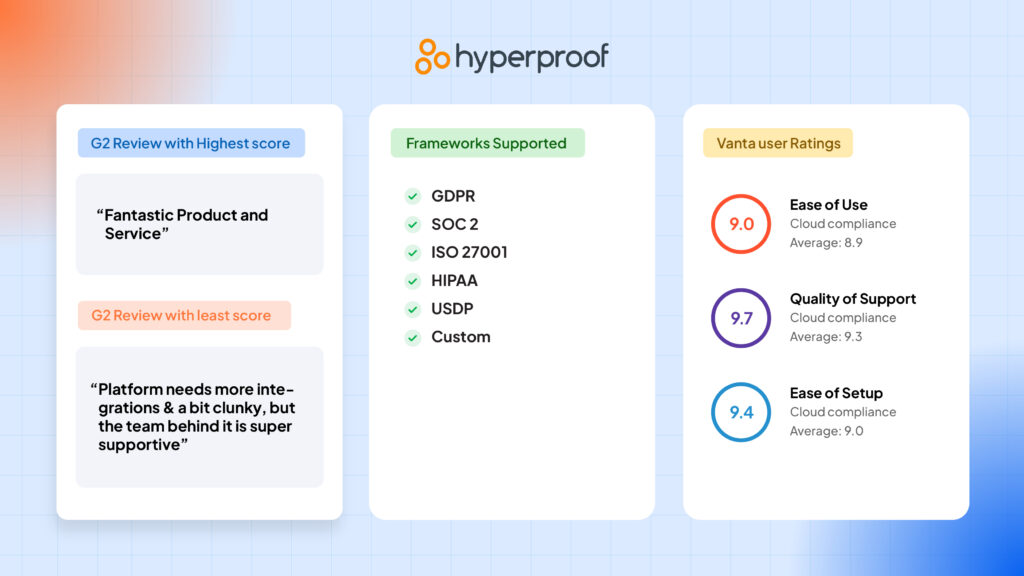
Best for: Mid-market and Enterprise companies with complex, multi-framework compliance programs and dedicated risk teams.
Key features:
- Cross-framework mapping: Link one security control to multiple regulations.
- Risk register: A robust module to identify, track, and mitigate organizational risks alongside compliance tasks.
- Custom dashboards: High-level reporting designed for executive presentations and board-level visibility.
| Pros | Cons |
| Audit centralization: A good module for managing auditor communication. | Steep learning Curve: Not “plug-and-play”; requires significant setup time. |
| Flexibility: Supports deep customization of workflows and task owners. | Complex UI: The sheer number of features can feel overwhelming at first. |
3. Secureframe
Secureframe is a compliance automation platform designed to help companies prepare for and maintain security certifications. It combines automated evidence collection with policy templates, personnel tracking, and access to compliance specialists. The platform focuses on reducing manual work during audits while giving teams a centralized view of their security posture.
Best for: Startups and growing companies looking to streamline SOC 2, ISO 27001, HIPAA, or PCI compliance with a structured, automation-led approach.
Key features:
- Automated evidence collection: Connects with cloud providers, HR systems, and other tools to gather documentation required for audits.
- Continuous monitoring: Tracks control health and flags issues that could impact compliance status.
- Personnel and access tracking: Monitors employee onboarding/offboarding, training completion, and access controls.
| Pros | Cons |
| – Helpful compliance guidance and audit coordination – Clean, structured interface – Broad framework support | – Pricing can increase as frameworks and features expand – Implementation may take time depending on complexity – Customization can be limited for highly unique workflows |
4. Delve
Delve is an AI-native compliance platform that utilizes specialized AI agents to automate the end-to-end audit lifecycle. It differentiates itself by moving beyond simple “connectors” to autonomous bots that handle policy drafting, evidence validation, and real-time remediation across both clinical and technical stacks.
Best for: AI-driven startups and healthcare technology firms needing rapid, “hands-off” compliance for SOC 2, HIPAA, or ISO 42001 (AI Governance).
Key features:
- Agentic evidence collection: AI bots that navigate your infrastructure to capture screenshots and logs, reducing human involvement by up to 90%.
- AI questionnaire automation: Automatically populates complex vendor security questionnaires using your live compliance data and policies.
- Automated code and infrastructure scanning: Continuous monitoring of GitHub PRs and cloud configurations to prevent security drift before it hits an audit.
| Pros | Cons |
| Good for speed: Can get teams audit-ready in as little as 1–2 weeks. | AI hallucinations: Validation occasionally requires human double-checking. |
| White-glove support: Includes 1:1 Slack access to compliance experts. | Limited legacy support: Not ideal for on-premise or non-cloud native setups. |
5. Scrut
Scrut is a comprehensive GRC platform built for mid-market companies that need to manage multiple global frameworks simultaneously. It focuses on “smart governance,” providing a unified dashboard that maps a single security control across 50+ different regulatory standards.
Best for: Growth-stage companies and fintechs operating in multiple regions (US, EU, Asia) that require SOC 2, ISO 27001, and GDPR on a single pane of glass.
Key features:
- Multi-framework mapping: “Test once, comply many” logic that deduplicates tasks across overlapping regulations.
- Scrut teammates: A coordinated group of AI agents that manage risk registers and vendor assessments autonomously.
- Cloud security posture management (CSPM): Built-in scanning for AWS, Azure, and GCP to detect and fix misconfigurations in real-time.
| Pros | Cons |
| Unified control set: Drastically reduces redundant work for global teams. | Platform complexity: The broad feature set can be overwhelming for beginners. |
| Strong risk management: Features a mature, built-in risk register. | Sync latency: Real-time dashboards may occasionally lag during heavy data pulls. |
6. Drata
Drata is a market-leading trust management platform known for its polished user experience and robust continuous monitoring. It provides a highly automated environment for companies to build, scale, and share their security posture with customers through an integrated trust center.
Best for: SaaS providers who want a premium, high-automation for SOC 2, ISO 27001, and NIST.
Key features:
- Continuous control monitoring (CCM): 24/7 automated testing of over 200+ integrations to ensure security controls never fail.
- Audit hub: A centralized workspace for auditors to review evidence, ask questions, and download verified packages without email threads.
- Trust center and Safebase integration: A public-facing portal to share real-time compliance status and automate NDA-backed document sharing.
| Pros | Cons |
| Industry-leading UI: Extremely clean, intuitive, and easy for teams to adopt. | High premium pricing: Can be significantly more expensive than “startup” tools. |
| Vast integration library: Connects natively to almost every major SaaS and cloud tool. | Upsell friction: Many key features (risk, trust center) are paid add-ons. |
7. Thoropass
Thoropass (formerly Laika) combines compliance automation software with an in-house audit firm. It is designed to remove the friction of finding a third-party auditor by providing the technology to get ready and the people to sign off on the audit in a single, fixed-price package.

Best for: SMBs and startups that want a predictable, “bundled” experience where the software provider also handles the final audit.
Key features:
- Integrated audit services: Direct access to an in-house or closely partnered audit firm, ensuring no “translation errors” between your evidence and the auditor’s needs.
- OrO Way methodology: A guided, step-by-step roadmap that takes you from gap analysis to a completed SOC 2 or ISO 27001 report.
- Automated evidence collection: Native integrations with cloud providers and developer tools to pull live data into “audit folders.”
| Pros | Cons |
| High accountability: One team is responsible for both your readiness and your final report. | Higher upfront cost: The bundled model often requires a larger initial investment. |
| Predictable timelines: Fixed paths to certification help with accurate business planning. | Cluttered UI: Users sometimes report that the interface feels dense when managing many controls. |
8. Auditboard
AuditBoard is an enterprise-grade GRC platform that focuses on “Connected Risk.” It is highly specialized for internal audit teams and large organizations that need to manage complex SOX (Sarbanes-Oxley), IT compliance, and environmental, social, and governance (ESG) metrics in a unified environment.
Best for: Fortune 500 companies and large public enterprises with dedicated internal audit and risk departments.
Key features:
- CrossComply: A framework-agnostic engine that allows you to manage SOC 2, ISO, and HIPAA simultaneously using a “test once, satisfy many” logic.
- AuditBoard AI: Generative AI that summarizes audit findings, identifies risk patterns, and automates the creation of workpapers.
- OpsAudit: A robust internal audit management module for planning, field work, and reporting across global departments.
| Pros | Cons |
| Enterprise scalability: Built to handle thousands of users and massive datasets across global regions. | Very expensive: Generally carries a high entry price point compared to startup-focused tools. |
| Advanced analytics: Features no-code, drag-and-drop reporting for executive-level visibility. | Complex implementation: Onboarding can take 3–6 months and often requires IT support. |
9. Whistic
Whistic is a “Trust Management” and third-party risk management (TPRM) platform. Unlike tools that focus purely on your compliance, Whistic focuses on the exchange of security information, helping you assess your vendors and helping your sales team share your security posture with buyers.
Best for: InfoSec teams that spend significant time filling out security questionnaires or vetting the security of third-party software vendors.
Key features:
- Trust center exchange: A public-facing portal where you can proactively share your SOC 2 reports and security docs to avoid answering manual questionnaires.
- Assessment AI: Uses AI to automate vendor assessment process by reading and summarizing a vendor’s uploaded documents.
- Whistic trust catalog: A massive database of pre-assessed security profiles for vendors, allowing for “zero-touch” third-party reviews.
| Pros | Cons |
| Sales accelerator: Drastically shortens the time spent in security reviews during a deal. | Niche focus: Not a replacement for a full internal GRC tool like Sprinto or Delve. |
| Intuitive UX: Very easy for both your internal team and your vendors to use. | Limited internal monitoring: Lacks the deep infrastructure scanning found in Sprinto. |
10. Onetrust GRC
OneTrust is a global leader in privacy, security, and governance. Their GRC module is part of a massive platform that covers everything from cookie consent to ethics and whistleblowing. In 2026, it is the most comprehensive tool for organizations that see Data Privacy as their primary compliance challenge.
Best for: Global enterprises that need to manage high-complexity privacy regulations (GDPR, CCPA) alongside IT risk and corporate ethics.
Key features:
- Privacy automation: Automated Data Subject Access Requests (DSAR) and Data Protection Impact Assessments (DPIA).
- AI governance: Embedded compliance controls for the AI lifecycle to ensure your organization’s AI use complies with global laws.
- Third-party management: A massive suite for vendor risk that includes automatic classification of third-party trackers on your websites.
| Pros | Cons |
| Good privacy depth: The definitive tool for GDPR and global data protection laws. | “Heavy” platform: Can feel bloated and slow due to the sheer number of modules. |
| Consolidated logic: Centralizes privacy, security, and ethics into one single vendor relationship. | Complex configuration: Often requires a dedicated admin or external consultant to set up. |
How did I evaluate the above tools?
I used a multi-dimensional compliance maturity model rather than a simple feature comparison. The goal was to assess how each platform performs under real-world compliance pressure, especially in a 2026 environment where companies must balance automation, regulatory complexity, and operational scale.
First, I examined automation depth versus human oversight. Some platforms operate as “autopilot” compliance engines with strong API-first evidence collection across cloud, HRIS, and developer tools. Others blend automation with human-in-the-loop advisory support, which can be critical for healthcare, enterprise, or high-risk environments. The evaluation considered where each tool sits on this spectrum and how well that model fits different company profiles.
Second, I analyzed framework mapping and cross-pollination capabilities. Modern teams rarely pursue a single framework. I assessed how efficiently each platform maps overlapping controls across SOC 2, ISO 27001, HIPAA, GDPR, and more.
Finally, I validated positioning against independent review platforms like G2, Trustpilot, Reddit discussions, and analyst commentary to identify recurring themes around usability, implementation friction, support quality, and renewal experiences.
What should you consider while choosing an alternative to Vanta?
When evaluating alternatives, you should consider these five strategic pillars to ensure you don’t outgrow your new tool:
1. Integration depth and “auto-remediation”
Most tools have “connectors,” but their depth varies significantly. In 2026, you should look for more than just data pulling.
Vanta is excellent at identifying issues, but often leaves the “fix” to you. Look for tools like Sprinto or OneTrust that offer “automated remediation guidance.” These platforms don’t just tell you a test failed; they provide the specific code snippet or configuration change needed to fix it directly within the UI.
Ensure the tool has native, deep-level APIs for your specific stack (e.g., specialized Healthcare EHRs like Epic/Cerner or DevOps-heavy stacks like Terraform and Kubernetes).
3. The “Human-in-the-loop” support model
Consider tools that bundle in-house audit services or fractional compliance officers. Check if the platform has a pre-vetted network of auditors who are already trained on the software. This can reduce audit friction and back-and-forth.
4. AI-driven trust and sales enablement
In 2026, compliance is a sales tool. Your alternative should help you close deals, not just pass audits.
- Trust centers: Look for a strong, public-facing Trust Center (like those offered by Sprinto or Drata). This allows your prospects to self-serve security documents under NDA, significantly reducing the load on your security team.
- AI questionnaire automation: The “holy grail” of 2026 compliance is a tool that can read a 300-question security survey from a prospect and auto-populate it using your live compliance data. Sprinto and Secureframe have made major strides here.
5. Total cost of ownership (TCO) and pricing transparency
Vanta is known for a “modular” pricing approach that can lead to “sticker shock” during renewal.
- Hidden fees: Watch out for “per-user” or “per-framework” fees that scale aggressively as your team grows.
- Bundled vs. A La Carte: Some alternatives (like Sprinto) offer all-in pricing that includes the audit and penetration testing, which can be much more cost-effective for growth-stage companies.
Step up from just ‘compliance automation’
Vanta helped define the first wave of compliance automation. But the market has evolved. Compliance today isn’t about ticking boxes faster; it’s about understanding risk in real time, adapting to new frameworks instantly, and operating with intelligence across your stack.
Legacy tools automate workflows. Sprinto represents the next phase: autonomous trust. Here’s what that shift looks like:
- Build personalized agents for GRC: Create AI agents trained on your controls, policies, risks, historical evidence, and cloud infrastructure. These agents understand your environment and operate with full context, helping you investigate gaps, answer auditor queries, and manage compliance without starting from scratch every time.
- Map to any custom framework: Regulations are expanding. Customer questionnaires are getting more complex. Sprinto allows you to upload custom or emerging frameworks and automatically maps them to your existing controls, risks, policies, and monitoring checks.
- Achieve real-time risk intelligence: Instead of static dashboards, Sprinto continuously analyzes evidence gaps, policy drift, misconfigurations, and AI activity across your systems. It correlates signals across your stack to give you a live, dynamic view of organizational risk and not just a snapshot taken before audit season.
Frequently asked questions
If you’re looking for the top alternative to Vanta, Sprinto stands out for its balance of deep automation, ease of setup, and transparent pricing, especially for teams who want to move fast without getting bogged down in complex workflows or hidden costs. Sprinto’s integration-first approach and outcome-oriented automation make it especially strong for startups and growing companies.
Vanta’s pricing isn’t published as a simple list; plans (Essentials, Plus, Growth, Enterprise) are custom-quoted based on company size, compliance frameworks, and features you select. Total costs scale up significantly once you add more frameworks or advanced capabilities.
For startups, Sprinto often edges out Vanta because it delivers faster setup, simpler workflows, and clearer pricing, making it easier to go from zero to audit-ready without heavy ramp time. Other strong contenders for early-stage teams include Scrut (good value + integrations) and Delve (AI-native audit acceleration), but Sprinto typically balances automation depth and usability best for growing startups.
While Vanta does speed up SOC 2 readiness by automating evidence collection, Sprinto tends to be better for fast SOC 2 audits overall, thanks to its simpler onboarding, guided automation, and focused evidence orchestration that helps teams get audit-ready quickly with fewer hurdles. Users often find Sprinto’s workflows more direct and less manual than Vanta’s setup process.
If automation depth is your priority, platforms like Sprinto and Secureframe are often cited for their broader and more sophisticated automated control monitoring and workflow capabilities.
Flexibility in compliance automation typically comes from modular frameworks, custom controls, and adaptable workflows. Tools like Sprinto and Hyperproof are known for flexible frameworks and customization.
In ease of implementation, Sprinto generally leads, with many users reporting smoother onboarding and less friction in connecting systems and automating controls compared to Vanta and Drata. Vanta is intuitive but can involve more steps and sales-driven tiering, and Drata, while powerful, often has a steeper setup process, especially when handling multiple frameworks and integrations.

Anwita
Anwita is a cybersecurity enthusiast and veteran blogger all rolled into one. Her love for everything cybersecurity started her journey into the world compliance. With multiple certifications on cybersecurity under her belt, she aims to simplify complex security related topics for all audiences. She loves to read nonfiction, listen to progressive rock, and watches sitcoms on the weekends.
Go beyond the surface and uncover the governance, risk, and compliance insights that actually matter.


Win digital goodies for boardroom success


Explore more





research & insights curated to help you earn a seat at the table.