


TL;DR
| BCM tools help organizations prepare for and recover from disruptions. Key features include business impact analysis, dependency mapping, crisis communication, risk tracking, vendor oversight, automation, and audit-ready reporting. |
| Platforms like Fusion, Archer, and MetricStream are often used by highly regulated enterprises with dedicated BCM teams. Everbridge focuses on crisis alerts. Sprinto supports both growing SaaS and mature organizations that want continuity embedded into risk, compliance, and audit workflows. |
| Define your primary goal, assess complexity and integrations, and select a platform that fits your team size and long-term growth plans. |
If you’re running audits, managing third-party vendors, or supporting enterprise customers, business continuity can’t live in a spreadsheet. Regulators expect evidence. Customers expect reliability. And operational disruptions can quickly impact revenue and trust.
Modern business continuity management (BCM) software goes beyond static recovery plans. It connects resilience to risk monitoring, vendor oversight, compliance workflows, and real-time response.
Here’s a practical comparison of the top BCM software platforms to help you make the right choice.
12 business continuity software to consider in 2026
We’ve curated the top business continuity tools based on ratings, reviews, and real-world use cases. Here are the 12 business continuity management software solutions to know in 2026.
| Tool | Best for | Where it’s strong | What to watch out for |
| Sprinto | SaaS and scaling organizations embedding continuity into risk and audit workflows | Automation, real-time risk visibility, vendor resilience, audit readiness | Not a standalone crisis communication platform |
| Fusion Risk Management | Large enterprises with formal BCM teams | Visual dependency mapping, resilience modeling, executive dashboards | Heavy implementation and maintenance |
| Ncontracts | Heavy implementation and maintenance | Regulatory alignment, vendor continuity oversight | Narrower fit outside financial services |
| ServiceNow BCM | Enterprises already using ServiceNow | Tight integration with IT incidents and workflows | Complex setup, IT-focused orientation |
| Archer Business resilience | Large enterprises with structured oversight | Customizable governance workflows, board reporting | Configuration-heavy, less modern UX |
| Riskonnect | Global organizations needing integrated crisis coordination | AI-driven insights, stress testing, mass notification | Broad platform complexity |
| LogicManager | Organizations with structured ERM programs | Consistent documentation, accountability tracking | Less crisis-execution focus |
| MetricStream BCM | Highly regulated global enterprises | Strong reporting, regulatory depth, broad GRC ecosystem | Steep learning curve, enterprise pricing |
| SAI360 | Regulated firms emphasizing culture and governance | Integrated training, crisis activation, policy alignment | Backend configuration complexity |
| Everbridge | Organizations prioritizing emergency alerts | Large-scale notifications, global reachISO 22301 alignment, documentation discipline | Limited full BCM functionality |
| Parasolution | Mid-sized firms focused on structured continuity plans | ISO 22301 alignment, plan documentation discipline | Smaller integration ecosystem |
| Protecht | Risk-driven organizations seeking flexibility | No-code customization, impact tolerances, service mapping | Requires defined internal ownership to avoid over-configuration |
1. Sprinto (Modern, integrated BCM via GRC)
Sprinto is a unified GRC (Governance, Risk, and Compliance) platform that helps mid-market and fast-growing organizations operationalize business continuity as part of continuous compliance and risk management.
It is most commonly used by organizations running recurring audits, such as SOC 2 and ISO 27001, that need to demonstrate operational resilience, third-party continuity, and audit readiness, without maintaining a separate business continuity management tool. This approach works well for teams that see business continuity as an outcome of strong controls, real-time risk visibility, and ongoing monitoring rather than static documentation.
Key Features
- Risk-based business impact analysis (BIA): Sprinto’s risk registers and asset mapping help identify critical systems, processes, and dependencies, providing a practical foundation for BIA.
- BCDR Policy & Documentation: Sprinto provides auditor-vetted and customizable templates for Business Continuity and Disaster Recovery (BCDR) policies.
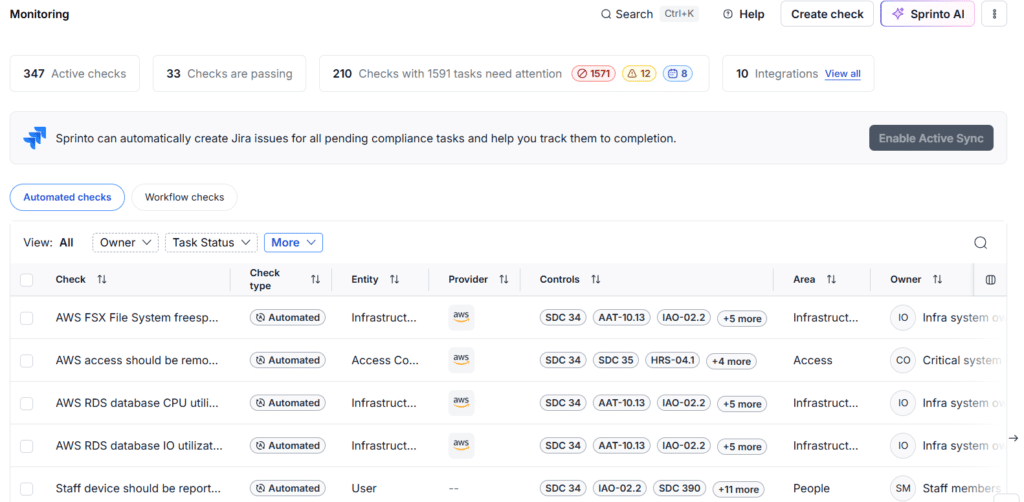
- Continuous control monitoring: Availability, access, change management, and incident-related controls are monitored continuously to surface issues that could affect operational continuity.
- Integrated risk management: Risks related to system downtime, security incidents, and operational failures are tracked centrally, scored dynamically, and linked to controls.
- Vendor continuity and risk monitoring: Sprinto continuously monitors vendor risk posture, security incidents, and due diligence status to reduce third-party continuity gaps.
- Executive dashboards and reporting: Real-time dashboards give leadership visibility into operational risk, control health, and resilience across business units.
- Workflow automation and ownership tracking: Built-in workflows assign ownership, track remediation, and ensure accountability for gaps that impact continuity.
Pros
- Scales well as audit scope, frameworks, and vendor ecosystems grow
- Eliminates the need for a separate BCM-only tool for many mid-market organizations
- Automates routine BCM tasks, such as evidence collection and follow-ups.
- Easy for non-technical teams to use, which helps department leaders participate in business impact analysis.
Cons
- Does not replace a highly prescriptive standalone BCM tool.
- Limited scenario modeling and crisis communication capabilities, as it’s a versatile GRC tool.
Pricing: The BCM module is a part of the overall product and there is no additional pricing for it. For custom Sprinto quotes, talk to an expert.
2. Fusion Risk Management
Fusion Risk Management is an enterprise-grade BCM tool and operational resilience platform designed for large organizations with complex environments.
It is best suited for organizations with dedicated BCM or operational resilience teams. These teams usually need deep modeling, scenario planning, and executive-level resilience reporting.However, the platform requires significant configuration and ongoing administration to align with internal processes.
Key Features
- Salesforce-based platform: Fusion is built on Salesforce, which supports large-scale data management, user access controls, and reporting.
- Visual dependency mapping: Shows how business processes, systems, vendors, and locations are connected, making it easier to see how disruptions spread.
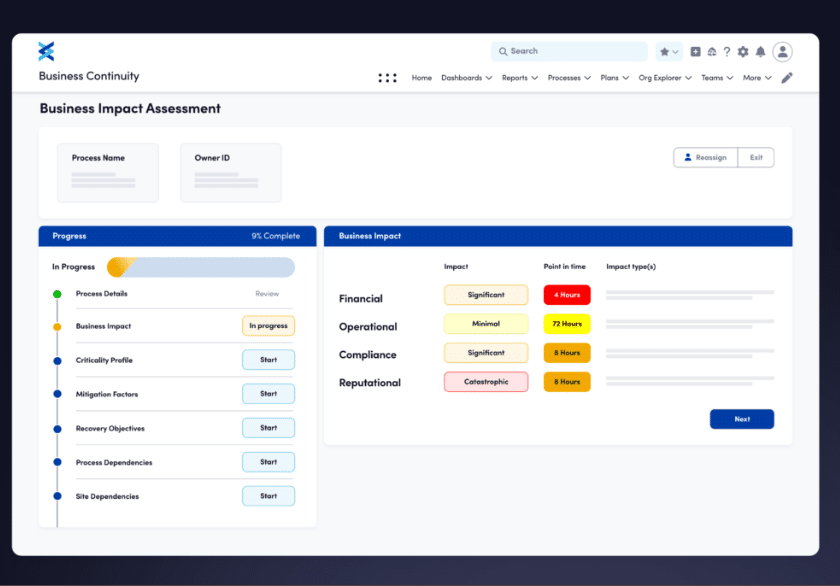
- Business impact analysis (BIA): Helps teams assess critical processes, set recovery time objectives, and identify key dependencies across the business.
- Scenario and stress testing: Allows teams to run disruption scenarios and tabletop exercises to evaluate preparedness and response plans.
- Executive resilience reporting: Provides dashboards that give leadership a clear view of resilience status, key risks, and readiness.
Pros
- Good fit for complex organizations with global supply chains.
- The platform is designed to bring IT, operations, risk, and business teams into a shared continuity view.
- Strong at showing how one disruption can affect multiple parts of the business, which supports better prioritization.
- Easy to scale without performance or access limitations.
Cons
- Implementation and configuration can be time-consuming and resource-intensive
- May feel more complex than needed for mid-market organizations or smaller BCM teams
- Ongoing administration often requires dedicated ownership or specialized expertise
Pricing: According to sites like Salesforce AppExchange, the default plan starts at $30000/year.
3. Ncontracts
Ncontracts is a risk and compliance platform used mainly by organizations in highly regulated industries like financial services and healthcare. It helps teams manage business continuity requirements, vendor risk, and compliance obligations in a structured, policy-driven way.
It works best for organizations where business continuity is closely tied to regulatory expectations and third-party oversight, but it does not cover deep, enterprise-wide resilience programs.
Key features
- Attorney-backed content and templates: Policies, business continuity plans, and assessments are developed and reviewed by legal and compliance experts to align with regulatory expectations.
- Built-in emergency notification capabilities: Supports notifying employees and stakeholders during incidents or disruptions, helping teams coordinate responses quickly.
- Vendor continuity assessments: Enables structured evaluations of third-party business continuity and operational resilience as part of vendor risk management.
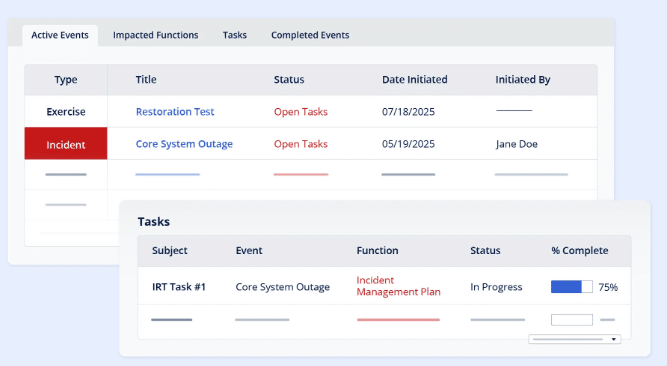
- Centralized issue and action tracking: Tracks continuity gaps, remediation tasks, and ownership to support follow-through and accountability.
- Regulatory compliance workflows: Built-in workflows support compliance with industry regulations and examiner expectations.
Pros
- Works especially well for banks, credit unions, and fintechs with strict continuity requirements.
- Connects BCM directly to Vendor Management (Nvendor) and Audit Management (Naudit)
- Built with regulator expectations in mind
- Reduces manual coordination across risk and compliance teams
Cons
- Organizations with broader or cross-industry BCM needs may find the approach limiting.
- The user interface prioritizes functionality over ease of use, which may feel less intuitive for non-compliance teams.
- Pricing can be less accessible for smaller organizations or teams with limited BCM scope.
Pricing: There is no public pricing available for the tool. You can contact the team for a custom quote.
4. ServiceNow BCM
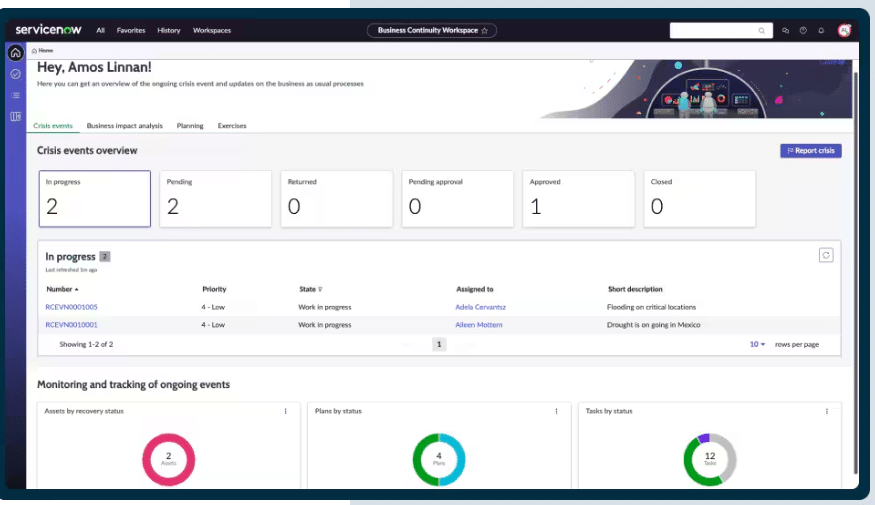
ServiceNow Business Continuity Management (BCM) is part of the ServiceNow Risk and Resilience suite. It helps organizations manage business continuity directly within the ServiceNow platform they already use for IT and operations.
ServiceNow BCM works best for large enterprises that want continuous planning tightly integrated with IT incidents and service availability.
Key Features
- IT-centric continuity planning: Business continuity plans are closely aligned with IT services, applications, and infrastructure managed within ServiceNow.
- Integrated incident and change management: Continuity workflows connect directly to incidents, outages, and change events already tracked in ServiceNow.
- Business impact analysis (BIA): Supports BIAs to identify critical services, dependencies, and recovery priorities.
- Workflow automation: Uses ServiceNow’s workflow engine to assign tasks, approvals, and remediation activities related to continuity.
- Centralized reporting and dashboards: Provides dashboards that surface continuity status, risks, and task progress across the organization.
Pros
- Ideal for teams already running IT, risk, and operations on ServiceNow.
- Reduces the need to reconcile data across multiple tools for risk, incidents, and continuity.
- Minimizes manual follow-ups by automatically assigning tasks, approvals, and escalations.
- Continuity actions and evidence are logged alongside incidents and changes, making reviews easier.
Cons
- Business continuity may feel centered around technology services rather than broader business processes.
- Setup and customization often require significant configuration and platform expertise.
- Licensing and implementation costs may be prohibitive for mid-market organizations or smaller BCM teams.
Pricing: ServiceNow uses a subscription-based model, charging based on the number of users. The range starts from $70-$200 per user per month. The implementation fee is in addition to the cost of additional services.
5. Archer Business Resilience
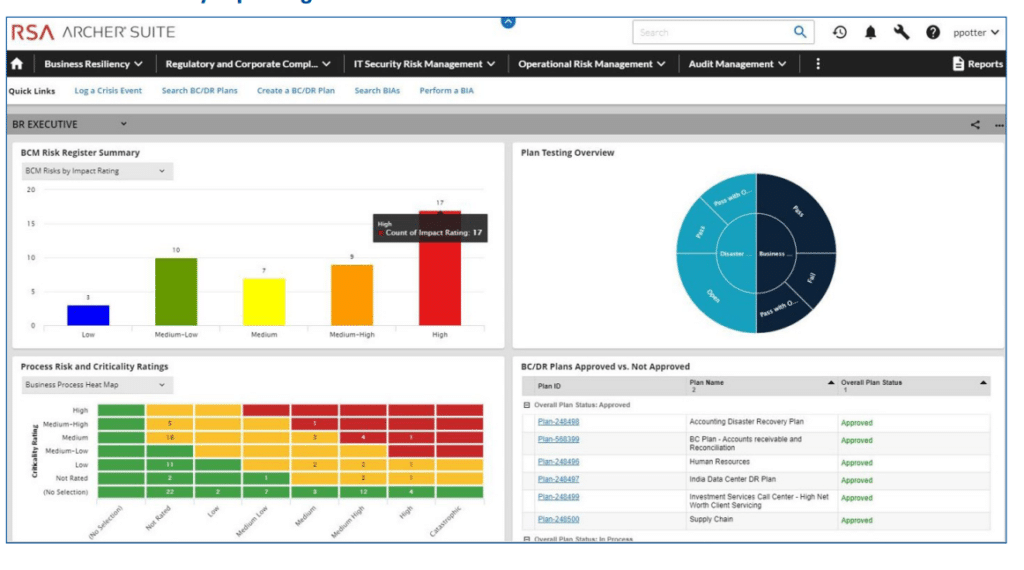
Archer Business Resilience is part of the Archer GRC platform and helps organizations manage business continuity along with enterprise risk and compliance.
It is used by large companies that want continuity planning built into their broader governance program.
This business continuity planning software works best for organizations already running Archer for risk management and looking to extend that investment into resilience.
Key Features
- Integrated resilience management: Connects business continuity, operational risk, and compliance into one program, allowing organizations to manage resilience holistically rather than in silos.
- Mobile crisis management: Enables teams to access response plans, receive notifications, and coordinate actions during incidents on mobile devices.
- Highly customizable workflows: Allows organizations to configure fields, workflows, and reporting to match internal governance and risk models.
- Centralized plan and policy management: Stores and maintains business continuity and recovery plans in a structured, auditable format.
- Issue and remediation tracking: Tracks resilience gaps, findings, and corrective actions across departments and business units.
Pros
- Commonly used in large enterprises with strict governance requirements.
- Allows organizations to configure workflows and controls to match internal governance models.
- Offers detailed, structured reports that support board reviews, regulatory exams, and internal governance meetings.
- Handles complex review and sign-off processes across departments.
Cons
- Setup and customization can require significant time and internal expertise.
- May not be as intuitive as newer continuity platforms.
- Can be overly complex and costly for mid-market organizations.
Pricing: Archer charges on the basis of use case. The implementation costs are extra. According to sites like 360 quadrants, the pricing starts from $55000 for enterprises.
6. Riskonnect
Riskonnect is a business continuity and risk management software platform designed to unify enterprise risk, crisis response, and operational resilience in one system. Rather than focusing solely on audit execution, it positions audit within a broader risk and resilience framework.
Riskonnect works best for large organizations that want business continuity planning, crisis management, and enterprise risk oversight managed alongside compliance and audit programs.
Key Features
- Integrated business continuity management: Supports continuity planning, BIAs, and recovery strategies within a unified risk platform.
- Stress testing and scenario analysis: Allows organizations to simulate disruption scenarios and assess how they impact critical processes.
- Native emergency notification: Enables real-time alerts and communication with employees and stakeholders during incidents.
- Integrated business continuity planning: Supports BIAs, recovery strategies, and continuity plan management within a unified platform.
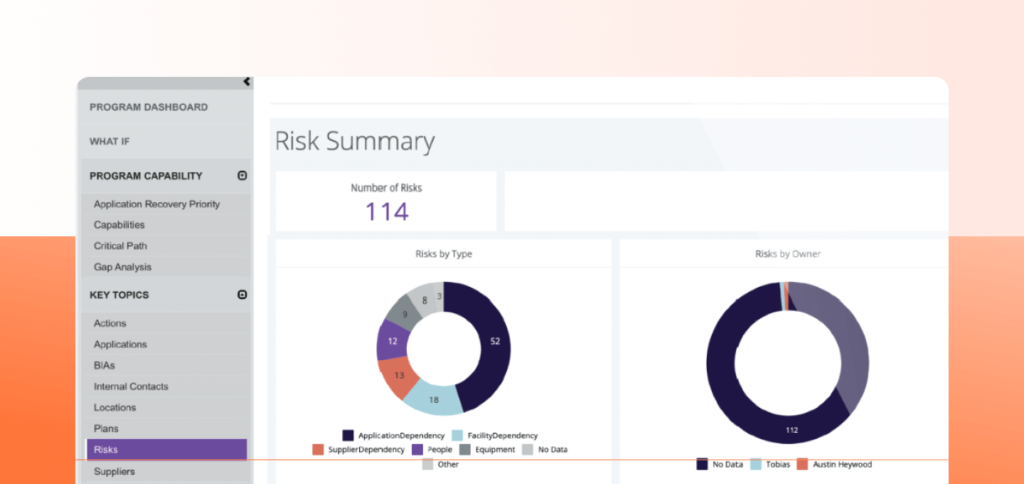
- Operational resilience dashboards: Provides leadership with visibility into risk exposure, disruptions, and response readiness.
Pros
- Offers international support and experience working with large, multinational organizations operating across regions and regulatory environments.
- Brings together crisis management and risk oversight in a way that supports cross-functional collaboration.
- Designed to support organizations with distributed teams, facilities, and operational footprints.
- Often selected by organizations looking for a long-term resilience partner rather than a lightweight continuity tool.
Cons
- The wide scope of risk modules may add complexity for teams focused mainly on BCM.
- May be overly complex for mid-market organizations or smaller continuity teams.
- Costs may rise as organizations adopt additional risk and resilience capabilities.
Pricing: One-time implementation for large businesses starts at $258,000, with additional costs based on requirements.
7. LogicManager
LogicManager approaches business continuity from a structured risk management perspective rather than as a standalone crisis tool. It is built around the idea that continuity planning should follow the same discipline as enterprise risk governance.
The tool works best for organizations that want continuity tightly embedded within formal risk oversight processes.
Key Features
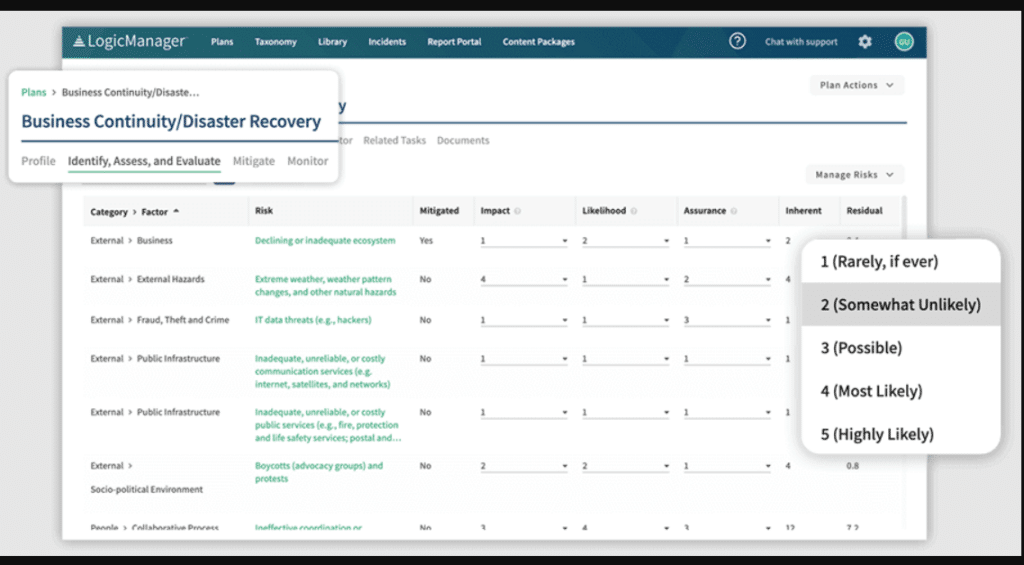
- Risk-based continuity planning methodology: Uses a structured, step-by-step framework that ties business continuity planning directly to risk identification and mitigation.
- Pre-built risk libraries and guidance: Provides curated risk and control libraries to help teams structure continuity programs without starting from scratch.
- Advisory-driven implementation model: Often supported by a guided setup to align the platform with the organization’s specific risk framework.
- Policy and documentation management: Centralizes continuity plans, policies, and supporting documentation.
- Reporting and board-level dashboards: Provides structured reports for leadership and governance oversight.
Pros
- Designed with a straightforward interface that allows teams to get started quickly without extensive training.
- Helps organizations identify continuity gaps and areas for improvement through structured risk evaluations.
- Gets appreciated for its guided implementation and ongoing advisory support, rather than a purely self-serve experience.
- Risk, compliance, audit, and continuity information are stored in a single system, reducing duplicate work.
Cons
- Certain regulated industries may require additional customization to meet specialized requirements.
- Some standard reports refresh periodically rather than providing instant, live data views.
- More affordable than some legacy GRC platforms, but still a step up from lightweight or compliance-focused automation tools.
Pricing: Pricing starts at $10,000–$30,000 per year for small and medium-sized businesses and $150,000 per year for enterprises.
8. MetricStream BCM
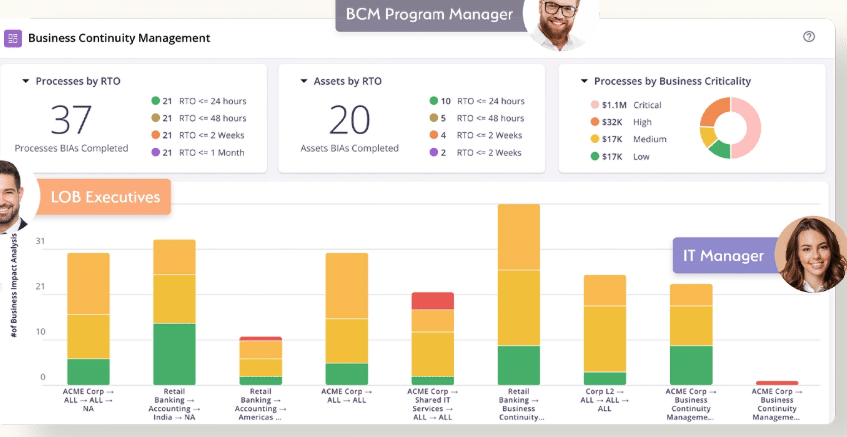
MetricStream BCM is part of the broader MetricStream GRC platform and focuses on managing business continuity within a compliance-driven framework. It is commonly used by large organizations that need continuity programs aligned closely with regulatory requirements and formal risk oversight.
MetricStream works best for organizations that treat business continuity as part of structured compliance and governance programs.
Key Features
- Framework-aligned continuity management: Supports continuity planning aligned with regulatory and industry standards.
- Shared data library: Uses one central library for risks, controls, and processes. Updates made in one area (like Audit) automatically reflect in Business Continuity plans.
- Smart issue management: Uses AI to categorize incidents and suggest next steps based on past recovery actions.
- Crisis and mass notification: Allows teams to send emergency alerts across SMS, email, and voice from within the platform.
- Audit-ready reporting: Provides documentation and reports to support internal and external audits.
Pros
- Organizations can expand into additional modules like audit, ESG, or cyber risk without changing platforms.
- Well-suited for companies operating across multiple regions with overlapping regulatory requirements.
- Known for visually polished dashboards that are suitable for board and regulatory presentations.
- Helps suggest Recovery Time Objectives through automated BIA mapping.
Cons
- Significant workflow changes may need professional services rather than simple configuration.
- Some large enterprise users report slower system response when handling high data volumes.
- More documentation-driven than crisis-execution-driven.
Pricing: According to Smartsuite, the pricing starts from $75000 to $150000 per year for small businesses and can go upto $1,000,000+ for large enterprises.
9. SAI360
SAI360 brings business continuity into a platform traditionally known for ethics, compliance, and corporate conduct management. It is often used by organizations where continuity planning is closely tied to policy governance and regulatory oversight.
SAI360 works best for companies that view resilience as part of a broader compliance and culture program.
Key Features
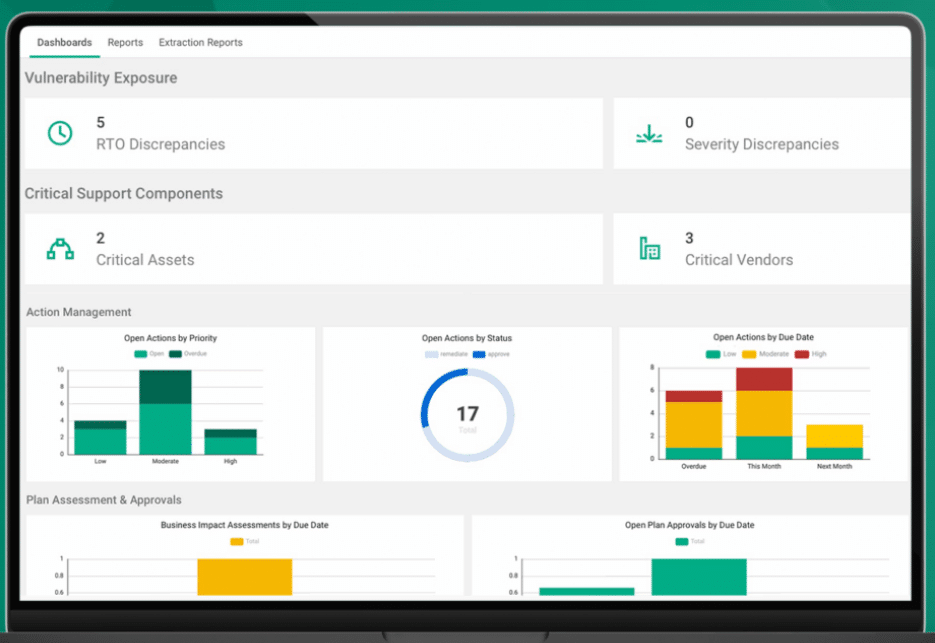
- Crisis activation: Escalate incidents, assign tasks, and track recovery timelines in real time through a mobile-friendly interface.
- Emergency notifications: Send instant alerts to teams using integrated mass notification systems.
- Global deployment support: Supports multilingual content and regional formats for international teams.
- Business impact analysis (BIA): Identifies critical processes and assesses disruption impact to guide recovery planning.
- Integrated learning and awareness: Links continuity roles to short training modules, so employees receive relevant guidance when assigned new responsibilities.
Pros
- Combines business continuity with a large compliance and risk training library, helping employees understand their roles during disruptions.
- Mobile activation and automated call trees make it easier to coordinate responses during real incidents.
- Offers implementation templates aligned with standards like ISO 22301 and FFIEC.
- Easier to manage day-to-day as compared to heavier enterprise platforms such as Archer.
Cons
- The backend configuration requires a significant time investment to master.
- Different modules can feel slightly disconnected due to the platform’s acquired components.
- Less affordable for smaller and mid-market organizations.
Pricing: According to Selecthub, the entry-level GRC modules range from $500 to $1000. The site hasn’t specified whether it’s per month or user, though.
10. Everbridge
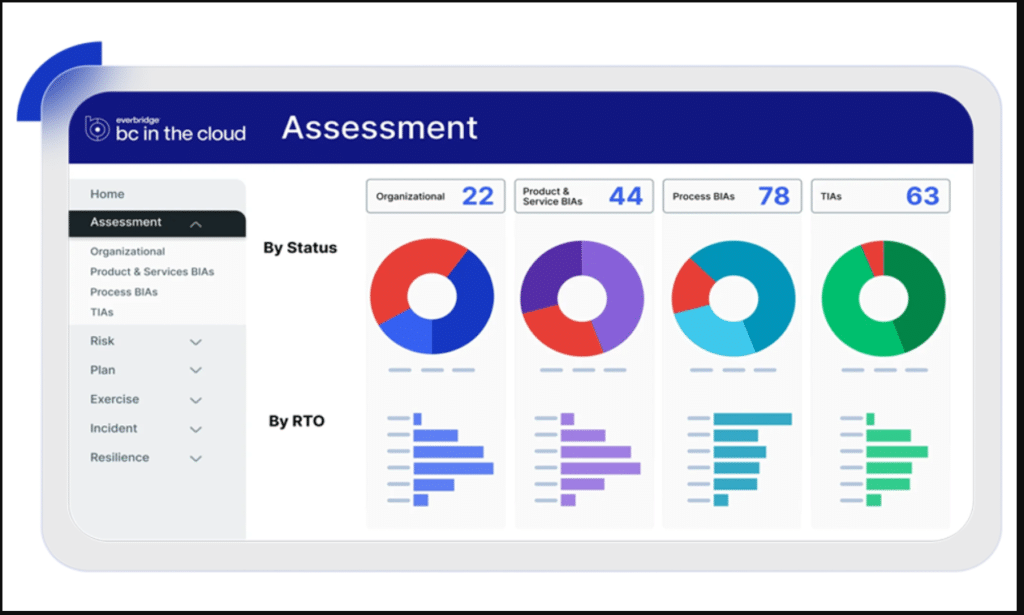
Everbridge is a critical event management platform best known for emergency communication and crisis response. With its acquisition of BC in the Cloud (BCIC), it now offers a full-lifecycle business continuity suite that connects structured planning with real-time emergency response.
Everbridge is best suited for organizations that want both formal continuity planning and large-scale crisis communication in a single platform.
Key Features
- Mass emergency notification: Sends alerts through SMS, email, voice calls, and mobile push notifications.
- Two-way communication: Tracks who received and acknowledged alerts in real time.
- Crisis management workflows: Supports structured coordination during active incidents.
- Mobile-first response tools: Enables teams to manage alerts and crisis updates from mobile devices.
- Geographic targeting: Sends location-based alerts to specific regions or facilities.
Pros
- One of the most recognized platforms for large-scale alerting and crisis response.
- Designed to support multinational organizations with distributed teams and facilities.
- Connects with HR systems, IT service platforms, security tools, and communication systems to streamline crisis coordination.
- Commonly used by enterprises, healthcare systems, universities, and government agencies.
Cons
- Focuses primarily on communication rather than comprehensive continuity planning.
- Pricing may increase based on user count and notification volume.
- Can send too many alerts, leading to alert fatigue
Pricing: Basic mass notification services start at $ 5,000 per year. According to sites like Vendr, the average contract value is $24523.
11. Parasolution
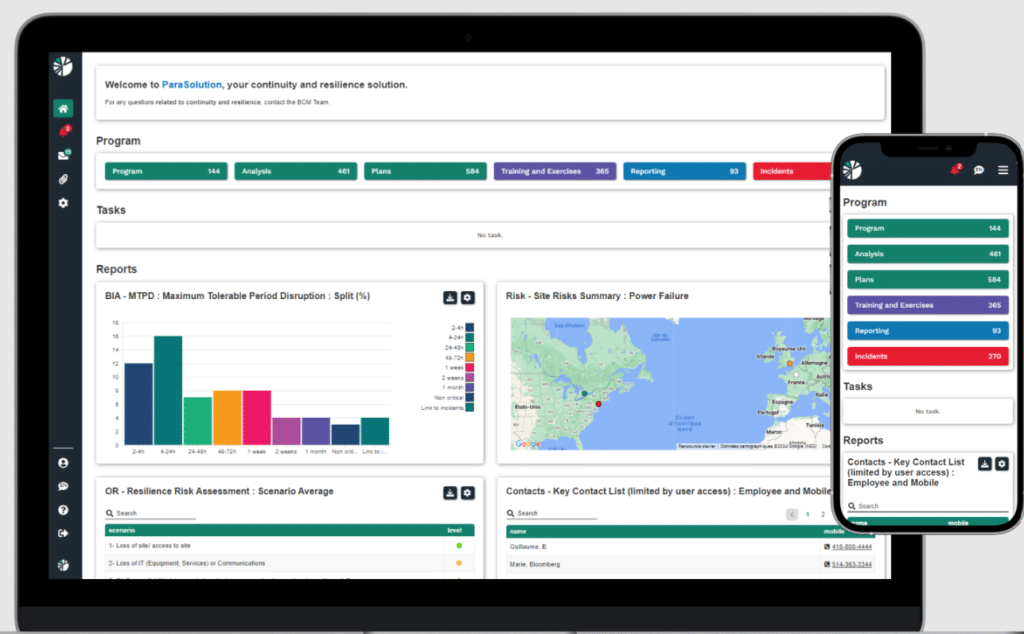
Parasolution is a business continuity and disaster recovery planning platform designed to help organizations build and maintain structured continuity programs. It focuses on plan management, documentation, and recovery coordination without the complexity of large enterprise GRC suites.
Parasolution combines its software with expert consulting and certified training support, giving organizations both the tools and guidance to develop an effective continuity program.
Key Features
- Business impact analysis (BIA): Identifies critical processes and defines recovery priorities.
- Dependency mapping: Visualizes how business processes, systems, and teams are connected to understand the impact of disruptions.
- Disaster recovery coordination: Aligns business continuity plans with IT recovery strategies.
- Multi-language support: Allows continuity plans and communications to be managed across multiple languages for global teams.
- Reporting and export tools: Generates reports for audits, internal reviews, and regulatory documentation.
Pros
- Organizations are often assigned a dedicated continuity expert during implementation, rather than relying only on standard support channels.
- Offers structured modules and templates to help organizations work toward and maintain ISO 22301 certification.
- Designed to help teams formalize and strengthen their continuity programs over time.
- Combines planning, testing, and communication features within one platform.
Cons
- The integration ecosystem is not as large as other enterprise systems
- The platform’s flexibility may require a clear internal strategy to avoid over-customization during rollout.
- Organizations needing deep alignment with audit, cyber risk, or enterprise compliance systems may require additional tools.
Pricing: According to Capterra, pricing starts at $5,000 per month.
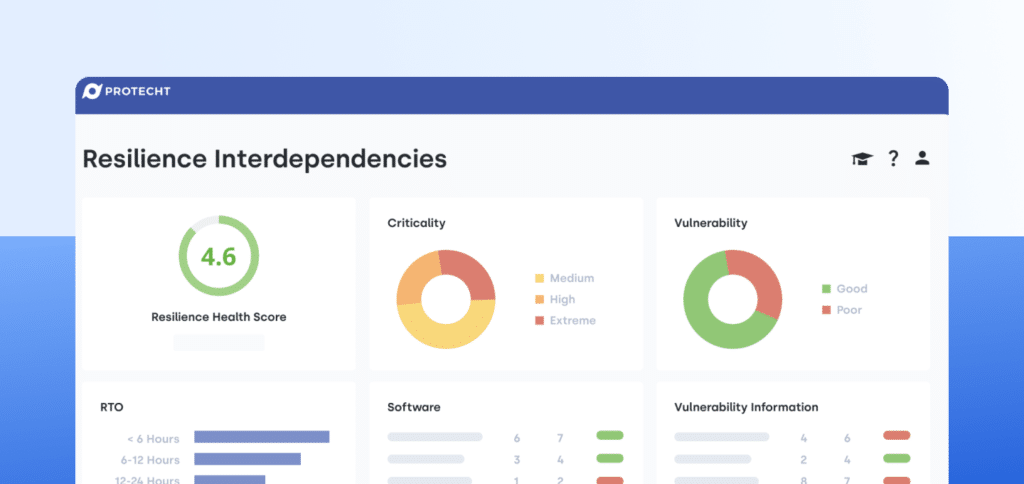
12. Protecht
Protecht is a risk and operational resilience platform that helps organizations manage business continuity within a broader risk management framework. It focuses on linking operational risk, controls, and resilience planning in one system.
Protecht works best for organizations that approach business continuity from a risk analytics and operational resilience perspective.
Key features
- Operational resilience mapping: Visually maps important business services and shows how systems, vendors, and teams support them.
- No-code registers: Uses drag-and-drop forms to build custom BIAs, incident logs, and recovery workflows without developer support.
- Integrated mass notification: Sends alerts via SMS, email, and app notifications during disruptions.
- Real-time resilience dashboard: Tracks task completion and response progress during active incidents.
- BCM marketplace templates: Offers pre-configured templates aligned with standards such as ISO 22301 and DORA to speed up implementation.
Pros
- Faster setup compared to legacy GRC tools because of no-code tools
- Clean UI that makes the platform user-friendly
- Supports unified intelligence where BCM integrates with broader enterprise risk management
- Goes beyond recovery planning to emphasize prevention and impact management.
Cons
- Organizations looking for lightweight continuity plan management may find it more detailed than necessary.
- The pricing is out of reach for smaller businesses.
- Some organizations outside the Asia-Pacific region may experience support timing differences for complex issues.
Pricing: According to Capterra, pricing starts at $45,000 per year.
How to choose the right business continuity management software
Not all BCM software is built the same. Some tools focus on crisis communication, others emphasize regulatory documentation, while some integrate continuity into broader risk and compliance programs. The right choice depends on your organization’s size, industry, and how you approach resilience.
Here are key factors to consider:
1. Start with your primary objective
Before comparing features, clarify what you’re solving for. Are you trying to strengthen crisis response, meet ISO 22301 requirements, improve vendor oversight, or reduce audit stress?
If your focus is real-time response and emergency coordination, communication capabilities will matter most. If compliance and audit readiness drive the decision, structured documentation and reporting should take priority. If you want continuity embedded into daily workflows, integration with risk and controls becomes more important.
2. Consider organizational complexity
BCM needs vary widely depending on scale.
- Large, multinational organizations often require advanced modeling, structured governance, and cross-region reporting.
- Mid-market companies may prioritize ease of deployment and lower administrative overhead.
- Smaller teams may simply need structured plan management without heavy configuration.
Think about who will own the system internally. A dedicated resilience team can handle more complexity. A lean security or operations team may need something more streamlined.
3. Integration Matters More Than You Think
Business continuity rarely operates in isolation. It connects to vendor management, risk tracking, IT service management, and HR communication systems.
Ask yourself:
- Will this platform connect to our existing tools?
- Will it reduce manual data entry?
- Can continuity data align with audit or compliance reporting?
Strong integrations reduce friction and improve data consistency over time.
4. Usability Drives Participation
A continuity program only works if business leaders participate in BIAs and testing exercises. If the system feels too technical or complicated, engagement drops.
Look for:
- Clear interfaces for non-risk professionals
- Minimal training requirements
- Logical workflows that match how departments operate
Ease of use often determines long-term success more than feature depth.
5. Evaluate Automation and Maintenance
Some BCM platforms rely heavily on manual updates and periodic reviews. Others automate reminders, reporting, and evidence tracking.
Over time, automation can significantly reduce administrative burden, especially for organizations managing multiple audits or vendor dependencies.
6. Support and Long-Term Scalability
Implementation models vary. Some vendors offer guided onboarding and ongoing advisory support. Others provide self-service tools with optional professional services.
Consider:
- What level of support will we need?
- How will pricing scale as we grow?
- Does this tool align with our long-term risk strategy?
A platform that fits today but cannot scale with your regulatory or operational complexity may create future migration challenges.
Sprinto for business continuity and operational resilience
Traditional business continuity tools focus on documentation and crisis response. Sprinto approaches continuity differently by embedding resilience directly into daily risk management, control monitoring, and audit workflows.
Sprinto works best for growing SaaS and mid-market organizations that want business continuity integrated into compliance and risk without adding another standalone BCM tool.
- Moves continuity from periodic reviews to continuous resilience through always-on monitoring and automated control validation.
- Connects risks directly to live controls, helping teams identify exposure before it becomes operational disruption.
- Strengthens third-party resilience with AI-powered vendor due diligence and continuous oversight.
- Keeps audits stress-free with automated evidence collection, validation, and reuse across frameworks.
- Prevents policy drift by mapping controls to policies and automatically detecting gaps.
- Embeds AI directly into workflows, enabling faster insights without adding complexity.
- Maintains governance safeguards with human-in-the-loop controls and accuracy checks.
- Scales without adding headcount, reducing manual coordination and administrative overhead.
Discover how Sprinto embeds business continuity into risk, compliance, and vendor oversight, all in one platform.
FAQs
Business continuity management (BCM) software helps organizations prepare for, respond to, and recover from disruptions such as system outages, cyber incidents, vendor failures, or natural disasters. It centralizes continuity planning, business impact analysis (BIA), task tracking, and reporting so teams know what to do when disruptions happen and can resume critical operations faster.
BCM software focuses on keeping the business running, while disaster recovery (DR) tools focus on restoring IT systems.
BCM software covers people, processes, vendors, and decision-making during disruptions. Disaster recovery tools are typically technical solutions used by IT teams to back up and restore infrastructure and data. Many organizations use both, but they serve different purposes.
For SaaS companies, the best BCM software is one that integrates with risk management, compliance, and vendor oversight, rather than operating as a standalone planning tool. SaaS businesses often need to prove continuity during audits and customer due diligence, so platforms that tie continuity to controls, monitoring, and evidence collection tend to work best. Sprinto is a great choice here.
Yes, most growing small businesses do. As companies add customers, handle sensitive data, or depend on third-party vendors, even short disruptions can cause outsized impact. Small businesses running audits, selling to enterprise customers, or operating in regulated industries benefit from BCM software to reduce downtime, meet compliance expectations, and respond more effectively when incidents occur.How does BCM software support compliance and audits?
BCM software helps organizations document continuity plans, track ownership, and maintain evidence required for standards like SOC 2 and ISO 27001. It creates an audit trail showing that continuity risks are identified, reviewed, and managed, which reduces last-minute audit preparation and improves defensibility during audits and customer reviews.
Key features to look for include:
– Business impact analysis (BIA) tools
– Clear ownership and task tracking
– Integration with risk, vendor, or IT systems
– Automation for reminders and follow-ups
– Reporting and audit-ready documentation
The right mix depends on your size, industry, and whether continuity is driven by compliance, operations, or regulatory needs.

Payal Wadhwa
Payal is your friendly neighborhood compliance whiz who is also ISC2 certified! She turns perplexing compliance lingo into actionable advice about keeping your digital business safe and savvy. When she isn’t saving virtual worlds, she’s penning down poetic musings or lighting up local open mics. Cyber savvy by day, poet by night!
Go beyond the surface and uncover the governance, risk, and compliance insights that actually matter.


Win digital goodies for boardroom success


Explore more



research & insights curated to help you earn a seat at the table.