Shadow AI vs Shadow IT: What’s the Difference and Why It Matters for Security and Compliance


TL;DR
| Shadow IT is the unauthorized use of apps, devices, services, or infrastructure without IT approval. Think personal Dropbox for work files or an unsanctioned Slack workspace. |
| Shadow AI is a subset of Shadow IT involving AI tools, models, and AI features embedded in approved software. Examples: pasting source code into public ChatGPT, or AI note-takers joining customer calls without review. |
| The former is an asset management problem. The latter is more of a governance problem, and your existing Shadow IT playbook won’t fully cover it. |
In April 2026, an engineer at Vercel, the cloud infrastructure company, connected a personal AI assistant called Context.ai to their Google Workspace account. The agent needed permission to write emails and create documents on their behalf, a routine ask for productivity tools. What nobody knew at the time: Context.ai itself had been compromised two months earlier. A single OAuth token from that integration was enough for an attacker to penetrate Vercel’s Google Workspace, and from there, internal infrastructure and a subset of customer environment variables.
That’s the direction Shadow AI is heading: past the intern pasting a confidential doc into ChatGPT, into agents with credentialed access to production systems, doing exactly what they were built to do in ways nobody anticipated. IBM’s 2025 Cost of a Data Breach Report found that 1 in 5 organizations experienced a breach linked to Shadow AI last year. Those breaches cost $670,000 more than the average. And in 97% of cases, proper AI access controls were absent.
Over 30% of organizations report experiencing a major AI-related security incident in the past 12 months. [From Sprinto’s AI Risk Report 2026]
Employees reaching for tools their IT teams haven’t approved has been happening since the 1980s. Shadow AI is just the latest variation, and the old playbook won’t fully cover it. This guide walks you through where Shadow AI and Shadow IT overlap, where they diverge, and what to put in place before your next audit tests it.
What is Shadow AI?
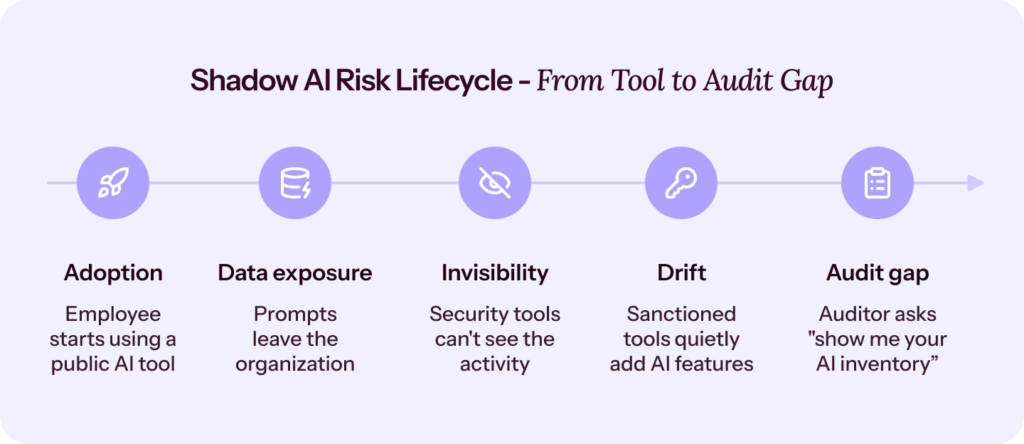
Shadow AI is the use of AI tools and systems by employees without IT or security approval, monitoring, or oversight. It could be as simple as an intern pasting a customer contract into ChatGPT to get a summary, or as ambitious as a developer building a new LLM integration over the weekend, or hooking up an internal AI agent to sensitive systems without waiting for approvals.
MIT Project NANDA’s State of AI in Business 2025 study found that workers at more than 90% of companies use personal AI tools for daily work, while only 40% of those companies have an official LLM subscription. The researchers call it the Shadow AI economy.
Common examples of Shadow AI
The security and compliance risks from Shadow AI are real. But they’re the result of a more fundamental problem: you can’t govern what you can’t see. So what does Shadow AI actually look like in practice?
Here are the patterns you’re most likely to find:
- Public generative AI: Your employees logging into ChatGPT, Claude, Gemini, or Perplexity through personal accounts to draft emails, debug code, or summarize documents. Data submitted through a personal account is governed by the vendor’s consumer terms, not your organization’s enterprise agreement.
- AI coding assistants: Developers using GitHub Copilot, Cursor, or Claude Code to autocomplete, debug, or generate code without security review of what’s being sent to the underlying model. Stack Overflow’s research found that 45% of developers admit to using unsanctioned code assistants.
- AI meeting note-takers: Tools like Otter and Fireflies join calls, transcribe conversations, and store recordings in accounts your organization has no legal relationship with. Once the transcript exists, it sits outside your retention policies, your DLP, and your audit scope.
- AI features embedded in sanctioned SaaS: Tools in your vendor ecosystem you already approved that quietly add AI capabilities like summarization, autocomplete, or data analysis. The disclosure is often buried in a release note, which means a new model is now processing your data, and nobody on the security team noticed.
- Privately hosted models: Models pulled from Hugging Face or GitHub and run on unsanctioned local infrastructure with no visibility into what data they process or who can access them. Malware Patrol researchers documented over 14,000 Ollama servers publicly accessible on the internet, many of which lacked authentication.
- AI agents with no guardrails: Agents connected to your HR, finance, or customer data systems that can query, summarize, and act across those systems in response to a single prompt. The risk isn’t malfunctioning. It’s that the agent does exactly what it’s built to do, in ways nobody anticipated.
Why employees reach for unsanctioned AI
Shadow AI is rarely malicious. Three dynamics drive most of it:
- Friction with approved tools: If your sanctioned tools are slow, clunky, hard to access, or unavailable, your employees will find workarounds.
- Deadline pressure: BlackFog’s January 2026 survey found that 60% of employees said using unsanctioned AI is worth the security risk if it helps them meet a deadline. 21% believe their employer will turn a blind eye as long as the work gets done.
- Leadership sets the tone: The same BlackFog survey found that 69% of C-suite executives believe speed trumps privacy or security. Only 37% of administrative staff agree.
If your Shadow AI program is built solely around employee training, you may be addressing the wrong audience.
How Shadow AI affects security, compliance, and visibility
The risks from Shadow AI are multifaceted. Your data ends up in environments you can’t audit. Your compliance posture develops gaps you can’t see. And your detection tools weren’t built to catch either one.
Nearly 39% of organizations have an AI usage policy, but it is not consistently enforced. [From Sprinto’s AI Risk Report 2026]
Here’s what that blind spot costs you across three dimensions:
- Security: Data entered into a third-party model ends up in an environment you can’t audit, inspect, or delete. Prompts themselves reveal intent. An employee asking an LLM to identify unfavorable terms in a contract gives the model both the document and your negotiating position.
- Compliance: IBM’s 2025 breach research found that 63% of breached organizations had no AI governance policy or were still developing one. Only 34% of those who do have a policy have had it audited. A policy that isn’t enforced tells the auditor you’ve thought about the problem, and the breach investigator you didn’t act on it.
- Visibility: Shadow AI moves through prompts typed into a browser tab, leaving almost nothing for traditional DLP or CASB tools to inspect. AI-related incidents take 26% longer to identify than traditional ones, not because the signals aren’t there, but because the tools aren’t looking in the right place.
Sprinto continuously discovers AI tools and SaaS in use across your stack, sanctioned and otherwise, and maps each one to the controls that apply. Schedule a demo →
What is Shadow IT?
Shadow IT is the older, broader problem. Gartner defines it as IT devices, software, and services outside the ownership or control of IT organizations. The term emerged with personal computing in the 1980s, expanded dramatically with SaaS and cloud, and now extends to cover AI.
Each wave made it easier for employees to adopt technology without telling anyone. Each wave needed a new governance response. Shadow AI is just the third major iteration of a pattern IT has been trying to manage for decades.
Common examples of Shadow IT
The challenge with Shadow IT is that different employees often solve problems in different ways. A developer spins up a personal AWS account. A marketing team buys a tool on a credit card. A support rep uses a personal VPN.
Here are the patterns you’re most likely to find:
- Unsanctioned cloud storage: Employees move work files into personal Dropbox, OneDrive, Google Drive, or WeTransfer accounts to share with clients, work from home, or work around corporate file-size limits. Once the data lands there, it sits outside your DLP, your access controls, and your audit scope.
- Unauthorized collaboration tools: Individual teams create ad hoc Slack workspaces, Notion accounts, and Trello boards to coordinate projects faster than the sanctioned tools allow. Each one becomes a separate data store, often with no admin visibility and no offboarding process when employees leave.
- Rogue SaaS subscriptions: Tools get charged to a corporate card or expensed after the fact, often tied to personal email addresses. Microsoft has found that 80% of employees use non-sanctioned apps without going through review.
- Personal VPNs: Your employees install VPNs on work devices to bypass corporate filtering, geo-restrictions, or monitoring. The traffic that matters most to your security team becomes invisible to it.
- Unmanaged personal devices: Phones, tablets, and laptops connect to corporate Wi-Fi or access work email without enrollment in mobile device management.
How Shadow IT affects security, compliance, and visibility
Shadow IT creates an expanded attack surface of unpatched software, credential sprawl across SaaS apps, and data scattered across unmanaged locations. On compliance, it exposes your organization to GDPR, HIPAA, PCI-DSS, SOX, and ISO 27001 requirements you can’t demonstrate you meet. LastPass research found that 76% of SMBs struggle to detect Shadow IT at all.
The visibility problem is structural. Most inventory tools find installed software by scanning the registry or filesystem. They can’t catch portable executables or web-based tools. And this structural blind spot is now compounded by AI tools, which often require no installation at all.
“Manual compliance traps teams in the compliance checkbox. When the work is spreadsheets, screenshots, and sign-offs, you lose time for the governance and risk work that actually makes systems safer.” ~ Ricky Waldron, CISSP
How Shadow AI differs from Shadow IT
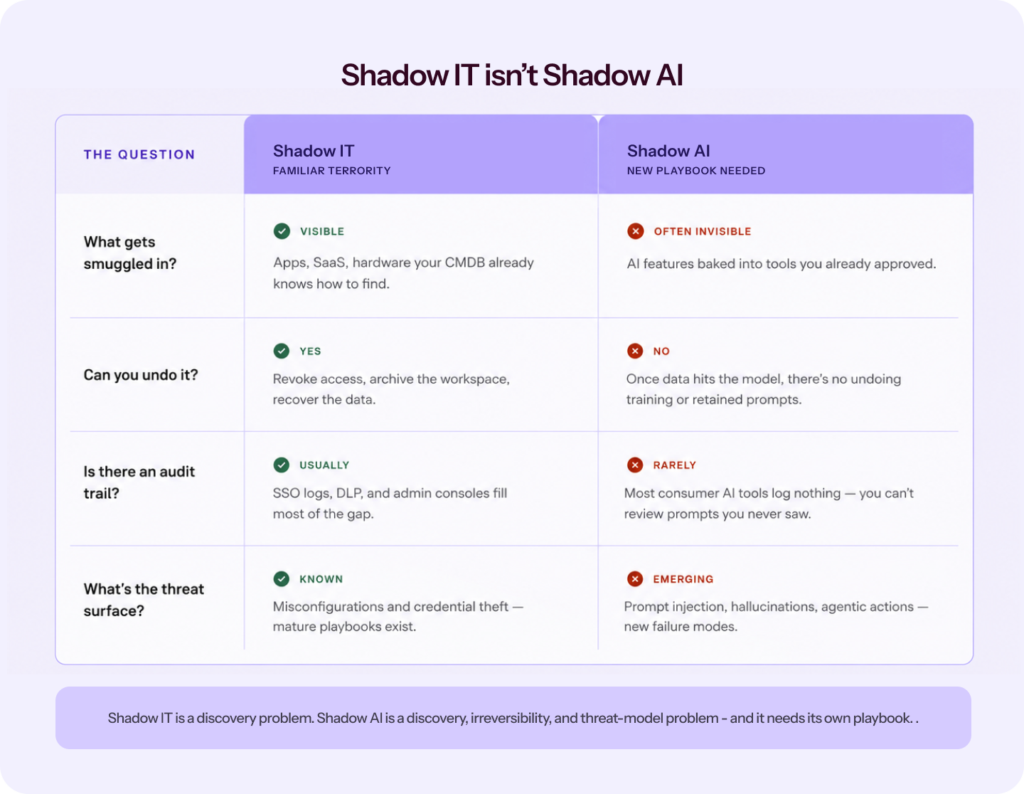
Shadow AI is a subset of Shadow IT. But you can’t treat the two as the same and apply the same controls, frameworks, or governance posture. You’d be underestimating the consequences of the Shadow AI problem.
Here’s how they diverge along the dimensions that matter for your security and compliance teams:
| Dimension | Shadow IT | Shadow AI |
| What’s unsanctioned | Apps, SaaS, hardware, infrastructure | AI tools, models, APIs, embedded AI features |
| Behavior | Deterministic; same input, same output | Non-deterministic; outputs vary and can be fabricated |
| Data fate | Data stored in unapproved systems, usually retrievable | Prompt data may become training data and be irrecoverable |
| Blast radius | Contained to the team using the tool | Spans the organization through outputs, decisions, and content |
| Audit trail | Typically exists; logs, usage records, admin visibility | Most consumer AI tools keep no logs of prompts or outputs |
| Threat surface | Misconfiguration, credential theft, unpatched software | Adds prompt injection, model manipulation, hallucinations, agentic actions |
| Reversibility | Revoke access, delete account, recover data | Once data enters the model, it’s gone |
| Governance maturity | ~15 years of tooling and playbooks | Emerging;NIST AI RMF andISO 42001 still being adopted |
| Regulation | GDPR, HIPAA, SOC 2, ISO 27001 | All of the above + EU AI Act, ISO 42001, NIST AI RMF |
“We wouldn’t have been able to scale the way we have if we were still on spreadsheets. Right from when we onboard someone new, Sprinto continuously tracks compliance and alerts key tasks to complete, so everyone has a security-first mindset and there’s a clear structure in place.” ~ Deepak Singla, Founder and CEO, Fini AI
Three structural differences between Shadow AI and Shadow IT that matter
If you ask me, these three differences matter more than the rest: Shadow AI shapes decisions (not just stores data), the data it touches can’t usually be retrieved, and agentic AI turns a passive leak into an active actor within your systems.
Here’s how each of these Shadow AI differences breaks a control that your Shadow IT playbook had solved:
1. AI influences decisions. Shadow IT just stores data.
A personal Dropbox is a bad place for customer data, but it doesn’t tell anyone what to do. An unsanctioned AI tool does. When your employees rely on AI outputs to draft customer communications, summarize contracts, interpret financial data, or screen resumes, the tool isn’t just holding information; it’s actively shaping your employees’ work. It’s shaping decisions.
The Butler Snow case is a clear illustration. In 2025, a partner at the 400-attorney US law firm used ChatGPT to generate case citations for two court motions and filed them without verifying the output. Five citations were fabricated. The judge disqualified three attorneys, writing: “If existing AI sanctions were deterring misuse, we wouldn’t be here.”
But the firm itself wasn’t sanctioned, because Butler Snow had pre-existing AI policies and responded robustly after the incident. The governance layer protected the firm even when an individual lawyer violated it. That’s the insurance value of documented, enforced AI governance.
2. Data leaves permanently
Shadow IT usually moves data sideways. Shadow AI can move it out entirely. Information submitted to a public AI tool may be retained, reviewed, or used to improve the underlying model. On free-tier consumer services, opt-out is usually off by default. Even after opting out, providers typically retain some logs for safety and abuse review.
Samsung’s engineers found this out the hard way in March 2023. Three separate employees pasted sensitive company data, including source code, test code, and internal meeting transcripts, into ChatGPT. Samsung’s internal warning afterward acknowledged that the data was “impossible to retrieve” because it had now been moved to OpenAI’s servers. There’s no USB drive to subpoena.
3. Agentic AI turns Shadow AI from a passive leak into an active risk
The next evolution of Shadow AI is agentic. AI systems that don’t just answer questions, but take actions. Gartner projects that by 2030, more than 40% of enterprises will experience security or compliance incidents tied to unauthorized Shadow AI, with most of that shift toward agentic use.
Any agent with access to private data, the ability to communicate externally, and exposure to untrusted content is a data exfiltration risk waiting to happen. The common approach to constraining agents today is to put instructions in the system prompt, often in ALL CAPS, and hope the agent follows them. It often doesn’t. The non-determinism that makes LLMs useful is the same non-determinism that makes them ignore guardrails when context shifts.
The mental model has to shift from limiting what an agent can access to limiting what it can decide to do. IBM’s 2025 report puts the practical implication in plain terms: “Treat AI agents and humans equally from a data governance perspective.” When that’s missing, the failure mode is visible. In early 2026, researchers at Wiz found a misconfigured database in Moltbook, a vibe-coded AI social network. It exposed 1.5 million API authentication tokens and 35,000 email addresses. The same pattern is now emerging inside enterprises.
So which is more dangerous: Shadow IT or Shadow AI?
Neither can wait. Shadow IT carries the larger ongoing attack surface; Shadow AI carries the larger per-incident risk.
Shadow IT still accounts for 30–40% of enterprise technology spending, and a large share of breaches still trace back to unvetted systems. Shadow AI is narrower in scope, but the stakes per incident are higher. IBM’s 2025 report found that Shadow AI breaches cost an average of $670,000 more than standard breaches. The difference shows up in what gets exposed: customer PII was compromised in 65% of Shadow AI breaches versus 53% globally. Intellectual property, less often exposed overall, carried the highest cost per record at $178 when it was compromised in a Shadow AI breach.
The honest answer matters less than what you do about it. If you’re building a Shadow AI program, don’t start with policy. Start with visibility and technical controls. A well-written, but unenforced, acceptable use policy is worse than no policy at all, because everyone thinks the problem is solved when it isn’t.
“AI adoption is moving faster than oversight. Shadow IT was about unapproved tools; Shadow AI is unapproved intelligence acting on your data. Governance cannot rely on episodic reviews when systems change by the day.” ~ Raghuveer Kancherla, Co-Founder, Sprinto
Where audits typically flag gaps
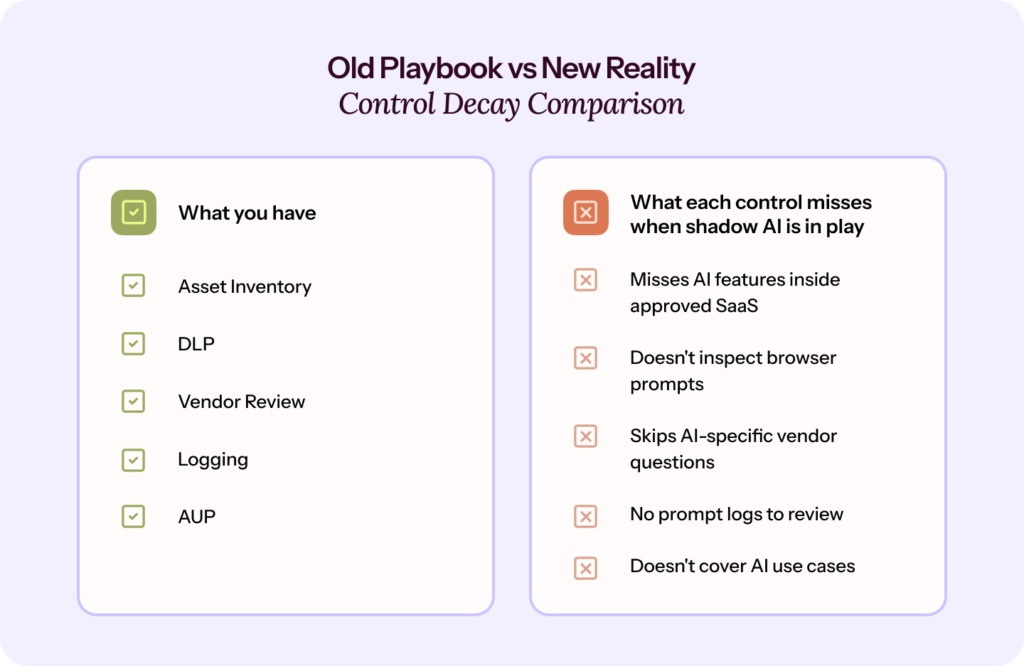
Shadow AI doesn’t need to be named in a framework to create failures against it. Your existing controls already cover the underlying obligations; AI just adds a surface where those controls break down.
| Control area | Shadow IT risk | Shadow AI addition | Framework touchpoints |
| Asset inventory | Unapproved SaaS and devices missing from inventory | AI tools and embedded AI features missing from inventory | SOC 2 CC6.1, ISO 27001 A.5.9, EU AI Act Art. 12 |
| Acceptable use policy (AUP) | No AUP or outdated AUP | AUP doesn’t address AI-specific use cases | SOC 2 CC1.4 / CC5.3, ISO 27001 A.5.10 |
| Access governance | Excess privilege, no least-privilege enforcement | Sanctioned AI inherits over-broad user permissions | SOC 2 CC6.1 / CC6.3, ISO 27001 A.5.15 |
| Vendor risk | Vendors onboarded without security review | Vendors not assessed for AI-specific risks | SOC 2 CC9.2, ISO 27001 A.5.19–A.5.22 |
| Data classification | Sensitive data in unsanctioned systems | Sensitive data in prompts, model logs, training sets | SOC 2 CC6.1, GDPR Art. 32, HIPAA 164.312 |
| Monitoring and logging | Incomplete logging across systems | No logging of AI prompts, outputs, or tool usage | SOC 2 CC7.2, ISO 27001 A.8.15 |
| Governance function | No security governance body | No AI governance body or policy | NIST AI RMF GOVERN, ISO 42001 Clauses 5–6 |
Vendor risk adds a new dimension for AI
Shadow AI is, among other things, an uncontrolled expansion of your third-party footprint. Every new AI tool is a new vendor, often one that has never been through your due diligence process. And these vendors process your prompts, customer data, source code, call transcripts, employee records, or regulated information, often under terms your security team never reviewed.
A starter list of AI-specific questions worth adding to your existing vendor questionnaires:
- What data from our organization is used to train, fine-tune, or improve your AI models, and what’s the opt-out mechanism?
- How do you prevent and detect adversarial attacks, prompt injection, and data poisoning?
- What’s your incident response plan for a security event involving your AI technology, and how will we be notified?
- Do you have an AI governance framework in place, and can you provide documentation?
- What liability and indemnification terms apply in the event of damages caused by your AI?
- What certifications do you hold relevant to AI security (SOC 2, ISO 42001, NIST AI RMF alignment)?
Shadow AI vs Shadow IT in regulated industries
Regulated industries are now being audited for AI governance. Most organizations in healthcare, finance, and legal services don’t yet have answers to the questions regulators are asking, because those questions are newer than the frameworks they’ve been working under.
1. Healthcare and HIPAA
Public AI tools like ChatGPT, Claude, and Gemini are almost certainly not covered entities under HIPAA. The HIPAA Security Rule applies to healthcare providers, exchanges, and their business associates, not to AI vendors. This creates a dangerous voluntary-compliance trap. OpenAI describes some of its healthcare partnerships as “configured to support HIPAA.” It doesn’t claim HIPAA compliance. The legal obligation flows back to you, the healthcare organization using the tool.
Each HIPAA infraction carries up to a $1 million fine. Aggregated PHI adds another layer. Even de-identified health data can sometimes be re-identified when combined with other data. Without explainability into how the AI processed the data, demonstrating compliance becomes nearly impossible.
2. Finance and regulated services
Major banks moved early, restricting ChatGPT for staff use in 2023.
Financial services organizations face a specific compliance gap that most haven’t fully internalized: most US state privacy laws include carve-outs for GLBA and FCRA-covered institutions. AI laws generally don’t include equivalent carve-outs.
Financial institutions that relied on sectoral laws to insulate them from state-by-state variation will need a direct AI regulation strategy. SR 11-7, the Federal Reserve’s guidance on model risk management, applies to AI models. And Shadow AI, by definition, operates outside any model risk management process.
3. Legal and professional services
Client confidentiality, attorney-client privilege, and bar ethics rules all apply the moment AI enters the picture. The American Bar Association issued Formal Opinion 512 in July 2024 on the use of generative AI, and multiple state bars have followed suit.
Privileged communications pasted into a consumer chatbot create genuine questions about whether privilege has been waived. Questions that haven’t been fully tested in court. For law firms and professional services, a Shadow AI policy is effectively table stakes now.
Why businesses struggle to detect Shadow AI and Shadow IT
Detection is hard because Shadow AI doesn’t behave like the threats your tooling was built for. The deeper issue is that most organizations carry years of strategic debt in the exact areas they need for governance to work. Four reinforcing failures show up most often:
- Fragmented visibility: Security, IT, data governance, and procurement still run as separate functions with separate tooling. When a marketing team buys an AI copywriting tool on a corporate card, your security team often finds out months later, if at all.
- Strategic debt: Strategic debt is what you owe when you wait too long to build something, like data governance, identity governance, or data classification, because it felt too expensive at the time. Most organizations carry years of strategic debt in exactly the areas they now need for AI governance. You can’t implement AI governance well if you don’t know what data you have, who has access to it, and which vendors are touching it.
- The browser is the least-instrumented control plane: Most modern Shadow AI happens there. Security tools built for an era when the action was in email, on endpoints, or in network traffic struggle to monitor the prompts typed into a browser tab.
- The policy-enforcement gap: Your employees often believe their employer will turn a blind eye even when a policy exists. The reason it happens is simpler than it looks: nobody wants to slow down. Leadership wants AI productivity gains now, employees want to ship work now, and enforcement creates friction that everyone treats as optional.
Security awareness training is a weaker lever than it appears to be here. You can’t treat cybersecurity like a behavioral problem when it’s a technical one. For Shadow AI, this reframes the question entirely. It isn’t about getting your employees to stop using ChatGPT. It’s about why your sanctioned tools aren’t good enough that they’d stop using them.
Two views worth taking seriously: Should you block public AI, or sanction alternatives fast?
Both positions have real logic behind them. Which one fits your organization depends on regulatory exposure, workforce sophistication, and how much productivity loss you can absorb while you catch up.
- The block-first view: If you operate in banking, defense, healthcare, or any environment where a single data leak can cause irreparable exposure, blocking public AI is a reasonable first step. The argument isn’t that blocking works forever. It’s that containing the risk while you build the governance function is a better bet than hoping employees will make good choices on their own.
- The sanction-first view: Blocking doesn’t actually work. Employees who lose access to their work machine use personal devices, mobile hotspots, or paste data into personal email and work from home. You’ve reduced your visibility without reducing the underlying behavior. The durable answer is to quickly roll out sanctioned alternatives, so employees have a better option than the unapproved tools they’d otherwise reach for.
- The middle ground most mature programs land on: Block the highest-risk categories of public AI immediately. Anything involving regulated data, client work, or confidential information. Sanction fast alternatives for the other 80% of use cases. Pair both with training and a fast-lane approval process for new tools your employees want to add. Accept that “done” is not a state AI governance ever reaches.
The risk of picking the wrong side is real. Block too hard, and you create the Shadow AI problem you were trying to prevent. Enable too fast, and you sanction tools before you’ve built the governance to oversee them. Treat it as a sequencing question: what should you contain right now, what can be enabled in the coming months, and what needs to be governed in the next year?
How to prevent Shadow AI and Shadow IT
Every credible analysis of Shadow AI converges on the same conclusion: banning AI drives it underground. Employees don’t stop using it; they just stop telling you. BlackFog found that 63% believe using unvetted AI is perfectly acceptable.
The alternative is governance with enablement. Sanction the tools your people need, set clear rules, deploy technical controls, and audit the outcome.
1. Write an AI-specific acceptable use policy
Only 15% of organizations have AI-specific policies, which makes this an easy early win. Extend your existing AUP rather than writing a new one. AUPs are already required under SOC 2 and most major frameworks.
Make rules workflow-specific, not abstract. “Don’t upload CRM exports to GenAI tools” beats “use AI responsibly” every time. Your policy should cover data classification (what can and can’t be entered into AI), the approved tools list, the exception process, escalation paths, and consequences for violation.
Recognize that policy alone isn’t governance. A well-written policy with no technical controls is often worse than no policy with technical controls on one sanctioned provider.
2. Build a sanctioned AI catalog
Sanctioned alternatives displace Shadow AI in a way that blocking never does. Enterprise versions of the AI tools your employees already want to use offer data protections that consumer versions don’t. Data isn’t used for training, audit logs exist, and admin controls are available.
A practical catalog includes ChatGPT Enterprise, Claude for Enterprise, Copilot for Microsoft 365, Gemini Enterprise, Amazon Q, and, for organizations with the engineering capacity, a private internal model. Microsoft 365 Copilot has achieved ISO/IEC 42001 certification, and Colorado’s AI Act provides safe harbor for ISO 42001-compliant organizations under certain provisions. ISO 42001 is expected to be recognized as a harmonized standard under the EU AI Act.
For organizations that want a non-certifiable starting point, the NIST AI RMF is widely adopted in the US.
3. Train employees, with realistic expectations
Training is a component, not the whole solution. Make it continuous rather than annual, role-specific rather than one-size-fits-all, and tied to observed behavior rather than abstract rules. Executive training matters disproportionately. If 69% of C-suite executives believe speed trumps security, awareness training for administrative staff is addressing the wrong audience.
But don’t expect training to solve everything. The hard reality is that no amount of training compensates for bad systems. If your sanctioned AI tool is slower and worse than free ChatGPT, training won’t close that gap. If your approval process takes three months, training won’t stop your engineers from working around it.
4. Extend identity and vendor controls to AI
Treat AI agents as identities. They should authenticate, receive explicit authorization, operate under least privilege, and never hold long-lived credentials. Orphaned agents with access to production systems are exactly the kind of time bomb your compliance program is supposed to prevent.
Extend your vendor review to AI-specific concerns: ISO 42001 certification status, data residency commitments, training data opt-outs, and published model or system cards. Periodic re-review of sanctioned SaaS apps is essential because approved tools are rolling out AI features without clear change logs, and what you approved six months ago may now process prompts in ways the original review never contemplated.
5. Monitor SaaS, browser, and AI usage continuously
Layered monitoring is the only approach that works:
- Network and DNS filtering to identify traffic to known consumer AI services
- SaaS discovery platforms that specifically detect AI apps in use
- Browser DLP that inspects and redacts prompts before submission
- Email and endpoint DLP for cases where AI tools integrate with local files
- Prompt monitoring for sanctioned AI tools, paired with a defined response framework
Having a response framework is just as critical as having monitoring in place. Monitoring without consequences is ineffective. If you invest in a monitoring framework, you also need a plan for how to act on what you discover.
How Sprinto helps you control Shadow AI and Shadow IT
Sprinto is an autonomous trust platform built to track who owns each AI system in use (sanctioned or not), what data flows through it, whether the vendor has been reviewed, which controls apply, and how you can prove it all when an auditor or customer asks.
For Shadow AI and Shadow IT specifically, that translates into:
- Live AI registry: The platform detects and inventories Shadow AI, assesses data sensitivity and operational impact, and aligns AI systems with emerging standards like ISO 42001, NIST AI RMF, and the EU AI Act.
- Vendor risk workflows with AI-specific due diligence: With Sprinto, AI vendors are reviewed the same way your other vendors are, with security questionnaires, data-handling terms, and certifications. The only difference is that AI-specific questions are added in.
- Framework mapping across AI and traditional controls: Sprinto maps AI controls to the frameworks you already comply with: SOC 2, ISO 27001, HIPAA, GDPR, and ISO 42001. You will be able to clearly understand where they overlap and where the same evidence is carried across audits, and where they don’t. The gap will be identified early enough to assign an owner.
- Continuous SaaS and AI tool discovery: Sprinto detects new SaaS and AI tools as they appear across your environment and maps each to the controls that apply, so nothing slips into use without a review trail.
- Policy templates and AI acceptable use attestation: Sprinto includes ready-to-use AUP templates and employee attestation workflows. Continuous evidence collection keeps your audit trail current, not last quarter’s snapshot.
The outcome isn’t zero Shadow AI. That’s unrealistic. The outcome is a practical governance loop: detect what changed, classify the risk, assign ownership, review the vendor, apply the right controls, monitor for drift, and keep proof ready. Humans still own the judgment calls.
Sprinto handles the routine of tracking, refreshing, and preparing evidence so your team doesn’t have to reconstruct it from Slack threads the week of an audit.
We wanted a platform to help us achieve quick and automated compliance and Sprinto was able to do that for us with over 96% automation and any manual compliance had very good instructions and support was above and beyond. ~ Jason E, Senior IT Systems Administrator
Ready to take control of Shadow AI before your next audit or customer security review? Book a Sprinto demo →
FAQs
Shadow AI rarely has a single owner; security typically handles detection, compliance handles audit alignment, IT handles SaaS hygiene, and legal handles contracts. Programs fail when no single function is accountable end-to-end. Mature organizations fix this by expanding the CISO mandate, appointing a Chief AI Officer, or forming a cross-functional AI governance committee with documented decision rights.
Partially. CASBs and network DLP catch logins and traffic to known AI services like ChatGPT, but they usually miss prompts typed into a browser, AI features embedded in sanctioned SaaS, agentic API access, and brand-new tools not yet in the vendor’s catalog. Closing those gaps requires browser-based DLP or a dedicated AI security platform.
Shadow AI is unsanctioned: AI tools your team hasn’t approved and doesn’t monitor. AI sprawl is broader and covers any uncontrolled growth of AI tools, including sanctioned ones that lack ownership, oversight, or consistent policy. The two problems often coexist, which is why most governance programs address them together.
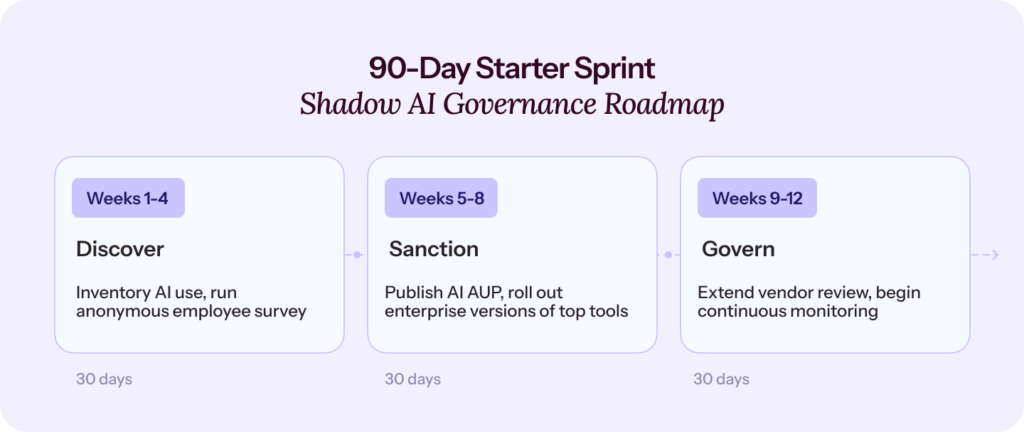
Organizations with mature SOC 2 or ISO 27001 programs can extend existing controls to cover AI in 3 to 6 months; full ISO 42001 certification typically takes 6 to 12 months. A practical 90-day starting sprint: inventory AI usage in weeks 1-4, publish an AUP and roll out enterprise tools in weeks 5-8, then extend vendor review and begin monitoring in weeks 9-12. Most durable improvement comes from steps that take weeks, not quarters.
Five metrics signal whether a program is working: coverage (inventory versus discovery scans), time to detect new tools (days, not weeks), time to approve new tool requests (under two weeks before employees route around you), vendor review completion rate, and AI-related audit findings. Avoid vanity metrics like training completion or AUPs signed, without supporting behavior or enforcement data.
Author
Sucheth
Sucheth is a Content Marketer at Sprinto and holds CompTIA Security+. He helps security and GRC teams to navigate audits: what each framework requires, what auditors ask for, and what it costs to maintain.Go beyond the surface and uncover the governance, risk, and compliance insights that actually matter.


Win digital goodies for boardroom success


Explore more



research & insights curated to help you earn a seat at the table.