

How do you get started with the GDPR automation process? Are you overwhelmed by the thought of tracking permissions and understanding the implications of data privacy laws?
Don’t worry – automating your GDPR processes can be simpler than you think! With a few proactive steps, you can start managing user data responsibly while protecting yourself from regulatory issues and costly fines.
In this blog post, we’ll explore what it takes to get started with GDPR automation and why it’s essential for any organization that stores or handles personal user data. Let’s dive in.
- GDPR is the EU’s data protection law that defines how organizations collect, process, and secure personal data, making compliance essential for any business dealing with EU users.
- It’s important because it strengthens user privacy, reduces the risk of data breaches, and helps organizations avoid steep non-compliance penalties.
- Automating GDPR compliance cuts manual workloads, improves accuracy, and ensures continuous monitoring of security and privacy controls.
- Sprinto streamlines GDPR compliance monitoring by automating evidence collection, mapping controls, and reducing audit prep, helping organizations maintain a stronger and more consistent compliance posture with significantly less manual effort.
What is GDPR automation?
GDPR automation refers to the use of technology to streamline GDPR compliance. At the core of this process is the GDPR itself, the EU’s data protection law that governs how organizations collect, store, transmit, process, and secure personal data. It establishes strict requirements for privacy and transparency, while giving individuals stronger rights over their information, including access, correction, and deletion.
GDPR compliance can be complex given the breadth of its obligations. Automation tools help by reducing the manual workload and keeping your controls monitored consistently, making compliance more manageable for teams of any size.
GDPR compliance automation involves utilizing intelligent software, tools, and technology such as artificial intelligence (AI), machine learning, and natural language processing to interpret, classify, and manage personal data. This allows organizations to maintain an efficient and accurate record of the data they collect, store, transmit, and process. A key example is ROPA generation: AI-powered data discovery combined with third-party integrations can automatically build and maintain your Records of Processing Activities, shifting your team’s focus from creating the inventory to reviewing and validating it.
But before you go ahead to implement the automation, here is a simple GDPR audit checklist you need to be aware of:
Download Your GDPR Audit Checklist
Why is GDPR automation required?
Here is why organizations need a powerful compliance platform to manage their GDPR obligations effectively:
- GDPR automation streamlines the process of identifying and managing personal data that falls under the scope of the GDPR. It sifts through vast amounts of data, searching for patterns and flagging data that may require attention from the compliance team.
- Data mapping automation reduces the risk of manual errors and the time spent on tracking and organizing data, leading to more efficient compliance with GDPR requirements.
- GDPR automation ensures compliance and assists in fulfilling data subject access requests by providing an organized, up-to-date inventory of personal data easily accessible when you need it.
- It translates to potential cost savings for organizations, as it reduces the need for manual labor in data management and compliance processes.
- It displays a business’s commitment to data protection and privacy, improving consumer trust and solidifying its reputation in today’s increasingly competitive market.
- GDPR requires organizations to continuously demonstrate compliance through documentation and evidence not just at audit time. This includes maintaining ROPA, DPIA records, security controls, policy documentation, and training records. Managing this manually across teams and systems is time-consuming and error-prone. Automation platforms simplify accountability by continuously collecting and organizing compliance evidence, ensuring you can demonstrate compliance at any point not just when an auditor comes knocking.
Determine and document lawful basis for processing
Under GDPR Article 6, organizations must identify and document a lawful basis for every processing activity before it begins, not after. Without this foundation, no other aspect of GDPR compliance is complete. The six lawful bases are:
- Consent: The individual has given clear, informed, and freely given consent
- Contractual necessity: Processing is necessary to fulfill a contract with the individual
- Legal obligation: Processing is required to comply with a legal requirement
- Legitimate interests: Processing serves a genuine business interest that is not overridden by the individual’s rights
- Vital interests: Processing is necessary to protect someone’s life
- Public task: Processing is necessary to perform a task in the public interest
Automation platforms help by mapping each processing activity to its appropriate lawful basis, linking that documentation directly to the relevant entry in your ROPA, and flagging activities where the lawful basis is missing, unclear, or due for review. This ensures your legal basis documentation stays current as your processing activities evolve.
Privacy by design and default (Article 25)
GDPR Article 25 requires organizations to integrate privacy controls into systems and processes from the design stage, not as an afterthought. This means privacy must be built in before a system goes live, not patched in after a compliance gap is identified. Automation platforms help embed privacy controls by default, including:
- Data minimization: Ensuring only the minimum necessary data is collected and processed
- Access controls: Restricting data access to authorized individuals based on role and necessity
- Encryption and pseudonymization: Protecting data at rest and in transit through technical safeguards
- Automated compliance checks during deployment: Flagging privacy gaps before new systems or features go live, rather than after
Automated data classification
Before you can protect personal data, you need to know what you have. GDPR requires organizations to identify and handle different categories of data appropriately. These include:
- Personal data: Any information that can identify an individual directly or indirectly
- Sensitive personal data (special categories): Data revealing racial or ethnic origin, health information, biometric data, religious beliefs, and similar high-risk categories requiring stricter protection
- Pseudonymized data: Data where identifiers have been replaced but re-identification remains possible
- Anonymized data: Data that has been irreversibly stripped of identifying information and falls outside GDPR’s scope
Automation tools help classify data accurately using pattern detection and tagging mechanisms, ensuring each category is handled, stored, and protected according to the correct GDPR requirements and reducing the risk of misclassification that could lead to compliance gaps.
As you explore GDPR automation, remember that embracing this technology is a strategic move for businesses seeking to maintain a complete and accurate inventory of personal data across their systems. A well-maintained data inventory is the foundation of effective GDPR compliance. It gives you the visibility needed to identify what data you hold, where it lives, and which assets require protection through security controls. The result is increased operational efficiency and a more defensible compliance posture.
How to automate GDPR compliance with Sprinto?
Sprinto makes GDPR compliance faster and far more manageable by using automation and intelligent, AI-assisted workflows to remove the heavy manual work. Instead of juggling spreadsheets, mapping controls by hand, or interpreting requirements alone, Sprinto builds a connected and always-updated GDPR program for you.
Step 1: Identify risks and unify your data
Sprinto brings together data from your systems, teams, devices, and vendors to give you a complete view of your GDPR environment. Its intelligent analysis automatically surfaces risks across data access, processing activities, vendors, and infrastructure. It also generates DPIAs and privacy insights so you can clearly understand how personal data flows through your organization and what areas need attention.
Third-party processor management (Article 28)
For SaaS companies, vendor risk is one of the most significant GDPR compliance challenges. Under Article 28, any third-party processor handling personal data on your behalf must provide adequate safeguards governed through a formal Data Processing Agreement, not just a standard commercial contract.
Processors must be contractually required to:
- Process data only on documented instructions
- Implement appropriate security measures
- Assist with data subject rights requests and breach notifications
- Delete or return data upon termination of services
Automation platforms support this by streamlining vendor risk assessments, maintaining a register of executed DPAs, tracking subprocessor relationships, and verifying that cross-border transfer mechanisms such as SCCs or adequacy decisions are in place before data leaves the EU.
Step 2: Map requirements and gain full control visibility
Sprinto translates GDPR requirements into a clear operational program by connecting your policies, risks, controls, and documentation in one place. With AI-assisted mapping, it links your internal controls to the right GDPR Articles, aligns policies with the correct risks, and instantly clarifies which requirement applies to which part of your setup. This removes hours of manual interpretation and ensures complete coverage.
International data transfers are a critical part of control visibility. If personal data is transferred outside the European Economic Area (EEA), organizations must implement appropriate safeguards such as Standard Contractual Clauses (SCCs), adequacy decisions, or Transfer Impact Assessments (TIAs). Automation tools help by tracking international data flows across your systems, flagging transfers that lack a lawful mechanism, and maintaining the documentation regulators expect to see.
Step 3: Automate controls and stay continuously compliant
Once your GDPR foundation is in place, Sprinto automates the ongoing work to keep you compliant throughout the year. The platform continuously monitors controls, checks evidence, detects policy drift, and analyzes vendor documentation for potential risks. AI also helps streamline repetitive compliance tasks by summarizing requirements, extracting key clauses, and reviewing questionnaires. With real-time monitoring tied directly to GDPR controls, Sprinto keeps you consistently audit-ready with minimal effort.
If you want to know more, schedule a walkthrough. Our GDPR experts will get in touch with you.
Must check: 12-Step GDPR Compliance Checklist
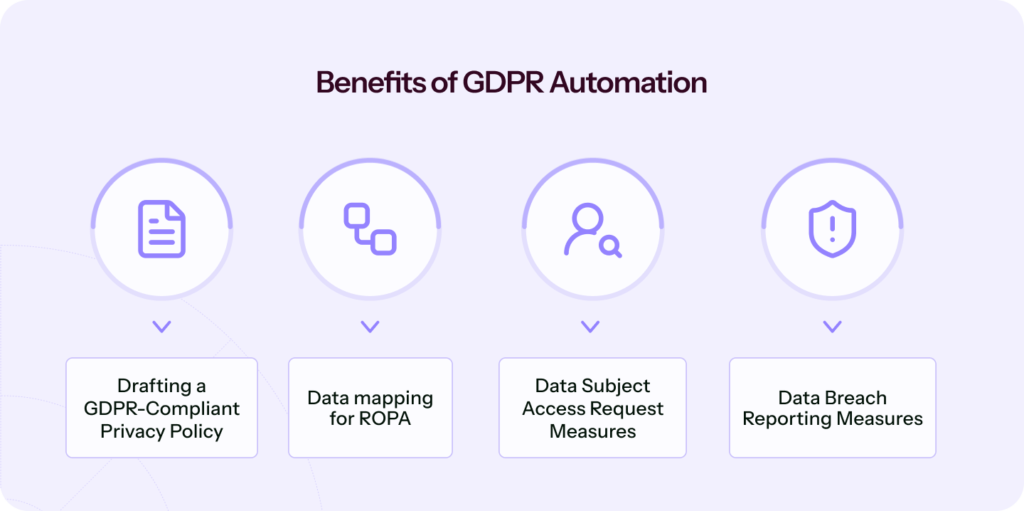
Benefits of GDPR Automation
Automating GDPR tasks helps you stay compliant without the heavy manual work. It keeps things organized, reduces errors, and makes privacy management much easier. Here are the key benefits:
- Creating a GDPR-friendly privacy policy
- Data mapping for ROPA
- Handling DSAR requests
- Data breach reporting
Here’s how:
Drafting a GDPR-compliant privacy policy
GDPR is complex and often filled with uncertainty. With businesses seeking to comply with all GDPR requirements, drafting GDPR-compliant Privacy Policies can seem daunting and time-consuming.
But thankfully, there is an easier, smarter way to do this – Sprinto. With Sprinto, you get more than just templates; you also benefit from a vetted network of legal experts who will help ensure your policies accurately reflect today’s data privacy landscape. This ensures that your customers remain safe, secure, and content. So don’t sweat trying to draft GDPR-compliant Privacy Policies; let Sprinto be your compass in this maze of regulations.
Data mapping for ROPA
When it comes to data mapping, a tech organization needs the perfect partner, someone who understands all the complicated ‘what’, ‘where’, and ‘why’ that comes with handling personal data while maintaining an accurate Record of Processing Activities (ROPA). Sprinto provides detailed records of how your data enters and exits the company, with personalized alerts for when updates are needed, so you’re always up to date.
Data retention and automated deletion
Retention is one of the most common findings in GDPR audits and one of the most preventable. Under GDPR Article 5’s storage limitation principle, personal data must not be retained longer than necessary for the purpose it was collected. Defining and enforcing retention schedules is therefore a critical part of maintaining an accurate and compliant ROPA.
Automation tools help enforce retention policies by:
- Applying retention schedules by data category across systems
- Triggering automated deletion workflows when data reaches the end of its retention period
- Maintaining archival controls for data that must be retained for legal or regulatory reasons
- Sending alerts when data is approaching or exceeding defined retention thresholds
Building retention automation into your ROPA lifecycle ensures that your data inventory stays accurate, your storage footprint stays minimal, and your compliance posture stays defensible.
Data subject rights management
GDPR grants individuals several rights over their personal data under Articles 12–22. Managing these requests manually across a growing user base is operationally demanding; automation ensures every request is tracked, verified, and fulfilled within the regulatory 30-day timeframe. Automated workflows support the full spectrum of data subject rights, including:
- Right to Access (DSAR): Individuals can request a copy of their personal data and information about how it is being used
- Right to Rectification: Individuals can request correction of inaccurate or incomplete personal data
- Right to Erasure (Right to be Forgotten): Individuals can request deletion of their data where there is no compelling reason for its continued processing
- Right to Restriction of Processing: Individuals can request that processing be limited in certain circumstances, such as when accuracy is contested
- Right to Data Portability: Individuals can request their data in a structured, machine-readable format for transfer to another provider
- Right to Object: Individuals can object to processing based on legitimate interests or for direct marketing purposes
- Rights related to automated decision-making: Individuals can request human review of decisions made solely through automated processing that significantly affects them
With Sprinto, you get automated workflows for managing all data subject rights requests, SLA monitoring to ensure responses are completed within the 30-day window, and evidence logging to maintain an audit trail of every request received, verified, and fulfilled.
Data breach reporting measures
Under GDPR Article 33, organizations must notify the relevant supervisory authority within 72 hours of becoming aware of a personal data breach. If the breach poses a high risk to affected individuals, those individuals must also be notified without undue delay under Article 34. Meeting these tight deadlines while simultaneously assessing the breach, gathering evidence, and coordinating internally is where manual processes most often break down.
Automation tools assist with:
- Breach classification: Automatically categorizing incidents by type and severity to determine notification obligations
- Risk scoring: Assessing the likelihood and impact of harm to affected individuals to determine whether individual notification is required
- Regulator notification workflows: Guiding teams through the 72-hour reporting process with structured templates and deadline tracking
- Breach documentation registers: Maintaining a complete record of every incident including facts, effects, and remedial measures taken
Sprinto’s built-in incident management module and data breach report tracking keeps a detailed record of personal data breaches throughout their lifecycle. Its integration with tools like JIRA further simplifies coordination across teams, making breach reporting a structured and auditable process rather than a reactive scramble.
Quick read: A quick GDPR checklist for US companies
Where to start (Sprinto)?
Sprinto simplifies GDPR compliance by automating your workflows, giving you continuous monitoring, and reducing manual overhead. You can shift from chasing spreadsheets and audit proofs to focusing on your business.
How Sprinto automates GDPR compliance:
- Automated data & entity mapping: Sprinto identifies data across your systems, maps it automatically to GDPR requirements, and unifies entities (people, devices, infrastructure) to highlight risks and obligations.
- Continuous control monitoring: It continuously monitors your GDPR controls, flags any drifts, and ensures you remain compliant throughout the year—not just during audits.
- Automated evidence collection: Sprinto gathers logs, system data, and control outputs automatically, storing them in audit-ready formats, so teams no longer have to chase screenshots or manually verify proof.
- Streamlined DPIAs & documentation: The platform guides you through Data Protection Impact Assessments with templates, recommendations, and structured workflows to meet regulatory expectations.
- Built-in breach response workflows: It assists in detecting incidents early, outlining steps for GDPR’s 72-hour reporting rule, and coordinating privacy incident documentation.
- GDPR-aligned security and privacy training: Sprinto offers built-in training modules designed to help every employee understand and follow GDPR best practices across the organization.
- Fully hosted Trust Center: You can easily showcase your security and privacy posture with a ready-to-use Trust Center—helping you build transparency and trust with customers, partners, and auditors.
Also, our provisions for a security and privacy audit help validate the practicality of your control measures and practices. Schedule a walkthrough now, and let us show you how easy it can be to stay compliant with GDPR automation.
FAQs
The GDPR is a mandate that safeguards the private information of European Union (EU) citizens. It affects any enterprise which stores or processes its data– even if it does not have a physical presence in the EU.
Under GDPR, organizations are required to appoint a DPO if they carry out large-scale systematic monitoring of individuals, process sensitive personal data at scale, or are a public authority or body. Even where a DPO is not mandatory, many organizations appoint one voluntarily as a best practice.
Automation tools support the DPO’s role by centralizing compliance evidence, maintaining an up-to-date view of processing activities, and continuously monitoring privacy risks reducing the manual burden of oversight and ensuring the DPO has the visibility needed to fulfill their responsibilities effectively.
The GDPR does not apply in the following circumstances:
-> When the individual to whom personal data relates is deceased.
-> If the person pertains to legal construction, such as a company or institution.
-> Should an individual be carrying out processing outside of their remit?
GDPR protects any individual located within the EU, regardless of their citizenship or nationality. Under Article 3, GDPR applies to organizations processing personal data of individuals who are in the EU at the time their data is collected, meaning a US citizen visiting Europe is protected by GDPR, while an EU citizen living in the US is not. It is therefore more accurate to say that GDPR protects EU residents and individuals present in the EU, not exclusively EU citizens.
You likely need GDPR software if your business collects or processes personal data from people in the EU. These tools help you manage data mapping, DSARs, policies, and security controls more efficiently, especially if your operations are growing or if you don’t have a dedicated privacy team.
GDPR automation reduces manual tasks, lowers the chance of errors, and helps you stay compliant throughout the year. It simplifies data mapping, evidence collection, DSAR handling, breach reporting, and policy updates, making the compliance process faster and easier.
GDPR requires businesses to collect and process personal data in a lawful manner, secure it properly, respect user rights such as access and deletion, document how data is handled, report breaches within 72 hours, and maintain accountability through audits, policies, and vendor oversight.
Popular AI-driven tools include Sprinto, Vanta, Drata, and other privacy platforms that help automate data mapping, control monitoring, DSAR responses, and evidence collection. They utilize automation and AI to streamline manual tasks and expedite the compliance process.
The best tools for privacy automation and GDPR compliance depend on how you manage personal data: Sprinto leads as an autonomous trust platform with continuous monitoring, automated evidence collection, and support for GDPR alongside other frameworks; OneTrust and TrustArc are suited for enterprise-grade privacy program management; BigID focuses on data discovery and mapping; while DataGrail, Osano, and Transcend help automate consent management and DSAR workflows.

Author
Meeba Gracy
Meeba, an ISC2-certified cybersecurity specialist, passionately decodes and delivers impactful content on compliance and complex digital security matters. Adept at transforming intricate concepts into accessible insights, she’s committed to enlightening readers. Off the clock, she can be found with her nose in the latest thriller novel or exploring new haunts in the city.
Reviewer
Rachna Dutta
Rachna Dutta is an Information Security Consultant at Sprinto and a certified ISO 27001 Lead Auditor with expertise across a broad spectrum of global and India-specific compliance frameworks, including PCI DSS, SOC 2, HIPAA, FedRAMP, HITRUST, NIST CSF, and RBI regulatory requirements.Go beyond the surface and uncover the governance, risk, and compliance insights that actually matter.


Win digital goodies for boardroom success


Explore more





research & insights curated to help you earn a seat at the table.