Future-Ready AI Governance: 10 Shifts GRC Teams Should Prepare for Before 2028


TL;DR
| AI governance challenges impact the whole organization; they are not just a security issue. |
| As AI enters vendor tools, workflows, decisions, evidence, and autonomous actions, GRC teams will need visibility, ownership, traceability, controls, and audit-ready proof. |
| Organizations need to tart building future-ready AI governance and addressing AI governance challenges now, before new expectations become the standard by 2027 and 2028. |
A year ago, many enterprise AI risk conversations were still centered on acceptable use, data leakage, employee experimentation, and vendor disclosures. But over 30% of organizations reported experiencing a major AI-related security incident sometime in 2025.
Meanwhile, as of mid-2026, AI is no longer just a tool some employees might use on the side; it is being embedded into procurement workflows, customer support operations, vendor tooling, internal approvals, compliance processes, and enterprise decision-making itself.
For GRC teams, the question is not just how to respond to these changes today. It is about preparing for governance expectations that are likely to become standard over the next 12–24 months. The teams that see the shift early can start building the right capabilities, systems, budgets, ownership models, and training programs before AI risk becomes too complex to manage reactively.
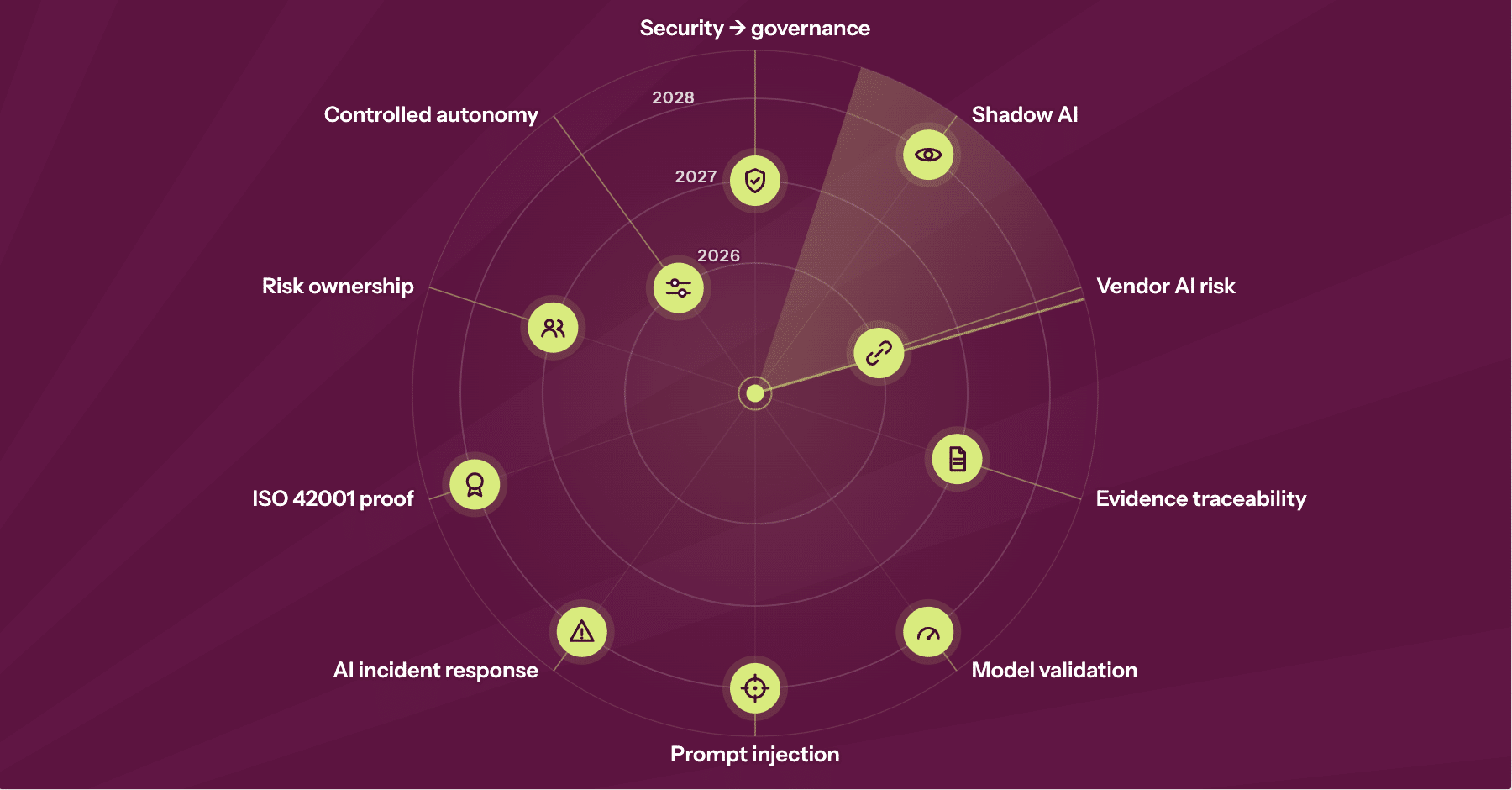
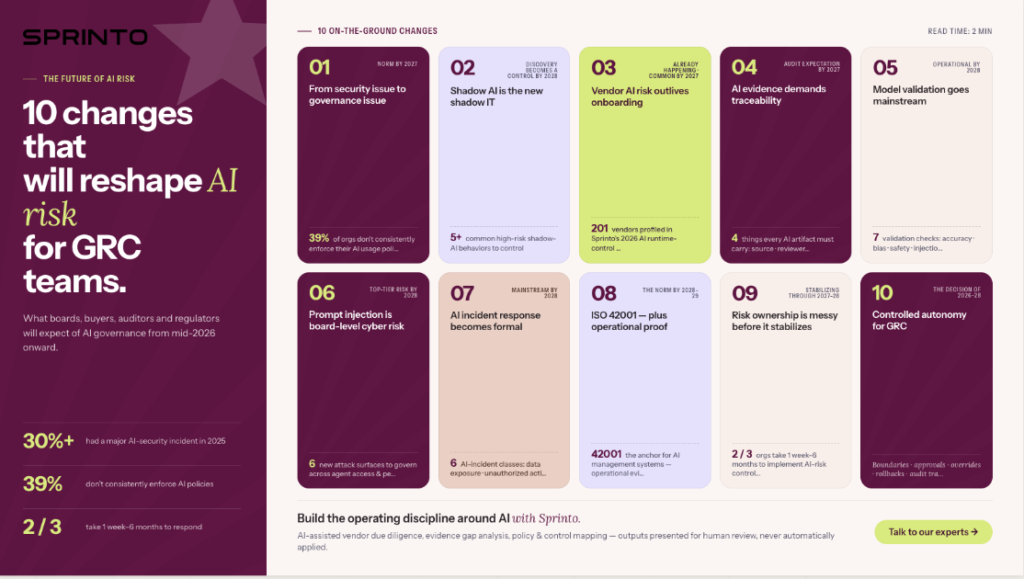
In this blog, we look at what GRC teams should be preparing for next, based on today’s AI risk signals. Here are 10 on-the-ground changes that will transform how your team functions over the remainder of 2026 and onward.
Change # 1: AI risk will move from “security issue” to “governance issue”
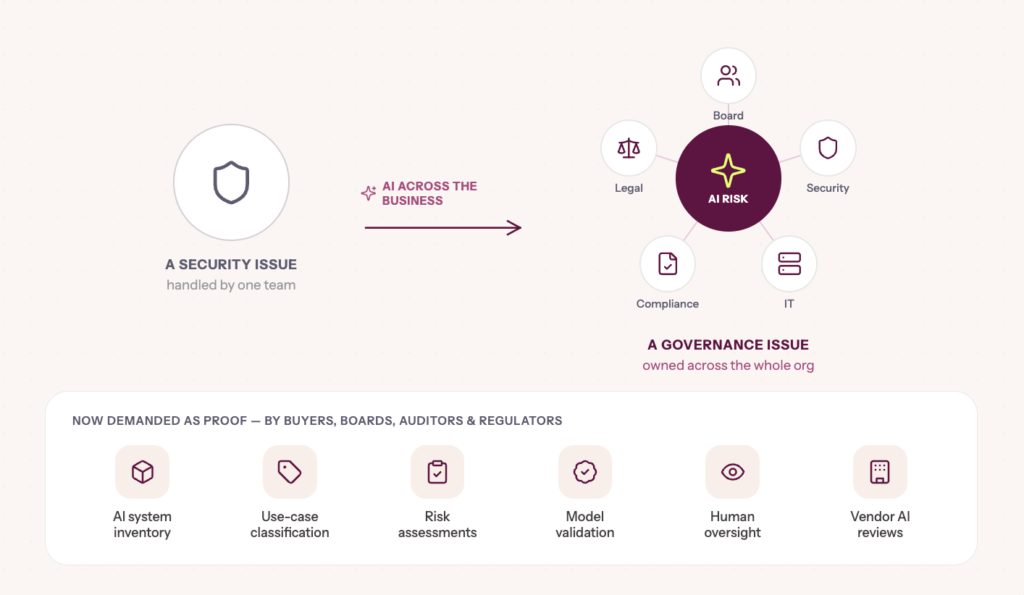
“Important risks emerge during execution, not only at model development or deployment time,” says researcher Christopher Koch in his paper advocating runtime guardrails for agentic AI. By the end of 2026, GRC teams will need to demonstrate responsible AI governance instantly. Expect buyers, boards, auditors, and regulators to ask for evidence of:
- AI system inventories
- AI use-case classification
- Risk assessments by use case
- Model validation and testing
- Human oversight
- Vendor AI-risk reviews
- Oversight that keeps pace with risk
This will impact renewal and trust conversations with customers, procurement reviews, audit prep cycles, cyber insurance discussions, and board reporting. As of the start of this year, 39% of organizations reported not consistently enforcing their AI usage policies. No wonder customers want proof of action, rather than proof of policy.
AI governance will become an evidence and reporting challenge. This is already playing out in mid-2026 and is likely to become a norm and expectation by 2027. Take a free AI Readiness assessment to find out where your AI governance maturity stands.
Change # 2: Shadow AI will become the new shadow IT
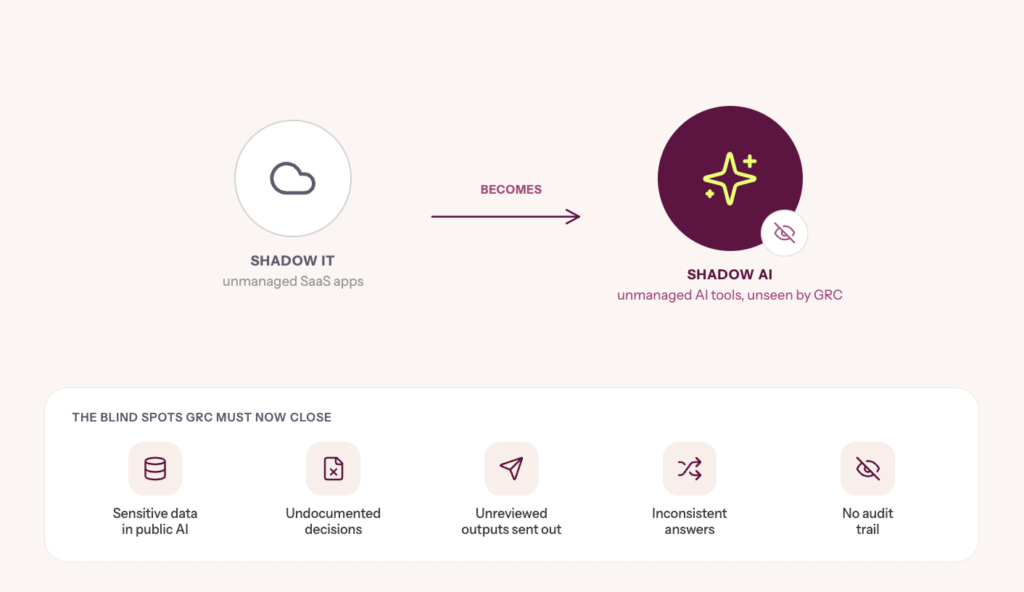
The biggest AI governance challenge will be employees using unmanaged AI tools for productivity-related tasks such as sales notes, code, customer data, legal review, support responses, HR tasks, and internal analysis without GRC oversight.
A sales team using AI to summarize customer calls, an HR team screening candidates with AI assistance, or a support function relying on AI-generated responses all create governance exposure, possibly long before security or compliance teams are aware that those workflows exist. By the time governance teams discover shadow AI tools, those systems may already be shaping customer communication, influencing hiring decisions, processing sensitive data, or generating operational outputs without formal review, validation, logging, or approval controls.
Here are some of the high-risk actions that GRC teams will need to prevent:
- Sensitive data copied into public AI tools
- Undocumented automated decisions
- Unreviewed AI-generated content sent externally
- Inconsistent answers across teams
- No audit trail for how outputs were produced
Come 2028, AI usage discovery will become a popular control, similar to SaaS app discovery today.
Change # 3: Vendor AI risk will slow procurement and extend beyond onboarding
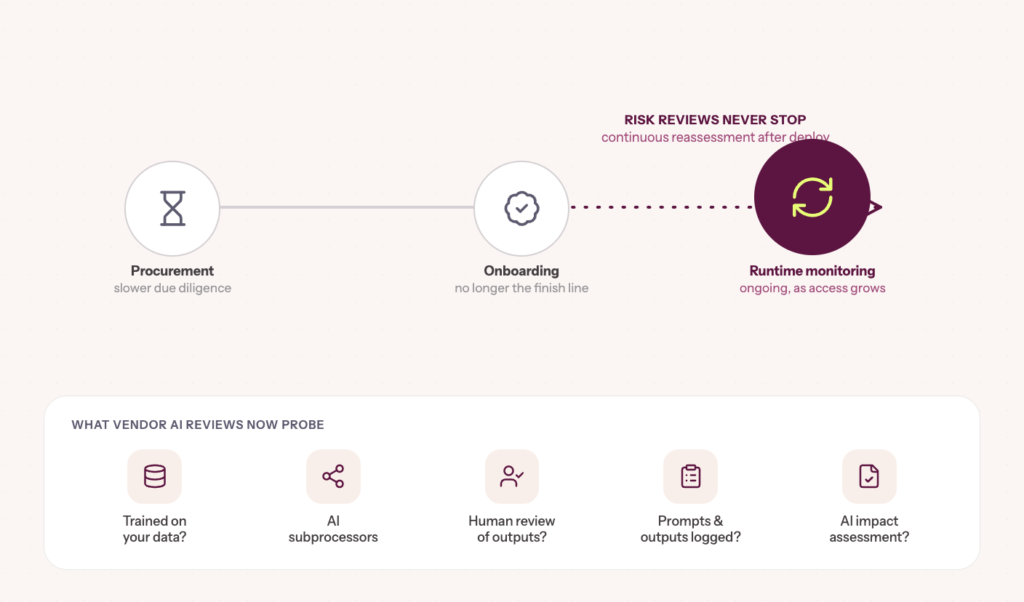
Vendor AI risk reviews will increasingly delay procurement cycles, expand due diligence requirements, and continue long after onboarding is complete. The primary assessment itself will evolve from evaluating a vendor’s security posture to assessing how AI systems make decisions, handle data, and operate within workflows.
Additionally, organizations will also need continuous runtime monitoring to track how those systems behave after deployment.
Customers, regulators, and board executives might well ask questions like:
- Does the vendor use customer data to train models?
- Which subprocessors provide AI capabilities?
- Is there human review for high-impact outputs?
- Are prompts, outputs, and decisions logged?
- Has the vendor done an AI impact/risk assessment?
For example, a vendor tool that initially enters the organization as a productivity assistant may later gain access to emails, meeting notes, internal documents, ticketing systems, customer records, or enterprise search environments — significantly changing its operational risk profile after procurement has already been completed. Good vendor AI governance would involve continuously reassessing those systems as their capabilities, integrations, permissions, and operational influence evolve, rather than just evaluating them once during onboarding. (Read excerpts from a 201-vendor report about how AI is redefining vendor blast radius and runtime control dependencies in 2026).
TPRM teams might increasingly find themselves diving deeper into evaluating vendor ecosystem risk, rather than just the immediate vendor in isolation.
Procurement teams will not only evaluate whether a vendor is secure, but also whether its AI behavior remains governable after deployment. This is already happening in some cases, and is likely to become more commonplace by 2027.
Change # 4: AI-generated evidence will make traceability and auditability critical
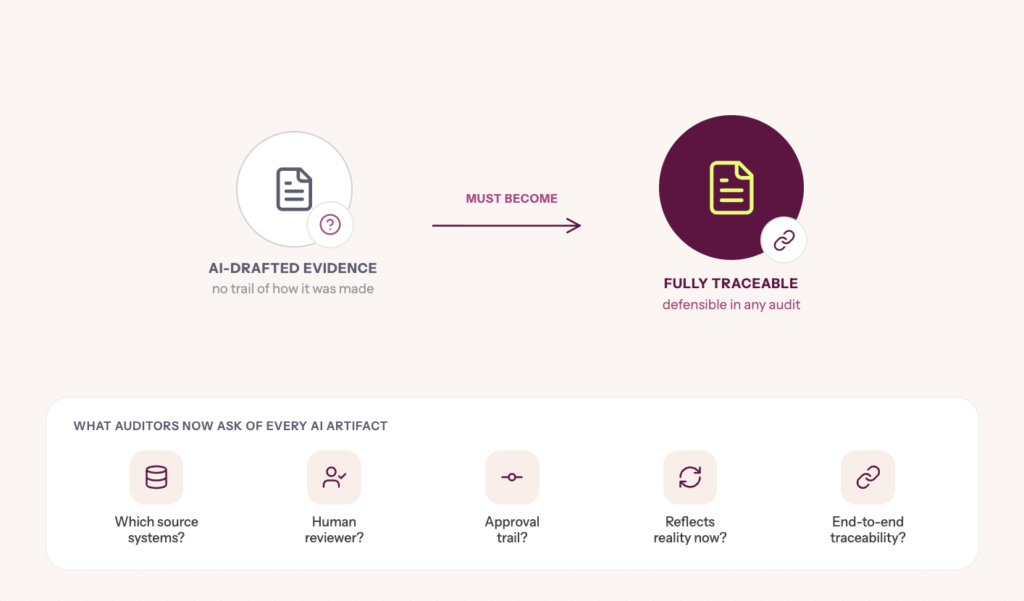
Organizations will increasingly use AI to draft policies, summarize controls, generate risk assessments, write audit narratives, and assist with evidence collection. Proving how that documentation was generated, reviewed, approved, and maintained over time will become critical.
Auditors and compliance teams will increasingly ask:
- What source systems or evidence informed this output?
- Was a human reviewer involved?
- Can changes and approvals be traced?
- Does the output reflect current operational reality?
- Is there clear traceability behind evidence artifacts?
Organizations using AI within GRC tools—with embedded review layers, approval trails, version history, and evidence traceability—will have a significant advantage over teams relying on generic LLMs, ad hoc prompting, and manual copy-paste workflows.
Consider a compliance workflow in which AI automatically rewrites a policy, updates a control description, or closes remediation tasks. During audits, the AI governance challenge at hand will be proving whether automation-led changes were reviewed, approved, traceable, and operationally accurate.
By 2027, the value of AI systems will be measured by how reliably actions, decisions, changes, and outputs can be traced, reviewed, governed, and defended during an audit.
Change # 5: Model validation will become a mainstream control
Model validation is already part of ISO 42001 expectations and will become a baseline AI control: models should be tested for accuracy, bias, and performance before deployment.
In 2026 and beyond, validation will not only apply to companies building models. It will also apply to companies embedding AI into workflows.
Common validation expectations will include:
- Output accuracy testing
- Bias/fairness checks
- Safety testing
- Prompt-injection testing
- Regression testing after model or prompt changes
- Monitoring for drift
- Defined fallback or escalation paths
That means if your customer support team is using AI to draft responses, summarize tickets, or recommend actions, you will need formal validation, review controls, escalation paths, and drift monitoring around those systems, in line with what we discussed in the previous point ie defensibility during an audit. Without that validation, you’re at risk for undocumented decision-making and operational behavior that cannot be defended during audit, investigation, or executive review.
In a precedent-setting case, a civil resolution tribunal ruled against Air Canada and ordered it to reimburse a passenger’s losses stemming from incorrect information provided by its chatbot. It was a small amount, but it sets the direction for such cases that may emerge in the future.
By 2028, many organizations will find that AI systems embedded into everyday workflows are influencing operational decisions far more than initially intended. This AI governance challenge will force GRC teams to treat validation, drift monitoring, and escalation controls as operational necessities rather than technical best practices. If you do this earlier, you’ll be ahead in the game. Either way, you have time to prepare and plan.
Change # 6: Prompt injection and agent abuse will become board-level cyber risks
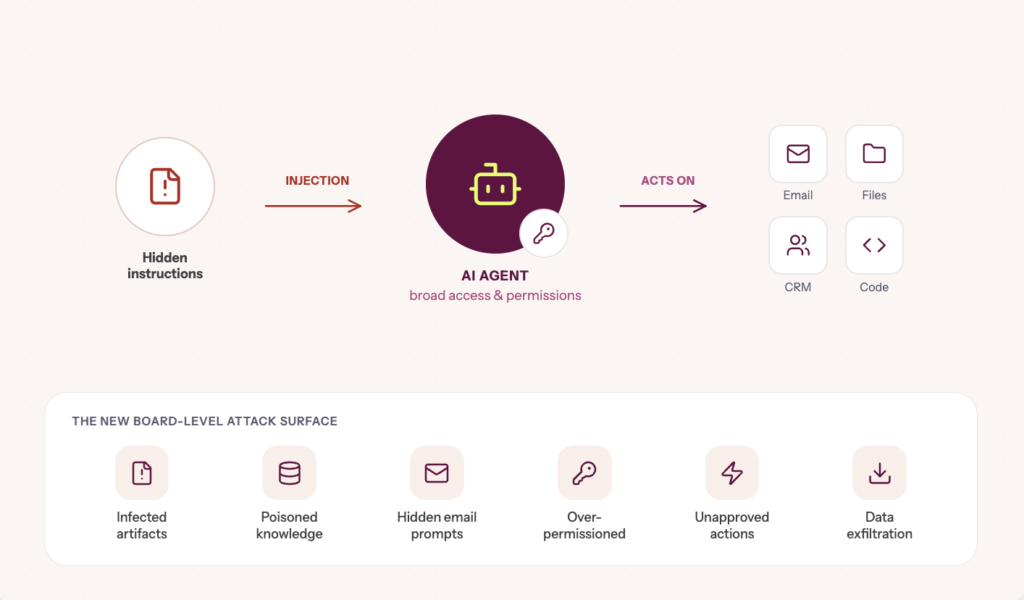
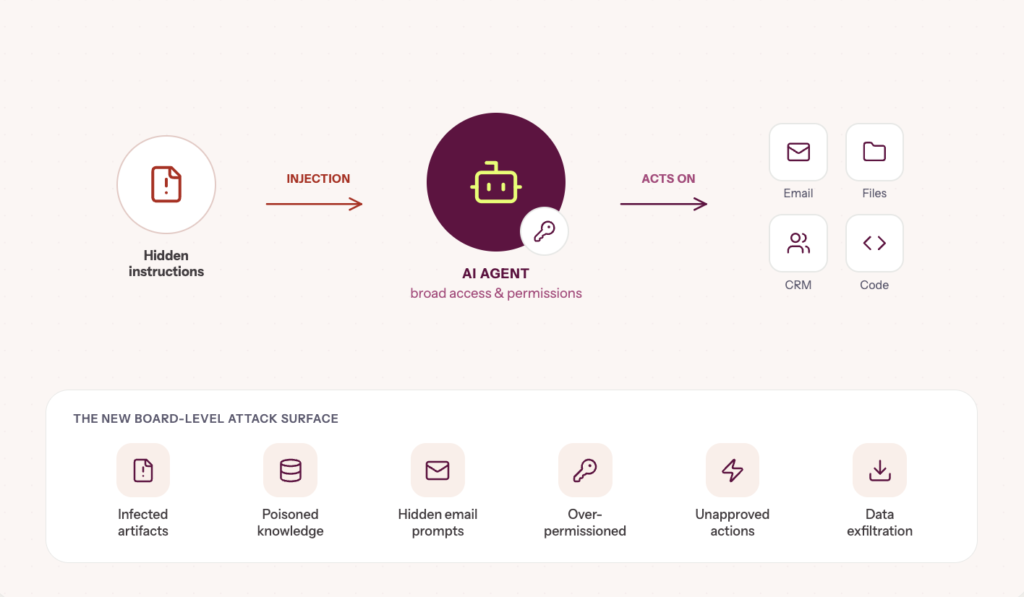
As AI agents gain access to email, files, CRM, ticketing systems, code repositories, and cloud environments, attackers will target the agent’s instructions, tools, and permissions. Basically, AI risk and AI governance challenges around them will become extremely hard to ignore.
The likely attack surface:
- Files, tickets, or internal documents containing embedded prompts that manipulate agent behavior (infected internal workflow artifacts)
- Corrupted or misleading knowledge-base content used to influence AI outputs and decisions (poisoned enterprise knowledge sources)
- Hidden instructions embedded in emails, websites, or external content retrieved by AI agents (external prompt injection attacks)
- Over-permissioned AI assistants
- Agents taking actions without sufficient approval
- Data exfiltration through tool calls
By 2028, if not earlier, access control for AI agents will become a core security and GRC priority. This will cover what AI systems can access, retrieve, modify, approve, and execute across environments.
Change # 7: AI incident response will become a formalized governance function
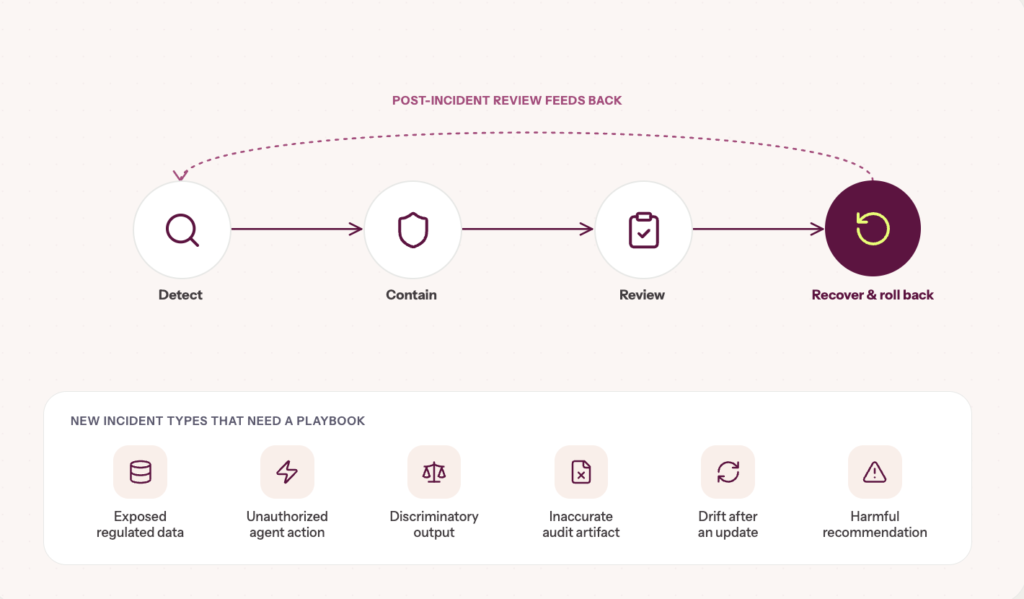
Organizations already maintain incident response and disaster recovery processes for security failures, outages, insider threats, and operational disruptions. Over the next few years, many will realize that AI systems require procedures for escalation, containment, review, and recovery.
Examples of AI-specific incidents may include:
- An AI system exposing confidential or regulated data
- An AI agent taking an unauthorized action inside an enterprise workflow
- A model generating discriminatory or non-compliant outputs
- An AI-assisted workflow producing inaccurate compliance or audit artifacts
- An AI system behaves differently after a model or vendor update
- An AI-generated recommendation causing operational, legal, or financial impact
Traditional security incidents focus on compromised systems. AI incidents will increasingly focus on compromised decisions, actions, outputs, and autonomy.
Mature organizations will begin introducing AI-specific incident playbooks, escalation paths, rollback procedures, human override controls, and post-incident review mechanisms into existing incident response and disaster recovery programs. Early movers will adopt this as a solution to AI governance challenges now, and mainstream adoption can be expected by 2028.
Change # 8: ISO 42001 will gain traction, and buyers will also want practical proof of AI governance
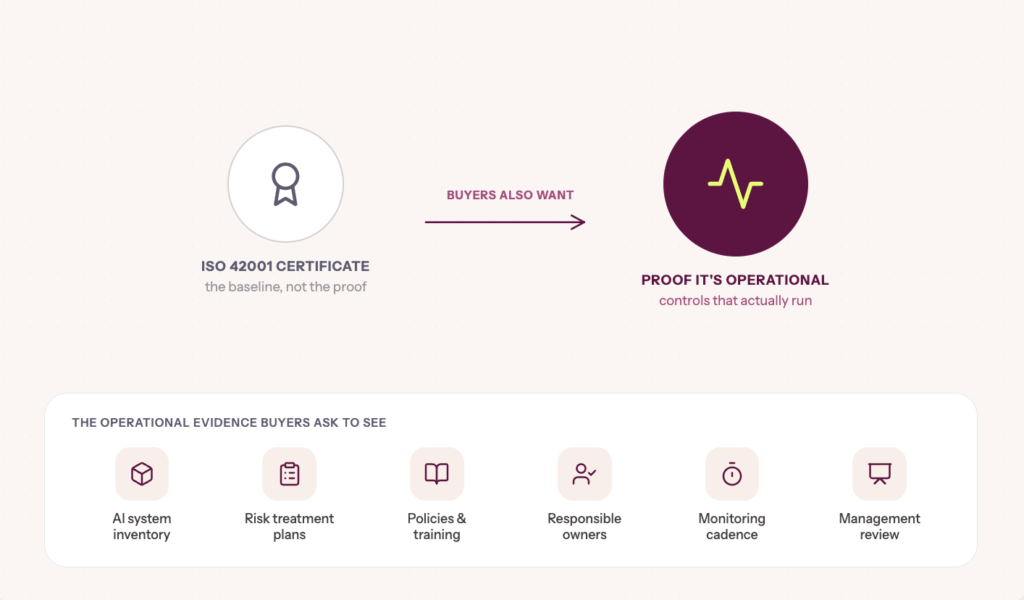
We’re already seeing more requests for ISO 42001 on the ground. This certification is likely to become the recognized anchor for AI management systems, but the real test will be operational proof.
A certificate alone may not satisfy sophisticated buyers. They will want to see:
- Inventory of AI systems
- Risk treatment plans
- Policies and training
- Responsible owners
- Monitoring cadences
- Evidence of management review
- Vendor and data-governance linkage
By 2027, buyers will increasingly expect organizations to demonstrate not just that AI governance controls exist, but that those controls are operational, measurable, continuously monitored, and tied to real business workflows. By 2028-2029, this will be the norm rather than the exception.
Change # 9: AI risk ownership will be messy before it stabilizes
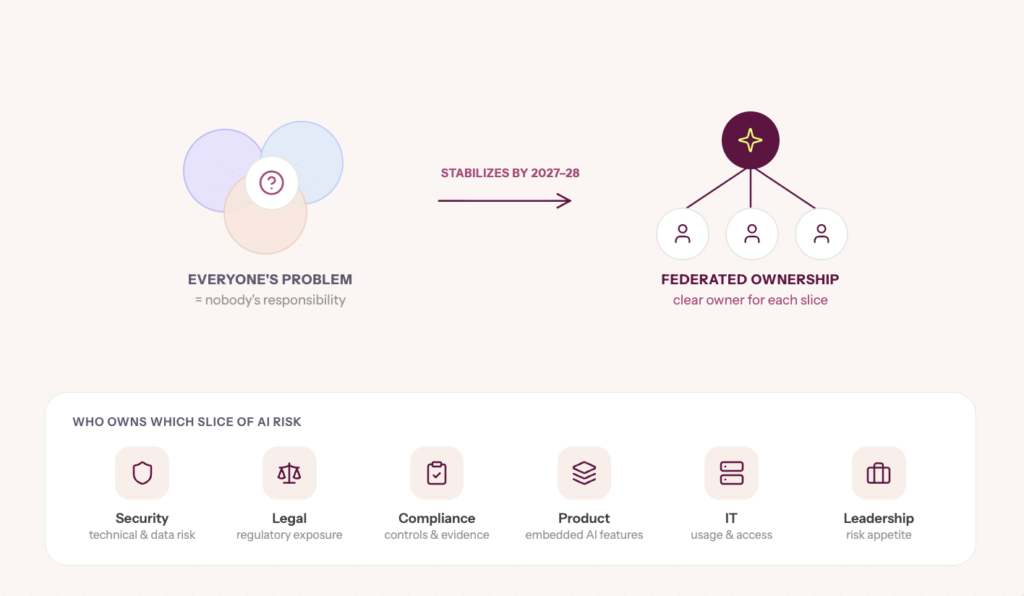
In many organizations, AI risk will initially become everyone’s problem and therefore nobody’s responsibility. It might look a little like this for a while: Security teams discovering AI usage after deployment. Legal teams stepping in during procurement or contract review. Compliance teams being asked to map controls around systems they did not evaluate upfront. Product teams are shipping AI capabilities faster than governance processes can adapt. And IT teams are trying to maintain visibility into which AI tools employees are already using across the organization.
This chaos escalates response time. Our AI Pulse Check Report found that 2 in 3 organizations take between 1 week and 6 months to implement controls or policy changes in response to AI-related risks. Such a timeline obviously leaves too much to chance.
Sometime this year or next, all that chaos and delayed response times will push organizations to create clearer ownership structures for AI governance, even if they do not create a dedicated AI governance office.
More likely, responsibility will remain federated:
- Security owns technical and data risks
- Legal owns regulatory and contractual exposure
- Compliance owns controls, auditability, and evidence
- Product owns embedded AI functionality
- IT owns enterprise AI usage and access visibility
- Leadership owns organizational risk appetite and accountability
The organizations that manage AI risk most effectively will be the ones that decide early who is accountable when AI systems fail, drift, expose risk, or make the wrong decision. 2027-2028 is the year of stabilization.
Change # 10: GRC teams will need “controlled autonomy” to keep up
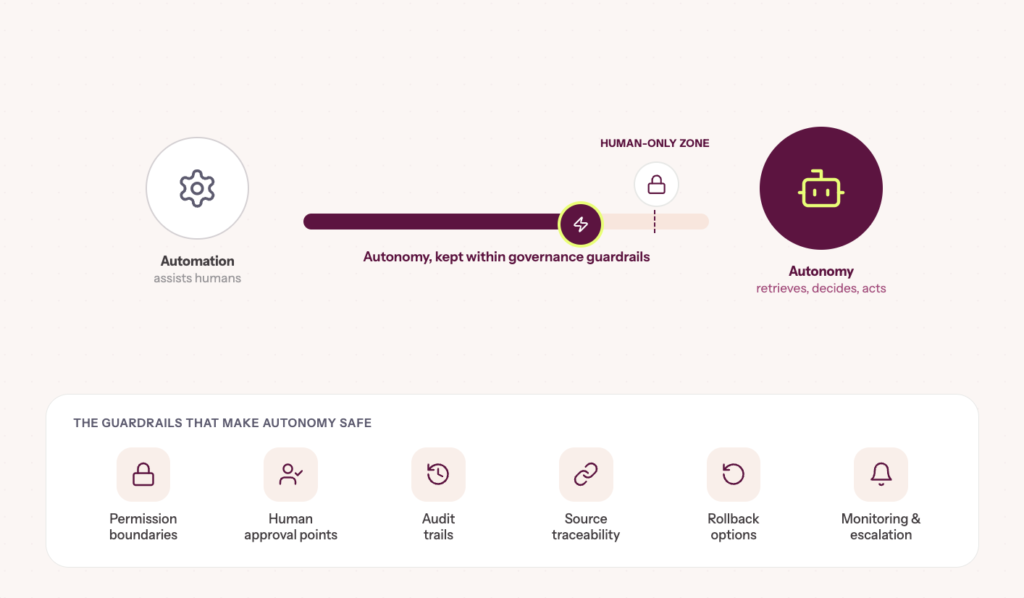
Most organizations are already comfortable with automation. The next shift will be autonomy—systems that do not just assist humans, but independently retrieve information, make decisions, trigger workflows, and take action across enterprise environments.
And in many cases, organizations will not really have a choice given today’s AI governance challenges, and the fact that they’re only going to compound.
You cannot realistically monitor hundreds of AI vendors manually, continuously validate AI-assisted workflows, track shadow AI usage across teams, review every AI-generated compliance artifact, manage AI incident response, and maintain operational visibility into autonomous systems at enterprise scale without introducing some level of AI-driven automation and autonomy into governance itself.
The decision over the next few years will therefore not be about whether organizations adopt autonomous AI systems. It will be about where autonomy is appropriate, where human review remains necessary, and which actions should never happen without oversight.
Even if an AI system is capable of autonomously updating a policy, closing a remediation task, approving low-risk access requests, summarizing evidence, or escalating incidents, organizations will still need governance layers that ask questions like:
- What is the system allowed to do autonomously?
- Which actions require approval or escalation?
- Which systems can AI agents access?
- What decisions must remain human-controlled?
- How are autonomous actions monitored, reviewed, and can they be reversed if necessary?
Between now and 2028, the question will shift from whether AI should be autonomous to how much autonomy organizations can safely operationalize.
Future-proof GRC for the next phase of AI risk with Sprinto
For GRC teams, the work ahead is to build the operating discipline around AI: knowing where it is used, what it can access, what decisions it influences, who owns the risk, and how its actions can be reviewed and defended.
The job is expanding quickly. You used to review vendors at onboarding; now you may need to monitor how their AI systems behave after deployment. You used to collect evidence; now you need to prove how AI-assisted evidence was generated, reviewed, and approved. You used to manage access for people and apps; now you need to think about what AI agents can retrieve, modify, approve, and execute. You used to prepare for security incidents; now you may need playbooks for AI incidents involving bad outputs, unauthorized actions, model drift, or compromised decisions. The biggest challenges of AI governance are the pace at which change occurs, the much larger blast radius, and the possibility of no visibility that a change occurred in the first place. And these challenges are only set to compound.
The teams that prepare well will be the ones that help their organizations use AI with clear boundaries, evidence, accountability, and control.
Handling this with the automation approaches that may have worked in the past will be difficult. You cannot run human-speed governance in an AI-speed business environment. The first step is to understand the differences between automation and autonomy. Automation helps complete predefined tasks faster. Autonomy allows systems to retrieve information, make recommendations, trigger workflows, and take action with less human involvement.
Autonomous systems take on crucial parts of GRC workflows even with human-in-the-loop controls in place. As a result, these systems must be carefully evaluated and governed. GRC teams should look for autonomous systems that offer clear permission boundaries, human approval points, audit trails, source traceability, rollback options, monitoring, escalation paths, and evidence of how actions were taken.
With Sprinto, for example, teams can start operationalizing parts of this AI governance discipline inside their broader GRC workflows. Sprinto AI already supports AI-assisted vendor due diligence, evidence gap analysis, policy and control mapping, risk-to-control mapping, security questionnaire responses, and configurable AI Actions through AI Playground. These capabilities help teams review inputs, generate findings or summaries, identify gaps, and keep humans in control of final decisions.
Sprinto can help teams overcome AI governance challenges with:
- Vendor and third-party AI risk reviews: Use AI-powered vendor due diligence to review vendor security documents, surface key insights, and generate findings that support third-party risk decisions.
- AI-assisted compliance work: Use Ask AI and AI Playground to analyze policies, risks, vendors, incidents, vulnerabilities, and other supported GRC records, with outputs presented for human review rather than automatically applied.
- Evidence and audit readiness: Use evidence gap analysis to flag missing, outdated, or irrelevant evidence during uploads, helping teams catch issues earlier in the audit process.
- Policy, control, and risk alignment: Use Sprinto AI to map controls to policies, risks, checks, and criteria, reducing manual tagging and helping teams maintain clearer connections across their compliance program.
- Incident and vulnerability support: Use Sprinto-defined AI Actions to generate incident summaries, remediation recommendations, pentest analysis, and vulnerability remediation plans.
- Configurable AI governance workflows: Use AI Playground to create custom, no-code AI Actions for organization-specific compliance tasks across supported entities. Current actions are designed to produce suggestions or displayed outputs for review, keeping human approval in the loop.
Some emerging AI governance needs, such as shadow AI discovery, AI system inventories, agent access governance, AI-specific incident playbooks, model validation, and ISO 42001 readiness mapping, are still developing areas for most GRC teams. And Sprinto’s roadmap is moving toward more proactive, agentic workflows to serve these needs as well.
The next phase of AI will be managed by teams that can turn AI governance into a living operating system—one that keeps pace with how AI is actually used in the business.
FAQs
AI risk in GRC refers to the governance, compliance, security, audit, and operational risks created when AI systems are used in business workflows. This includes shadow AI, vendor AI risk, model validation, AI-generated evidence, agent access, and accountability for AI-driven decisions or actions.
AI governance is becoming important because AI is moving from experimentation into everyday enterprise workflows. GRC teams now need to prove where AI is used, what it can access, how it is monitored, who owns the risk, and whether its outputs and actions can be reviewed and defended.
GRC teams should prepare for AI system inventories, shadow AI discovery, vendor AI risk reviews, model validation, AI incident response, ISO 42001 readiness, agent access controls, evidence traceability, and clearer ownership across security, legal, compliance, IT, and product teams.
Shadow AI refers to the use of unmanaged or unapproved AI tools by employees or teams without formal oversight. It can create risks around sensitive data exposure, undocumented decisions, unreviewed outputs, inconsistent customer communication, and lack of audit trails.
AI changes third-party risk management by requiring teams to assess how vendor AI systems make decisions, handle data, interact with workflows, and behave after deployment. Vendor reviews will increasingly need to include AI risk assessments, runtime monitoring, and ongoing governance.
ISO 42001 provides a recognized framework for AI management systems. It helps organizations structure AI governance around risk assessments, controls, oversight, policies, ownership, monitoring, and continual improvement. In 2026 and beyond, buyers may increasingly expect practical proof of ISO 42001-style governance.
Author
Raynah
Raynah is a content strategist at Sprinto, where she crafts stories that simplify compliance for modern businesses. Over the past two years, she’s worked across formats and functions to make security and compliance feel a little less complicated and a little more business-aligned.Go beyond the surface and uncover the governance, risk, and compliance insights that actually matter.


Win digital goodies for boardroom success


Explore more


research & insights curated to help you earn a seat at the table.