TL;DR
| AI is being embedded into vendor products faster than third-party risk management programs can assess it. CRMs, HR platforms, customer support tools, and dozens of operational SaaS categories now route data through AI inference layers that didn’t exist when those vendors were originally onboarded. Sprinto’s Vendor Category Landscape 2026 maps where this exposure is now concentrated across 16 vendor categories — and what TPRM needs to look like in response. |
| AI is changing vendor tiering because risk is no longer limited to core infrastructure vendors. |
| Traditional backbone categories like cloud, cybersecurity, and DevOps still require the highest governance rigor, but AI integrations are now expanding runtime exposure across CRMs, collaboration tools, HR systems, finance platforms, and other operational SaaS categories. |
| At the same time, foundation models and enterprise AI assistants are emerging as a new high-impact vendor tier that requires dual governance: vendor-side diligence combined with internal runtime controls like RBAC, DLP, and usage monitoring. |
Structural impact is no longer purely operational; integration risks and user behavior now shape exposure via third parties in your vendor ecosystem. Take, for instance, Vercel’s April 2026 breach. Attackers reportedly leveraged an OAuth connection from a breached AI tool into a Vercel employee’s account and gained access to internal systems. Services remained operational, the impact was contained, and the information accessed was marked “not sensitive”, but the incident highlighted something important:
The breach began with an AI integration layered into the workflow.
The incident illustrates how the blast radius in modern vendor ecosystems is increasingly shaped not just by operational dependencies, but also by AI integrations and runtime behavior.
It’s not the only incident, either. Amazon execs sat down to discuss the management of new risks emerging from AI layers in their tools after a “trend of incidents” linked to “Gen-AI assisted changes”.
This is precisely the structural shift that emerges clearly in our latest report, Vendor Category Landscape, 2026. This blog is part 1 of a 4-part series breaking down the report’s findings.
Why traditional TPRM prioritization models don’t fully address AI vendor risk
Mature TPRM programs have always prioritized vendors based on impact. Cloud infrastructure, cybersecurity platforms, DevOps systems, and backup providers have long commanded sustained oversight because their operational blast radius is obvious. If one of those systems fails or is compromised, enterprise-wide consequences follow.
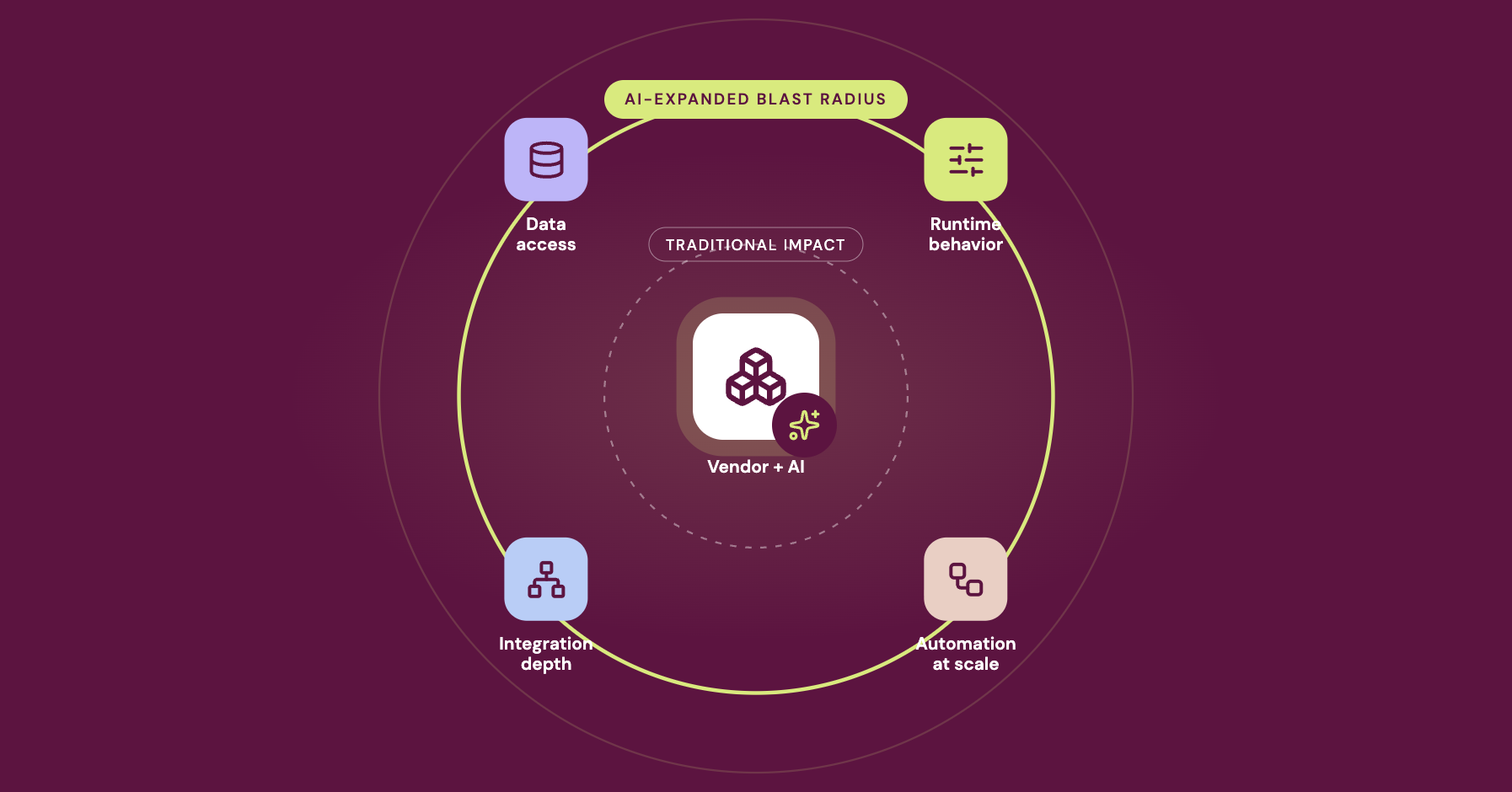
That logic remains sound. What is changing is not the principle of prioritization. It is what now determines blast radius of any third party. In an AI-embedded vendor ecosystem, exposure is increasingly shaped by:
- Breadth of data access
- Runtime behavior and configuration
- Automation at scale
- Integration depth across systems
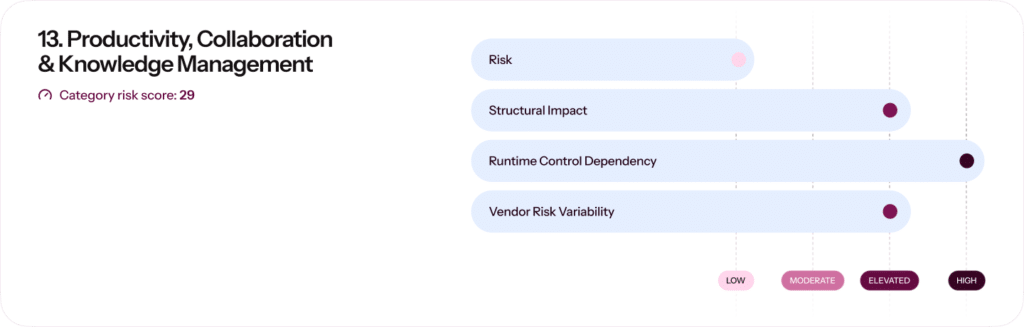
When AI capabilities are layered onto existing third-party tools, those tools behave differently, and risk management needs to change accordingly. Let’s look at vendor categories that scored high in Runtime Control Dependency in the Vendor Category Landscape, 2026, to observe how AI-related changes should affect risk assessments:
A platform that did not previously access data may start doing so due to AI integrations. For example, a collaboration tool may now embed AI assistants that summarize meetings, draft internal memos, analyze shared files, and respond to prompts using organizational knowledge.
Similarly, platforms that once only stored data may now ingest, analyze, generate, and act on it, often in real time. Some examples:
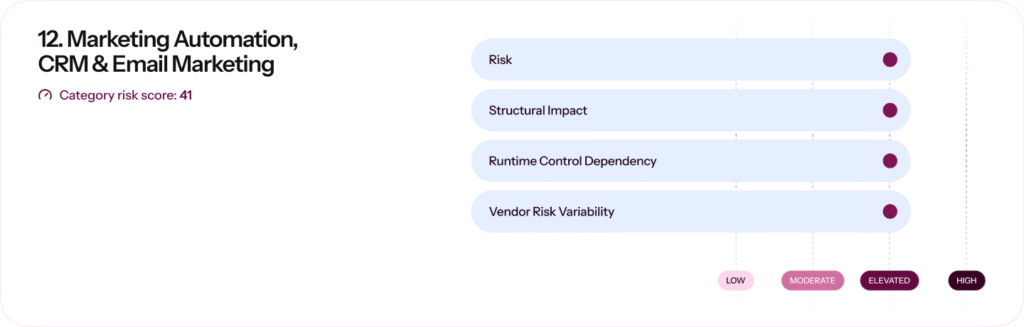
A CRM platform that auto-segments users and triggers outbound campaigns now depends on real-time data inputs, integration feeds, and configuration settings. A small change in segmentation criteria, API permissions, or workflow triggers can immediately result in unauthorized bulk communications, exposure of regulated customer data to the wrong audience, or contractual and regulatory breaches at scale—all without changing the vendor’s governance posture.
An HRMS that previously stored employee records may now use AI to screen resumes, automatically route applications, summarize performance data, and generate internal reports — thereby expanding data ingestion. Now, risk is a function of ongoing operational behavior rather than periodic review.
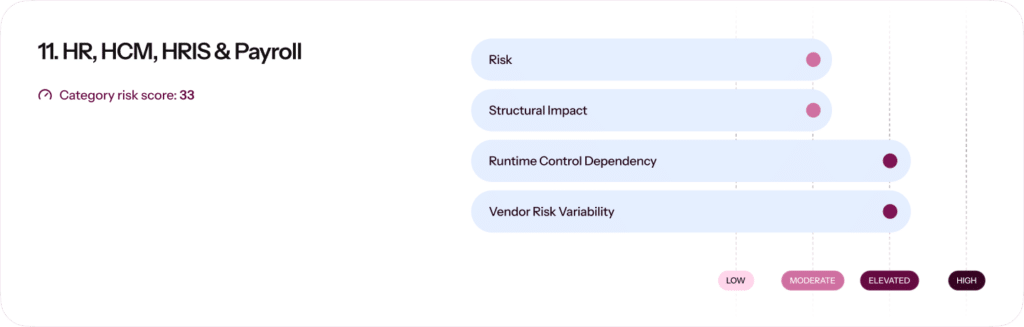
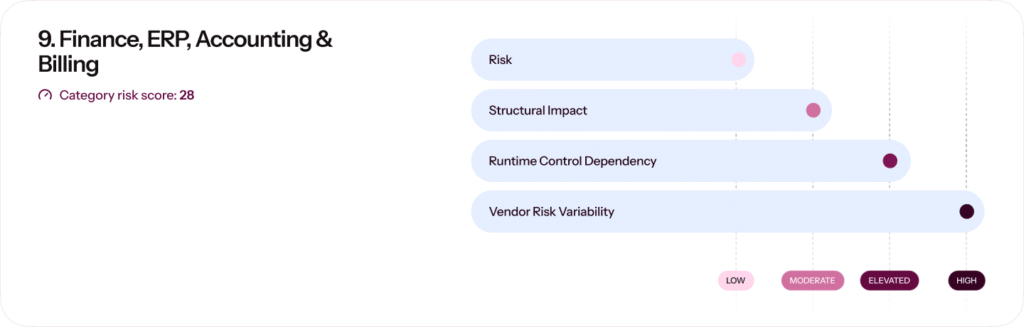
An ERP platform that once processed transactions may now use AI to auto-classify expenses, reconcile accounts, flag anomalies, and trigger downstream financial workflows without manual review. It is now sensitive to real-time transaction flows and integration state. Runtime monitoring becomes crucial.
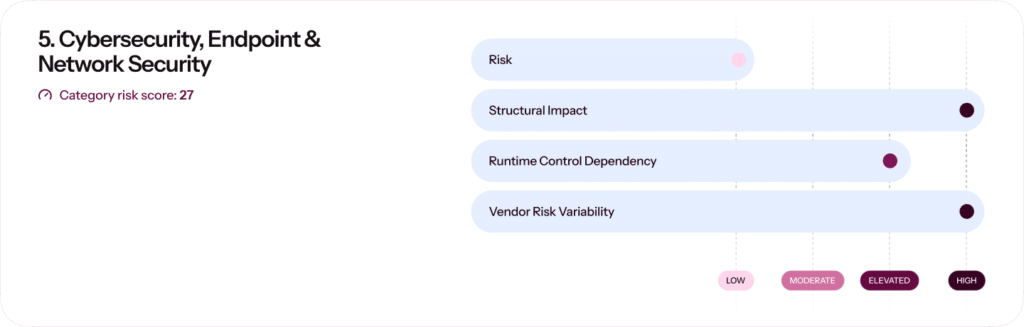
A cybersecurity platform that once generated alerts may now use AI to auto-triage incidents, recommend remediation actions, or trigger containment steps—shifting exposure from detection to automated response. The effectiveness and safety of that automation depend on runtime configuration and policy tuning.
| Blast radius is no longer defined largely by operational dependency alone. It is increasingly defined by how widely data can flow and how quickly automated decisions can scale impact. |
Vendor categories where AI-driven third-party risk calls for runtime monitoring
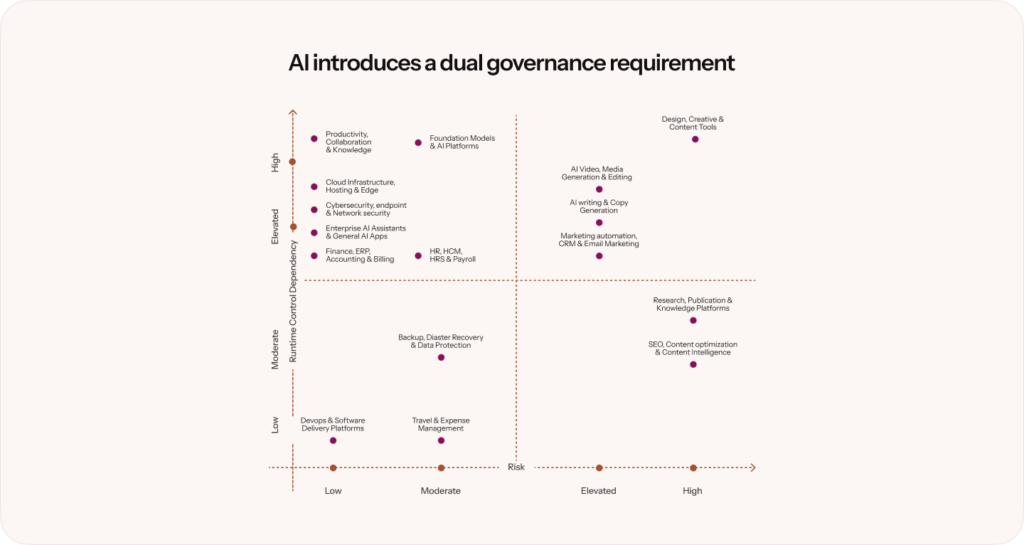
The Vendor Category Landscape 2026 examined 201 vendors across 16 categories and evaluated them across four dimensions:
- Governance maturity
- Structural impact
- Runtime control dependency
- Vendor risk variability
One of the clearest findings: runtime control dependency is rising across more categories than expected.
Enterprise AI Assistants and Foundation Models exhibit elevated and high runtime dependency, respectively, even when governance maturity does not appear extreme.
More importantly, this dynamic is not confined to AI-native vendors.
Categories such as:
- Marketing Automation & CRM
- Productivity & Collaboration tools
- HRMS & Payroll platforms
- Finance & ERP systems
- Endpoint & Network Security tools
- Cloud Infrastructure
are increasingly inheriting AI-related runtime exposure through integrations.
This means risk is shaped not only by vendor posture, but by:
- Internal configuration
- Usage patterns
- Integration architecture
- AI-enabled automation
That is a structural shift. Where once sustained monitoring may have focused on a limited set of infrastructure layers, organizations must now account for runtime dependency across operational systems that:
- Handle sensitive customer data
- Automate outbound communications
- Process employee and financial records
- Integrate deeply into workflows
The Vercel incident serves as a reminder: exposure can emerge through integration layers that sit adjacent to core systems—not necessarily inside them.
AI is rapidly expanding the vendor risk surface
Traditional backbone categories—Cloud Infrastructure, Cybersecurity, DevOps, Backup & Disaster Recovery—continue to carry high structural impact. Most organizations already treat them accordingly.
However, as we explored in the previous section, GRC teams are now dealing with a long list of vendor categories that require runtime oversight and management. AI layers have materially changed how third-party risk management must operate in these cases.
Your board, customers, and auditors are no longer asking, “Which vendors are critical?” They are increasingly asking, “How has AI changed the impact profile of vendors we once considered contained?”
And: “If runtime exposure shifts daily, how do we monitor and defend that exposure effectively?”
How to update your TPRM program for AI-era vendor risk
The findings of Vendor Category Landscape, 2026, aren’t calling for broader scrutiny everywhere, but more precise scrutiny where runtime behavior amplifies exposure.
Some categories remain structurally constant. Others have shifted materially due to AI integrations.
Understanding which is which—and why—is the starting point for recalibrating TPRM in 2026.
The full Vendor Category Landscape 2026 report offers a detailed analysis of Runtime Control Dependency across all 16 vendor categories studied, including median Risk scores for each category and analyses of Structural Impact and in-category Risk Variance. Download the full report to explore the category-level analysis in detail.
FAQs
Traditional TPRM evaluates vendors through periodic reviews focused on governance, compliance, and operational dependency. AI-related vendor risk changes faster than those review cycles because exposure now depends on runtime behavior, integrations, permissions, and automated decision-making. AI-enabled vendors can expand access and trigger actions dynamically, even when their governance posture appears stable.
AI-related vendor risk can include unauthorized data exposure, prompt leakage, excessive permissions, hallucinated outputs, automated actions at scale, insecure integrations, and shadow AI usage. In AI-enabled environments, even minor configuration errors can rapidly amplify exposure of customer, employee, or financial data.
AI integrations are significantly changing vendor risk across CRMs, collaboration platforms, customer support tools, developer platforms, HR systems, finance tools, cybersecurity products, and cloud infrastructure. These systems increasingly ingest, generate, and act on sensitive data through AI-driven workflows.
Shadow AI refers to employees using AI-enabled third-party tools, plugins, or copilots outside approved TPRM and security oversight. This creates AI-driven third-party risk because organizations may not fully understand what data is being shared, retained, or processed by those external AI systems.
In the context of AI-driven vendor risk, a high blast radius indicates that the AI-enabled system can rapidly spread impact across data, workflows, users, and connected systems. AI automation increases blast radius because errors, unauthorized access, or misconfigurations can scale instantly across integrated environments.
Runtime control dependency reflects the extent to which AI-driven vendor risk calls for real-time configurations, integrations, permissions, and automated behavior, rather than a static vendor posture alone. In AI-enabled systems, risk exposure can shift daily based on how tools are configured and used inside the organization.
Organizations should evolve TPRM programs for AI-related vendor risk by adding continuous runtime monitoring, integration visibility, AI usage governance, access controls, and automation oversight. AI-era TPRM also requires closer evaluation of how vendors process data, trigger actions, and interact with connected systems over time.

Author
Raynah
Raynah is a content strategist at Sprinto, where she crafts stories that simplify compliance for modern businesses. Over the past two years, she’s worked across formats and functions to make security and compliance feel a little less complicated and a little more business-aligned.Go beyond the surface and uncover the governance, risk, and compliance insights that actually matter.


Win digital goodies for boardroom success


Explore more


research & insights curated to help you earn a seat at the table.