


Most organizations already have, or are building, AI Governance in some form. Precisely 69.9% as per Sprinto’s CISO Pulse Check Report released earlier this year. Moreover, only 52.81% of GRC teams even track AI as a separate category, let alone ensure AI risk is being governed continuously.
But what happens to AI Governance when your security team is reviewing zero-day vulnerabilities? When your compliance team tied up with audit prep? When your HRMS vendor rolls out a new embedded AI feature?
That is an architecture problem.
| Many GRC (and allied) teams are struggling with AI Governance architecture. Here’s what we’re hearing | ||
| A Group AI Governance & Program Manager at a multi-brand enterprise with 14 companies and 20+ products said they’re trying to move from brand-level, fragmented governance to a single group-level AI Governance layer that connects Jira, SharePoint, custom dashboards, and evidence repositories. | An AI and IT governance owner at a large European software group said AI Governance cannot be split from IT governance because AI use cases move through business intake, governance review, development, production, and operations, and every stage needs evidence. | A governance leader at a $1B+ enterprise software group said the biggest problem isn’t the lack of an AI Governance process; it’s that the process is now too distributed across brands, tools, emails, and teams to stay under control. |
| An IT/security stakeholder at a health/life sciences company piloting AI Governance said their current AI use-case tracking is informal and manual, relying on people self-reporting through Teams, which makes a structured AI registry valuable. | A security/compliance owner at a SaaS company reviewing AI vendors and suppliers said they need AI-specific vendor questionnaires that adapt to a vendor’s risk profile, especially when public information is missing, outdated, or unreliable. | A compliance leader at a fintech/investment platform said AI monitoring raises employee privacy questions, so they need clarity on what data is collected, retained, hashed, or deleted before rolling it out. |
So, how can you build an AI Governance stack that is continuously active rather than periodically attended to?
This guide is for GRC practitioners who want to build just that. Not a policy document that gathers dust, but an operational function with controls that generate evidence, catch drift, and hold up under scrutiny, whether an audit is imminent or two years away.
If your organization has AI systems that interact with real users, influence real business decisions, or connect to live internal data, this applies to you now. Examples include a fraud detection model, a CV screening tool, copilots rolled out to staff, and a chatbot handling customer queries. On the other hand, if you are still evaluating or piloting AI tools with nothing in front of customers, nothing influencing business decisions, and nothing connected to live internal systems, use this guide to build the architecture before the systems arrive rather than after.
– Most organizations have AI systems running without a single team owning the full lifecycle risk, leaving gaps in AI risk management. This guide shows GRC and security leaders how to architect governance that is continuously active, not periodically attended to
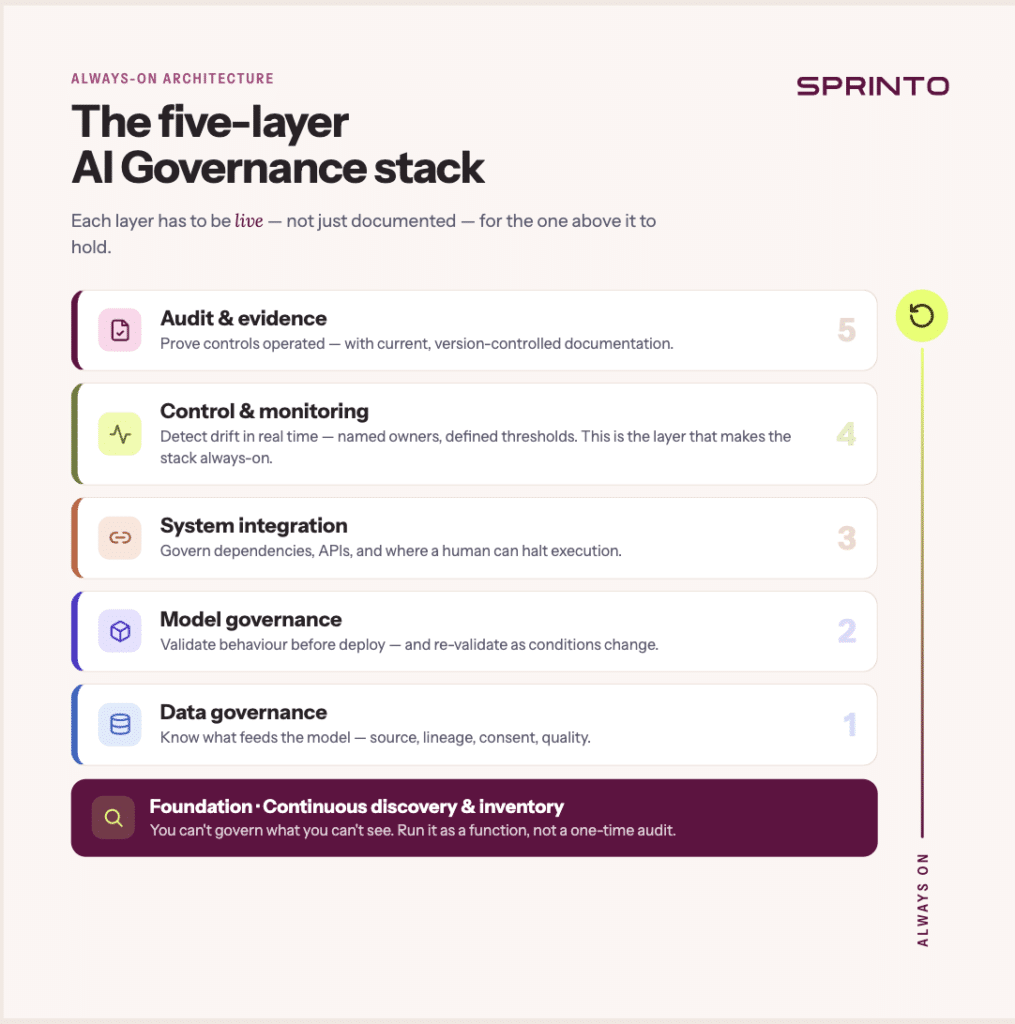
– The always-on AI Governance stack comprises five layers: Data, Model, System Integration, Monitoring, and Audit. Each of these must be live, not just documented, for the architecture to hold
– Before you try to get a budget or operational support, map every AI system against the five layers and score honestly which controls are actually running; that gap is your starting point and your business case
First off: Start with an AI Governance framework, but choose wisely
Before you design anything, anchor yourself to a standard. This is not box-ticking; it is a credibility strategy, a common reference point for you and other stakeholders, and the skeleton your always-on architecture will hang from.
EU AI Act: Choose this if you sell into European markets.
NIST AI RMF: This is a good option if your primary need is to build and operationalize an internal governance function.
ISO 42001: If you’re not targeting European markets but need to demonstrate AI Governance externally through a certifiable management system, this is a good choice.
Now you’re ready to start building your always-on AI Governance stack
Almost ready
Before you can govern AI, you need to be sure you’re tracking all the tools that touch your infrastructure and people.
If you cannot currently list every AI tool, model, and use case touching your infrastructure or your people, you need this before you can embark on actual AI governance.
Here’s a quick overview of how you can run gap-free AI inventorying:
| Source | Method | What it finds |
|---|---|---|
| Automated technical discovery | Browser extension monitoring | AI tools employees are accessing day to day |
| AI gateways and MCP gateways | Which models are being called and by which systems | |
| CASB | Cloud applications in use, including AI-enabled SaaS | |
| MDM | AI applications running on managed devices | |
| Code repo scanning | AI libraries and API calls to foundation model providers embedded in your codebase | |
| Foundation LLM provider logs | Which models your organization has active API relationships with | |
| System-driven discovery | Agent builder and workflow tools | Autonomous or semi-autonomous AI processes running inside your environment |
| Third-party integrations | SaaS tools with AI features enabled by default that were never explicitly reviewed | |
| People-driven discovery | Employee self-reporting | AI tools in use that automated discovery cannot reach: Teams building on top of models directly, shadow AI, personal API keys |
| Manual ingestion | Edge cases, legacy systems, and anything outside standard tooling coverage | |
| Ongoing continuous discovery | All of the above are running permanently | New tools onboarded without central review, AI features added silently to existing products, and employees accessing models outside sanctioned channels |
Tips for efficient, gap-free inventorying:
- Use both automated and manual testing methods
Automated methods like gateways, CASB, MDM, and code scanning give you coverage at scale. But they miss what they can’t see: a personal API key, a model buried three layers deep in a third-party integration, or an AI feature quietly switched on in a product update. People-driven discovery fills those gaps.
- Inventory use cases, not just tools
A single tool can power fifty use cases, each with its own risk profile. An AI copilot drafting internal emails is a different governance problem than the same tool summarising customer contracts or generating production code. What matters is what the AI is doing, for whom, and which decisions it influences, not just which tools are licensed. Also tag each use case by origin — built internally, bought and used internally, or built or deployed for customers. The obligations differ materially across these three, and conflating them is one of the most common gaps in early-stage AI Governance programmes.
- Structure it as a matrix, not a list
One vendor can power multiple use cases; one use case can draw on multiple vendors or models. As a consequence, inventory should showcase which use cases depend on which vendors, models, and data sources. That structure is what makes use-case-level risk assessment possible.
- Don’t treat this as a one-time exercise
New tools get onboarded, features get added silently, employees find ways around sanctioned channels, continuously. Discovery has to run alongside the governance stack, not precede it.
– Deploy automated discovery across all available channels Build a low-friction, self-report channel for employees to declare AI tools and use cases automated discovery can’t reach
– Inventory at the use-case level, capturing what the AI does, for whom, and which decisions it influences. Structure the inventory as a matrix linking use cases to vendors, models, and data sources
– Tag every use case by origin: built internally, bought and used internally, or built/deployed for customersRun discovery as a continuous function, not a one-time auditain dependency, not just the vendor name on the contract, and not just the application in front of the capability.
Now you’re ready to begin planning your AI Governance architecture in a true sense.
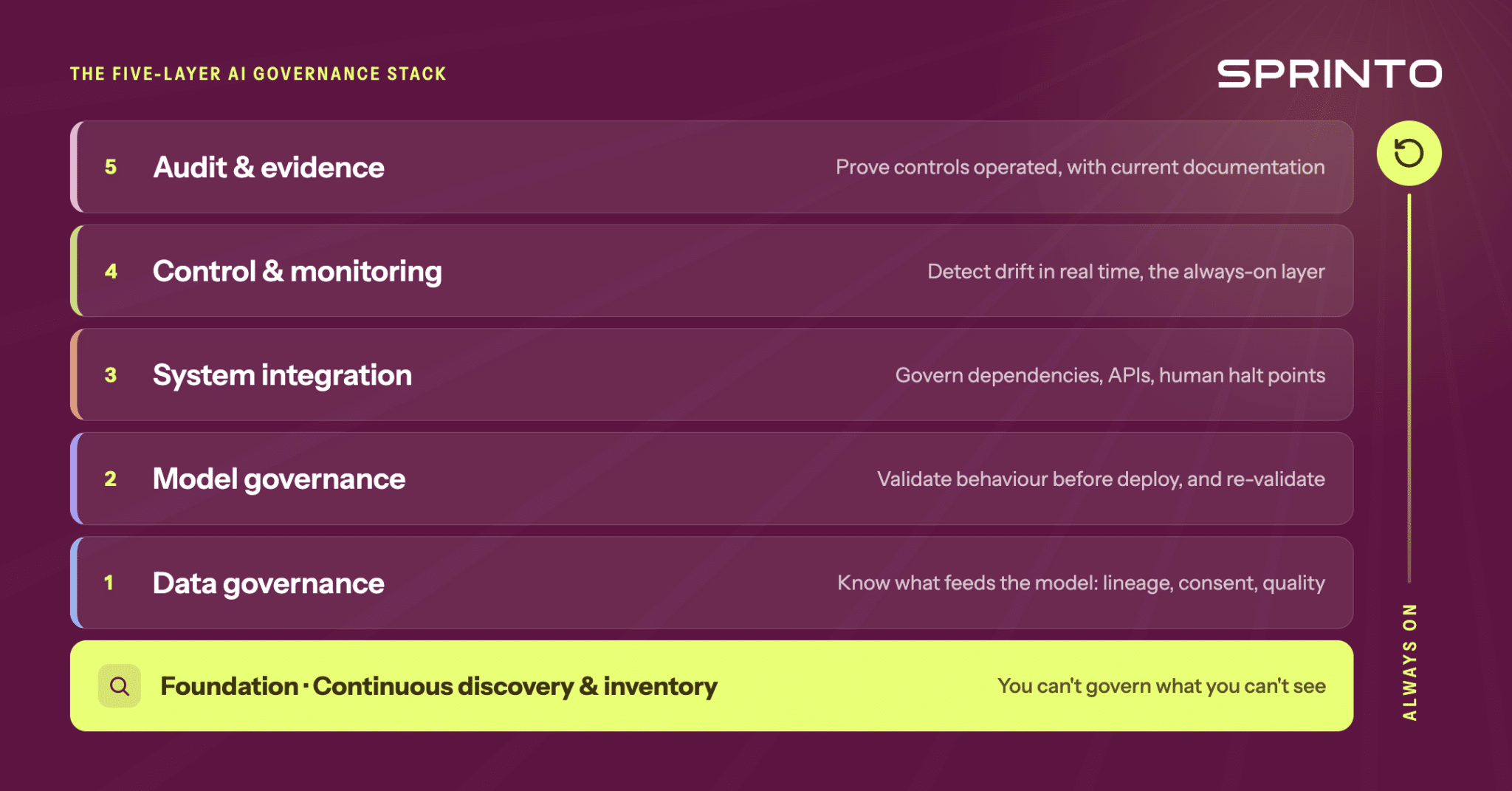
Think of your AI Governance stack as having five layers, each of which must be functioning before the one above it can hold.
Layer 1: AI data governance
You need AI data governance if any AI system in your organization is trained or fine-tuned on internal data, or if you are procuring AI tools without knowing what data they were built on.
Every AI system is downstream of data. Before you govern the model, you need to govern what feeds it. This means asking questions that GRC professionals should find familiar: Where does this data come from? What classification does it carry? Is there a consent trail? How is data lineage documented?
What changes in an AI context is that data quality problems can have delayed, often invisible effects. A bias introduced at the data ingestion stage may not surface as a visible output failure for months. Your AI Governance architecture should account for tools that let you trace a problematic output back to its training or fine-tuning data at any point, not just at deployment. The tools you need to achieve this depend on the kind of model you’re using. For out-of-the-box models, your obligations center on what data is sent to the model at inference. For models you train yourself, you need a full assessment of the training datasets themselves, including provenance, consent, representativeness, and the biases they may introduce.
– Establish data cards or datasheets for every AI training dataset. They should cover what it contains, where it came from, and what exclusions or transformations were applied
– Define data quality thresholds before model development begins, not after a problem surfaces
– Require lineage documentation as a non-negotiable condition of any AI procurement contract
Layer 2: AI model governance
You need AI model governance if any AI system is making or influencing decisions (about customers, employees, transactions, risk, or anything important) without a formal validation process before or after deployment.
Once you have visibility into the data, you need a process to validate that models actually behave as intended and continue to do so as conditions change.
This is where many organizations are entirely unprepared. They run a proof of concept, the outputs look reasonable to the team that commissioned it, and the model goes to production with no formal validation gate.
AI model governance closes that gap by establishing what “good” looks like before deployment or procurement, and defining the conditions under which a model must be revalidated rather than assumed to remain good.
However, before any validation work begins, each declared use case requires its own risk assessment. This should cover questions like: What is the worst plausible failure for this specific use case? Who is affected if it fails? What decisions does it influence? What level of human oversight is appropriate? The answers determine what validation rigor is required, and they differ materially by use case, not just by model.
Pro tip: Agentic AI systems require additional scrutiny at this layer. Their model governance considerations are materially different from systems that produce outputs for human review.
– Require a model card for every AI system before production approval, showing purpose, performance metrics, known limitations, and intended use.
– Conduct bias and fairness assessments aligned to the specific risk context of the use case (The same model can be entirely appropriate for one use case and introduce material bias risk in another).
– Establish performance baselines at deployment against which future drift can be measured.
– Define re-validation triggers, i.e., the conditions under which a model must be formally reviewed again, rather than assumed to still be fit for purpose.Build vendor review cadences into contracts, not just at onboarding but at defined intervals throughout the relationship.
Layer 3: AI system integration governance
You need AI system integration governance if any AI system is connected to live data, internal APIs, or other software systems, rather than running in isolation.
AI systems sit inside larger technical architectures, depend on APIs and data pipelines, and interact with other software systems in ways that change their own governance risks.
AI system integration governance is about understanding those dependencies and the risks they introduce, and keeping that understanding up to date as architectures evolve. A model that performs well on a test set may behave differently when it receives inputs in unexpected formats, when upstream data pipelines lag, or when it is integrated with a system that amplifies its outputs without human review in the loop.
If your organization is deploying or evaluating agentic AI, your system integration governance needs to explicitly address where in the pipeline a human can halt execution, which actions agents are permitted to trigger without approval, and the rollback mechanism if an agent produces a harmful outcome. Designing these controls after deployment is significantly harder than designing them before.
Pro tip: AI dependency mapping should also include model-access continuity: what breaks if a model, vendor API, region, or feature becomes unavailable, restricted, deprecated, or materially changed.
This layer requires close collaboration with architecture and engineering teams, maintained through regular touchpoints rather than a single pre-launch review.
– Maintain documented system architectures with AI components explicitly identified, and update them as the system changes, not annually.
– Define integration test requirements that cover failure modes as well as normal operation.
– Assign clear ownership of every AI component within the broader system.Design human oversight mechanisms, (i.e., the points at which a human can review, override, or halt AI-generated outputs) into the architecture from the start, and test them periodically to confirm they are actually working.
– Define an explicit offboarding process for AI systems being decommissioned, covering data retention obligations, access revocation, and audit trail preservation. Governance obligations do not end when a system is switched off.Map model and vendor dependencies for every AI-enabled workflow, including fallback options if a model is deprecated, restricted, region-blocked, or suddenly unavailable.
Layer 4: AI control and monitoring
You need continuous monitoring if any AI system is used by real users, influences real decisions, or is connected to live data, and nobody is formally responsible for detecting when it starts behaving differently.
This is the layer that makes the stack always on. Everything else creates the conditions for the safe use of AI; this layer is what actually detects when those conditions no longer hold.
Monitoring here means two distinct things: system monitoring that covers configuration, access, and state, and transaction-level monitoring of every AI-related interaction at your organizational boundary: employees accessing AI tools through browsers, model calls through MCP and AI gateways, AI applications on managed devices, and staff using organizational credentials to sign into third-party tools that may never have been formally reviewed. Both are required, and neither substitutes for the other.
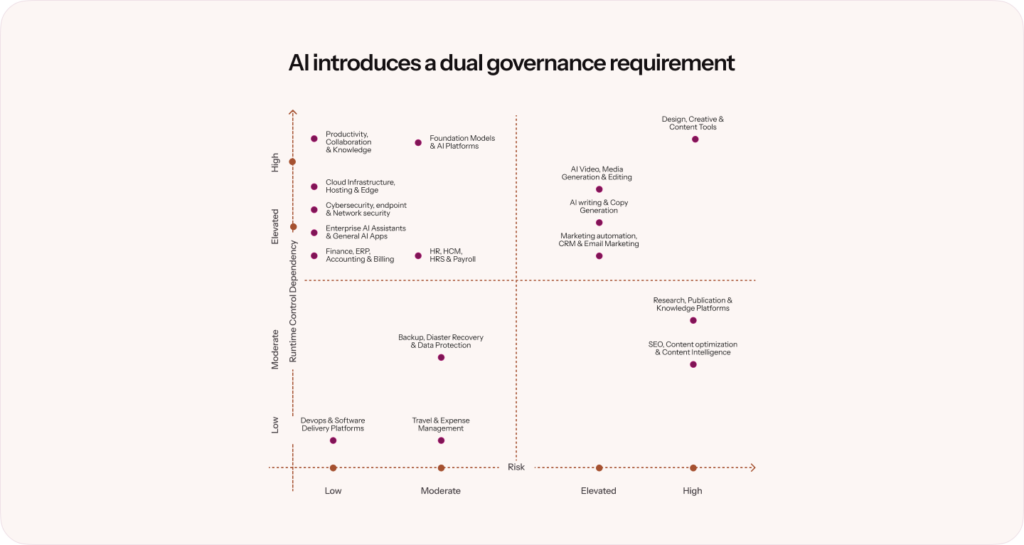
| A study of 201 vendors across 16 categories shows the large number of vendors that require runtime monitoring in native AI and “non AI” categories (that have inherited AI risk due to integrations and AI features). |
Pro tip: The operational ownership question is critical here. Monitoring that nobody watches is noise. This layer requires a named team with defined response obligations, not just read access to a dashboard.
– Define what you are monitoring and set detection thresholds before go-live, not after the first incident.
– Build performance monitoring that tracks output quality metrics over time, not just system uptime.
– Implement anomaly detection on input distributions. A sudden shift in the kinds of queries a model receives is an early warning signal.
– Distinguish between system monitoring and transaction-level monitoring of individual AI outputs and ensure both have named owners and defined thresholds.Establish incident logging for unexpected or harmful outputs with a clear escalation path.
– Assign named owners with defined response SLAs, not just visibility into the monitoring dashboard.
Layer 5: AI audit and evidence gathering
You need AI audits and related evidence-gathering tools in your AI Governance stack if you would struggle to demonstrate to a regulator or auditor today that your AI systems are under control.
The top of the stack is what transforms a collection of controls into a defensible governance program. The logic is the same as in audits and evidence everywhere else: you need to be able to demonstrate, after the fact, that your controls were in place, that they operated effectively, and that, when problems occurred, you identified and addressed them.
What makes this layer critical to an always-on stack is that the documentation must reflect the current state of your systems, not their state at launch. AI evolves too fast for that. The regulatory stance, including the EU AI Act, is explicit about this: technical documentation for high-risk systems must cover intended purpose, performance metrics, data governance practices, monitoring architecture, and human oversight mechanisms, and it must be kept current. But even without a regulatory requirement, documentation that describes a system as it was eighteen months ago is not governance that will build trust with customers or your board. It is a historical record.
– Build your documentation architecture as infrastructure, not as a project deliverable, but as a living record that is updated as systems change.Version-control all governance documentation so you have a traceable history of how systems and controls have evolved.
– Define review intervals for all documentation and treat them as operational commitments, not aspirational targets.
– Treat evidence generation as a byproduct of the governance process. If producing evidence requires a separate effort, the process is not designed correctly. This is an extension of Layer 4. Build evidence collection as a continuous output with a defined check-and-fix loop, not a log that is reviewed retrospectively, but a process that surfaces gaps in real time and tracks their resolution
To see where your organization currently sits in terms of AI Governance, take a minute to go through Sprinto’s AI Governance Maturity Calculator. It covers the seven areas that matter most—from AI inventory and human-in-the-loop controls to vendor ecosystem visibility and external transparency—and tells you whether your governance is developing, maturing, or advanced. Try it now.
Starter kit for thinking through your AI Governance stack
- Where to start
The always-on AI Governance stack can feel like an ambitious architecture to present to a leadership team that is still debating whether AI Governance needs its own function at all. Map every AI system currently in production against the five layers, and honestly score which layers are live versus assumed.
Most organizations doing this exercise for the first time find that Layer 4 and Layer 5 are almost entirely absent. Monitoring exists in some form, but nobody owns the threshold decisions or the escalation path. Documentation exists from the procurement or launch phase, but has not been touched since. That gap between the controls that were designed and the controls that are actually running is your starting point and your business case.
- Tackling the alignment conversation
The way to get an always-on AI Governance stack funded and supported is not to lead with frameworks or compliance obligations, although both matter. It is to make the risk legible to people who are accountable for it.
Your board and your C-suite are already being asked to sign off on AI deployments. What most of them do not yet have is a clear answer to three questions: Which of our AI systems could cause us material harm if they fail or behave unexpectedly? Do we have the controls in place to detect that before it becomes an incident? And if something goes wrong tomorrow, can we demonstrate we were governing it responsibly?
The five-layer AI Governance stack is the architecture that makes those questions answerable. Frame it that way, not as a compliance program, but as the operational infrastructure that lets the organization use AI ambitiously because the risk is genuinely understood and continuously managed. That is a conversation that lands differently than a NIST alignment exercise.
If you need data to make the always-on case to leadership, Sprinto’s Vendor Category Landscape 2026 offers a useful anchor. Across 201 vendors and 16 categories, a significant portion now score high in runtime control dependency, meaning exposure is shaped not by vendor posture alone, but by how tools are configured, integrated, and used internally. Static assessments, the report concludes, are insufficient in a runtime-dependent environment. That is the always-on argument made in numbers.
- Sprinto can help operationalize an always-on AI Governance stack
Here’s how Sprinto helps you at each layer:
At the data governance layer, Sprinto helps teams build stronger foundations by connecting AI-related controls, checks, policies, and evidence to the underlying compliance system. Its AI-ready data layer is designed to give AI capabilities consistent context across GRC entities, so teams can work from structured, reliable governance data rather than scattered records.
At the model and vendor governance layer, Sprinto supports AI-powered vendor due diligence, security questionnaire analysis, risk-to-control mapping, and policy-to-control mapping. This helps teams evaluate third-party AI systems, surface risk signals from vendor documentation, and connect those findings back to the right controls and remediation workflows.
At the system integration layer, Sprinto’s control-to-check mapping links real-time system checks to controls, helping organizations move from point-in-time governance to continuous compliance monitoring. AI Playground also lets teams create custom AI actions across policies, risks, evidence, vendors, and other GRC areas without engineering support.
At the control and monitoring layer, Sprinto AI helps detect gaps earlier through evidence gap analysis, policy gap assessments, vendor due diligence insights, and risk-control recommendations. Coming soon, Sprinto plans to expand this with proactive agents, policy drift detection, 360° risk identification, monitor fix suggestions, and external configuration fix guidance. These roadmap items are subject to change, but they point toward a more self-healing governance model where issues are detected and routed before they become audit blockers.
At the audit and evidence layer, Sprinto helps teams keep governance defensible by turning control activity into reviewable evidence. Evidence Gap Analysis flags missing, outdated, or irrelevant evidence during uploads, while upcoming pre-audit evidence review and browser-based evidence collection aim to make audit preparation more continuous and less manual.
The result is an AI Governance stack that does not depend on someone remembering to check every layer manually.
Further reading: Future-proof your AI Governance program.
FAQs
Start with discovery and Layer 1. You cannot govern what you have not found, and you cannot govern a model without governing the data that feeds it. Once you have an inventory and basic data governance in place, move to Layer 4, i.e., monitoring, before you perfect Layers 2 and 3. The reason is that monitoring tells you when something is wrong. Operating without it means problems surface through incidents rather than controls. Layers 2, 3, and 5 can be built out progressively alongside live operations. Don’t wait for a perfect stack before going live. A partial stack that is actually running is more defensible than a complete stack that exists only on paper.
In practice, all four have a role, and that is precisely the problem. When ownership is distributed without a named function at the center, AI Governance defaults to nobody. IT buys the tools, legal reviews the contracts, security assesses the vendors, and engineering ships the features. Nobody is looking at the full lifecycle risk. The AI Governance function needs a named owner who sits within GRC or a dedicated AI risk function, and has the authority to set standards, require evidence from other functions, and escalate when controls are not operating as intended. The other functions become stakeholders, rather than owners.
You do not need a separate program, but you do need extensions to your existing one. ISO 27001 governs information security, confidentiality, integrity, and availability of data and systems. AI Governance adds dimensions that ISO 27001 does not cover: model behavior, output quality, drift, bias, explainability, and the specific risks of autonomous decision-making. ISO 42001 is designed to sit alongside ISO 27001 and extend it for AI systems. NIST AI RMF is designed to integrate with existing risk management programs rather than replace them. The practical approach is to map your existing controls against the five layers, identify the gaps, and build AI-specific extensions into your existing governance architecture rather than building a parallel system.
There is no universal answer, but there are clear triggers. Re-validation should happen when the model is updated or fine-tuned, when the data it operates on changes materially, when the use case expands beyond its original scope, when performance metrics drift beyond defined thresholds, or when the regulatory context changes. For monitoring, thresholds and escalation paths should be reviewed at least quarterly, not because the technology demands it, but because operating environments change and yesterday’s thresholds may not be catching today’s drift. For high-risk use cases, re-validation should be more frequent and formally documented. For lower-risk use cases, a lighter-touch review cadence is defensible, provided the monitoring layer is genuinely active.
Layer 1: Data inventories, lineage documentation, consent records, and data quality thresholds defined and evidenced
Layer 2: Model cards, bias assessments, performance baselines, re-validation records, and vendor contract terms, including no-training clauses
Layer 3: System architecture documentation showing AI components, integration test results, evidence that human oversight mechanisms exist and have been tested
Layer 4: Monitoring dashboards, threshold definitions, incident logs, escalation records, named owners with defined response obligations
Layer 5: Version-controlled documentation reflecting the current state of each system, evidence that controls were operating continuously, not just during an audit window, and a clear record of how identified issues were resolved
The common failure mode is documentation that describes the system at launch rather than as it currently operates. Auditors are increasingly aware of this gap and will ask for version histories and recent evidence, not just policies.
Yes. The five-layer stack applies regardless of whether you build or buy. When you use a third-party AI tool, you inherit the governance risk of that tool; you do not transfer it to the vendor. You still need to know what data is being sent to the model, whether that data is being used for training, how outputs are reviewed before they influence decisions, and whether you can demonstrate all of the above to an auditor or regulator. In some respects, bought AI is harder to govern than built AI because you have less visibility into the underlying model, less control over updates, and less ability to run your own validation. The vendor risk sections of Layers 2 and 3 exist precisely because of this dynamic.

Author
Raynah
Raynah is a content strategist at Sprinto, where she crafts stories that simplify compliance for modern businesses. Over the past two years, she’s worked across formats and functions to make security and compliance feel a little less complicated and a little more business-aligned.Go beyond the surface and uncover the governance, risk, and compliance insights that actually matter.


Win digital goodies for boardroom success


Explore more



research & insights curated to help you earn a seat at the table.