What Is AI Governance and Why Do You Need It?


AI is scaling faster than any technology before it, and every function it touches is being reshaped in real time. As adoption accelerates across your org, the responsibility to govern it lands exactly where it always does: on the desks of GRC teams, InfoSec leads, and CISOs. The technology is new. The accountability structure is not.
And as Ross Haleliuk noted in his RSAC 2026 recap, the rate of change and the rate of AI adoption have made it so that this year, AI governance is a solidly funded line item in a CISO’s quarterly plan. It is no longer a panel-topic curiosity. It is a serious thing being actively tackled.
So let us answer the two questions that actually matter: what is AI governance, and why is every serious GRC function suddenly racing to set one up?
What is AI governance?
At a fundamental level, AI governance is the process of establishing the policies, controls, owners, and evidence needed to use AI responsibly within your organization.
That means governing how AI tools are adopted, what data flows into them, who has access, what decisions they inform, and whether there is real oversight around that usage. Teams embedding AI in their own products carry an extra layer of responsibility around model behavior, training data, output quality, and human-in-the-loop review.
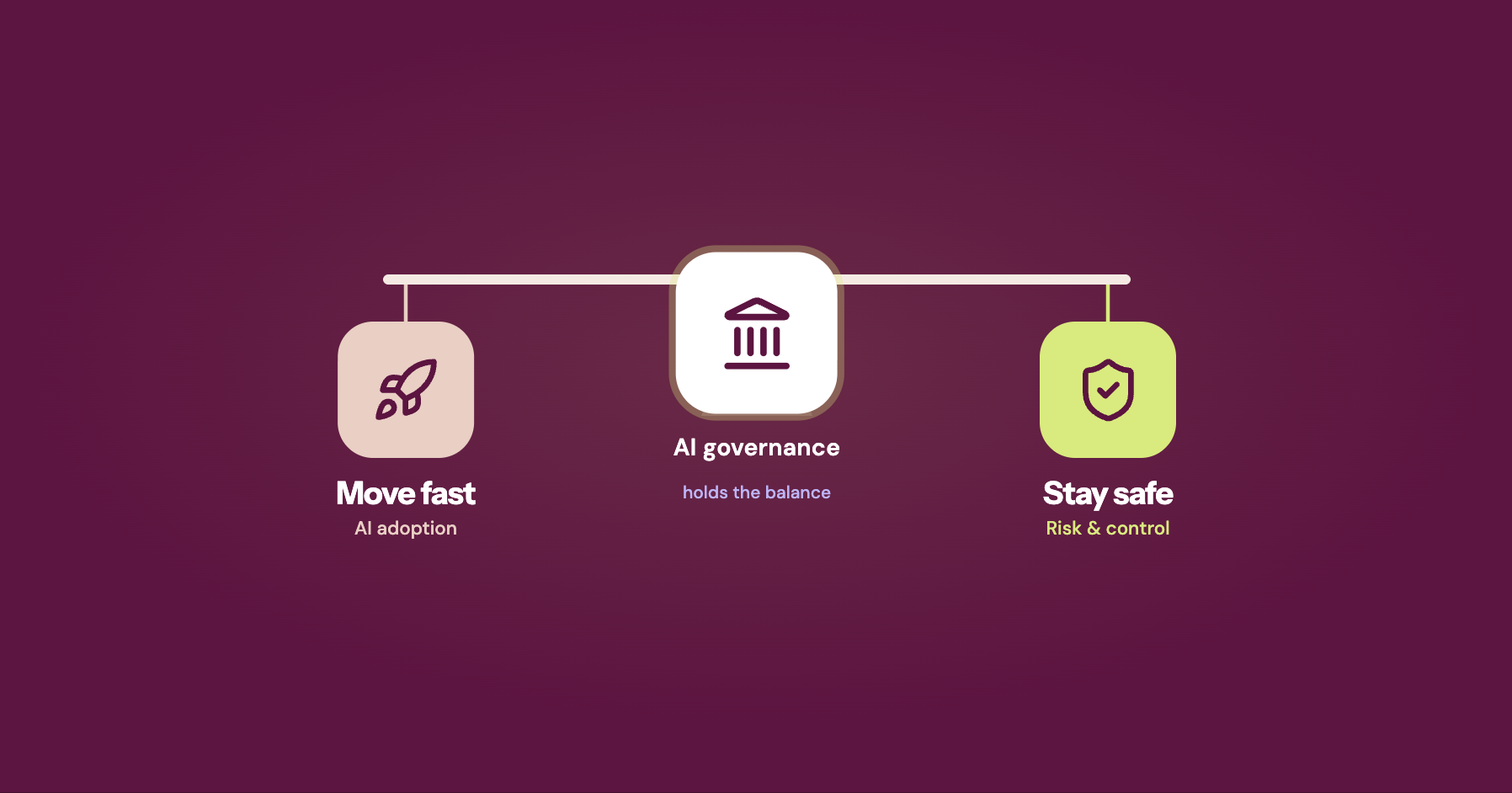
While AI governance frameworks, checklists, and best practices exist to structure all of this, the underlying work comes down to a balance every GRC team already knows: mitigate risk without slowing the business down.
The challenge is that AI moves faster than traditional controls were designed to handle. Tools and features are flowing into the business and bringing risks that most frameworks were never scoped for: data leaking into public models, vendors quietly enabling AI capabilities without disclosure, auditability gaps where no evidence trail exists, and outputs that sound authoritative but may not be reliable.
Why you need AI governance
From our conversations with CISOs and GRC professionals and broader industry discussions in 2026, the same six pressures keep surfacing.
1. Employees are already using AI. You just cannot see most of it.
Shadow AI is the most immediate reason GRC teams are standing up governance programs. AI is embedded in daily work across nearly every organization, yet almost none have a usable inventory of where, how, or by whom it is used. The risk surface is invisible by default, and it is growing every week.
Andrew Walls, VP analyst at Gartner, told CSO Online in 2026 that “every CISO I talk to has discovered some form of shadow AI.” Three in four CISOs have already found unsanctioned GenAI tools running inside their environment. Another 16 percent do not know whether they have the problem at all.
The instinct to lock it down is the wrong response. As Diana Kelley, CISO at Noma Security and former CTO at Microsoft, said on a Sprinto webinar, “Most shadow AI use is coming from good people trying to optimize their work. Your job isn’t to tell them to stop, it’s to understand what business process they’re trying to improve and then point them toward approved tools and safe environments.” Senthil Kumar Ayyapan, CISO at Ocrolus, made the same point on the call: “You can’t stop people from using AI. You have to embrace it safely.”
Governance is what makes both possible at once. It surfaces the shadow AI you currently cannot see, brings sanctioned tools into a controlled environment where people can actually use them, and keeps evidence that the controls hold. The alternative is the two-bad-options trap: ban AI and watch employees route around it, or accept invisible risk and let the next audit find it for you.
2. Your vendors are quietly becoming AI vendors
The fastest-growing AI risk surface is not in systems built in-house. It is sitting inside vendors that were onboarded long before AI was on anyone’s questionnaire. One of the GRC leaders we spoke to framed it this way: “In TPRM, we just do not know which of our vendors are becoming AI vendors and which are not.”
For example, a product onboarded a year ago could have shipped a copilot feature. A CRM could have quietly added a generative summarization feature. None of these risks were ever covered in the original vendor questionnaire, which means that these new risks are outside the TPRM process by default.
Detecting that drift is what an AI-aware TPRM process exists to do. The questionnaire is updated to cover the AI questions that matter—whether the vendor uses your data to train its models, retention windows and opt-out, notification when AI features ship or change, subprocessor and underlying model dependencies, and incident response—and reviews re-trigger when a vendor enables a new AI feature.
This is the highest-volume use case GRC teams currently ask for help on, and it is why automated AI vendor discovery and continuous third-party risk monitoring sit at the core of the Sprinto Autonomous Trust Platform.
3. Static workflows cannot keep up with how fast AI risk moves
AI moves faster than almost any technology we have seen. Models get updated overnight. Vendors turn on generative features without telling anyone. New regulations drop with little warning. The gap between “something changed” and “we have a control for it” is now measured in days, not quarters.
As Senthil Kumar Iyyappan, CISO at Ocrolus, summed up on one of our webinars: “The risk landscape, compliance requirements, and regulatory environment are constantly evolving. Static workflows simply can’t keep pace.”
That is exactly why teams are folding AI governance into a continuous-monitoring posture. Sprinto’s AI Pulse Check Report, built on responses from 103 CISOs, found that two out of three organizations still take longer than a week to push a control or policy change after spotting a new AI risk. That delay is exactly what a structured program closes.
4. Regulators have stopped asking nicely
In 2026, the regulatory landscape is shaping up such that AI governance is no longer optional. A patchwork of regulations is emerging, with the EU AI Act as its centerpiece. Its high-risk obligations take effect on 2 August 2026, with full enforcement and fines, and the General Purpose AI obligations have been live since August 2025. The rest of the world is filling in around it, from Singapore to the US.
The direction is clear: AI compliance is on its way to being legally required everywhere. But the on-ground gap is not awareness. According to Sprinto’s AI Pulse Check Report, nearly 70 percent of CISOs say they are tracking these regulations and actively preparing for them. The gap is execution. Roughly 40 percent have an AI usage policy that exists on paper but is not enforced, and only 21 percent have controls that block sensitive information from being uploaded to public AI platforms.
5. Your customers want proof, not promises
Enterprise buyers and auditors have already rewritten their due diligence playbooks. The questions moved on from “Do you use AI?” to “Show me the policy, the data flow diagram, the data handling practices, and the AI-specific incident response plan.” For anyone selling into regulated industries, this is showing up on renewal cycles right now.
The deeper shift is the more interesting one. As Sprinto’s Proving AI Trust analysis put it, “trust only creates value when it is demonstrable.” The leading organizations are not stopping at internal policies. They are making AI governance public, modular, and easy to inspect, so a customer can self-serve the answer to “Is your AI safe to use?”
Dropbox publishes an AI transparency page that names underlying model providers, lays out a 90-day retention window, and explicitly states that customer data is not used for third-party training. Notion clarifies its model dependencies in writing and contractually restricts subprocessors from training on workspace data by default. Autodesk publishes a Trust Center that documents its AI principles.
The cost of not having governance is not just regulatory exposure or sales velocity. It is the inability to prove trustworthiness on the buyer’s timeline.
What an AI governance program looks like in practice
For teams getting ready to build a program from the ground up, the work splits into two phases that mirror how mature programs actually run.
Sprinto’s 12-step blueprint for AI governance walks through both phases in detail. It covers what gets inventoried first, how the AI risk council is structured, where policy meets enforcement, how decision criticality drives oversight, and how to keep the program live as the AI footprint shifts underneath you. If you are standing this up from scratch, it gives you a concrete picture of how the work runs end to end.
Phase one is foundational. This is where the inventory gets built. You start by mapping every AI tool in use across the business, tracing what data flows into each one, who has access, and what breaks if it fails. That means vendor copilots, sanctioned platforms, and the long tail of tools employees signed up for on their own. From there, ownership lands with a cross-functional AI risk council that pulls from legal, privacy, product, engineering, and compliance, because no single function has the full picture. Policy follows: what data each tool can touch, when it can advise, and when it can decide. And then the hard part, moving all of that from paper into enforcement.
Phase two is behavior and decision governance. Once the foundation is in place, the work shifts to keeping the program live as the AI footprint changes underneath you. New unsanctioned tools get caught and triaged. Vendors get re-assessed when they ship new AI features. AI tools are classified by decision criticality, and customer-facing automated decisions earn far more scrutiny than internal advisory uses. Humans in the loop are trained to challenge outputs and watch for automation bias. Audit-ready evidence is collected continuously rather than at audit time, and AI failures are treated as governance events with a structured response, post-incident review, and clear ownership.
Conclusion
Every GRC team is navigating the same challenge in 2026: your org wants to move fast with AI, and the risk function needs to make sure that speed does not accelerate faster than governance. AI governance is what sits in the middle. It gives the business a safe, governed path to adopt AI productively while giving GRC the visibility, evidence, and controls to manage what comes with it. The organizations that get this right are making AI adoption sustainable through proper governance.
Author
Srikar Sai
As a Senior Content Marketer at Sprinto, Srikar Sai believes good content should be bookmark-worthy by default. He writes about cybersecurity and GRC, aiming to move the needle with every piece. He’s also an ISO 27001-certified Lead Auditor.Go beyond the surface and uncover the governance, risk, and compliance insights that actually matter.


Win digital goodies for boardroom success


Explore more


research & insights curated to help you earn a seat at the table.