What AI Risks Exist Today? A Guide for GRC Teams in 2026


Most GRC teams don’t need another reminder that AI risk is real. Given the breakneck pace of AI adoption, they probably have a closer seat to the problem than anyone else in the organization.
Sprinto’s CISO AI Pulse Check Report found that three in four CISOs have already discovered unsanctioned AI tools inside their environments, and over 30% of organizations experienced a major AI-related security incident in the past 12 months.
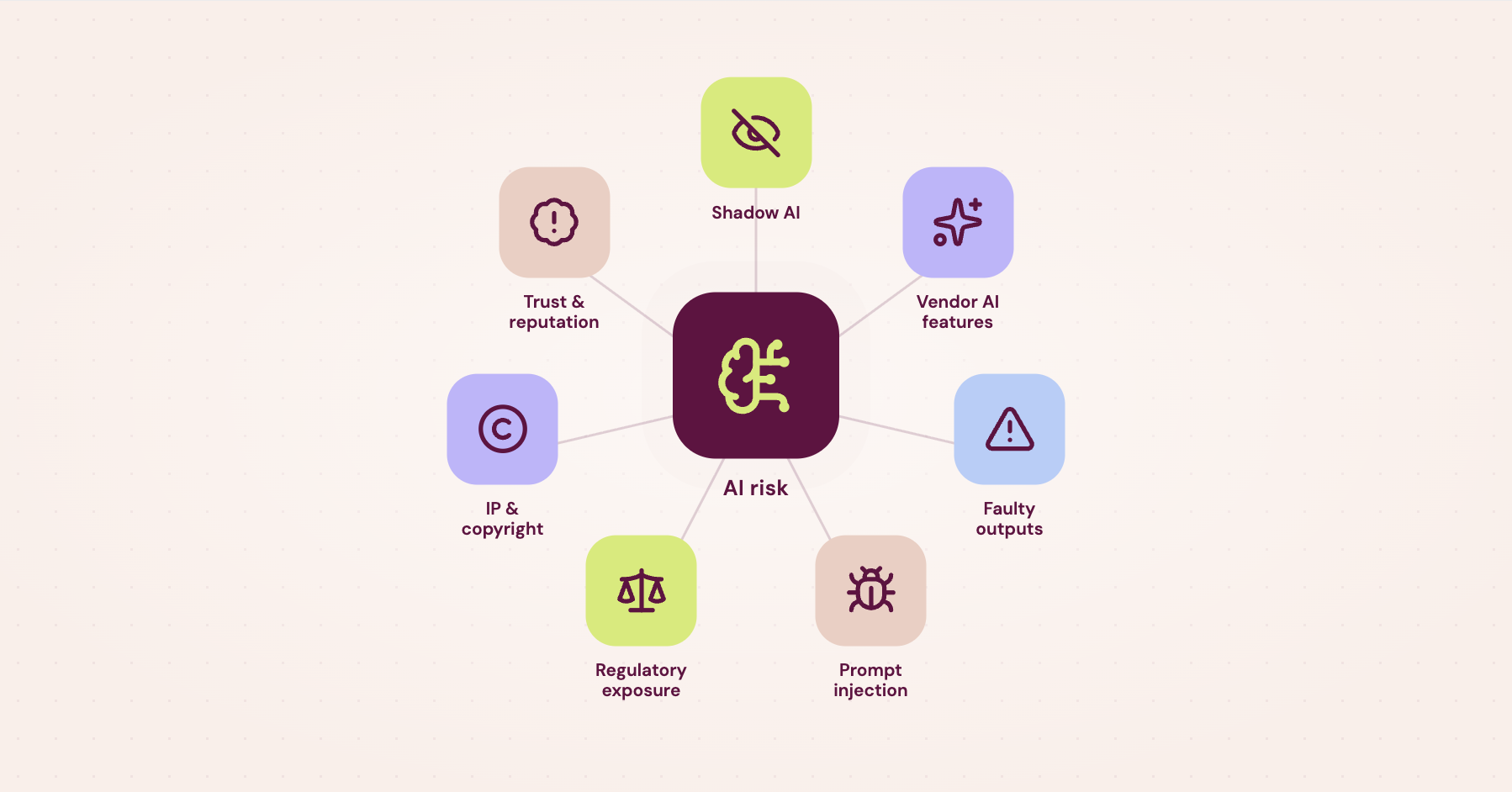
What the report also made clear is that AI risk isn’t one problem. It’s complex and multilayered, and it shows up differently depending on which part of the organization you’re looking at. So we decided to break down the most common categories of AI risk, how each one affects organizations in practice, and what GRC teams can actually do about them.
1. Data exposure through unsanctioned AI use
If you’ve been in security for any stretch of the past two years, you already know employees are pasting things into AI tools they shouldn’t be pasting things into. That part isn’t new. What’s worth paying closer attention to is the scale and the motivation behind it.
This behavior is commonly referred to as Shadow AI—the use of AI tools, models, or automation systems without the organization’s IT or security teams’ approval, oversight, or visibility. Much like shadow IT, it emerges when employees adopt tools faster than governance processes can keep up.
A January 2026 survey by BlackFog of 2,000 enterprise workers found that 49% are using AI tools not sanctioned by their employer, and 86% are using some form of AI at least weekly. The inputs aren’t trivial. 33% admitted to sharing research or datasets, 27% shared employee data like salaries or performance information, and 23% shared company financials.
And here’s the part that should reframe how you think about the problem. 60% of those workers said using unsanctioned AI was worth the security risks if it helped them meet deadlines. Senior leaders aren’t exempt. 69% of C-suite respondents prioritized speed over security.
The risk runs in two directions. That data may be retained by the AI provider, used to train future models, or surfaced in another user’s session. And your organization has no record of which information went where, which makes incident response, audit defense, and regulatory disclosure far harder when the question eventually comes up. IBM’s Cost of a Data Breach Report 2025 found that organizations with high levels of shadow AI faced $670,000 more per breach on average compared to those with low or no shadow AI usage.
| “The employees sharing sensitive data with unsanctioned tools aren’t doing it maliciously. They’re doing it because no approved alternative is fast enough. The governance gap is really a supply problem.” A GRC leader, in conversation with the Sprinto team |
This is what most teams call shadow AI, and it sits at the top of nearly every AI risk register in 2026. But here’s what the teams actually making progress on this have figured out. When approved alternatives are provided, unauthorized use drops by as much as 89%. The fix isn’t another policy memo. It’s giving people something sanctioned that’s fast enough to actually use, with real controls between sensitive data and public model providers.
2. Emerging AI features in the vendor ecosystem
This one catches even well-run programs off guard. The vendor you assessed 18 months ago may have looked nothing like an AI company at the time. Since then, it may have embedded a generative layer into its core product, started routing customer data through a third-party model, or launched an AI assistant that processes inputs your team never agreed to share. Your original risk assessment didn’t account for any of this, because none of it existed yet.
For GRC professionals, this is the second-largest AI risk surface in 2026. The risk isn’t coming from new vendors. It’s coming from existing ones that evolved after onboarding, and the standard TPRM process has no mechanism to catch that shift unless you’ve built one in.
One of the GRC leaders we spoke to framed it this way: “We just do not know which of our vendors are becoming AI vendors and which are not.”
If you’re thinking “we probably have this covered,” it’s worth checking. In Sprinto’s analysis of 201 vendors across 16 categories, evaluated on 47 parameters spanning AI safety, data governance, security controls, transparency, and compliance certifications, training-data opt-out provisions, and customer data handling were among the lowest-scoring dimensions. This information is rarely volunteered by vendors and rarely requested in questionnaires.
The fix is an AI-aware TPRM process. That means AI-specific questions at intake, automated discovery to flag new AI features in your existing vendor stack, and review re-triggers when a vendor enables a new AI capability. The goal is to make sure you know when your vendors add AI features.
3. Model output errors: hallucination, bias, and confident wrongness
Often, AI tools produce outputs that look polished and confident but turn out to be wrong, biased, or unsafe. The failure modes range from loan-decision tools systematically disadvantaging protected classes to medical summarization tools inventing symptoms a patient never reported. The common thread is that these errors are plausible enough that humans downstream rarely catch them.
That’s why decision criticality matters. A customer-facing automated decision earns far more scrutiny than an internal advisory model, and the human-in-the-loop has to be trained to challenge AI output rather than rubber-stamp it.
The fix isn’t to eliminate AI from decision processes. You’re past that point, and so is your business. It’s to calibrate oversight to the stakes of each decision and make sure the humans in the loop are actually equipped to question what the model produces.
4. Prompt injection and other AI-specific security threats
If the first three categories involve risks that traditional security frameworks can at least partially address, this one is different. AI brings its own attack surface, and the toolkits most teams rely on were not designed for it.
Prompt injection lets an attacker hide instructions inside data the model reads, hijacking it into leaking information or performing actions the user never authorized. The attack surface extends to jailbreaks that bypass safety guardrails, indirect injection through documents and emails that turn trusted content into a vector, and agentic AI systems with real action capabilities that multiply the blast radius of any successful attack.
Prompt injection now sits at number one on the OWASP Top 10 for LLM Applications, and in 2025 and 2026, it moved from theoretical risk to active exploitation. High-severity vulnerabilities were disclosed in Microsoft 365 Copilot and GitHub Copilot, both allowing attackers to silently exfiltrate sensitive data through prompt injection without user interaction. In fact, NIST has described indirect prompt injection as “generative AI’s greatest security flaw.”
For most organizations, the exposure is concentrated in two places. The first is models used internally, where injection could exfiltrate sensitive data. The second is AI agents with action capabilities, where a successful attack could trigger unauthorized transactions or downstream actions. If you’re looking for a starting point for scoping these, the OWASP LLM Top 10 is the best reference available right now.
5. Regulatory and compliance exposure
If your organization is using AI in any capacity, this applies to you, and the window to get ahead of it is narrowing.
The EU AI Act’s high-risk obligations become enforceable on 2 August 2026, with its extra-territorial reach mirroring GDPR, meaning organizations serving European customers are in scope regardless of where their models run. Beyond the EU, AI-specific regulations are stacking up across the US, APAC, and sector-specific regulators, and collectively they’re moving faster than most compliance programs can keep pace with.
The real risk for most organizations isn’t that they’ll be fined on day one of a new regulation. It’s that they’ll be caught without an evidence trail when the question comes, whether from a regulator, an auditor, or an enterprise buyer running their own compliance check. All three are now asking for the same thing: an AI inventory at the use-case level, continuous monitoring evidence, and documented human oversight for high-risk decisions. The organizations that don’t have this are carrying exposure they may not fully see yet.
One senior GRC leader we spoke to put it well. The risk isn’t just having a policy gap. It’s not being able to prove the policy is working when someone asks.
6. IP, copyright, and training-data risks
This category usually sits with legal, but the exposure touches GRC directly. AI tools can generate content that infringes copyright, leak one customer’s data into another’s session, or be trained on inputs that were licensed for something else entirely. For organizations using generative AI in products or marketing, the risk is on both sides of the transaction. Your AI outputs may create liability, and the data you feed into vendor tools may not stay where you expect it to.
Practically, this means TPRM questionnaires need to ask about training-data flows, opt-out rights, and retention. And internal teams need clear boundaries around when AI-generated content is acceptable and when it isn’t, because those boundaries look different for a marketing team generating images than for a legal team drafting contracts.
7. Trust and reputation risk on the buyer’s timeline
This is where governance gaps become visible to the people deciding whether to buy from you. Enterprise procurement teams and auditors have raised their expectations significantly in the past year.
They want AI-specific policies, data flow documentation, and incident response plans, and they want them ready when they ask, not assembled after the fact. Every week that it takes to produce is a week the deal sits in review. For organizations without a structured governance program, this isn’t a theoretical risk. It’s a measurable drag on sales velocity.
| “Our clients are asking us for AI governance documentation. We’re asking the same of our vendors. The expectation is that governance is modular, self-serve, and audit-ready, not produced on request at the end of a procurement cycle.” A senior leader at a global IT services organization, in conversation with the Sprinto team |
As we discussed in the Proving AI trust blog, some leading organizations have moved to making their AI governance public, modular, and easy to inspect, so customers can self-serve the answer to “Is your AI safe to use?” That’s where buyer expectations are heading, and based on what we’re hearing in the field, they’re getting there fast.
What the strongest GRC teams are doing differently
Across all seven categories, the teams that are ahead share a few common traits, and none of them involve having figured out everything at once. They built an AI inventory at the use-case level, they treat shadow AI discovery as a continuous process, and they run AI-aware TPRM workflows that include vendor AI feature notifications as a standard contract clause. And they collect continuous evidence rather than treating audit prep as a periodic scramble.
AI risk is plural. It touches every layer of the organization, from employee workflows to vendor relationships to customer trust. For GRC professionals, the job is to put structure around all of this without slowing the business down. The teams that are winning in 2026 aren’t the ones who eliminated every risk. They’re the ones who scope each category with clear owners and controls, and run continuous evidence collection so that whichever risk surfaces first, the program is already watching.
Author
Srikar Sai
As a Senior Content Marketer at Sprinto, Srikar Sai believes good content should be bookmark-worthy by default. He writes about cybersecurity and GRC, aiming to move the needle with every piece. He’s also an ISO 27001-certified Lead Auditor.Go beyond the surface and uncover the governance, risk, and compliance insights that actually matter.


Win digital goodies for boardroom success


Explore more


research & insights curated to help you earn a seat at the table.