TL;DR
This guide compares the top risk compliance software tools for 2026, based on automation, risk visibility, integrations, scalability, and ease of implementation.
Best Risk Compliance Software in 2026:
1. Sprinto
2. Drata
3. Vanta
4. OneTrust
5. AuditBoard
Risk compliance software has become the backbone of staying audit-ready in a hyper-regulated landscape. Understanding the 5 components of a risk management framework first ensures that the software you select addresses all five dimensions: identification, measurement, mitigation, reporting, and governance and think HIPAA breaches, ISO 27001 audits, and emerging ISO 42001 AI governance.
For startups and mid-market teams in healthcare or AI, the wrong choice can lead to delayed certifications, ballooning costs, or compliance gaps that invite fines.
This 2026 guide highlights our top 5 picks for risk compliance software (including a head-to-head comparison table), must-have features, selection criteria, and a deep dive into their core strengths.
Top 5 risk and compliance software with key features, pros, cons, suitability, pricing and ratings.
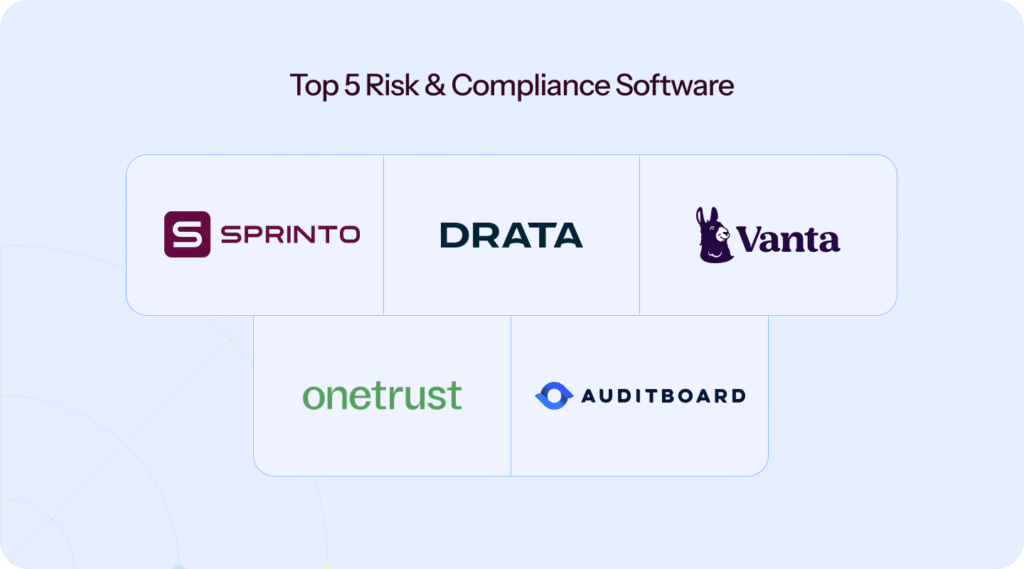
Risk compliance platforms come in distinct types to match your scale and needs:
- Compliance automation tools automate evidence gathering and control mapping for SOC 2, ISO 27001/42001, and HIPAA.
- GRC suites integrate governance, risk, and compliance with control mapping, policy workflows, and AI automation, along with frameworks and standards.
- ERM systems address enterprise-wide risks such as TPRM and cyber threats.
- Risk management platforms focus on quantitative scoring and scenario modeling.
The best ones offer seamless automation, deep framework coverage, wide integrations, and self-serve setup to slash audit prep from months to weeks. Here’s our curated top 5 for 2026, complete with a comparison table:
| Platform | Best for | Integrations | Implementation | Free trial |
| Sprinto | Startup/Mid-market | 300+ with API | Guided onboarding & self-serve options | Yes, with a self-serve model |
| Drata | Startup/Mid-market | 300+ | Sales-guided onboarding with structured support | Limited |
| Vanta | Mid-market/Enterprise | 400+ | Guided implementation with packages and best-practice support | For 7 days |
| Onetrust | Mid-market/Enterprise | 165 | Enterprise-grade implementation (typically sales-led) | Yes |
| Auditboard | Enterprise | 200+ | Sales-led, tailored implementation | No |
A quick reality check: Keep in mind that “Free Trials” in the GRC world are rarely “click-and-start.” These tools require access to your sensitive production data (AWS, GitHub, HRIS) to work; even a “Yes” usually involves a security call with a solutions engineer first.
1. Sprinto
Sprinto is an AI-native, autonomous GRC platform that helps growing businesses build and scale trust through continuous, hands-free compliance.
The platform centralizes compliance, risk management, vendor oversight, audits, and monitoring into one connected system, using intelligent agents to handle evidence collection, control monitoring, and audit readiness. It helps users stay continuously audit-ready and scale confidence across SOC 2, ISO 27001, GDPR, HIPAA, PCI-DSS, and 200+ frameworks.
Sprinto is trusted by over 3,000 companies across 75 countries. It’s real-time automation and integrations reduce effort, eliminate audit fatigue, and provide defensible risk insights for teams at any growth stage.
Sprinto’s key features are:
- AI-native compliance automation: Sprinto embeds compliance into daily workflows through self-healing, agentic automation rather than manual checklists.
- Continuous controls monitoring: The platform monitors systems, users, and configurations in real time to detect drift before it becomes an audit risk.
- Automated evidence collection: Sprinto can pull evidence directly from 300+ integrated tools, eliminating manual uploads and screenshots.
- Unified risk management: You can connect risks to controls and frameworks, giving leaders real-time visibility into exposure and remediation.
- Vendor risk management (TPRM): Sprinto automates vendor assessments, scoring, and ongoing monitoring to reduce third-party risk.
Best suited for: Teams that want AI-native automation and continuous compliance + risk visibility without building workflows manually. Particularly for startups to mid-market scaling into enterprise-grade compliance and risk programs.
| Pros | Cons |
| Exceptional support & guidance: Users repeatedly mention specific account managers and value the dedicated Slack channels that provide near-instant answers. | Initial setup complexity: Several reviews mention an “overwhelming” initial list of tasks. While the platform guides you through them, the sheer volume of “failing” checks on day one can be daunting for small teams. |
| High-velocity automation: Reviewers report cutting audit prep time by up to 70–90%. The platform’s ability to “autopilot” evidence collection from AWS, GitHub, and HRIS tools is praised. | Minor integration bugs: Some users reported “false positives” or “false negatives” in issue reporting, where the platform might flag a control as failing due to a sync delay or a minor glitch with a specific third-party API (notably GitLab). |
Pricing: Custom-quoted pricing tailored based on company size, compliance surface, frameworks, and integrations. You pay for what you use.
G2 rating: 4.8 / 5 stars
2. Drata
Drata is an AI-native trust management platform built to make compliance continuous rather than episodic. It focuses on automated evidence collection and real-time control monitoring to help teams stay audit-ready at all times.
Drata is used by companies ranging from early-stage startups to large cloud-native organizations.
Drata’s key features:
- Audit hub: A centralized “command center” where you can collaborate directly with your auditor, assign them tasks, and track their progress in real-time.
- Adaptive automation: Allows you to create custom automated tests and checks tailored to your specific tech stack or internal processes.
- AI questionnaire assistance: Uses your existing security documentation to automatically suggest answers for incoming customer security questionnaires.
Best suited for: Growing SaaS companies and tech-led teams (50–500 employees) that prioritize a clean, modern UI and need to manage frameworks like SOC 2, ISO 27001, and HIPAA with deep automation.
| Pros | Cons |
| Auditors like the dedicated portal that centralizes evidence, reducing the “email tag” during audit season. | Some users find it difficult to map custom controls or internal policies that don’t fit Drata’s “pre-baked” templates. |
| Real-time visibility into control failures with automated alerts that prevent “compliance drift.” | Newer modules like Vendor Risk and Trust Center are noted by some reviewers as being less mature than specialized competitors. |
Pricing: $15,000 (Median Annual Price)
G2 rating: 4.8 / 5 stars
3. Vanta
Vanta is a compliance automation platform designed to help companies prove security and build customer trust quickly.
With a large ecosystem of integrations and AI-driven workflows, Vanta automates security monitoring for standards like SOC 2 and ISO 27001. It’s particularly popular with fast-growing teams that want a straightforward path to certification and ongoing compliance.’
Vanta’s key features:
- Extensive integration ecosystem: With over 400+ native integrations, it offers the deepest automated evidence collection for the widest variety of SaaS tools.
- Trust center: A public or private-facing webpage that showcases your real-time security posture to prospective customers to build sales trust.
- Vulnerability management: An integrated module that pulls in data from scanners (like Snyk or AWS Inspector) to track and prove you are remediating bugs.
Best suited for: Startups and mid-market companies that need a quick path to compliance via a large library of native integrations.
| Pros | Cons |
| The platform connects to almost every SaaS tool in a typical modern stack. | Users mention that adding new frameworks (e.g., moving from SOC 2 to ISO) can be expensive. |
| Intuitive for non-technical founders or HR managers to navigate without a dedicated GRC expert. | Some reviewers find that the automated alerts can be excessive, requiring manual tuning to avoid “notification fatigue.” |
Pricing: $30,000 to $80,000 for pro and enterprise.
G2 rating: 4.8 / 5 stars
4. OneTrust Tech Risk & Compliance
OneTrust is an enterprise governance platform that helps organizations manage privacy, risk, and data responsibilities at global scale.
Known for its deep regulatory intelligence, OneTrust supports complex use cases spanning privacy compliance, third-party risk, AI governance, and ESG. It’s often chosen by large, multinational organizations operating across multiple jurisdictions and regulatory regimes.
Onetrust’s key features:
- Consent & preference management: The industry-standard tool for managing cookie banners, GDPR “right to be forgotten” requests, and user opt-ins.
- Regulatory intelligence: A built-in database of global laws across 300+ jurisdictions that alerts you when a legal change affects your business.
- Third-Party Risk Management (TPRM): A deep module for assessing the security of your vendors, including automated risk scoring and a massive database of pre-completed vendor assessments.
Best suited for: Large, multi-national enterprises or highly regulated businesses (Finance, Healthcare) where privacy and complex Third-Party Risk are the primary concerns.
| Pros | Cons |
| Good for managing Data Subject Access Requests (DSAR) and complex cookie consent across 100+ countries. | Reviewers often describe the UI as “cluttered” and the setup as “massive,” usually requiring a dedicated admin or external consultant. |
| You only buy what you need (e.g., just Vendor Risk or just IT Risk), though everything lives in one ecosystem. | Users have noted that, while it is a single platform, the “connectivity” between modules can sometimes feel disjointed. |
Pricing: Starts at $827/month and increases with added features.
G2 rating: 4.6 / 5 stars
5. Auditboard
AuditBoard is an enterprise-grade risk and audit platform built for internal audit, SOX, and risk management teams. It brings together audit, risk, and compliance data into a single system, replacing spreadsheets and disconnected tools.
AuditBoard is widely used by large organizations that need structured governance, strong reporting, and executive-level visibility.
Auditboard’s key features:
- Connected risk architecture: Links your Enterprise Risk Management (ERM), internal audits, and SOX compliance so that one data point updates every module simultaneously.
- Executive & board reporting: Highly advanced visualization tools designed specifically to turn complex audit data into heatmaps and reports for C-suite presentations.
- AuditBoard AI: An AI assistant that helps auditors draft “Scoping Memos,” summarize lengthy audit findings, and suggest staffing for specific audit projects.
Best suited for: Enterprise internal audit and finance teams, specifically those managing SOX compliance or complex Internal Audit programs for public companies.
| Pros | Cons |
| It mirrors the professional audit workflow and document management needs. | Not a “quick fix” tool; setup often takes months and requires a clear internal strategy before starting. |
| Good reporting and “Heat Map” dashboards designed for C-suite and Board of Directors presentations. | Generally considered one of the most expensive options, making it a “tough sell” for smaller startups without a dedicated audit team. |
Pricing: Averages around $40K-$150K per year.
G2 rating: 4.6 / 5 stars
What are some must-have features that buyers evaluate?
When buyers evaluate risk and compliance software today, they’re not impressed by long feature lists or framework counts. What they really care about is whether the platform reduces friction, improves visibility, and holds up under real-world pressure, from audits and customer security reviews to board-level scrutiny.
The must-have features below reflect what modern security, risk, and compliance leaders consistently look for when deciding which platform to invest in.
1. Unified view of risk + compliance
Buyers want a single source of truth where risks, controls, frameworks, audits, and remediation all connect. A unified view makes it clear which risks matter, which controls mitigate them, and how gaps impact compliance and the business. Without this linkage, teams end up compliant on paper but blind to real exposure.
2. Efficient management of third-party risks
Vendors are one of the largest and least visible attack surfaces. Buyers look for platforms that go beyond static questionnaires to continuously assess, score, and prioritize third-party risk. The goal is to focus attention on high-impact vendors without drowning teams in manual reviews.
3. Automated risk alerts
Modern risk programs are proactive, not reactive. Buyers expect automated alerts when controls drift, risks increase, or vendors change posture, so issues are addressed before audits or incidents force action. Timely alerts reduce surprises and keep teams focused on what actually needs attention.
4. Executive-ready reporting
Risk and compliance data must be easy to explain to non-technical stakeholders. Buyers evaluate how well a platform translates complex controls and risks into clear, real-time dashboards for executives, boards, and regulators. Strong reporting builds confidence and eliminates hours of manual slide preparation.
5. Deep integration with your tech stack
A platform is only as good as its visibility into the environment. Buyers prioritize tools that integrate deeply with cloud infrastructure, identity systems, HR tools, ticketing, and development workflows. Deep integrations enable continuous monitoring, automated evidence, and accurate risk signals without disrupting existing processes.
6. Custom workflows and easy automations
No two organizations run risk and compliance the same way. Buyers want flexible workflows and low-effort automation that adapts to their structure, frameworks, and maturity level. The best platforms reduce manual coordination while still allowing teams to apply judgment where it matters most.
“Sprinto stood out in terms of its overall value, especially advanced risk management options. I no longer needed to depend on teams for updates. Whenever a change occurs, Sprinto continuously monitors the environment and triages alerts whenever things change.”
– Evelyn Vinueza, CISO, Tangelo (Latin American fintech, ISO 27001)
How to choose the right risk and compliance platform?
Before getting into how to choose, it’s worth being transparent about how we evaluated the platforms in this guide. We looked at each platform through the lens of a modern security or risk leader, not marketing claims. Our evaluation focused on:
- Product depth across risk, compliance, audits, and third-party risk (not just SOC 2 checklists)
- Automation maturity: What’s truly hands-free vs. what still needs humans
- Scalability across frameworks, teams, and geographies
- Integration depth with real-world tech stacks
- Customer feedback from G2 and peer reviews
- Implementation reality: How hard it is to get value, not just buy licenses
Most importantly, we asked a simple question for every tool: Does this platform reduce risk and friction as the business grows, or does it quietly add more work over time?
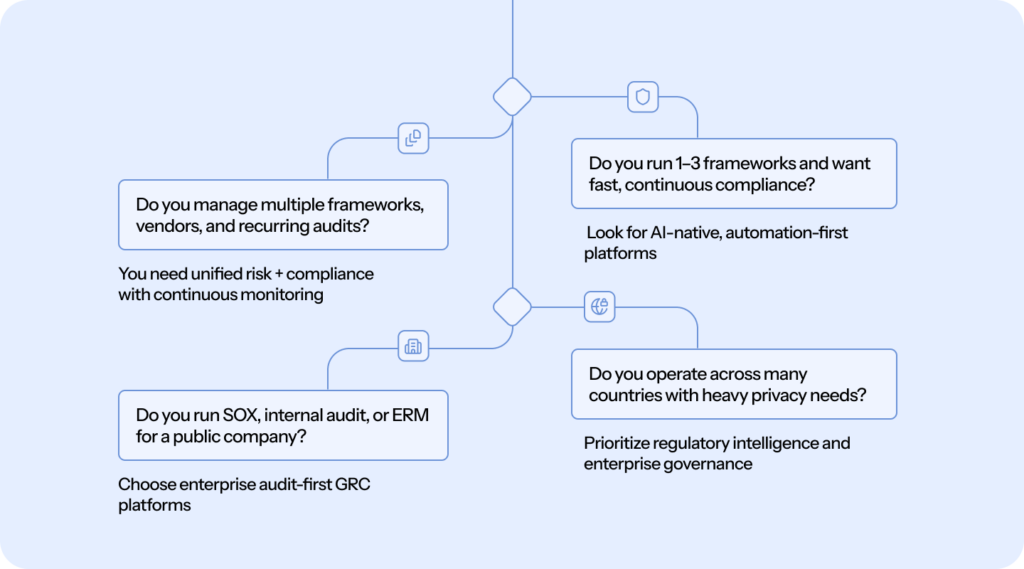
With that context, here’s how you should realistically approach the decision:
1. Evaluate the fit for your company
One of the most common mistakes teams make is buying either too much or too little GRC. Enterprise-grade platforms often assume dedicated GRC teams, layered approvals, and long implementation cycles. Lightweight tools, on the other hand, can break down once you move beyond a single framework or audit.
The right platform should fit your current scale while giving you room to grow. If you’re managing multiple frameworks, onboarding vendors, and supporting sales security reviews without a large GRC team, you need software that absorbs complexity without adding operational overhead.
2. Prioritize continuous risk visibility
Real-time visibility into what’s happening across your environment means continuously monitoring controls, access, configurations, and integrations, and surfacing issues as soon as they emerge.
From a CISO’s perspective, the most valuable platforms are proactive. The software must continuously monitor controls and generate automated alerts that help teams address issues before they become audit findings or security incidents.
3. Demand automation that minimizes manual work
If your team is still uploading screenshots, chasing evidence, or coordinating status updates, the platform isn’t doing enough. Real automation means evidence collection, control checks, and monitoring run in the background, with humans stepping in only when judgment is required.
4. Assess implementation effort and time to value early
Implementation should be structured, guided, and measurable, with clear progress in weeks, not months. Tools that require extensive consultation or a lengthy setup often continue to require effort long after deployment.
Sprinto’s guided onboarding and self-serve automation are designed to help teams reach audit readiness quickly without turning compliance into a prolonged project.
Implementation roadmap after choosing a risk and compliance software
A successful implementation isn’t measured by how many controls you turn on; it’s measured by how much manual effort disappears and how confidently you can answer risk questions. When implemented correctly, a modern risk compliance platform becomes an always-on system of trust, not just another tool to manage.
Below is a realistic, field-tested roadmap CISOs and security leaders can use to drive value quickly without overwhelming their teams.
First 30 days: Establish the foundation
In the first month, the focus should be on connecting your environment and establishing baseline compliance and risk visibility. This phase often reveals gaps, but that’s a good thing. You want to surface issues early, not during an audit.
Key activities
- Connect core systems (cloud infrastructure, identity, HR, code repositories, ticketing tools)
- Select priority frameworks (e.g., SOC 2, ISO 27001, HIPAA)
- Establish control, ownership, and responsibility
- Baseline current control health and risk posture
- Centralize policies, evidence, and audit artifacts
Days 31–60: Automate and operationalize
With the foundation in place, the next step is to let automation do the heavy lifting. This is where the platform starts paying for itself by removing repetitive tasks and reducing human dependency.
Key activities
- Enable automated evidence collection and continuous control monitoring
- Configure risk alerts for control drift, access changes, and vendor risk
- Map risks directly to controls and frameworks
- Launch third-party risk workflows for critical vendors
- Train internal teams on reviewing alerts and remediations—not collecting data
Days 61–90: Optimize, scale, and prove value
By the third month, the platform should move beyond operational efficiency and start delivering strategic value. This phase is about scale, reporting, and confidence.
Key activities
- Expand coverage to additional frameworks or regions
- Fine-tune alert thresholds to reduce noise
- Roll out executive and board-level dashboards
- Support live audits using the platform’s audit workspace
- Use insights to prioritize remediation based on risk impact
A Sprinto-led recommendation path
Based on these criteria, here’s a practical way to decide if Sprinto is the right fit.
If you’re a startup or mid-market company running frameworks like SOC 2, ISO 27001, HIPAA, or GDPR and you want compliance and risk to run continuously rather than in audit-season bursts, Sprinto is a strong choice.
If your goal is to reduce dependency on manual work, minimize engineering interruptions, and scale compliance without adding headcount, Sprinto’s automation-first model aligns well with that outcome.
If you expect your compliance surface to grow, more frameworks, more customers, more vendors, but don’t want to re-platform in 12–18 months, Sprinto’s unified risk and compliance architecture is designed to scale with you.
With its AI-native, agentic automation and unified GRC platform, Sprinto makes risk and compliance easier than ever. See for yourself.
FAQs
Compliance automation tools primarily automate evidence collection and control tracking for frameworks such as SOC 2, ISO 27001, and HIPAA. Risk compliance software expands on this by combining compliance workflows with ongoing risk monitoring and control oversight.
GRC platforms (Governance, Risk, and Compliance) provide a broader system that connects policies, risks, controls, audits, and reporting across the organization. ERM (Enterprise Risk Management) systems operate at an even higher level, managing enterprise-wide strategic risks such as financial, operational, cyber, and regulatory risks—often with board-level reporting in mind.
Not exactly. Risk compliance software typically focuses on operational compliance and control monitoring, while GRC software includes governance processes, enterprise-wide risk frameworks, audit programs, and executive reporting. That said, many modern platforms blend both categories, offering unified risk and compliance capabilities within a single system.
Compliance automation tools help teams achieve and maintain certifications quickly by automating evidence collection, control checks, and documentation workflows. Enterprise GRC platforms go further by managing governance structures, internal audits, risk registers, policy lifecycle management, and board-level reporting. Compliance automation focuses on execution; enterprise GRC focuses on organizational governance at scale.
For SOC 2 and ISO 27001 teams, continuous control monitoring and automated evidence collection are critical. These frameworks require proof that controls operate effectively over time, not just at a single point in time.
There isn’t a universal “best” option—it depends on company size, regulatory complexity, and internal maturity. Startups and mid-market teams often benefit from automation-first, AI-native platforms like Sprinto that reduce manual effort.
Popular tools in the market include Sprinto, Drata, Vanta, OneTrust, and AuditBoard. Each serves a different segment, ranging from compliance automation for high-growth startups to enterprise audit and governance solutions for large organizations.

Author
Sucheth
Sucheth is a Content Marketer at Sprinto and holds CompTIA Security+. He helps security and GRC teams to navigate audits: what each framework requires, what auditors ask for, and what it costs to maintain.Go beyond the surface and uncover the governance, risk, and compliance insights that actually matter.


Win digital goodies for boardroom success


Explore more




research & insights curated to help you earn a seat at the table.