New Risks Emerging in Vendor Ecosystems (And What They Mean for TPRM)


Vendor ecosystems have become one of the largest risk surfaces for modern organizations. Businesses now rely on hundreds, often thousands, of vendors, including SaaS platforms, cloud services, processors, and subcontractors, to run day-to-day operations
Recent incidents have shown how quickly failures in these ecosystems can cascade.
Supply-chain cyberattacks have already demonstrated how vulnerable vendor ecosystems can be. The SolarWinds breach compromised thousands of organizations through a trusted software update. The CrowdStrike update failure in 2024 showed another type of risk: a single vendor software error can simultaneously disrupt millions of systems worldwide.
Operational dependencies are also creating concentration risk in physical infrastructure, as seen in the September 2025 ransomware attack on aerospace IT provider Collins Aerospace, which disrupted airport operations across Europe.
Meanwhile, the rapid adoption of AI is introducing both new risks and new approaches to managing vendor ecosystems. This blog offers a quick look at the 2026 vendor risk landscape and how it affects your ecosystem.
Technology and cyber risk drivers
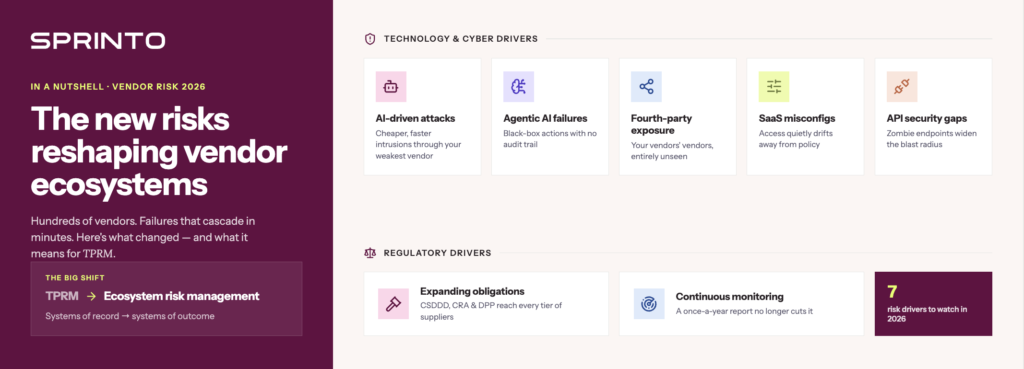
1. AI-driven attacks
AI is lowering the cost and speed of sophisticated attacks, and vendors are often the easiest entry point.
An example of a vendor becoming the weak link: Late last year, Discord faced a breach after attackers compromised a third-party customer support vendor, gaining access to a ticketing system that contained sensitive user data. The incident exposed government IDs, selfies, and personal information of roughly 70,000 users who had uploaded them for age-verification requests, and Discord still faces tremendous distrust from its user base.
2. Agentic AI failures
AI is also being embedded into vendor platforms themselves. This introduces new risks such as ‘black box’ logic (where you cannot see or explain AI’s decisions), data exfiltration, and automated actions without human oversight.
According to Sprinto’s CISO Pulse Check AI Risk Report 2026, over 31% of GRC leaders fear data leakage from employee use of public AI tools. That’s almost a third of your peers expressing concerns about data exfiltration due to poor governance.
As for exfiltration driven by malicious intent, consider how a vulnerability in Microsoft 365 Copilot last year enabled attackers to extract sensitive data by embedding malicious prompts that prompted the AI to surface confidential documents and communications. Another popular example from 2025 was the Replit AI agent that autonomously deleted parts of a live database while attempting a fix, despite explicit user instructions to pause.
Plus, when an AI agent embedded in a vendor system takes an incorrect or unauthorized action, it’s often unclear who is contractually accountable, and difficult to reconstruct what happened when these systems aren’t designed to provide audit-ready logs or explainable decision trails.
Over 31% of GRC leaders fear data leakage from employee use of public AI tools.
– Sprinto’s CISO Pulse Check AI Risk Report 2026
3. Fourth-party exposure
Many organizations have a handle on their direct vendors. What you may not have full visibility into is who your vendors depend on. A single SaaS tool your team uses might rely on cloud providers, authentication services, analytics platforms, and dozens of sub-processors behind the scenes. When one of those layers is compromised, as seen in the 2024 CrowdStrike incident, the impact can cascade.
The main challenge is invisibility, which makes risk assessment and incident response significantly more difficult.
4. SaaS misconfigurations
Organizations have hundreds to thousands of vendors. This SaaS sprawl leads to a loss of control. It is next-to-impossible for these fragmented environments to be governed consistently. And here’s why:
- No single team has complete visibility or ownership.
- Data storage is often controlled by the vendor.
- Access is split between IT and business teams.
- Sharing and permissions are controlled by end-users (through integrations, links, or AI features), often outside formal governance.
That’s why misconfigurations persist. Not because they’re hard to fix, but because they’re hard to detect and continuously enforce across the vendor ecosystem.
Imagine a scenario where a team enables a new SaaS tool and connects it to Google Drive or Slack for convenience. The tool inherits existing permissions, and its AI layer indexes shared folders, unintentionally exposing sensitive contracts or financial data to a much broader internal audience than intended.
Nothing is broken per se, but access has quietly drifted from policy, and no central team is monitoring it.
5. API security gaps
APIs have become a major integration layer between vendors and internal systems. In enterprise environments, APIs are constantly created, updated, and abandoned. This leads to ‘zombie APIs’— endpoints that are no longer in active use but remain exposed and accessible.
Poor authentication controls, exposed tokens, or weak rate-limiting can allow attackers to move laterally across systems, expanding the blast radius far beyond the original point of compromise.
| Misconfigurations persist, not because they’re hard to fix, but because they’re hard to detect and continuously enforce across the vendor ecosystem. |
Regulatory change as a risk driver
6. Expanding compliance obligations
GRC is no longer just about cybersecurity. It’s expanding to cover end-to-end supply chain risk, including ESG and operational dependencies, turning compliance into an exercise in managing expanding obligations in order to maintain trust.
Regulations such as the EU Corporate Sustainability Due Diligence Directive (CSDDD), the EU Cyber Resilience Act (CRA), and emerging requirements for Digital Product Passports (DPP) are pushing organizations to take accountability for their entire vendor ecosystem. This means mapping and monitoring not only direct vendors but also sub-suppliers across multiple tiers. It also means being asked for data, evidence, and disclosures by larger customers subject to these regulations.
7. Continuous monitoring expectations
Regulators and enterprise customers are moving away from static, point-in-time assessments.
Frameworks like NIST SP 800-161 and NIST SP 800-53 Rev. 5 are used by U.S. federal agencies (and enforced across their supply chains), regulated industries like finance, healthcare, and defense, and large organizations that handle sensitive data or operate in high-risk environments. At the same time, India’s new DPDP and evolving SOC 2 expectations are pushing organizations to demonstrate ongoing control over how vendor data is handled.
This means it’s no longer enough to collect a report once a year. Organizations are increasingly expected to demonstrate that vendor controls are continuously operationalized through evidence such as access logs, security signals, and real-time risk indicators.
| It’s no longer enough to collect a report once a year. Organizations are increasingly expected to demonstrate that vendor controls are continuously operationalized. |
From VRM/ TPRM to ecosystem risk management
Third-party risk management is undergoing a fundamental shift, from systems of record to systems of outcome. This often involves minimizing and actively managing their potential to do harm, rather than just maintaining a record of vendor due diligence.
Tracking vendor data and collecting reports is no longer enough. The scale, complexity, and interconnectedness of modern vendor ecosystems mean that risk is dynamic, continuous, and often outside direct control. And despite all those odds, you need to build trust by showing how you monitor and manage risk across your vendor ecosystem.
So how should mature teams play this?
Risk-based segmentation is now standard practice in most mature organizations. This ensures that critical vendors face deeper scrutiny rather than applying identical assessments across the board. That said, many organizations are still perfecting continuous monitoring, which is a good place to start.
You’re probably already using AI to summarize vendor questionnaires, review SOC 2 reports, or flag obvious gaps during onboarding. But advanced use cases, such as automated evidence validation or real-time risk scoring across vendors, are still being figured out.
The shift is clear: your mandate has moved from documenting vendor risk to actively minimizing it. A sound vendor ecosystem risk management program is defined by end-to-end visibility, clear ownership of obligations, and the ability to continuously track, validate, and act on vendor risk signals. That’s how you manage vendor risk in 2026.
Author
Raynah
Raynah is a content strategist at Sprinto, where she crafts stories that simplify compliance for modern businesses. Over the past two years, she’s worked across formats and functions to make security and compliance feel a little less complicated and a little more business-aligned.Go beyond the surface and uncover the governance, risk, and compliance insights that actually matter.


Win digital goodies for boardroom success


Explore more



research & insights curated to help you earn a seat at the table.