
How Modern CISOs Can Secure AI-Powered Enterprises Without Slowing Innovation

AI has quietly become infrastructure. It is now embedded in how organizations build products, support customers, write code, analyze data, and make decisions. For CISOs, this shift has created a new reality. AI is accelerating the business, but it is also stretching security, risk, and compliance programs beyond what they were designed to handle.
Most CISOs already know this. AI risk awareness is high across U.S. organizations. Policies exist. Committees have been formed. Budgets are being discussed.
Yet many security leaders still feel unprepared to manage AI risk at scale. The problem is not a lack of intent, but that AI Governance has outgrown traditional enforcement and compliance models.
The challenge for modern CISOs is clear: secure AI-powered enterprises without slowing innovation.
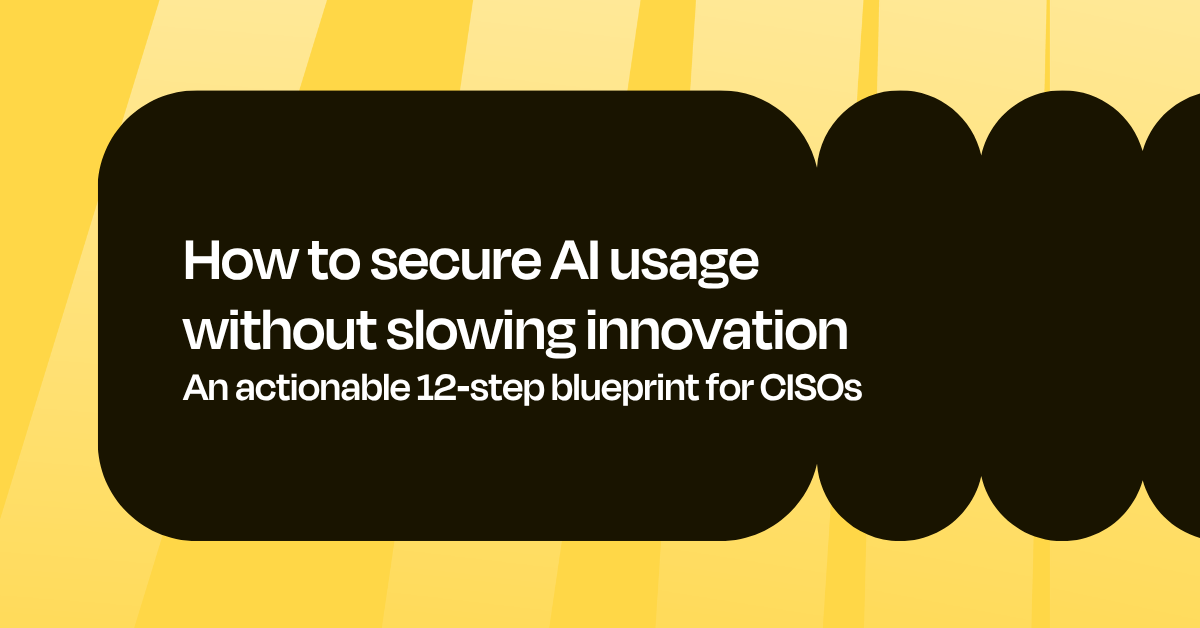
| A CISO’s guide to enabling enterprise productivity without inviting catastrophic data exposure. 👉 Download the CISO Pulse Check Report and Blueprint. The report highlights benchmarks about the current awareness and maturity of AI risk mitigation in U.S. organizations and a 12-step blueprint with clear deliverables, measurable outcomes, and action items for CISOs and GRC teams. |
Why AI enforcement feels broken today
Many organizations have implemented AI usage policies. But, in practice, enforcement is inconsistent. This is a serious warning sign. Without enforcement, it becomes challenging to prevent shadow AI usage. Security and privacy incidents become harder to control. AI compliance becomes harder to prove.
The primary issue is uncertainty.
AI tools evolve daily. Some run in browsers. Others are embedded in desktop apps or operating systems. Some rely on system-level access that traditional controls cannot easily see.
CISOs are still figuring out what proper AI enforcement actually means. Blocking AI entirely may feel safe, but it often backfires. Employees shift to personal devices or unmonitored tools. Innovation slows. Visibility disappears.
Here is a 2-step blueprint for CISOs to enable safe, visible, and accountable use of AI at your organization:
Step 1: Build the AI Governance and security foundation
The first phase of securing AI-powered enterprises is about control. This is where most organizations must start. Without this foundation, advanced AI risk management is impossible.
1.1. Gain visibility into AI usage
Modern AI Governance starts with visibility. CISOs need a clear picture of where AI is deployed across the organization. This includes standalone AI tools, embedded AI features, and experimental use cases.
Visibility must go beyond tools. It must include the data AI systems touch and the decisions they influence. Advisory systems carry a different risk than automated systems. Internal use is different from customer-facing use.
Without this clarity, risk conversations stay abstract.
1.2. Establish shared ownership for AI Risk
AI risk does not rest solely with security. It cuts across legal, privacy, product, engineering, and compliance. Customer impact must also be represented. Product teams alone are not enough.
A dedicated AI risk council helps align these perspectives. It also creates a dedicated space for decision-making. Just as important, it defines when AI risks must be escalated to executive leadership or the board. Customer harm and regulatory exposure should never stay buried.
Ownership reduces confusion. Escalation prevents surprises.
1.3. Create a system of record for AI Governance
Spreadsheets and email threads do not scale. Every AI system should have a documented record. This includes its intended use, known limitations, and possible misuse scenarios.
The principle is simple. No record means no approval. At the same time, innovation must not be blocked. Fast paths for low-risk experiments are essential. Time-bound approvals keep governance relevant and prevent teams from bypassing controls.
This balance is critical. Too much friction creates shadow AI. Too little structure creates blind spots.
1.4. Define clear data and decision rules
Employees are more likely to follow rules when they understand why they exist. AI data governance should clearly explain which data is allowed, which is restricted, and which is prohibited.
Just as important is decision governance. CISOs should define when AI is allowed to advise and when it is allowed to decide. Automated, customer-facing decisions deserve much higher scrutiny.
Clear rules reduce guesswork. Guesswork creates risk.
1.5. Move from Policy to Enforcement
Policies alone do not reduce risk. Controls do. AI usage policies must be mapped directly to technical and procedural enforcement.
Exceptions should exist, but they should expire.
Lightweight assessments are fine for low-risk use cases, but are not enough for customer-facing or high-impact automation. Defining this boundary is a key marker of AI risk maturity.
1.6. Reduce exposure of Sensitive Data
Preventing sensitive data from leaking into public AI platforms is one of the most immediate priorities.
DLP helps, but it is not sufficient. Prompts are messy. Context matters.
Compensating controls are essential. Training, logging, and periodic reviews help close gaps that technical controls miss. Approved AI tools and safe alternatives reduce the temptation to go rogue.
1.7. Operationalize AI Risk
AI risk should not live outside daily operations. Incident response plans must include AI misuse, exposure, and failure scenarios.
Monitoring should detect drift, misuse, and over-reliance.
Dashboards should do more than show metrics. They should trigger tasks, reviews, and escalation. Visibility without action is not governance.
By the end of Part 1, organizations achieve control. AI usage is visible. Ownership is clear. Enforcement is real. Compliance evidence is no longer scattered.
Step 2: Govern Model Behavior and Decision Risk
Once governance foundations are in place, CISOs can address the next layer of AI risk. This is where trust is built. Frameworks like NIST AI RMF emphasize that AI risk is not only about data and vendors. It is also about behavior, judgment, and impact.
2.1. Classify AI by decision criticality
Not all AI systems deserve the same scrutiny. Some support productivity. Others influence real outcomes. CISOs should classify AI systems based on decision impact.
Advisory systems are different from automated ones. Reversible decisions are different from irreversible ones. Customer-facing AI deserves the closest attention.
This classification determines safeguards.
2.2. Define acceptable AI behavior
AI systems will fail. The question is how and when.
Organizations must define acceptable behavior, known failure modes, and scenarios where AI must not be trusted.
Explicitly stating when AI should not be relied upon is just as crucial as saying when it can be used. This clarity reduces misuse and overconfidence.
2.3. Train humans to challenge AI
One of the most significant AI risks is automation bias.
People tend to trust AI outputs too much. Training must address this directly.
Employees should be taught when to question AI. They should understand the signs of incorrect or misleading output. This training is critical for reducing silent harm.
2.4. Monitor behavior over time
AI risk does not stop after deployment. Models drift. Usage patterns change. New failure modes appear.
Ongoing monitoring helps detect anomalies, misuse, and degradation early. User and customer feedback should inform governance reviews.
2.5. Treat AI failures as governance events
Not every AI failure is a security incident. Some are quality issues.
Some cause customer harm without a breach. All require clear ownership.
AI failures should trigger a structured response, escalation to product leadership, and post-incident review. Treating them as governance events closes the loop.
Securing AI without slowing innovation
Modern CISOs face a delicate balance. Move too slowly, and AI risk compounds. Lock things down too tightly, and innovation goes underground.
The path forward is clear. Govern AI usage first. Then govern AI behavior. Control enables trust. Trust enables scale.
AI-powered enterprises are here to stay. The CISOs who succeed will be those who secure AI in a way that enables the business to move forward with confidence.
Author
Pulkit Jain
Pulkit drives growth through Content at Sprinto. His work has been featured in top publications such as Forbes, The Wall Street Journal, World Economic Forum, e27, and more. His experience as an m-shaped B2B marketer comes fueled with a passion for customer-centricity, affinity for data, and a love for technology, movies, comics, and gaming.Go beyond the surface and uncover the governance, risk, and compliance insights that actually matter.


Win digital goodies for boardroom success


Explore more



research & insights curated to help you earn a seat at the table.