Why Brands Are Adopting Autonomous Audit Management In The Wake of New-Age Change


If you run compliance, security, or risk management for an enterprise, you already know where traditional Audit Management fails. Your audit surface changes with every entity, platform, vendor, cloud environment, or stakeholder you add to the system. And manual coordination just cannot keep up, but your business has to, nonetheless.
AI introduces a new kind of pressure into the mix. With every surface AI touches, it adds a layer of scrutiny, increasing the burden of proof and reducing the tolerance for ambiguity. Auditors today don’t just want to see policies for AI Governance, they want to know how you maintain accountability, monitor what it touches, ensure explainability, and manage change.
And then there’s the adoption issue. AI tools are being adopted much faster than ever before. Sprinto’s recent AI Risk Report estimates that 27% of organizations have yet to automate AI Governance, while only 39% consistently enforce AI usage policies. This clearly shows that governance has yet to keep pace with the rate of AI adoption.
Most enterprises don’t have an answer to this conundrum because they were never built for such a reality. As a result, Audit Management remains reactive, fragmented, and resource-intensive while leadership is kept in the dark, only getting a clearer picture when it’s too late.
The chinks in the traditional Audit Management armor
The overarching theme for enterprises handling Audit Management the traditional way is chaos.
Audits are treated as point-in-time events instead of a state of being. This means that preparation only starts when an audit is scheduled. As a result, your team has to work overtime to pull screenshots, secure last-minute approvals, and review system logs, with a deadline looming.
And despite weeks of preparation, cracks eventually appear during an audit, most of which cannot be fixed on time. These cracks primarily appear in three areas of Audit Management: evidence, prior findings, and auditor questions. Let’s take a closer look.
1. Keeping evidence current
The biggest challenge with evidence collection is ensuring that the evidence you collect accurately depicts the reality of your controls.
Change is not only constant, it often goes unnoticed. Documents become stale, ownership changes, and unverified files get uploaded—each of these factors weakens evidence. So even if your team collects the evidence you ask of them, they cannot prove that it’s current, sufficient, or maps to the controls being tested.
And in the time it takes your team to validate each piece of evidence, systems evolve, AI disrupts processes, and drift happens. As a result, a lot of the evidence you’ve collected may be incomplete or outdated. This isn’t a ‘you’ problem; it’s just how things have been handled so far.
2. Ensuring past findings stay resolved
Enterprises are under enormous pressure to avoid repeat findings. But traditional Audit Management, coupled with periodic audit prep, makes them an eventuality.
When an auditor discovers a finding, your team promptly works to resolve it. But findings are often treated as administrative tasks rather than operational risks. This means that without continuous monitoring, a finding from a previous audit is very likely to resurface during your next audit. And with a periodical approach, gathering proof is often left until the next audit is around the corner.
3. Satisfying auditor questions
Auditors don’t just analyze what’s in front of them during an audit. They also look for how well you know your systems and controls. And if your team relies on Slack or Microsoft Teams conversations, tickets, documentation, emails, or even memory to reconstruct control history, it doesn’t send the right signal.
Not only is this harder because none of this information is centralized or readily available, but it also tells the auditor you don’t know your control environment as well as you’re supposed to.
Enter Autonomous Audit Management
Before we get into why brands are recognizing the need for Autonomous Audit Management, we need to first define it.
What is Autonomous Audit Management?
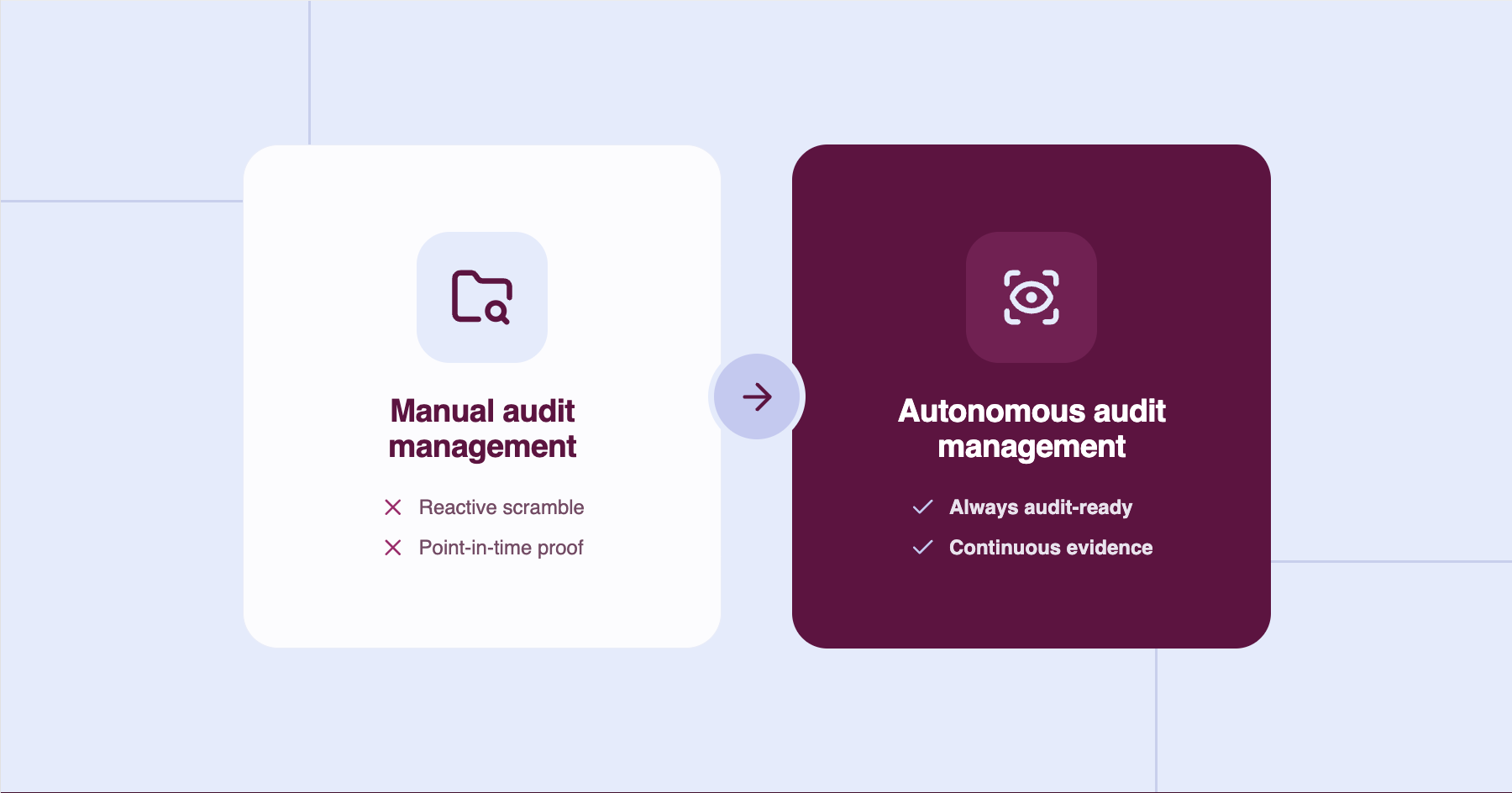
Autonomous Audit Management is a transformative approach that changes the way organizations operate. At its core, Autonomous Audit Management transforms audit readiness from a periodic exercise into a continuous process. It ensures that readiness is not defined within the confines of an audit but rather exists as an iterative, living state that adapts based on your context. And so, audits become less disruptive, and readiness isn’t treated as an end goal; it’s what you’re able to prove in the here and now.
So what does this look like in action, and how does it fill the gaps?
Evidence is constantly updated.
With Autonomous Audit Management, evidence collection isn’t a rushed process that begins once the audit approaches. It is collected and evaluated periodically throughout the year. Any changes in ownership, processes, access, structure, or tooling immediately trigger a refresh to ensure evidence remains current and updated.
Crucially, your control health is made visible in real-time so your team can spot gaps as they emerge, not when controls are sampled. So audits become about validation.
Autonomous Audit Management makes sure findings remain closed.
Within an Autonomous system, Audits don’t end with acknowledged findings—it requires proof for closure.
With Autonomous Audit Management, closure mandates traceability, ownership, remediation deadlines, and strong evidence that the issue is fixed. Procedurally, it ensures that every finding is linked to a clear owner, due date, remediation plan, and updates evidence stack that shows what changed. This way, your team can maintain stronger accountability and ensure fewer repeat findings.
Over time, Autonomous Audit Management establishes a reliable control environment and provides leadership with confidence that findings are being resolved. And every audit leaves you stronger than the last.
Context becomes the bedrock on which audit readiness is built.
Audit success heavily hinges on how effective your narrative is and how much context you’re able to provide your auditor.
Instead of forcing your auditor to piece together information from scattered documents, screenshots, and files, an autonomous approach connects controls, ownership, evidence, changes, and remediation history into a single, defensible thread. And instead of reconstructing history, your team is able to present a narrative that’s verifiably justified.
The immediate benefit is speed and clarity—your auditors get quicker answers, your teams face fewer repeat requests, and your leadership gets a clearer picture of risk and readiness.
Audit findings strengthen your risk posture.
Autonomous Audit Management maximizes the value of audit reports. It derives actionable insights from these reports and converts them into actionable risk intelligence.
When a report is received, it analyzes findings, suggests remediation, and assigns owners, providing them with a clear description of what needs to be done and why. While this happens, an Autonomous system helps your risk managers create or update the risk register based on finding severity, affected controls, and business impact. This ensures thorough operational follow-through without manual parsing or fragmented handoffs. And you’re able to provide leadership with a clear picture of how audit outcomes connect to the broader risk landscape.
Sprinto seamlessly enables Autonomous Audit Operations
Sprinto’s Autonomous Trust Platform deploys agents that help you turn audit readiness into a flexible, focused, and adaptable endeavor.
- Sprinto collects and evaluates evidence against audit requirements while flagging missing or outdated artifacts.
- The platform extracts findings from audit reports, assigns owners, and sees them to closure with continuous monitoring. It also sends you reminders about prior findings while you prepare for your next audit.
- Sprinto extracts action items from audit reports, sets context with owners, and proactively generates or updates your risk register based on findings.
- When your auditors seek clarifications, Sprinto’s audit agent creates ready responses and documented justifications, so your team doesn’t have to reconstruct answers.
But we’ve just scratched the surface—and there’s more to come. Want a more in-depth walkthrough of how Sprinto’s all-new Autonomous Trust Platform works? Speak to our experts today.
Author
Vishal V
Vishal, Sprinto’s Content Lead, masterfully weaves nuanced narratives and simplifies convoluted compliance topics with seasoned expertise. His perennial curiosity fuels his pursuit of fresh angles in every piece. Off-work, he’s an avid photographer, birder and a music buff, he blends expertise and exploration seamlessly in work and life.Go beyond the surface and uncover the governance, risk, and compliance insights that actually matter.


Win digital goodies for boardroom success


Explore more



research & insights curated to help you earn a seat at the table.