The Rise of Non-Human Identities: Why AI Agents Need Identity Governance


TL;DR
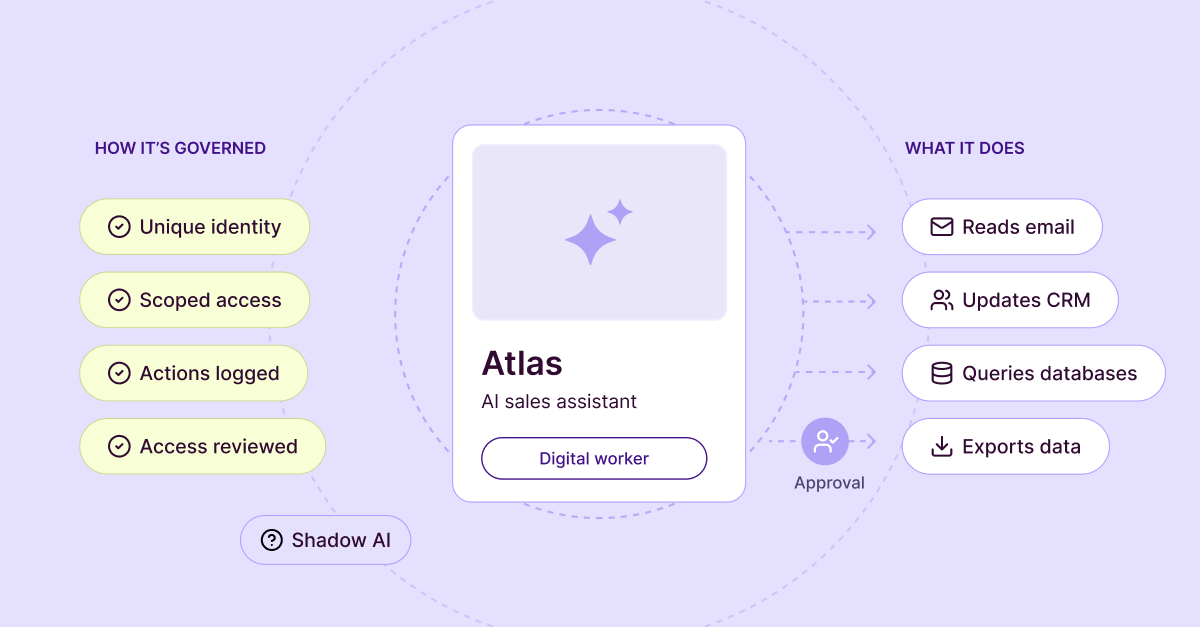
| AI agents now read your email, query your databases, update your CRM, and trigger workflows. This is the kind of access you’d normally reserve for privileged users. Most organizations still govern them like regular applications. |
| Machine identities already outnumber human identities by more than 80-to-1 (CyberArk, 2025), and the consequences are evident: 30% of CISOs (Sprinto’s CISO Pulse Check) reported a major AI incident in the last 12 months. |
| Agentic AI governance means treating every agent as an identity: a named owner, a unique identity, task-scoped permissions, activity logs, and a managed lifecycle from creation to retirement. |
| Point-in-time approvals aren’t enough for software that acts autonomously; governance has to run continuously, at runtime, with evidence you can show an auditor. |
A few years ago, identity and access management (IAM) was relatively straightforward.
You had:
- Employees
- Contractors
- Service accounts
- A handful of privileged administrators
And most IAM programs were built on a single core assumption: Humans are the primary actors in your business.
That assumption is starting to break down. Today, businesses are deploying AI agents that can:
- Read emails
- Access documents
- Query databases
- Update CRM records
- Create Jira tickets
- Trigger workflows
- Interact with customers
- Execute tasks across multiple business systems
Unlike traditional software, these systems don’t just process information; they take action on it. And that changes what governance has to cover.
A sales rep asks an AI agent to prepare for an upcoming customer meeting. The agent reviews emails, pulls CRM records, analyzes support tickets, generates a summary, updates opportunity notes, and schedules follow-up actions. The employee gave one instruction. The AI completed six different tasks across multiple systems. At that point, the agent behaves less like software and more like a worker. And yet most organizations still govern it like an application.
That’s the blind spot: the biggest AI governance challenge over the next few years won’t be prompt engineering, hallucinations, or model selection. It will be identity.
The moment an AI agent can act on your behalf, access your systems, and make decisions that affect your business outcomes, it becomes an identity. And identities need governance.
This is what agentic AI governance means in practice: giving every autonomous agent an owned identity, scoped permissions, monitored actions, and a managed lifecycle, extending the disciplines you built for human users to software that acts on its own.
As AI agents embed themselves across your sales, engineering, finance, support, security, and operations, you’ll need answers to a new set of questions:
- Which agents exist?
- What systems can they access?
- What actions can they perform?
- Who approved those permissions?
- How are their actions monitored?
- Who is accountable when something goes wrong?
These aren’t AI questions. They’re identity governance questions. And they may become the most important governance challenge of the AI era.
The rise of non-human identities
Your business already manages thousands of non-human identities.
These include:
- Service accounts
- API keys
- Workload identities
- Automation bots
- OAuth tokens
- Machine credentials
Security teams refer to these as non-human identities (NHIs). Historically, these identities existed to support systems and applications behind the scenes.
AI agents are different. Unlike traditional machine identities, agents can interact with multiple systems, execute tasks, make decisions, and operate with varying degrees of autonomy. In many cases, they are becoming digital workers. And they’re growing fast.
According to CyberArk’s 2025 Identity Security Landscape report, machine identities now outnumber human identities by more than 80-to-1, and nearly half of them hold sensitive or privileged access. CyberArk expects the total number of identities to roughly double in 2025 as AI adoption accelerates.
The result is a world in which the majority of actions within enterprise environments may no longer be performed by humans.
Why traditional IAM wasn’t built for AI agents
Traditional IAM answers four fundamental questions:
- Who are you?
- What can you access?
- What actions did you take?
- Who approved that access?
These questions work well when identities are human. But AI agents introduce a new challenge. One of your employees might log into Salesforce to update an opportunity. An AI agent may:
- Access Salesforce
- Read customer emails
- Analyze support tickets
- Generate recommendations
- Update records
- Trigger follow-up actions
All without direct human intervention. The more autonomy agents receive, the more difficult it becomes to answer basic governance questions:
- Why was this action taken?
- Which permissions were used?
- Was a human involved?
- Who owns the outcome?
- Can the action be audited?
And the agents raising these questions increasingly have the kind of access you’d normally reserve for your most privileged users.
Why AI agents are becoming privileged users
You already apply strong controls to your privileged human users. Your finance team can’t approve unlimited payments. Your administrators can’t touch every system without oversight. Even your security team is monitored when it performs sensitive actions. AI agents increasingly operate with similar levels of access. They may have permission to:
- Access customer data
- Modify records
- Execute workflows
- Interact with external systems
- Trigger business processes
Yet many organizations still grant these capabilities using broad permissions, shared credentials, or generic service accounts.
This creates a dangerous governance gap: you carefully manage your privileged humans while handing growing authority to autonomous systems with limited oversight. As AI agents become more capable, treating them as simple applications will become increasingly risky.
Sprinto’s CISO Pulse Check AI Risk Report 2026 found that 30% of the 103 US CISOs surveyed experienced a major AI incident over the past 12 months.
What AI-native identity governance looks like
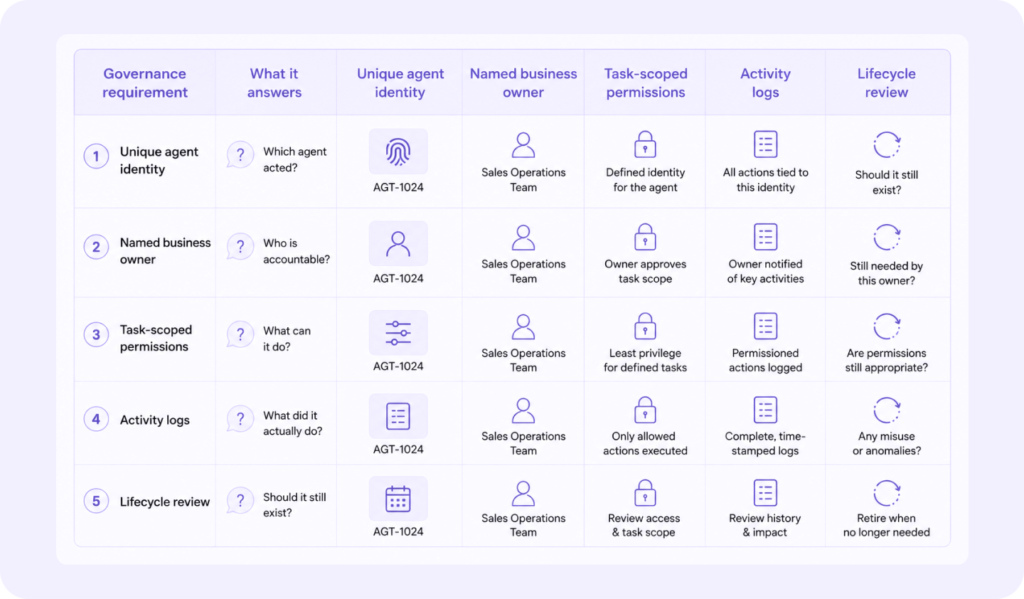
As you deploy more autonomous systems, your IAM programs must evolve from managing human users and service accounts to governing AI-driven identities that can reason, act, and execute workflows.
Traditional IAM often stops at who can access a system. AI-native IAM has to go further: what is this agent allowed to do, under what conditions, and on whose behalf?
That distinction matters because AI agents don’t behave like traditional applications. Applications follow predefined instructions. Agents interpret goals, choose actions, interact with tools, and dynamically execute workflows. Governance, therefore, has to extend beyond access control to accountability.
“AI governance fails when teams treat it as a policy document. You need to define what data the model can access, how much autonomy it has, when human oversight is required, what evidence proves controls work, and who owns the risk if the system fails.”~ Aashis Luitel, Al Governance Faculty, University of the Cumberlands [An excerpt from The wave of change to help brands tackle new age AI adoption panel discussion]
1. Every agent needs its own identity
Many organizations still allow automations and AI tools to operate through shared credentials, generic service accounts, or inherited user permissions. That may work for simple automation. It doesn’t work for autonomous agents. Every agent should have:
- A unique identity
- A business owner
- A technical owner
- An approved use case
- Defined permissions
- A review history
If an AI agent updates a customer record, approves a workflow, or accesses sensitive data, organizations should be able to clearly identify which agent performed the action. Without unique identities, accountability breaks down.
2. Least privilege must apply to agents
The most common mistake is granting agents broad access because it’s convenient. Your agent connected to email doesn’t automatically need your contracts. An agent summarizing support tickets doesn’t need permission to modify customer records. An agent generating reports doesn’t need permission to export your entire database. Just as human users receive role-based access, AI agents should receive task-based access.
The principle remains unchanged: An agent should never be granted more access than necessary to perform its approved function.
3. Observability becomes non-negotiable
The more autonomous your agents become, the more important visibility becomes. You need answers to questions like:
- What data did the agent access?
- Which tools did it use?
- What actions did it perform?
- Which permissions were exercised?
- Was a human approval involved?
- Did it attempt any restricted actions?
Without this visibility, your investigations become harder, your audits become more painful, and your governance remains largely theoretical. Observability turns agent behavior from a black box into an auditable process.
4. AI agents need lifecycle management
Your employees get onboarding, role changes, periodic reviews, and offboarding. Your agents need the same. For every agent, you should be able to answer:
- Why the agent was created
- Who owns it
- What systems it can access
- Whether it is still required
- When its permissions were last reviewed
An abandoned AI agent with access to documents, CRM systems, code repositories, or customer data is no different from an orphaned privileged account. Over time, forgotten agents may become one of the largest sources of hidden risk inside organizations.
5. Governance must happen at runtime
One of the biggest shifts in AI governance is the move from static approval to continuous enforcement. Historically, governance happened before deployment. An application was approved, granted access, and periodically reviewed.
Agents operate differently. Their actions are dynamic. They may access different tools, interact with different datasets, and perform different actions depending on context. That’s why you need runtime controls such as:
- Restricting access to sensitive systems
- Blocking unauthorized data exports
- Requiring human approval for high-risk actions
- Preventing access to specific datasets
- Limiting actions outside approved workflows
Runtime controls extend your governance from what an agent can reach to what it actually does.
The future of IAM is not human
For decades, identity programs focused almost entirely on people. Now, AI agents, bots, automations, workload identities, APIs, and machine credentials are becoming active participants in business operations. They are no longer supporting the business in the background. They are increasingly performing work. That shifts how you should think about identity.
The future of IAM will be less about managing who logged in and more about managing which identity acted, what it did, why it did it, and whether it was allowed to do it.
1. From access management to action governance
Historically, IAM focused on a single question: Does this user have access to this system? That question is no longer enough. You now need to ask:
- Can this agent approve payments?
- Can it modify customer records?
- Can it send communications externally?
- Can it access regulated data?
- Should a human review the action first?
The future of IAM is increasingly about governing actions, not just access.
2. From periodic reviews to continuous governance
Traditional access reviews happen quarterly or annually. AI agents evolve much faster. New integrations are added. Capabilities expand. Permissions change. Use cases multiply.
Governance must become continuous. You will need:
- Continuous agent discovery
- Continuous permission monitoring
- Continuous risk assessment
- Continuous policy enforcement
- Continuous access reviews
The objective isn’t to slow your teams down. It’s to make sure AI adoption can scale safely.
3. From policy documents to operational controls
Many organizations have already created AI policies. The challenge is that policies alone don’t govern behavior. Controls do. As AI agents become more autonomous, organizations will need governance embedded directly into operations.
In the CISO Pulse Check report, 39% of CISOs said their organization has an AI acceptable-use policy that is not enforced. If your AUP lives in a document with no control backing it up, you’re in that 39%.
That means maintaining evidence around:
- Agent inventories
- Ownership records
- Permission reviews
- Access approvals
- Activity logs
- Human oversight
- Policy enforcement
AI governance is quickly becoming an operational discipline rather than a documentation exercise.
4. The new identity perimeter
The traditional security perimeter was the network. Cloud computing shifted the perimeter to identity. AI is pushing that shift even further.
The modern identity perimeter now includes:
- Humans
- Devices
- APIs
- Service accounts
- SaaS integrations
- Workload identities
- Automation bots
- AI copilots
- AI agents
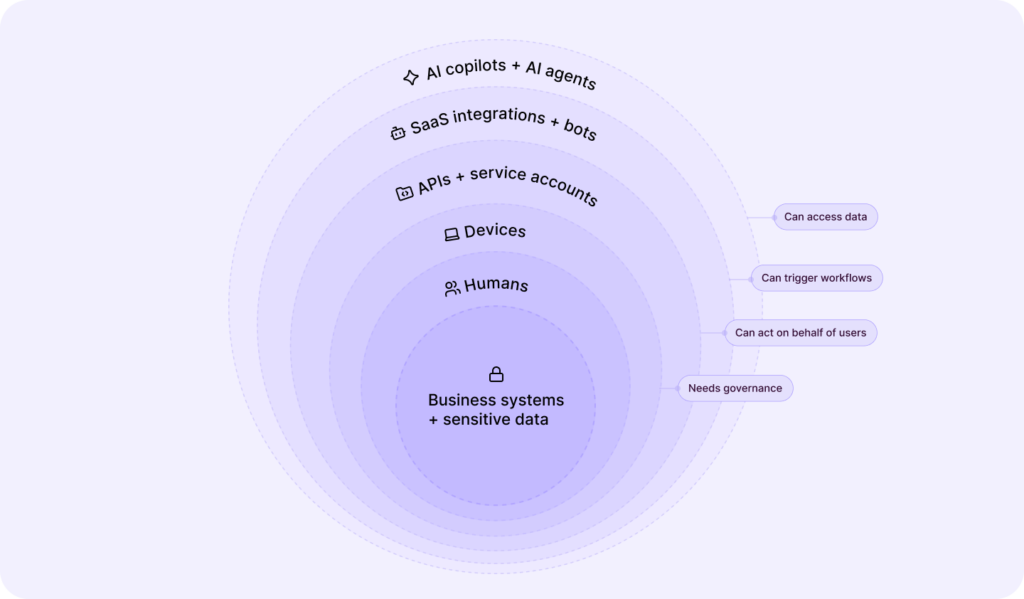
Each of these identities can access your systems, touch your data, and create risk. Each of them needs governance. And increasingly, AI agents will be among the most powerful identities in the enterprise.
The organizations that succeed with AI will be those that govern their agents well, not those that deploy AI the most. In an agent-driven world, the most important question is no longer what the AI can do but what this identity should be allowed to do.

FAQs
Author
Srikar Chitturi
Srikar has over 12 + years of experience as a marketer. He has worked in diverse sectors and multi-product settings, focusing on creating compelling product narratives and messaging. Outside of work, Srikar indulges in his passion for black-and-white photography, capturing moments with a timeless aesthetic.Go beyond the surface and uncover the governance, risk, and compliance insights that actually matter.


Win digital goodies for boardroom success


Explore more



research & insights curated to help you earn a seat at the table.