Vanta vs Drata vs Delve: Which Compliance Tool Fits You?


When sales questionnaires pile up, or a potential client asks for SOC 2, you need a platform that pulls evidence automatically, keeps controls organized, and gets you over the audit line without stealing weeks.
Vanta, Drata, and Delve all promise to do that, but they come at it differently—Vanta comes with scale and a big auditor footprint, Drata, with polished audit workflows and deep integrations, and Delve, with its AI-first approach.
In this blog, we take you through a step-by-step process to choose right platform for your company’s individual needs. Let’s get started.
TL;DR
| Vanta, Drata, and Delve all support multiple frameworks beyond SOC 2, your choice comes down to your complexity, audit timelines, and budget. |
| Vanta wins onthe evidence scale (hourly tests) and the broadest auditor ecosystem, but the pricing is opaque. |
| Drata excels at polished workflows, auditor collaboration, and strong integration, but often costs more. |
| Delve is AI-first and speedy for small teams, but it’s important to know that Delve is new to the market |
Vanta vs Drata vs Delve: A quick overview
Vanta

Vanta is a trust and compliance platform that helps teams simplify and fasten audits like SOC 2, ISO 27001, HIPAA, and more. It connects to your cloud, identity, code, and productivity tools, pulls evidence for you, and monitors controls on a schedule.
Vanta supports more than 35 frameworks and offers hundreds of pre-built integrations, which is handy if you’re working with multiple standards or growing into new markets.
Vanta maps overlapping requirements across different compliance frameworks and automatically reuses your work, so meeting one standard helps you make progress on others.
Vanta saves compliance teams time by minimizing engineering work, running frequent automated tests, and keeping you close to continuous compliance. Its Trust Center lets you share policies, reports, and FAQs, with AI support for common questions and NDA approvals. Vanta also offers an auditor network for smoother audits and an API to integrate data into existing workflows.
Drata

Drata is an AI-native compliance and GRC platform built around continuous monitoring and automated evidence collection. It centralizes controls, policies, risks, and audit tasks so teams can see status in one place and stay audit-ready for frameworks like SOC 2, ISO 27001, HIPAA, and others.
Drata’s edge is its end-to-end workflow. Pre-mapped controls let you reuse work across frameworks, while “Audit Hub” organizes requests and communication with your auditor. A built-in Trust Center publishes your policies and reports to speed security reviews.
Drata also supports over 170 native integrations, which reduces one-off scripting and helps SMBs get value quickly. For advanced teams, the Drata Control Framework (DCF) provides a common control catalog, and you can extend automation with custom connections and tests.
If you face a high volume of questionnaires, Drata’s AI features can draft responses using the evidence and policies already in the system. Combined with access reviews, policy templates, and risk management, the platform covers most day-to-day compliance operations in one place.
Delve
Delve is also an AI-powered compliance platform that helps you get prepared for SOC 2, ISO 27001, HIPAA, GDPR, and PCI DSS audits. Like others in this list, it connects to your systems, gathers evidence, and keeps controls up to date in the background.
In 2025, Delve announced a $32M Series A round, which signals momentum and the resources to keep shipping. If you need newer standards, Delve also lists support for ISO 42001, the EU AI Act, and NIST AI RMF.
What makes Delve special is the way it uses “agentic” AI. The platform doesn’t stop at tracking stuff — it deploys agents to do work for you. Those agents can take audit screenshots, create reports, autofill security questionnaires, scan code on every pull request, and scan your cloud for issues daily.
There’s a real-time Trust Center you can publish to buyers, and the company advertises white-glove onboarding with 1:1 Slack support included. For SOC 2, Delve markets a path measured in days rather than months, and for enterprise teams, it also automates third-party risk reviews by analyzing vendor responses.
Vanta vs Drata vs Delve: A detailed feature comparison
Now that we are familiar with the platforms, let’s pit them against each other in the most important pillars of being a dependable compliance platform.
Evidence collection
All three tools automate evidence, but they approach it differently. Vanta is designed for scaling. It cross-maps the results across frameworks so the same evidence counts in more than one place.
Drata focuses on audit readiness end-to-end. Its “Audit Hub” pulls period-bound evidence into a single workspace and lets you respond to requests, chat with auditors, and keep a clean trail. Customers often talk about how easy setup and integrations make ongoing evidence collection feel routine.
Delve takes an AI-first route. Its agentic system claims to gather screenshot evidence, validate it, and even draft audit artifacts for you. That’s paired with daily infrastructure scans and code checks on every pull request, which can identify problems early.
Winner: Vanta. For most teams, the long list of automated tests and frequent checks gives Vanta a strong edge in reliable, low-touch evidence collection across frameworks. Drata is close behind for its nice packaging of audit-period evidence; Delve’s automation looks promising, but it is newer and less proven at scale.
Integrations
Vanta has one of the widest published ecosystems, with 400+ integrations across cloud, identity, code, HRIS, devices, and more, backed by a steady flow of new connectors.
Drata lists 170 to 180 plus native integrations and also supports custom connections and tests, so you can push structured data from tools that don’t have a native connector. In practice, users say this covers most of a modern stack.
Delve mentions integrations with common platforms like Google Workspace, AWS, Azure, GitHub, and Okta, but it doesn’t publish a large catalog or count today. Honest third-party write-ups also point out that Delve’s connector library is still growing compared to older players.
Winner: Vanta. If connector coverage is your top concern, Vanta’s size and pace stand out. Drata is a solid second with good depth and extensibility. Delve is improving, but lacks a public, broad catalog right now.
Workflows
Drata is strongest on structured audit workflows. Audit Hub centralizes requests, evidence, and chat, includes a dedicated “Auditor View,” and even integrates with Fieldguide so auditors can pull what they need without a Drata login. That reduces back-and-forth and keeps everything tied to controls and tasks. Reviews also call out smooth end-to-end execution.
Vanta’s workflow strengths show up in day-to-day operations and buyer diligence. Cross-mapped controls help you reuse work across frameworks. Ticketing workflows and automated ticket creation are also nice bonuses.
Delve doubles down on agentic workflows and concierge help. The platform acts like a project manager that creates tasks from your gap assessment, and its team will represent you in front of auditors, with 1:1 Slack support and a shareable trust report. That’s appealing for small teams that want hands-on help alongside software.
Winner: Drata. For formal audit collaboration and traceability, in-app execution with auditors, Drata’s Audit Hub and Fieldguide link gives it the best workflow story. Vanta is a close second for sales-facing trust workflows and cross-framework operations, while Delve remains a better choice for smaller teams.
Real-time monitoring
Vanta, Drata, and Delve all promise always-on compliance, but they take different paths.
Vanta runs over 1400 automated tests on an hourly basis and ties them to a large integration network. That frequency and depth give you a fast signal when something isn’t right, plus cross-framework reuse of evidence. Vanta also uses AI to suggest fixes, which helps close issues quickly.
Drata’s draw is continuous control monitoring with near-real-time dashboards. It automatically tests mapped controls and pulls data from hundreds of services. In practice, customers say the monitoring feels routine once set up.
As expected, Delve goes AI-native. It advertises daily cloud scans for misconfigurations and code scanning on every pull request, so risk shows up right where engineers work. That’s paired with agents that gather screenshots and validate evidence in the background. It’s modern and developer-friendly, but we can’t say for sure how it performs in the long run since its so new.
Winner: Vanta. Drata is strong, and Delve’s developer-centric scans are clever, but Vanta’s hourly tests across a wide integration set make its live coverage the most mature for most teams.
Pricing transparency
Neither of the three solutions posts transparent pricing on their main pages, which makes budgeting harder.
Vanta’s pricing page directs you to request a demo without public numbers. Third-party buyers’ guides say that Vanta’s entry tier is around $10,000/year, with higher tiers much more, but those are estimates, not the list price.
Drata does better on structure. Its plans page details bundles, like Foundation, and what’s included—framework count, FTE caps, etc.—even if it still withholds list pricing. Outside sources give ballparks from $7,500 to $100,000/year, depending on scope and size.
Delve does not publish pricing today. The team has publicly said they charge an annual flat fee and have been exploring models, but there’s no current menu online.
Winner: Tie. All three are quote-based. Drata gets a slight edge because its plan structure and inclusions are visible up front, which helps SMBs and busy leaders scope needs before a sales call.
Customer support
Drata gets consistent praise for fast, hands-on support and proactive CSMs in recent G2 reviews. Users call out one of the best support teams, responsive ticketing, and named CSMs who stay engaged through setup and audits. That pattern shows up across multiple fresh reviews.G2
Vanta also scores well on support, with G2 reviews noting prompt help and even introductions to auditors. Some comments mention add-on costs and UI churn, but the support experience itself is described as helpful and engaged.G2
Delve positions support as white-glove by design: 1:1 Slack, direct help from specialists, and bundled audit coordination. G2’s (small) review set echoes that they’re very present on Slack and move quickly, which early-stage teams tend to value.G2
Winner: Drata. Drata has the deepest bench of recent, public customer feedback praising support quality and CSM involvement.
Auditor network
Vanta publicizes and quantifies a large auditor ecosystem—100+ audit firms in its network and 20,000+ audits completed through the platform. It also markets auditor-specific workflows and an Auditor API. This scale and the published numbers are persuasive if you want lots of choice and a proven track record.
Drata runs an Auditor Alliance with a public auditor directory, plus Audit Hub and a Fieldguide integration so auditors can pull what they need without a Drata login. That close collaboration reduces back-and-forth during the audit window.
Delve doesn’t list a public directory. Instead, it markets bundled audits and coordination, with the platform and team managing evidence and auditor interactions for you. Helpful for small teams, but less transparent if you want to choose among many firms.
Winner: Vanta. Drata shines for collaboration mechanics and auditor experience, but Vanta’s published scale (firms and audit count) makes it the safest pick if breadth and availability of audit partners are your top concern.
At a glance: Vanta vs Drata vs Delve
| Feature | Vanta | Drata | Delve |
| Evidence automation and cadence | 1,400+ automated tests that run hourly; auto-collects evidence tied to controls | Automated continuous control monitoring with always-on evidence collection across your stack | Agentic AI gathers screenshot evidence and validates it in the background |
| Continuous monitoring | Hourly tests across a large integration set for near real-time issue detection | 24×7 continuous monitoring; dashboards identify issues as they appear | Daily cloud scans and code checks on every PR to surface risk where engineers work |
| Integrations | 400+ integrations | 170+ native integrations | 100+ integrations |
| Framework coverage and cross-mapping | Supports 35+ frameworks with cross-mapped controls to reuse work | 20+ frameworks with the Drata Control Framework (DCF) | SOC 2, ISO 27001, HIPAA, GDPR, PCI DSS, ISO 42001, and NIST AI RMF |
| Auditor collaboration | 100+ audit firms; Auditor API and in-product collaboration | Audit Hub centralizes requests and chat; Auditor View and Fieldguide integration | Concierge model: team helps manage auditor interactions alongside the platform |
| Trust Center | Trust Center with Vanta AI Q&A and one-click NDAs for controlled sharing | Trust Center shows controls’ live status and key docs to speed reviews | Public trust page and shareable trust reports; AI-assisted answers |
| Access reviews | Built-in Access Reviews automate user entitlement attestations | Automated Access Reviews with linked evidence to controls | Not marketed as a dedicated module; focus is on agentic evidence and DevOps scanning |
| Cloud and code scanning | Offers vulnerability management guidance; posture comes via integrations and tests | Monitors cloud posture; integrates with security tools | AI infrastructure scanning (daily) and AI SAST that checks every PR |
| AI assist (questionnaires/fixes) | AI answers buyer questions and can generate remediation tips and snippets | Trust Center supports self-serve answers; automation across policies and tasks | AI handles screenshots, questionnaires, and guided fixes |
| API and extensibility | Public integrations library and API | Custom connections and tests to push structured evidence on your schedule | Emphasis is on built-in agents over public API docs (as of now) |
Vanta vs Drata vs Delve: Pros and cons
It’s not really possible to make an informed choice without knowing the pros and cons of each platform. So let’s dig into those:
Vanta
Vanta feels like the dependable choice. With Vanta, you get wide auditor relationships, mature automation, and a product that fits neatly into a growing compliance program.
The experience is more traditional; you get automated tests, mapped controls, steady monitoring, rather than heavy agentic AI that does work on your behalf. Pricing, however, stays behind a sales conversation, which can slow early budgeting.
Pros
- Vanta’s large auditor ecosystem makes it easier to find a partner and move from readiness to report without disruption.
- Frequent, automated tests keep you ready and reduce manual evidence-chasing across frameworks.
Cons
- Pricing is opaque, so planning and comparisons take extra time.
- The approach can feel more classic automation than modern AI agents doing tasks end-to-end.
Drata
Drata stands out for its sleek, well-organized interface and thoughtful flow from control mapping to audit delivery. Integrations cover the most important tools and systems, and the automation story is strong, especially when working with multiple frameworks and needing clean auditor collaboration. However, many buyers note a higher overall cost as a tradeoff.
Pros
- The polished UI and guided setup shorten the path to a workable, audit-ready system.
- Broad integrations and continuous monitoring create a smooth, end-to-end workflow
Cons
- Drata is expensive, which can be a red flag for lightweight teams.
Delve
Delve is the newcomer with an AI-first angle: agentic workflows, fast onboarding, and hands-on support designed for teams that want momentum. The company’s ecosystem is still maturing, and public reviews and auditor partnerships are thinner than the others, which matters as programs scale.
Pros
- Agentic AI helps collect evidence and push work forward with less manual effort.
- White-glove support and Slack access make it friendly for first-time audits and small teams.
Cons
- A newer, smaller ecosystem means fewer published partners and references.
- The focus today fits startups and SMBs better than complex, multi-region enterprise programs.
Vanta vs Drata vs Delve: When to choose each solution
Choose Vanta if:
- You want a safe, well-trodden compliance path with broad industry recognition.
- A large library of automated tests running in the background appeals to you.
- Cross-mapped controls matter, since they let you expand into new frameworks without redoing work.
- Stability, credibility with buyers, and strong auditor availability are just as important to you as product features.
Choose Drata if:
- You prefer a polished, deeply integrated compliance platform that feels seamless end to end.
- Moving from policy to audit with minimal friction is a top priority.
- You value a clean UI, thoughtful control mapping, and buttoned-up auditor workflows.
- Automation and refinement outweigh price concerns, and you’re comfortable paying for a premium experience.
Choose Delve if:
- You’re a startup or SMB team that needs speed, affordability, and momentum.
- Hands-on guidance is important, with agentic AI and 1:1 Slack support to keep you moving.
- You’d rather avoid a heavy lift or major internal process changes.
- White-glove help and a lighter price point matter more to you than having the most mature ecosystem.
Experience a faster path forward with Sprinto
Vanta, Drata, and Delve each bring something unique to the table. Vanta gives you scale and credibility, Drata shines with smooth workflows and strong integrations, and Delve pushes an AI-first style that helps teams move quickly.
But for many buyers, the tradeoffs are familiar: opaque pricing or higher total cost on one side, smaller ecosystems or newer footprints on the other.
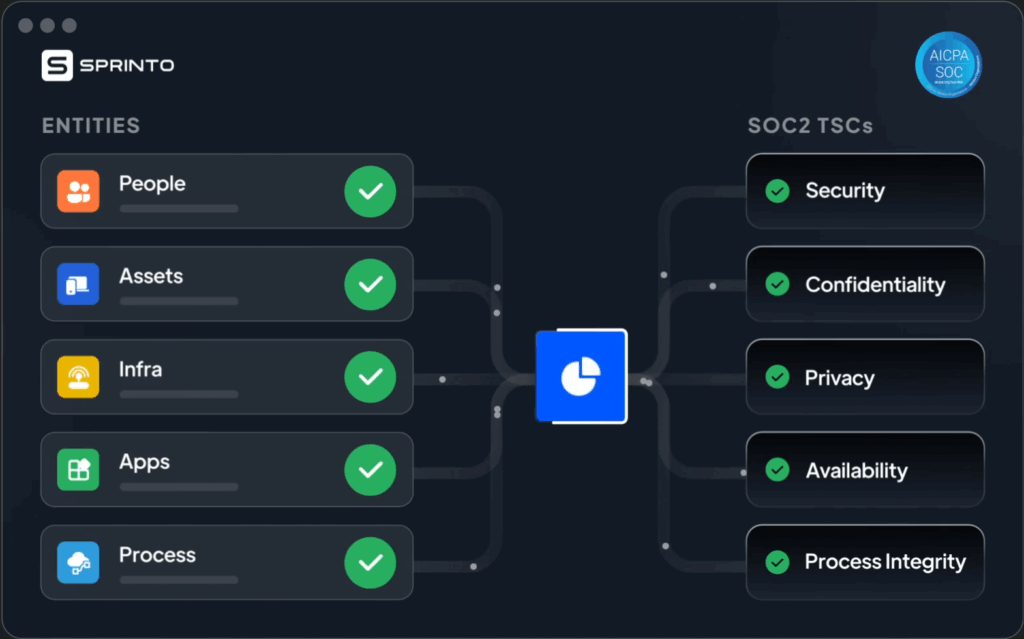
If you want AI-driven speed and the reliability of a mature, audit-ready system, consider Sprinto. It’s an autonomous trust platform that goes beyond surface-level automation, using AI agents and deep integrations to continuously monitor controls, collect evidence, and flag risks before they become audit blockers.
Unlike checklist-driven tools, Sprinto is built to run compliance on autopilot without compromising on depth or control:
- Bring auditors into a single workspace to review evidence, track queries, and close audits faster
- Automate up to 90%+ of evidence collection with continuous control monitoring and real-time alerts for drift
- Tap into 300+ integrations across cloud, identity, code, devices, and HR with flexible APIs to extend coverage
- Publish a dynamic security profile and securely share sensitive documents with access controls and NDAs
- Run continuous risk assessments with AI-powered recommendations that prioritize fixes based on impact and effort
Want to stay audit-ready without chasing spreadsheets? Talk to a Sprinto expert
FAQs
Both cover SOC 2 end-to-end. Vanta has a lot of breadth, like hourly automated tests and a large auditor network, so you stay close to “always ready” and have options when it’s time to pick a firm.
Drata’s edge is workflow: Audit Hub plus a Fieldguide integration lets your auditor work in their system while requests and evidence sync from Drata, which many teams find smoother during the audit window.On user review sites, both are well-rated for SOC 2 outcomes.
None of the three publishes list prices. Third-party buying data measures Vanta’s median contract at around $19,500/year, with higher tiers costing more.
Drata is in a wide $7,500 to $100,000/year band depending on size, scope, and frameworks.Delve does not post pricing; it’s quote-based via sales.
Yes. Vanta markets over frameworks with cross-mapped controls. Drata lists 20+ frameworks and supports custom mappings via its control framework.Delve advertises all the classic standards (ISO 27001, HIPAA, PCI DSS) and newer ones like ISO 42001, EU AI Act, and NIST AI RMF.
If you’re looking for a more autonomous approach to compliance, many teams evaluate Sprinto. It’s an autonomous trust platform that uses AI agents and deep integrations to automate most evidence collection, continuously monitor controls, and flag risks early while bringing audits, integrations (300+), and Trust Center workflows into one place.
Author
Pansy
Pansy is an ISC2 Certified in Cybersecurity content marketer with a background in Computer Science engineering. Lately, she has been exploring the world of marketing through the lens of GRC (Governance, risk & compliance) with Sprinto. When she’s not working, she’s either deeply engrossed in political fiction or honing her culinary skills. You may also find her sunbathing on a beach or hiking through a dense forest.Go beyond the surface and uncover the governance, risk, and compliance insights that actually matter.


Win digital goodies for boardroom success


Explore more





research & insights curated to help you earn a seat at the table.