TL,DR:
| Security refers to the technical controls protecting assets against cyber threats, while compliance is adherence to third-party regulatory standards demonstrating data protection to external parties |
| Being compliant does not guarantee being secure. An organization can pass an audit while still having exploitable vulnerabilities. Conversely, strong security controls do not automatically satisfy every framework requirement |
| Both disciplines share common ground through risk assessment, policy enforcement, and technical controls, and organizations should treat them as complementary rather than interchangeable |
Information technology has evolved rapidly over the last couple of decades, with the industry set to top $5 trillion in 2019. The growth of IT is giving rise to a new set of complex compliance and security challenges.
Industry experts are realizing the importance of how companies share, store, and receive information. IT compliance frameworks ensure the regulation of data happens securely. Compliance automation tools reduce the manual effort of demonstrating adherence to these frameworks, so security teams can focus on technical controls rather than documentation cycles.ens securely.
Although security and compliance have synergies, it can be challenging to tell them apart.
If organizations follow a certain framework, they can protect their data accordingly while aligning themselves with the highest security standards.
Although security is a big part of compliance, they are not the same thing. Knowing how to build a compliance program helps draw that boundary clearly, ensuring regulatory requirements are addressed as a distinct layer from the security controls that underpin them.
What is Security and Compliance
Security refers to the controls and systems that form an organization’s cybersecurity stack – the layered defenses that protect personnel, data, and assets from threats. It comprises of all the different strategies and controls that your organization implements to defend against cyber attacks. Security is highly nuanced and so, it requires consistent maintenance and a dedicated approach to build an effective cybersecurity program.
Compliance standards are set by third-party regulatory bodies and are generally considered a legal requirement. Sprinto’s supports 30+ compliance frameworks that help organizations demonstrate their security posture to customers and regulators. Our Compliance management software help organizations track adherence to these standards without conflating them with the security controls that protect the underlying data. Compliance proves evidence of security to show clients and customers that your internal processes are secure. This gives them a great deal of confidence that their information is effectively secured when they engage in business with your organization.
What is the Key Differences between Security & Compliance
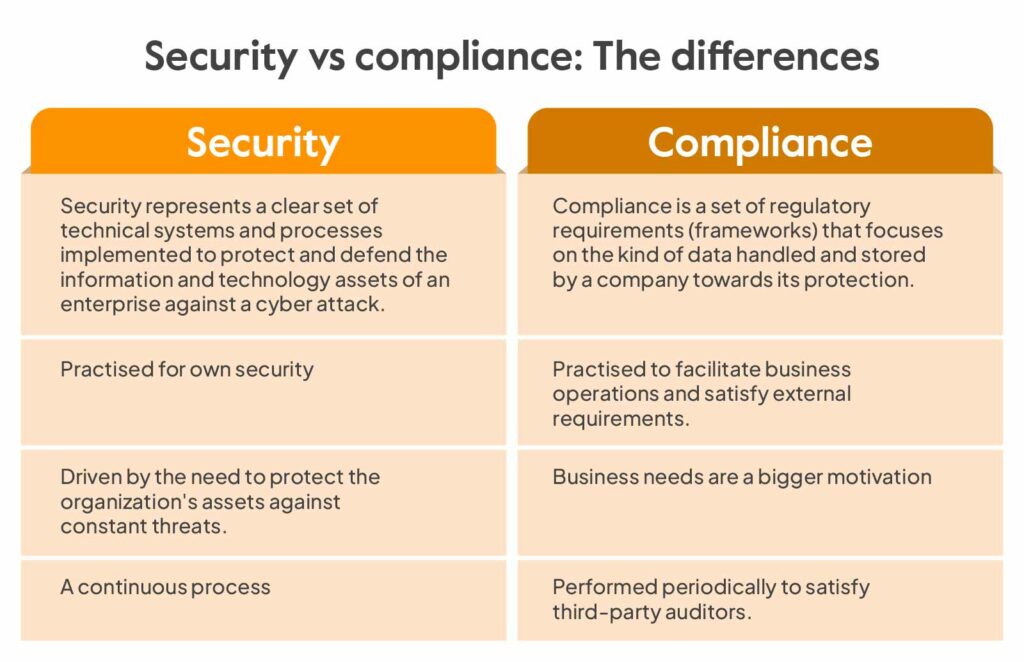
Although compliance and security are two sides of the same coin, security measures are fueled by business risk, whereas compliance is driven by legal obligation and demonstrates your organization’s ability to keep their data free from harm.
The key differences between these security and compliance are:
| Security | Compliance |
| Security represents a clear set of technical systems and processes implemented to protect and defend the information and technology assets of an enterprise against a cyber attack. | Compliance is a set of regulatory requirements (frameworks) that focuses on the kind of data handled and stored by a company towards its protection. |
| Practised for own security | Practised to facilitate business operations and satisfy external requirements |
| Driven by the need to protect the organization’s assets against constant threats | Business needs are a bigger motivation. |
| A continuous process | Performed periodically to satisfy third-party auditors. |
Similarities between Security and Compliance: Where do they Align
Compliance and security are two sides of the same coin—while security measures are driven by the motivation to protect critical business assets, compliance is fueled by legal obligation and market conditions.
Compliance wins the trust of your clients by demonstrating the ability to keep their data free from harm. It would be next to impossible for clients, without compliance requirements. It helps organizations implement policies and strategies to align with industry best practices and to make sure your organization is compliant with the law.
Ideally, a business’ compliance needs and security measures need to be in alignment, but that’s not always the case. Sometimes, security control and measures have been implemented, but all of the boxes for compliance needs may not have been checked.
Being compliant does not automatically mean being secure. A compliance audit checklist helps organizations verify both dimensions by confirming that security controls are not only present but operating correctly against each specific regulatory requirement they are mapped to. Security ensures the organization is well-protected against all forms of threats, and a compliance certification demonstrates this.
Automate your Security and Compliance with Sprinto
Align your security measures to protect business-critical assets by improving your organization’s cyber security posture while automating the tedious compliance process.
Achieve and maintain compliance to win the trust of your clients and customers. Stay up-to-date with third-party security standards and frameworks while being proactive about security, all from a single dashboard.
Sprinto has been consecutively recognized as a Leader in Security Compliance as well as in the Cloud Security and Cloud Compliance categories by G2, where it was rated #1 in User Adoption, Ease of Implementation, Usability, and ROI.
Frequently asked questions

Author
Ayush Saxena
Ayush Saxena is a senior security and compliance writer. Ayush is fascinated by the world of hacking and cybersecurity. He specializes in curating the latest trends and emerging technologies in cybersecurity to provide relevant and actionable insights. You can find him hiking, travelling or listening to music in his free time.Go beyond the surface and uncover the governance, risk, and compliance insights that actually matter.


Win digital goodies for boardroom success


Explore more



research & insights curated to help you earn a seat at the table.