
The New Vendor Tiering Model: How to Categorize Vendor Risk in an AI Era

| Tldr AI is changing vendor tiering because risk is no longer limited to core infrastructure vendors. Traditional backbone categories like cloud, cybersecurity, and DevOps still require the highest governance rigor, but AI integrations are now expanding runtime exposure across CRMs, collaboration tools, HR systems, finance platforms, and other operational SaaS categories. At the same time, foundation models and enterprise AI assistants are emerging as a new high-impact vendor tier that requires dual governance: vendor-side diligence combined with internal runtime controls like RBAC, DLP, and usage monitoring. |
On April 18, 2026, Microsoft documented a cross-tenant intrusion technique in which attackers abused Microsoft Teams to impersonate internal IT helpdesk staff and conduct data exfiltration. The technique relies on social engineering through Teams chats and calls, allowing threat actors to gain trust and pivot into internal environments.
This method is worth attention because it exploits Productivity & Collaboration platforms that are traditionally not considered to be risk gateways.
Many will also remember the famous deepfake story from February 2024, when a Hong Kong-based multinational lost approximately $25 million after an employee was deceived during a video conference call by fraudsters who used deepfake technology to impersonate the company’s top executives.
In both cases, the vector was not the core backbone infrastructure. It was trust embedded in Productivity & Collaboration tools, systems traditionally viewed as operational enablers rather than structural risk layers.
These incidents illustrate a broader pattern. Even as backbone systems remain critical, AI-driven integrations are expanding oversight requirements into categories previously considered contained. The vendor tiering model has effectively changed. The Vendor Category Landscape 2026 Report explores what stays the same and how vendor risk tiering has materially changed as a consequence.
The Vendor Category Landscape 2026 Report explores what stays the same and what has materially changed in TPRM in 2026.
Tier 1: Backbone categories where governance rigor is unchanged
Certain vendor categories remain structurally critical.
Cloud Infrastructure, Cybersecurity, DevOps platforms, and Backup & Disaster Recovery systems continue to carry high systemic impact. Disruption or compromise in these domains can affect enterprise-wide operations. GRC teams should maintain the status quo here.
They have always required:
- Continuous oversight
- Concentration risk management
- Contractual rigor
- Incident readiness
- Recovery defensibility
That logic has not changed.
Structural impact remains a foundational vendor tiering best practice. Even when vendor governance maturity appears strong, dependency depth and switching cost create inherent exposure.
If anything, the need for defensibility in these backbone categories has intensified, even if the reasoning behind vendor tiering remains consistent.
Tier 2: Operational SaaS categories now inheriting AI-driven exposure
AI integrations are increasing runtime dependency across categories that were historically considered contained.
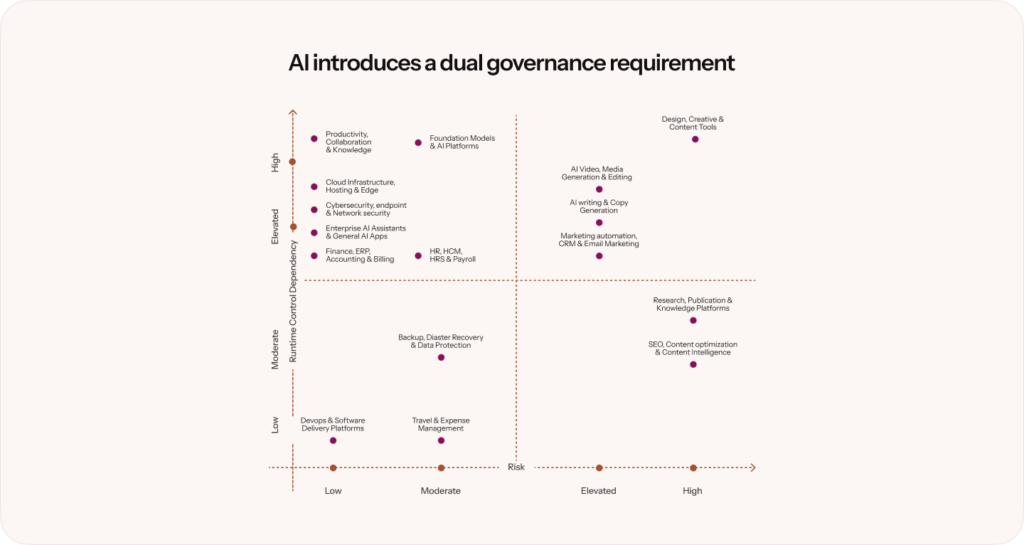
- Marketing Automation and CRM platforms now automate outbound communication and personalization at scale.
- Productivity and Collaboration tools embed AI assistants that summarize meetings, draft documents, and analyze internal knowledge bases.
- HRMS platforms incorporate AI-driven screening and workflow routing.
- Finance and ERP systems deploy automated reconciliation and anomaly detection.
- Even Cybersecurity and Cloud platforms integrate AI models that alter how detection and response operate.
In these environments, exposure is increasingly shaped by configuration, user behavior, integration depth, and automation logic. The blast radius of these tools is no longer limited to the data they store. It is defined by their behavior at runtime. (Read more about this in our blog AI Is Redefining How You Define Blast Radius)
This does not elevate all operational SaaS categories to infrastructure-level risk. But it does materially expand the set of domains that require active runtime oversight. GRC teams need to reconsider existing vendor tiering models to account for higher risk in these categories.
The Vendor Category Landscape, 2026, shows that several of these categories now score elevated in runtime control dependency. This means that exposure depends heavily on internal implementation and usage, not just vendor posture. That is a meaningful shift for vendor tiering in third-party risk management.
Tier 3: AI-native categories that need a new governance template
Some categories represent new structural entrants into the high-impact landscape.
Foundation Models and Enterprise AI Assistants combine two characteristics:
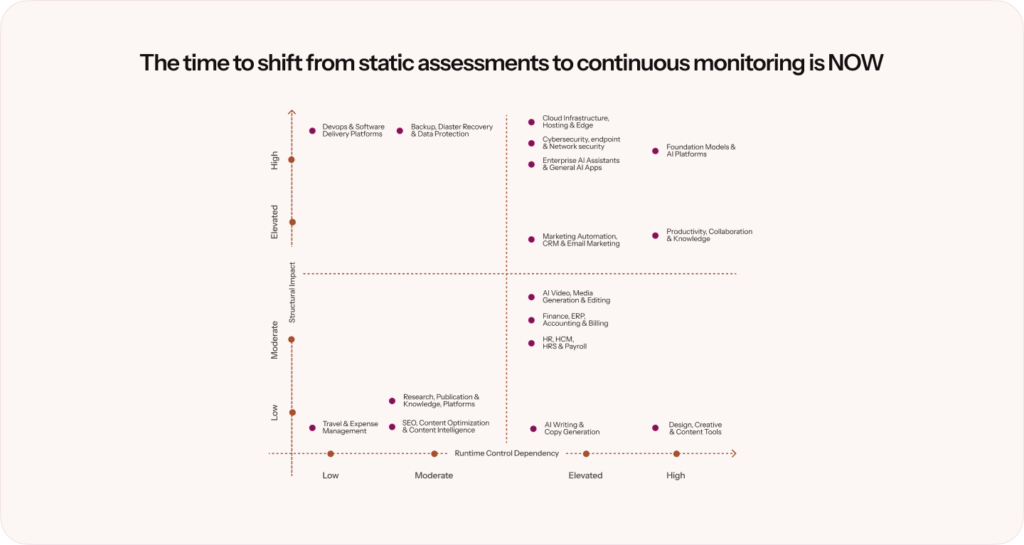
- High structural impact
- Elevated runtime control dependency
They introduce a dual governance requirement. Vendor-side diligence—including enterprise agreements and safety commitments—must be complemented by internal controls such as RBAC, DLP, and runtime monitoring.
Unlike traditional SaaS tools, these platforms may ingest sensitive data across departments and influence automated decision-making. Their depth of integration and AI behavior make them qualitatively different from legacy vendor categories.
They are not merely new tools. They represent a new layer in the vendor ecosystem, and need to be governed through that lens.
Operationalizing the new TPRM in 2026: A three-tier model
Understanding what stays constant and what shifts is useful only if it changes how oversight is structured.
The findings suggest a practical three-tier approach to vendor risk tiering, illustrated in the table below:
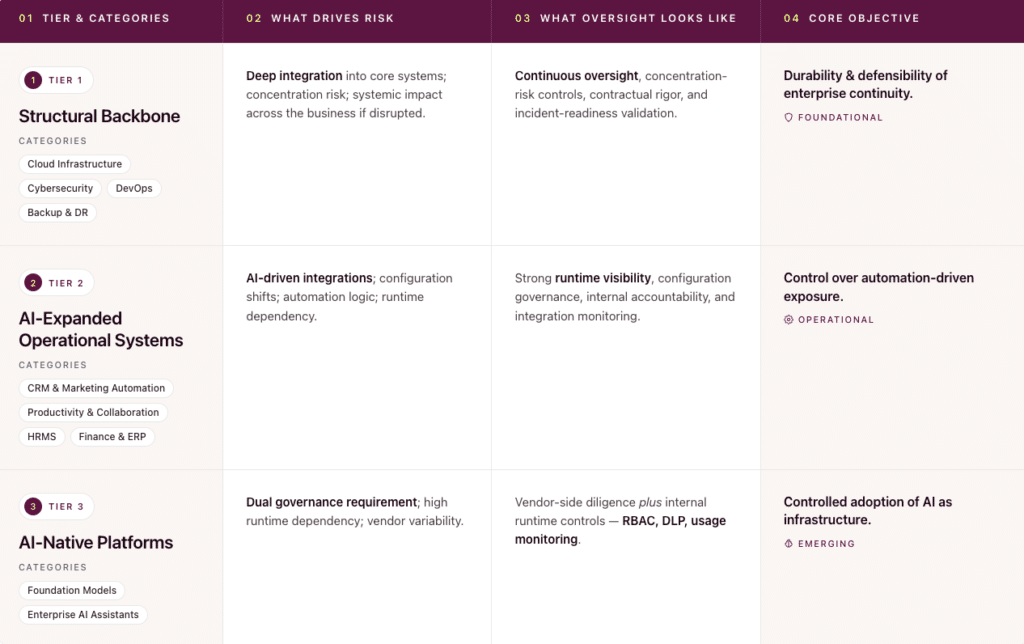
This shift is also reflected in emerging governance frameworks. DORA Article 28 increases expectations around ongoing oversight of ICT third-party providers, while the EU AI Act introduces additional obligations for high-risk AI systems. Frameworks like the NIST AI RMF similarly emphasize continuous governance, monitoring, and accountability for AI-enabled systems and vendors.
What this strategic balance means for GRC and procurement teams
The Vendor Category Landscape, 2026, shows that:
- Structural backbone categories remain critical and demand sustained defensibility.
- Operational SaaS categories are experiencing increased runtime dependency due to AI integrations.
- New AI-native vendor categories introduce novel risk characteristics.
The Microsoft Teams intrusion and deepfake fraud examples are reminders that threat actors adapt quickly to new attack surfaces.
TPRM models must do the same.
Not by discarding established vendor tiering logic, but by recalibrating it and expanding on it.
The full Vendor Category Landscape, 2026 report examines how these patterns manifest across 16 vendor categories and 201 vendors, providing a structured view of what remains constant and what has materially shifted. Download it to view detailed insights on these third-party risk management trends that will continue to play out through 2026.
In 2026, effective oversight begins with knowing the difference.
FAQs
How do you tier vendors by security risk?
Effective vendor risk tiering evaluates both structural impact and runtime exposure. Modern vendor tiering best practices now include factors such as AI functionality, integration depth, automation behavior, concentration risk, data sensitivity, and operational dependency rather than relying only on static questionnaires or criticality labels.
What factors should a vendor tiering model include?
A modern vendor tiering model should include governance maturity, runtime control dependency, integration complexity, vendor categories risk, AI-enabled automation, switching cost, and the sensitivity of affected workflows and data. In AI-era environments, vendor tiering assessment must evaluate how systems behave at runtime, not just what data they store.
Which vendor categories require the most TPRM oversight in 2026?
In third-party risk management 2026 programs, Cloud Infrastructure, Cybersecurity, DevOps, and Backup systems continue to require the highest structural oversight. However, vendor categories risk is also rising across collaboration tools, CRMs, finance platforms, HR systems, and AI-native platforms due to increasing runtime dependency and AI integrations.
How should AI vendors be governed differently from traditional SaaS?
AI vendors require a different vendor tiering in third-party risk management approach because they combine high runtime dependency with dynamic data access and automated decision-making. Effective vendor risk tiering now requires dual governance: vendor-side diligence alongside internal controls such as RBAC, DLP, integration monitoring, usage governance, and continuous runtime visibility.
Author
Raynah
Raynah is a content strategist at Sprinto, where she crafts stories that simplify compliance for modern businesses. Over the past two years, she’s worked across formats and functions to make security and compliance feel a little less complicated and a little more business-aligned.Go beyond the surface and uncover the governance, risk, and compliance insights that actually matter.


Win digital goodies for boardroom success


Explore more


research & insights curated to help you earn a seat at the table.