7 Operational Cracks That Have Gone Unnoticed In Your Trust Stack


Large organizations typically have impressive security stacks. Your tools cover endpoint detection and cloud security posture management. You have IAM with strong policies. You might even be using a GRC platform complete with ticketing integrations and automated evidence collection.
On paper, it looks mature.
And yet, you may find yourself in these scenarios more often than not:
- Security questionnaires take days, sometimes a whole week.
- Compliance status requests require stitching together updates from multiple systems.
- Risk posture questions are answered with, “As of our last review…”
- Vendor updates begin with, “During the previous vendor review/ audit cycle…”
All this struggle despite the fact that your tools are running, the controls exist, and the dashboards are green. So where’s the gap?
The gap is operational coherence. That’s why the cracks become especially apparent when you need to prove that everything is working as intended.
Across security programs that look mature on the surface, we consistently see 7 fault lines that contribute to this operational incoherence:
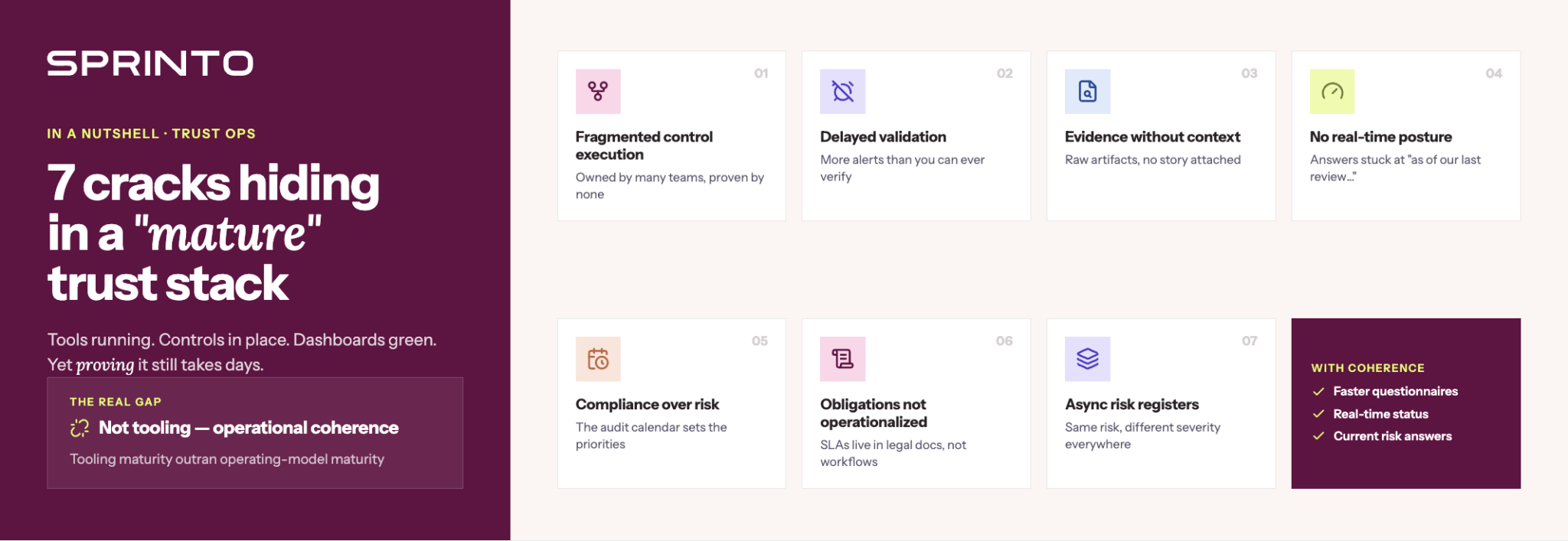
1. Fragmented control execution; singular control assurance
In modern environments, controls are rarely owned by a single function. IAM configurations sit with IT. Cloud configurations sit with DevOps. Endpoint policies sit with Security. GRC owns documentation and reporting.
This distribution makes sense. It reflects specialization and scale.
But when a control (like access provisioning, least privilege enforcement, or incident response readiness) needs to be demonstrated end-to-end, it requires coordination across teams.
So when a board member asks, “Are we confident this control is effective right now?” the answer often depends on pulling signals from multiple systems, reconciling ownership boundaries, and confirming nothing has drifted. By asking other teams.
The “by asking other teams” part is where the operating model breaks down, because that’s how you end up with backbreaking coordination burdens (leaving your team burnt out and frustrated) and the risk of delays.
2. Delays in validating control and system health
With automation, alerts are generated automatically. AI even summarizes incidents and flags anomalies. That’s progress, and should make your job easier.
But all that automation also increases the volume of output you and your team need to review. Even with filtering, alerts might still feel like too many to realistically handle.
Temporary access or configuration changes remain in place longer than planned. Open issues stay unresolved because new alerts keep arriving.
What’s happening is that automation is giving you more visibility than you can continuously validate, so you end up trusting the system more than you should because you don’t have time to verify it.
And that gap becomes obvious when you need to show proof that controls are in place for an audit, customer review or board meeting. That’s how you end up frequently scrambling to make things right.
| Automation is a double-edged sword. While it gives you more visibility, it also increases operational overhead, causing you to rely more on the system, leading to delays in system validation. |
3. Evidence is collected, but not contextualized
Your GRC program is very likely not short on evidence, but you might find yourself frequently trying to reconstruct how these tie to specific control requirements.
Responding to a questionnaire or compliance request involves contextualizing timing, scope, and applicability and reconciling inconsistencies across systems.
It looks like this: Evidence often exists as raw artifacts like logs, screenshots, exports and tickets. In that form, there’s no way to instantly answer critical questions related to each evidence artifact, such as: Which control does this support? For what period? Across which systems? Under whose ownership?
So when a customer or auditor asks a seemingly simple question, you’re not just generating a response, you’re rebuilding the whole story. You have to confirm that the artifact is current, verify that it reflects the right scope, and ensure it maps cleanly to the control being assessed.
This is why you end up spending days coordinating responses to security questionnaires.
4. No real-time view of trust posture
Many environments now operate with continuous monitoring tools that deliver instant cloud misconfiguration alerts, real-time anomaly detection, and automatic access change logging.
But there is no continuously visible control status. It gets reconstructed during review cycles. Exceptions do not always have enforced expiry and ownership. Evidence is not mapped to controls in real time. When asked, “Where do we stand right now?” the answer often requires checking multiple systems instead of pulling a clear, current, and up-to-date view.
Responses start to sound like “As of our last access review…” or “Based on the most recent assessment…” But you’re constantly adding new integrations and entire new environments as you enter new markets. So you end up struggling to defend “as of our last…” validation in today’s far-changed environment.
5. Compliance tasks take precedence over risk management
Risk does not move on an audit calendar.
But when you don’t have visibility into how controls tie to current risk exposure, what you and your team treat as urgent starts to be dictated by external deadlines. So the audit calendar becomes the whole org’s priority-organizer.
Emerging risks that fall outside audit checkpoints often lack the same immediacy because they aren’t lighting up on your screen the way audit milestones do.
That’s how you end up passing audits while blind spots grow in the background until an external event makes them impossible to ignore.
6. Obligations are documented, but not operationalized
In large organizations, obligations vary and multiply by the minute. Customer contracts define different notification timelines, reporting language, audit rights, and control expectations. Regulatory requirements layer on top. Internal risk tolerances add another dimension.
Incident response teams often operate from standardized playbooks. SLAs live in legal documents rather than execution systems. Obligation-specific requirements are known somewhere in the organization, but not always surfaced at the point of action. That’s because they are not embedded into operational workflows.
As a consequence, your team does not ask “Does this customer have different terms?” or “Are we within their agreed timeline?” at the right moment.
So you end up discovering contractual exposure during an incident or a customer escalation.
7. Multiple risk registers are running asynchronously
Cyber risk, vendor risk, privacy risk, and enterprise risk are often tracked in different risk registers, owned by different teams, and reported to different audiences.
The problem begins when the same underlying exposure appears differently across those registers. Each entry may show different severity ratings, owners, and remediation timelines.
A cloud misconfiguration, for example, may be logged in the cyber register as a high-severity control failure. In the vendor risk register, it may be recorded as contractual exposure tied to specific customers. In the enterprise register, it may appear as a broader brand or regulatory risk.
When the registers aren’t linked, updates don’t sync. When leadership asks for clarity, you end up having to compare entries manually, explain the differences, and agree on the actual exposure. You spend time managing operational overhead rather than focusing on reducing material risk, strengthening critical controls, improving vendor resilience, or addressing AI and data governance challenges.
| None of these operational cracks is a reflection of your tech stack. Instead, they are a call to evaluate operating model maturity. |
The way ahead: Rethinking the operating model
None of these cracks is a criticism of your tech stack. In most cases, the technology is well-chosen and correctly implemented. It’s just that tooling maturity has outpaced operating model maturity.
Does this scenario feel familiar? Security capabilities scale rapidly, control execution is spread across specialized teams, automation has amplified signal volume, and review cycles follow a compliance-determined schedule. What does not always scale at the same pace was the connective tissue: the mechanisms that unify distributed controls, continuously validate automation, contextualize evidence, align signal cadence with assurance cadence, and balance compliance with evolving risk.
But putting these mechanisms in place would require clearer ownership of controls, built-in validation cycles for automation, real-time mapping of evidence to control objectives, and structured alignment between evolving risk and formal oversight.
That’s when you get operational coherence.
And with operational coherence in place:
- Questionnaires move faster because narratives are already structured
- Compliance status updates are real-time views, not stitched reports
- Risk posture answers are current and do not require qualifiers tied to past reviews
- Executive conversations shift from artifact gathering to risk trade-offs
The stack may remain the same, but the system around it operates with far less friction.
Author
Raynah
Raynah is a content strategist at Sprinto, where she crafts stories that simplify compliance for modern businesses. Over the past two years, she’s worked across formats and functions to make security and compliance feel a little less complicated and a little more business-aligned.Go beyond the surface and uncover the governance, risk, and compliance insights that actually matter.


Win digital goodies for boardroom success


Explore more



research & insights curated to help you earn a seat at the table.