TL;DR
| Vendor concentration risk is becoming harder to defend because many critical vendor categories now have only a few viable providers, while AI integrations are increasing how much impact those vendors can have at runtime. |
| Defensible vendor selection now requires organizations to clearly document why specific vendors were chosen, what risks were accepted, and how concentration exposure is mitigated across operational SaaS platforms, AI-native vendors, and backbone infrastructure categories. |
| As a result, modern TPRM programs increasingly need structured, audit-ready workflows that preserve vendor selection rationale, mitigation plans, and governance decisions continuously rather than reconstructing them after the fact. |
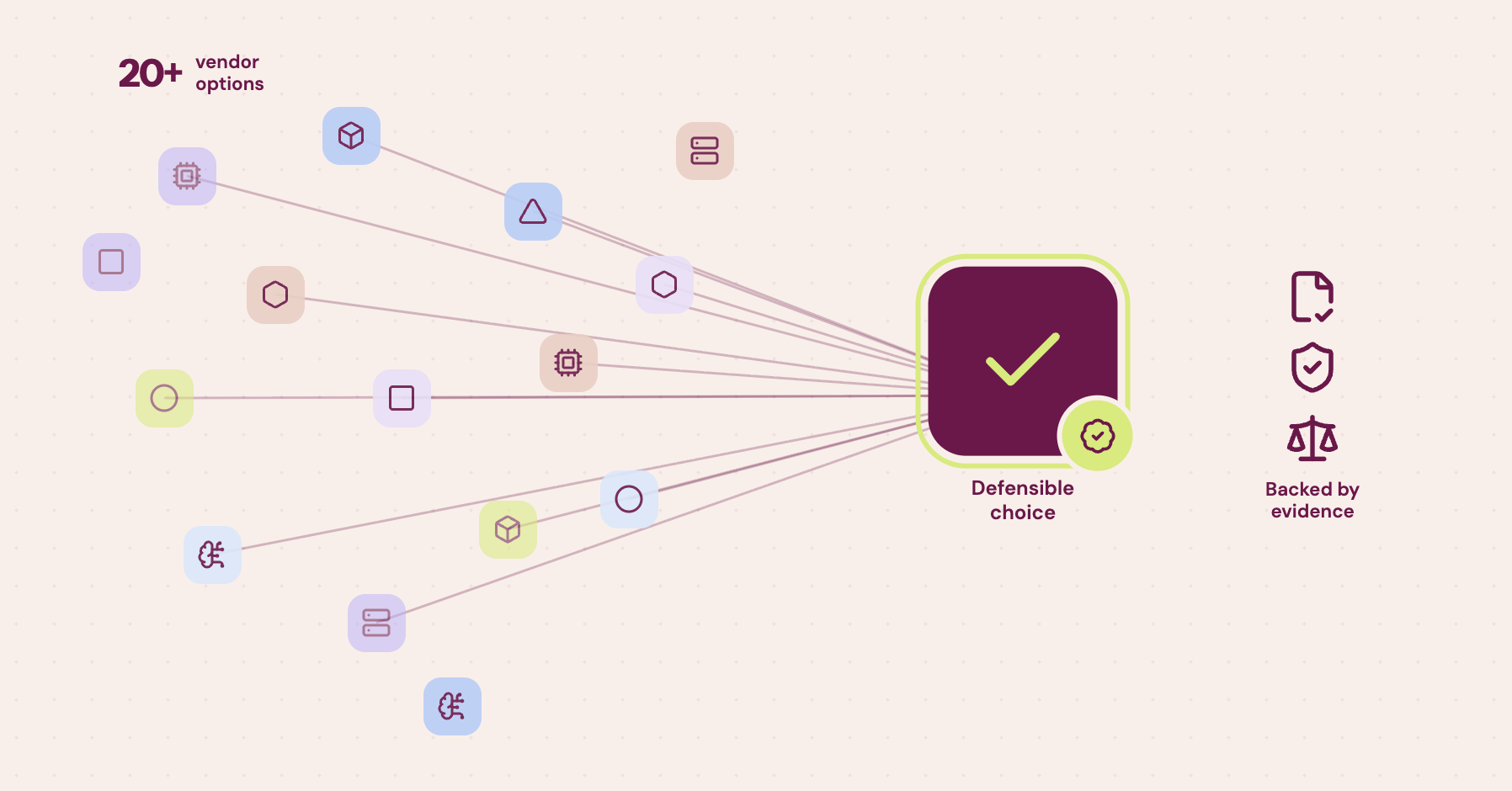
In vendor categories like Cloud Infrastructure, Cybersecurity, DevOps, Finance & ERP, and Marketing Automation, most organizations operate within a predictable shortlist. Switching costs are high. Architectural dependencies are deep. Commercial leverage is limited.
From a procurement perspective, the “right” vendor often appears obvious to you, the procurement team, and other internal stakeholders.
However, from an external defensibility perspective, your choice may or may not be obvious. How do you explain why you say you’re operating with the most resilient vendor in the category, while incidents in the news seem to question this? How do you explain the tradeoff calculations that went behind accepting some amount of vendor concentration risk?
A case in point: In late 2025, multiple European airports experienced cascading operational disruptions after a compromise affecting a shared airline check-in and passenger processing system. What amplified the impact was concentration: multiple airlines and airport operators relying on the same provider for a structurally critical function.
Our latest report, Vendor Category Landscape 2026, underscores this reality: several high-impact categories exhibit elevated to high vendor risk variability, meaning that vendors within the same domain do not present identical exposure profiles, and procurement and GRC teams often have only one or two viable vendor choices.
But you need more than “It was the only option” or “Both options come with the same risk” when it comes to defensibility over third-party concentration risks you accept. This blog is part 4 of a 4-part series breaking down the report’s findings into real-life actionables for GRC teams. It discusses defensibility around “obvious” vendor choices.
Third-party concentration risk management and defensibility
When reliance on a limited number of providers is unavoidable, vendor concentration risk must be:
- Explicitly identified
- Quantified
- Accepted at the appropriate level
- Hedged against
Let’s take a closer look at vendor categories that scored high on vendor variance in the Vendor Category Landscape, 2026. We’ve grouped these by use-case and impact for clearer analysis.
Operational SaaS with Structural Impact
Who’s on the list: Marketing Automation & CRM, Productivity & Collaboration, HRMS & Payroll, and Design & Creative Tools
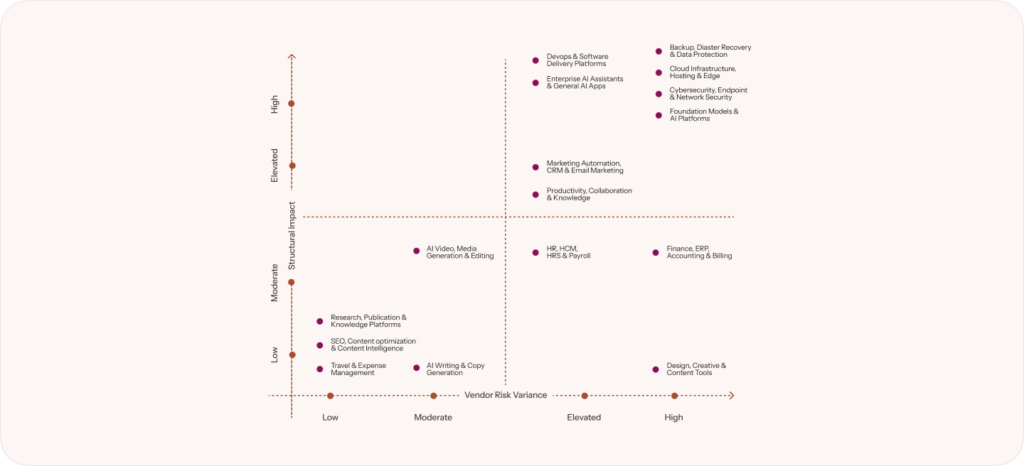
Risk summary: These platforms increasingly process sensitive customer, employee, and executive-level information as AI-driven integrations and automation expand the behavioral surface area of the platform. Insufficient evaluation of integration depth and configuration exposure can lead to misdirected communications, employee data exposure, reputational damage, or manipulation through impersonation vectors. Concentration here may not disrupt infrastructure, but it can disrupt trust.
Your move: In these categories, the defensibility question has expanded. It is no longer sufficient to demonstrate that the vendor is mature and compliant. The differentiator is how the platform behaves once AI features and integrations are activated. Selection decisions should therefore explicitly document assumptions about automation scope, data flow expansion, and integration exposure, because those factors, not vendor certifications alone, increasingly determine impact.
Also, explore how the Marketing, HRMS, Productivity, and Design categories compare in terms of structural impact and runtime dependencies. Download the full Vendor Category Landscape 2026 Report.
AI-Native and AI-Embedded Platforms
Who’s on the list: Foundation Models & AI Platforms and Enterprise AI Assistants
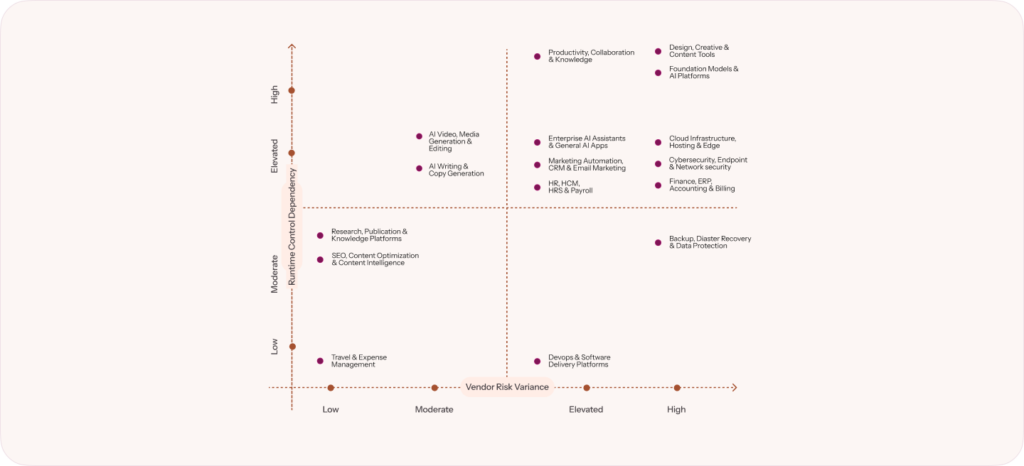
Risk summary: These platforms combine a high Runtime Control Dependency with significant Vendor-Level Risk Variability, and represent vendor choices that GRC teams may be defending for the first time. Differences in model architecture, data handling practices, safety commitments, and integration controls materially alter exposure.
Your move: Vendor selection in these categories should be treated as a governance posture decision. That includes documenting data boundary assumptions, defining acceptable integration models, negotiating safety and usage commitments contractually, and establishing explicit oversight mechanisms for evolving runtime behavior.
Review the full vendor category risk analysis of Foundation Models and Enterprise AI Assistants in the Vendor Category Landscape, 2026—Download Now.
Structural Backbone Categories
Who’s on the list: Cloud Infrastructure, Cybersecurity & Endpoint Security, DevOps & Software Delivery Platforms, Backup & Disaster Recovery, and Finance & ERP.
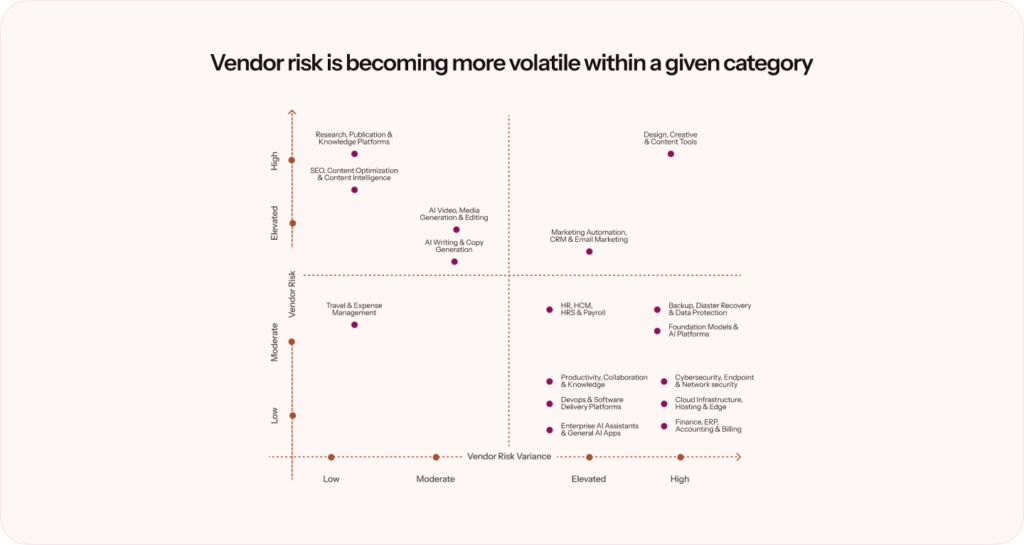
Risk summary: When vendor variance is high in these domains, vendor concentration is deep. Poor management can create risks like systemic outages, detection failures, reporting disruptions, or delayed recovery at enterprise scale, even if incidents are rare due to strong governance on the vendor’s part. Here, the concentration risk is architectural.
Your move: Many GRC teams already assess vendor concentration risk in structurally critical categories. That discipline remains foundational. TheVendor Category Landscape, 2026, strengthens the case for the rigor you likely already apply. Defensibility still requires being able to i) explain why this vendor was chosen over the limited alternatives and ii) demonstrate that the resulting concentration exposure is consciously weighed, documented, and hedged against—including through recovery architectures that do not unintentionally replicate the same dependency. (More on this below)
Examine the runtime control dependencies and structural impact data for backbone categories. Download the full Vendor Category Landscape, 2026.
How to hedge against vendor concentration risk
Hedging does not always mean vendor diversification, though in some contexts, redundancy may be advisable and appropriate. Your hedging options include:
- Architectural redundancy, where feasible, or compensating resilience controls, where it is not
- Explicit board-level acknowledgment of concentration exposure
- Contractual protections calibrated to structural impact
- Scenario planning for disruption or compromise
- Clear incident response coordination paths
- Exit and transition playbooks, even if rarely exercised
Understand where your vendor ecosystem is most structurally exposed. Explore the full Vendor Category Landscape 2026 Report.
Building defensibility into vendor selection
Within GRC, procurement, and operations teams, vendor decisions are often well-reasoned. The shortlist is familiar, vendor concentration risk-related trade-offs are debated, and security reviews are completed with discipline. Internally, the rationale usually makes sense.
The real test, however, is not whether the vendor risk assessment and selection decision made sense at the time. It is whether it can be explained clearly and confidently at any moment, without reconstructing context, revisiting assumptions, and retracing months-old conversations. And without slowing vendor onboarding while the evaluation documentation is assembled.
In high-variance categories with deep vendor concentration risk, defensibility cannot rely on memory or implied reasoning. It must be built into the selection process itself. That means capturing why alternatives were rejected, how exposure differences were evaluated, how concentration was weighed, and what mitigation pathways were defined—in a way that is accessible immediately.
What makes that possible is structure.
When vendor choices are evaluated in the context of concentration exposure—and when that reasoning is preserved, traceable, and accessible— defensibility becomes built-in rather than reconstructed.
That level of operational is increasingly becoming important not just for internal resilience and customer trust, but also for emerging expectations under frameworks like DORA Articles 28 and 29, where organizations are expected to understand, document, and manage concentration exposure across critical technology providers.
Whether the audience is customers, boards, auditors, or regulators, confidence comes from being able to show why. That is where structured systems and defensible workflows become critical.
Sprinto helps GRC teams operationalize vendor selection defensibility through structured onboarding workflows and a centralized system of record.
During vendor onboarding, Sprinto enables teams to:
- Accelerate vendor onboarding with AI-assisted due diligence by extracting insights and generating findings from vendor security documents
- Analyze and respond to security questionnaires using AI-powered suggestions, gap detection, and multi-format support
- Map controls to internal frameworks, policies, and risks for consistent compliance coverage
- Capture and assess vendor-related risks with AI-assisted scoring recommendations and summaries
- Record and manage vendor risk decisions within the risk register with human validation
- Leverage AI Playground, Sprinto’s AI action builder, to build custom AI actions that automate vendor assessment workflows and analyses
All of this becomes part of an auditable workflow, not scattered across spreadsheets, ticket threads, and meeting notes.
If third party concentration risk exists—for example, relying on a single cloud provider or a dominant CRM platform—that dependency and its mitigation plan can be explicitly documented, reviewed, and approved within Sprinto’s workflow and risk management modules.
Vendor choice may feel obvious internally.
Confidence, at any moment, comes from being able to show why. And Sprinto’s TPRM lets you achieve just that.
FAQs
Vendor concentration risk refers to the exposure created when an organization becomes heavily dependent on a small number of third-party providers for critical operations, infrastructure, or business workflows. In high-impact vendor categories like cloud infrastructure, cybersecurity, CRMs, and AI platforms, concentration risk can amplify operational disruption, data exposure, and recovery challenges if a provider experiences failure or compromise.
The biggest vendor concentration risk challenges include limited viable alternatives, deep architectural dependency, high switching costs, reduced negotiating leverage, and shared systemic exposure across customers using the same provider. AI integrations are also increasing runtime dependency in operational SaaS platforms, making concentration risk harder to evaluate through traditional vendor assessments alone.
To effectively manage vendor concentration risk, organizations should identify and quantify dependency exposure, document vendor selection rationale, assess architectural concentration, maintain recovery and exit plans, establish contractual protections, and implement continuous oversight for high-impact vendor categories. In AI-era environments, organizations also need visibility into runtime behavior, integrations, and automation-related exposure.
The top solutions to assess vendor concentration risk combine structured TPRM workflows, runtime visibility, centralized risk documentation, and continuous monitoring. Platforms like Sprinto help teams operationalize vendor concentration risk management by maintaining audit-ready records of vendor evaluations, onboarding decisions, mitigation plans, risk acceptance workflows, and ongoing vendor oversight within a centralized system of record.

Author
Raynah
Raynah is a content strategist at Sprinto, where she crafts stories that simplify compliance for modern businesses. Over the past two years, she’s worked across formats and functions to make security and compliance feel a little less complicated and a little more business-aligned.Go beyond the surface and uncover the governance, risk, and compliance insights that actually matter.


Win digital goodies for boardroom success


Explore more


research & insights curated to help you earn a seat at the table.