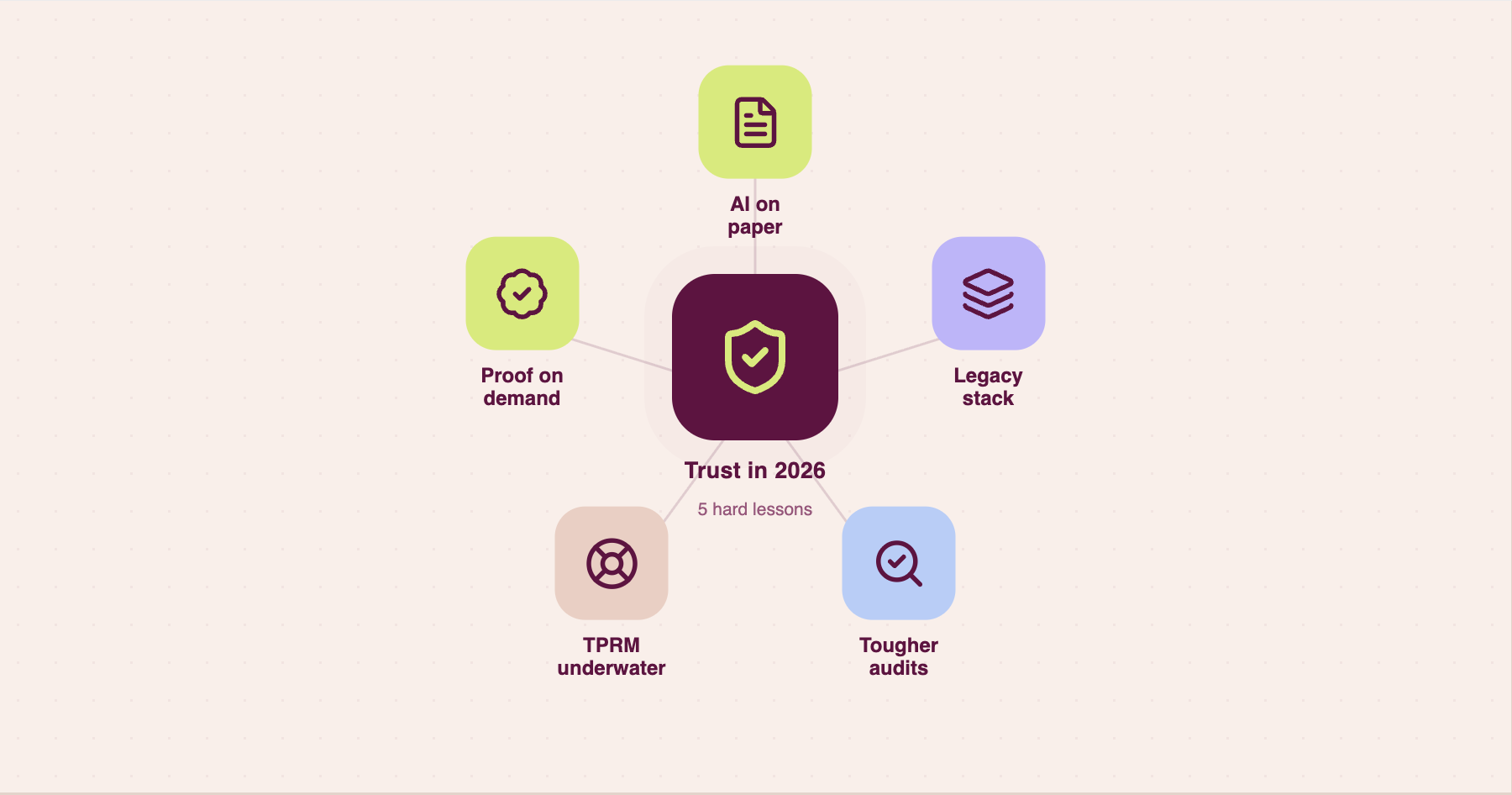
Over the course of 2025 and into 2026, we have spoken with thousands of GRC leaders, security practitioners, and CISOs across industries, and certain patterns have emerged clearly over that time.
From audit cycles getting harder to AI adoption outpacing governance, and vendor ecosystems growing deeper and more tangled. The specifics varied from one conversation to the next, but the underlying pressure was always the same: the operating model that has carried GRC programs through the last several years is hitting limits that are becoming harder to work around.
And the last few months have accelerated this dramatically. The trust landscape is shifting faster now than at any point we can remember. So we decided to write down the lessons that have come up most consistently across all of these conversations, and what they tell us about where the landscape is heading.
1. AI Governance is being run on policy docs and spreadsheets
If you run a GRC program today, AI is almost certainly on your radar. It might even be in your risk register. But when we ask practitioners how they are actually governing AI usage across their organization, the answer is usually some version of: “We have a policy. Enforcement is a work in progress.”
Our AI Pulse Check Report surveyed 103 CISOs and found that 69% have allocated dedicated budgets for AI risk management in 2026. That sounds encouraging, but only 25% rate their governance maturity as advanced, and 39% have AI usage policies that exist on paper but are not consistently enforced. So the intent is there; however, the machinery is not.
And the problem is compounding faster than most teams realize. One CISO we spoke with described their AI engineering team as being on a “buying spree,” evaluating and embedding tools before security has even been notified. Some of these vendors had SOC 2 reports from auditors whose websites did not even exist. That is the caliber of risk entering the environment, and it is moving faster than any manual intake process can keep up with.
But it is not just shadow AI. The vendors you already approved are quietly becoming AI organizations. They are embedding models into products you procured for entirely different purposes. So the vendor you assessed last year for CRM functionality now processes your customer data through an AI feature that nobody on your team signed off on.
The challenge: You are expected to govern AI across your organization, but you lack the tooling, visibility, and in many cases the organizational authority to do so effectively. The regulatory floor is rising, from the EU AI Act to California’s frontier AI law to the NIST AI Risk Management Framework, becoming the benchmark that regulations reference. And your board expects you to be ready. But readiness requires infrastructure that most programs have not built yet, because until recently, AI governance was a conversation, not a function.
2. Your GRC stack was built for a world that no longer exists
You have a GRC platform, and it works. It maps your frameworks, assigns control owners, and triggers evidence collection on schedule. But increasingly, the gap between what your platform tracks and what your organization actually looks like is widening, and that gap is where risk lives.
We hear versions of this from practitioners constantly. One head of GRC at a mid-market organization described running audits, answering security questionnaires, managing third-party risk, maintaining the trust center, and setting the certification strategy, all on their own. Their tools automate the repeatable parts, but the judgment calls, the context shifts, the things that happen between scheduled reviews, those fall entirely on one person.
And the pace of change makes it worse. Engineering deploys changes hourly, a new vendor gets embedded in production before procurement is notified, and your quarterly access review captures a snapshot of an organization that has already changed by the time the review is complete.
Rules-based automation executes predefined steps reliably. However, it does not interpret whether the state of your organization has changed in a way that affects previously validated controls. So a task gets marked complete, the dashboard turns green, and your actual risk posture may have already drifted. You know this. You can feel the distance between what the system says and what is actually happening, but there is no mechanism to automatically close that gap, so your team closes it manually, one exception at a time.
The challenge: You are managing more obligations, across more frameworks, in a faster-moving environment than ever before, and the tools you rely on assume a pace of change that no longer reflects reality. As a result, you are left with an assurance gap: the distance between what your compliance documentation says and what your organization actually is. Your team fills that gap with judgment and extra hours, but that is not sustainable when the rate of change keeps accelerating, and the obligations keep stacking.
3. The bar for audit credibility is rising, and your team is absorbing the impact
If you have been through an audit cycle recently, you have probably noticed the process feels different this year. Auditors are asking more questions, evidence that used to pass without much pushback is getting examined more closely, and timelines are stretching. If you are mid-audit, you may be dealing with increased rigor that nobody warned you about.
This is not happening in a vacuum. The compliance industry has been reckoning with the consequences of SOC 2 becoming a commodity. As demand grew, particularly among SaaS organizations selling to enterprises, more vendors entered the space and timelines compressed. Somewhere along the way, the line between speed and rigor got blurry. The AICPA responded this year with updated ethics guidance warning that any arrangement between an auditor and a tool provider that limits the member’s ability to set scope, obtain evidence, or remain objective creates independence threats. That guidance did not come out of nowhere, and as a result, the entire audit ecosystem is recalibrating.
You are feeling it operationally. Enterprise buyers are asking questions in deals that they never asked before: who conducted your audit, how was testing performed, and is the firm that sold you the readiness platform the same one certifying your compliance? Prospects are requesting separate documentation for the platform and the audit. These questions are becoming the norm, not the exception.
Meanwhile, auditing firms are tightening their own processes in response. More detailed scoping calls, more granular evidence requests, and minor non-conformities are being flagged where they previously were not. For your team, this naturally means more prep work, more back-and-forth, and longer cycles, often without additional headcount to absorb it.
The challenge: Your organization still needs certifications to close deals, but the expectations around how those certifications are produced have changed. The bar for what constitutes a credible audit is higher than it was even six months ago, and you are the person who has to meet that bar with the same team, the same tools, and timelines that have not adjusted to reflect the new reality. It does not show up as a crisis. It shows up as everything taking 30% longer than it used to.
4. Your TPRM program is underwater, and the model itself is the problem
Of all the lessons from this year, this might be the one where frustration runs deepest. Not because vendor risk management is new, but because the people doing this work already know the model is broken and lack the bandwidth to fix it.
Here is what the traditional TPRM workflow actually looks like in most organizations: you send a vendor a spreadsheet, they take weeks to respond if they respond at all, you review the answers, try to assign a risk score, file the results somewhere, and move on. A year later, you do it again. But in between, the vendor’s product and subprocessors have changed, maybe they have been acquired, and none of that is reflected in your assessment.
One practitioner described it this way: “We send them a spreadsheet, they fill it out, they send it back, we try to work some magic. And then it’s like one of those forgotten things where we don’t send them one the following year.” Another told us they manage over 80 vendors and cannot remember which ones have SOC 2 reports coming up for renewal. The numbers explain why this is breaking: large enterprises now average over 370 SaaS applications, mid-market organizations run close to 190, and nearly 70% of IT leaders say SaaS sprawl is their top operational challenge.
One organization we work with reported an 18% vendor response rate to security questionnaires. That means more than four out of five vendors in their ecosystem are effectively ungoverned from a questionnaire standpoint, and the vendors that do respond are increasingly sending AI-generated answers to your AI-parsed questionnaires. The entire feedback loop is drifting further from reality.
The challenge: TPRM teams are not failing. They are working incredibly hard within a model that was not designed for this level of complexity. But working harder within a broken model produces diminishing returns. The organizations that accepted this and started investing in fundamentally different approaches are pulling ahead. The ones still waiting on questionnaire responses are falling further behind, not because of effort, but because of architecture.
5. Buyers are asking trust questions you cannot answer fast enough
Enterprise buyers have changed what they ask for. A SOC 2 badge on your website used to be enough to move a deal forward, but now procurement and security teams want to understand your AI practices, data residency commitments, vendor oversight model, and incident response posture. They want proof that controls are working continuously, not a static report from months ago.
This shift accelerated as confidence in certifications eroded. Naturally, buyers are compensating by digging deeper themselves. They do not just want to see your report. They want to understand how it was produced, who the auditor was, and whether there were conflicts of interest. The questions that used to come up once in a dozen deals are now standard in every enterprise evaluation.
And the scope of what you need to prove keeps expanding. Your commitments extend to customers through contract terms and SLAs, to partners through data handling agreements, and to the public through trust pages and security disclosures. Each of those commitments carries real obligations, and most organizations track them in highly fragmented ways, if at all.
The lesson: The buyer expectation has moved from “show me your badge” to “prove to me, continuously, that you are doing what you say you are doing.” You need to be able to answer detailed questions about your security posture, AI governance, vendor oversight, and compliance status quickly and transparently. The organizations that can do this are closing deals faster. The ones that cannot are watching deals slow down or stall as prospects wait for answers that take too long to assemble.
What these lessons add up to
There is a common thread that runs through all five, and it is worth naming plainly: the trust landscape in 2026 is demanding more from GRC teams than the current operating model was designed to deliver. The systems, the processes, and the assumptions that got you here were built for a world that moves more slowly than the one you operate in now.
That is not a criticism of the work you have done. If anything, the fact that programs have held together this well under this much pressure is a testament to the people running them. But recognizing that the model needs to evolve is the most important lesson of the year, and it is the first step toward building something that can actually keep pace with what is being asked of you.

Author
Srikar Sai
As a Senior Content Marketer at Sprinto, Srikar Sai believes good content should be bookmark-worthy by default. He writes about cybersecurity and GRC, aiming to move the needle with every piece. He’s also an ISO 27001-certified Lead Auditor.Go beyond the surface and uncover the governance, risk, and compliance insights that actually matter.


Win digital goodies for boardroom success


Explore more


research & insights curated to help you earn a seat at the table.