Beyond Audit Fire Drills: How Enterprises Can Move From Periodical To Continuous Readiness



If you lead security, compliance, risk, or technology for an enterprise, you already know what periodical audit prep is like.
Your engineering team stops product delivery and instead shifts its focus to collecting screenshots, getting last-minute approvals, and reviewing system records no one has seen in months. Your security team, meanwhile, chases evidence that’s isolated across your tech stack, none of which tells a coherent story. Findings from the last audit that you thought were resolved? Think again. Vendor records, access reviews, policies, documentation, the pile keeps getting bigger.
But that’s not the hardest part. When an audit rolls around, your teams aren’t just presenting proof. They’re having to recreate history—which controls exist at a given moment, who owns them, whether remediations were carried out on time, and whether your evidence reflects how you operate currently.



It’s risky, chaotic, and feels nothing like strategic.
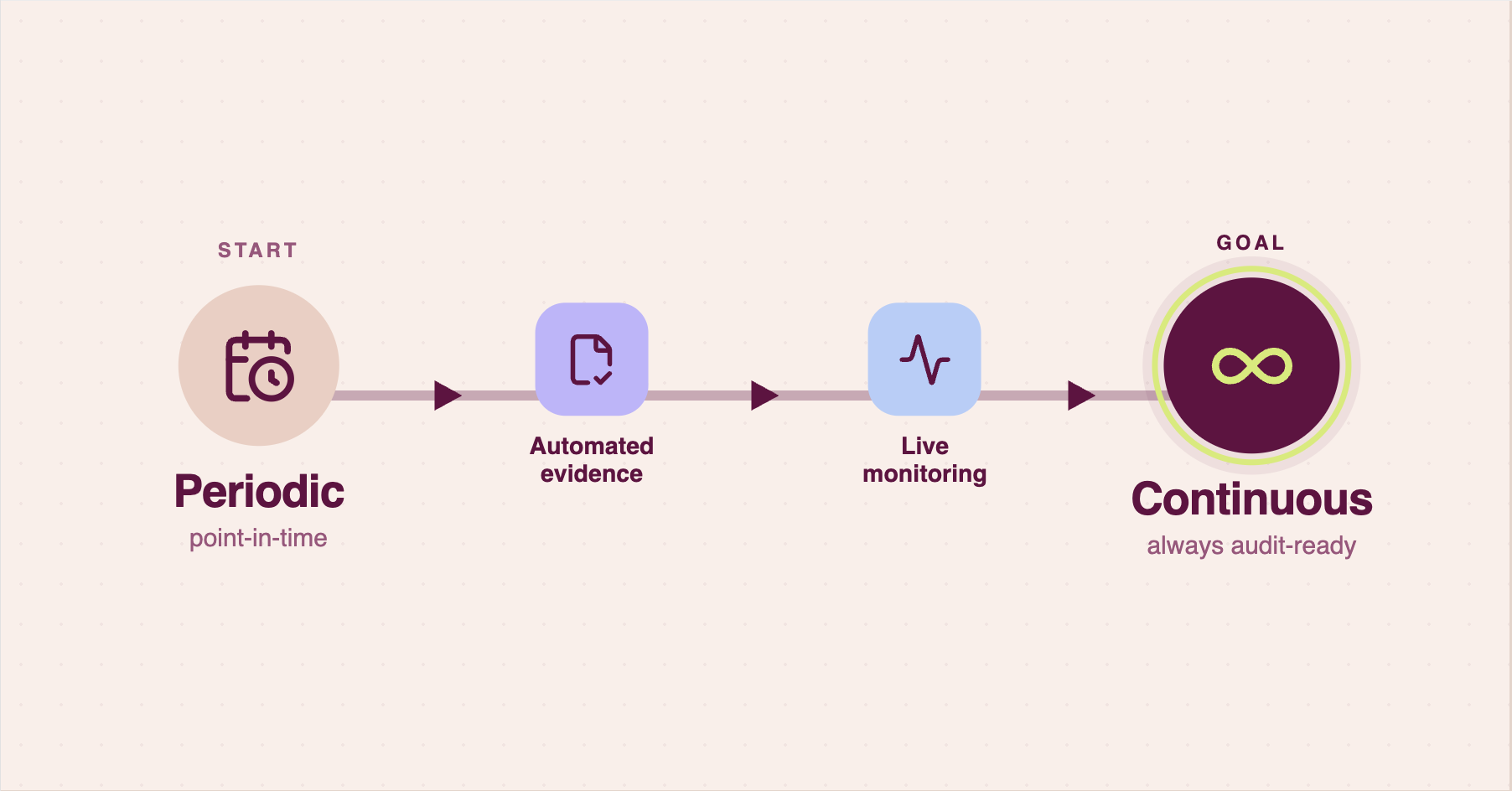
This is the true limitation of periodical audit prep. It assumes that your control environment remains unchanged between audits and can be recreated at a later point. But your organization doesn’t work that way—and most importantly, neither does risk. People, vendors, policies, systems, all of these change. And your business must move on, whether or not your compliance model keeps up.
And this is precisely why continuous audit readiness steps in. It ensures you’re not pulled into a last-minute dash to prove you’re compliant. It builds an environment that helps you adapt to change, keep track of risk, and demonstrate readiness without pulling your business off course.
So if you’re here to learn about how you can move from a point-in-time approach to continuous audit readiness, you’re in the right place. Let’s get started.
Understand what is actually auditable
If there ever was a starting point, it’s understanding what you need to defend. Most enterprises discover too late that their audit surface is much larger than initially anticipated.
You may think your scope starts and ends with a framework or certification. But it goes far beyond that. Your audit scope stems from your regulatory obligations, customer requirements, and contractual agreements. Even an internal policy and how your team uses AI can add to your audit surface.
The challenge is that these obligations don’t live in one place. Procurement owns vendors, legal manages contracts, IT takes care of access, and engineering may control systems that determine whether a control actually works in practice. And if you don’t know how all of these connect, audit readiness is always going to be a mammoth task involving more people than it should.
Comb the fine print. Strong documentation and ownership are non-negotiable. You need to identify owners, define their responsibilities, and ensure your controls actually reflect how you operate. And to tie it all together, you need to know what kind of evidence proves your narrative.
Risk management needs to happen before an audit, not because of it
Once you understand your audit surface, the next step is to have an honest evaluation of your risk management process and whether it is helping you stay proactively ready. For many enterprises, the answer to that question is no.
Often, risk assessment is carried out only when an audit is around the corner or when a customer request forces it. And if this is the case, you’re probably evaluating risk too late and too infrequently.
Your risk surface changes all the time, often unnoticed. A vendor may be added to a new workflow, your team may introduce a new AI tool, or an employee may need to expand their access to fulfill a job. None of these triggers an alarm, but they introduce new risk into the system all the same.
If you’re looking to evolve from this traditional approach, risk management must not end with a document that sits untouched once completed. It must help you continuously identify new risks, evaluate their impact and severity, and prioritize remediation. One of the most common operational failures here is not mapping the right controls to the risks you’ve identified. If “unauthorized access to production database” sits on your risk register but no control actually mitigates it, that gap surfaces as a non-conformity the moment an auditor looks for it.
The real shift here is as much psychological as it is operational. You need to stop asking whether you can defend your posture to your auditor and start asking yourself what weakens your posture before anyone has to ask.
Track regulatory change
Let’s side-strafe into compliance for a moment. Compliance doesn’t stand still. Requirements change, and new regulations come into effect. Industry pressures, market expansion, customer requests, and legal mandates can give rise to new compliance requirements. And for enterprises expanding rapidly across geographies, things can get complicated fast.
The problem is that these updates most likely reach you in phases. Someone hears about it in legal. Someone else spots it in a customer request. A requirement gets reflected in a new contract before your control environment has caught up. By the time it becomes visible to the broader organization, you may already be behind.
Regulatory change needs to be made operational. Continuous audit-readiness hinges on your ability to spot and keep track of changes, understand what the new scope covers, and how it translates into real-time control, policy, and evidence updates.
Having a person (or an agent?) assigned to keep track of what has changed can really help—they will need to absorb external change and work with internal teams to decide how they are put into practice.
Be mindful of evidence quality
One of the biggest mistakes you can make is assuming that the evidence you capture today will remain useful for your next audit. It absolutely does not.
Every small change made to your system degrades evidence quality because the proof you collected does not reflect the new reality. A screenshot taken today will not be valid six months from now. A policy acknowledgment may not be valid once a policy has been rewritten. A vendor review may be meaningless if the scope has changed.
Continuous audit readiness remedies this by helping you decode the relationship between evidence quality and change. Every meaningful change in your environment must prompt you to revisit the quality of your evidence. Ask yourself what evidence needs to be refreshed, replaced, or re-checked, and what kind of downstream impact these changes come with.
Think of evidence as a living representation of your current control environment. Demand a higher standard of evidence and ensure it covers even the most minute change. This way, you’re no longer asking if you have something saved, but you’re asking, “Does the evidence I’ve gathered still prove what I say it does?”
Don’t leave findings open
What you do after an audit denotes the maturity of your compliance stack. If the end of an audit signals a time to relax and move on, it’s very likely that risk still lives in your system, far longer than it should.
An untreated finding lingers in your environment and directly impacts trust. A control gap that remains unresolved, for instance, can lead to a breach. And this could spiral into a credibility problem among customers and stakeholders.
More likely than not, an open finding will be flagged by an auditor during the next audit, who will then wonder if you truly address findings or if they are simply acknowledged and deferred.
The best course of action is to close the loop as soon as an audit is done. Make this a practice. Run an exercise that analyzes findings, assigns owners, and sets clear responsibilities for each finding. Timelines are important: set clear deadlines and bring everything from remediation, action plans, and documentation to closure. In practice, this usually means documenting a Corrective Action register with root cause analysis and a due date for each finding; auditors typically check conformance against completion of these actions within their due dates at the next audit, not immediate resolution. This way, you get stronger with every audit.
Wrapping things up
The good news is that you don’t have to handle all of this on your own. And it doesn’t necessarily mean there’s more manual work. In fact, trying to achieve continuous readiness only compounds the problem if managed with spreadsheets and outdated tools.
It’s time to let tech do the heavy lifting. The use of AI agents and modern compliance tools becomes invaluable in such scenarios.
AI has a clear role to play in catching drift, flagging missing documentation, identifying ownership changes, and spotting new risks or outdated evidence. Meanwhile, agents can monitor everyday changes, from access updates and vendor additions to tool sprawl and AI adoption patterns, so you aren’t surprised by what you find during an audit.
Continuous audit readiness means less dependence on manual evidence collection and fewer interruptions for engineering and business teams. And most importantly, it means that readiness is built into daily operations and accurately reflects the way you actually operate.
Author
Vishal V
Vishal, Sprinto’s Content Lead, masterfully weaves nuanced narratives and simplifies convoluted compliance topics with seasoned expertise. His perennial curiosity fuels his pursuit of fresh angles in every piece. Off-work, he’s an avid photographer, birder and a music buff, he blends expertise and exploration seamlessly in work and life.Reviewer
Kishore Kumar R
Kishore Kumar R is a GRC and information security professional specializing in helping organizations achieve compliance with frameworks such as SOC 2, ISO 27001, HIPAA, GDPR, and PCI DSS. An ISC2 Certified in Cybersecurity (CC) and ISO 27001:2022 Lead Auditor, he works closely with customers to streamline compliance implementation, translating complex security requirements into practical, business-friendly solutions.Go beyond the surface and uncover the governance, risk, and compliance insights that actually matter.


Win digital goodies for boardroom success


Explore more



research & insights curated to help you earn a seat at the table.