TL,DR:
| PCI DSS SAQs help eligible merchants and service providers self-check cardholder data controls. |
| Your SAQ type depends on payment channels, storage practices, and cardholder data environment scope. |
| The article explains SAQ types, yes-or-no responses, remediation notes, and annual assessment steps. |
With trillions of dollars in purchases expected to be made using credit cards alone by 2024, the need for PCI compliance is more pressing than ever. Unfortunately, fraud remains a persistent threat, causing billions of dollars in losses each year.
One of the key ways to safeguard your customer’s data is by complying with the Payment Card Industry Data Security Standards (PCI DSS).
By completing a PCI compliance self-assessment questionnaire (SAQ), you’ll be able to demonstrate to both your customers and the industry at large that you take information security seriously.
In this article, let’s understand the PCI DSS Self Assessment Questionnaire.
What is a PCI DSS self-assessment questionnaire?
PCI DSS Self Assessment questionnaire is a tool that helps you assist merchants and service providers in evaluating their compliance with the framework. Any merchants that store or process cardholder data must perform an annual self-assessment. The SAQ is structured around yes-or-no questions, but the answers should be backed by evidence such as policies, configurations, scan results, vendor agreements, logs, and remediation records.
Now, if you happen to answer “no” to any of the questions, there is no need to panic. Provide some additional details about why the requirement may not apply to your business, or let us know about the progress of your ongoing remediation efforts.
This way, we can work together to ensure that you are well on achieving PCI compliance self-assessment.
Why do you need a PCI DSS self-assessment questionnaire?
The SAQ isn’t just a simple checklist to help you achieve PCI compliance. It’s your roadmap to better security! By filling out the SAQ, you’re taking a proactive step to ensure you’re getting all the important security requirements for your business. This means you can rest easy, knowing you’ve covered all your bases.
But that’s not all. Did you know that merchant processors typically require each merchant to provide a PCI SAQ as proof of payment security? That’s right. When you complete the SAQ, you’re demonstrating to your payment processor that you take your security seriously.
Also check out what’s new:
What does a PCI DSS self-assessment questionnaire include?
A PCI DSS Self-Assessment Questionnaire includes yes-or-no questions that help you assess whether your payment environment meets the applicable PCI DSS requirements.
Each question maps to a specific control area, such as network security, cardholder data protection, access control, vulnerability management, monitoring, testing, and security policies. For every requirement that applies to your environment, you must confirm whether the control is in place.
If the answer is “no,” you should document the gap, add a target remediation date, and explain the action your team will take to address it. Your answers should be supported by evidence such as policies, system configurations, scan results, vendor agreements, logs, or remediation records.
What are the requirements under the PCI self assessment?
Several versions of the SAQ are designed for specific types of businesses based on their payment processing environment. The SAQ version a business uses also depends on its PCI DSS levels classification, since merchant level determines whether self-assessment is permitted at all and which of the nine SAQ variants matches the cardholder data environment being attested.
Here’s a general overview of the PCI self-assessment requirements:
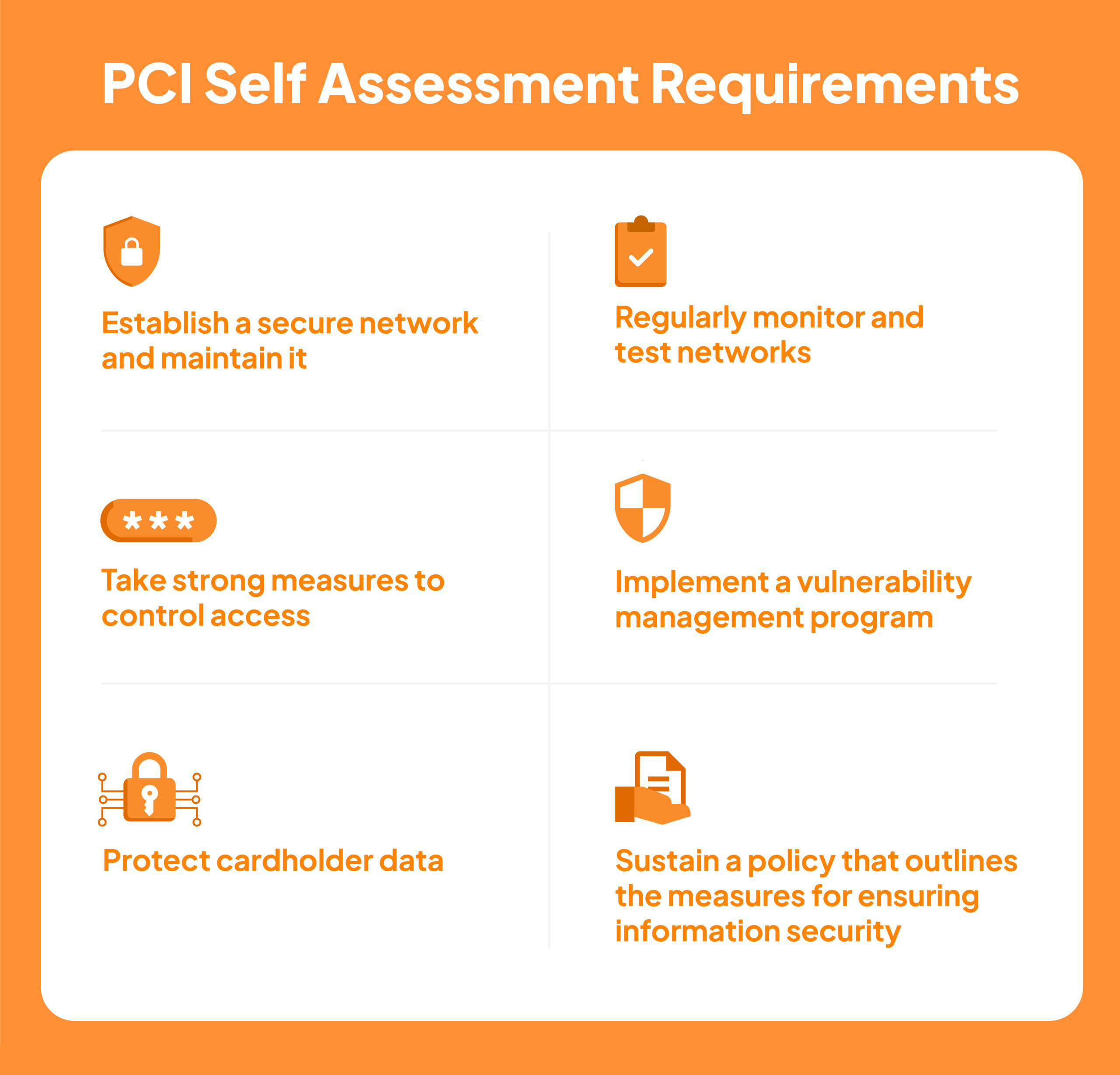
Establish a secure network and maintain it
- Protect cardholder data by installing and maintaining a firewall
- Make sure you don’t use vendor-supplied defaults for system passwords and other security settings
Protect cardholder data
- Data storage protection for cardholders
- Ensure that open, public networks are encrypted when transmitting cardholder data
Implement a vulnerability management program
- Maintain an anti-virus program or software on all systems and protect them from malware
- System and application development and maintenance
Take strong measures to control access
- Cardholder data should only be accessible to businesses with a business need-to-know
- Allocate a distinctive identification number to every individual who has access to a computer.
- Limit the availability of cardholder data by implementing controls to regulate physical access.
Regularly monitor and test networks
- Keep a record of and supervise every instance of access to network resources and cardholder data.
- Conduct periodic evaluations of security systems and procedures.
Sustain a policy that outlines the measures for ensuring information security
- Have a protocol in place that deals with information security for all staff members.
Remember, specific PCI Self-Assessment Requirements may vary based on the type of business you operate and how you handle payment card information. It’s important to choose the right SAQ corresponding to your payment processing environment and complete it truthfully and accurately to maintain compliance.
Choosing the right PCI compliance self-assessment questionnaire
Picking the right PCI DSS SAQ for your business is critical to ensure that you accurately assess your compliance with the PCI DSS and meet all necessary requirements. The underlying PCI DSS controls span 12 requirement domains covering network security, cardholder data protection, vulnerability management, access management, and monitoring, and each SAQ variant only asks the subset of questions relevant to its target environment rather than the full control set.
For example, a service provider who qualifies for SAQ verification should go for SAQ D as it is available for Service Providers. However, it’s important to keep in mind that companies can operate as both a merchant and a service provider.
Moreover, here is a way to check your eligibility. We have created an exhaustive list of questionnaire that you need to self-check before moving forward.
SAQ, AOC, ASV, and QSA: What still needs outside validation?
A PCI DSS self-assessment questionnaire helps you assess and attest to your compliance, but it does not replace all external validation steps. What you need depends on your PCI level, payment flow, merchant or service provider role, and whether your systems handle cardholder data.
Here is how the main pieces fit together:
| Requirement | What it means | When it matters |
|---|---|---|
| SAQ | The questionnaire your organization completes to confirm which PCI DSS controls apply and whether you comply with them. | Required when your payment brand, acquiring bank, payment processor, or customer requests proof of PCI self-assessment. |
| AOC | The Attestation of Compliance you sign after completing the SAQ. | Usually submitted to your acquirer, payment processor, customer, or partner with the SAQ. |
| ASV scan | A vulnerability scan of internet-facing systems in scope, performed by an Approved Scanning Vendor. | Often required when your payment environment includes externally accessible systems. |
| VAPT or penetration testing | Deeper security testing for applications, APIs, networks, or infrastructure. | May be required, depending on your PCI scope, customer requirements, auditor guidance, or risk profile. |
| QSA or PCI auditor guidance | Review from a Qualified Security Assessor or PCI specialist. | Useful when your scope is unclear, you are a Level 1 merchant or service provider, you store or process card data, or you need external assurance before submission. |
A common mistake is treating the SAQ as a form-filling exercise. In practice, the questionnaire should reflect your actual payment environment. A company using a hosted payment page may have a smaller scope than one that stores card details, runs payment APIs, or serves as a service provider for other businesses.
Before submitting your SAQ, confirm:
- Whether you are a merchant, service provider, or both
- Which payment channels and systems are in scope
- Whether cardholder data is stored, processed, or transmitted by your environment
- Whether third-party processors, payment pages, or tokenization reduce your scope
- Whether ASV scans, penetration tests, or other evidence are required
- Who needs to review or accept your SAQ and AOC
Sprinto can help map PCI DSS controls, collect evidence, track remediation, and organize the work required for SAQ submission. However, the SAQ answers must still reflect your organization’s actual payment flow and control environment.
How to fill out the PCI compliance questionnaire (step-by-step)?
Filling out the PCI compliance questionnaire is easier when your scope is clear and your evidence is ready before you begin. Here’s how you can get started.
1.Identify your SAQ type
Determine which SAQ version applies to your business (A, B, C, C-VT, D, etc.) based on how you store, process, or transmit cardholder data.
2.Gather documentation
Collect security policies, system configurations, vendor agreements, ASV scan results (if required), and security logs to answer accurately.
3.Answer the yes/no questions
Your PCI compliance questionnaire answers must reflect your actual environment, not your intended one. For each requirement, mark “Yes” only where the control is in place and you hold evidence for it. Where the answer is “No”, record the gap, the remediation steps, and a target date. The four response options are Yes, Yes with CCW (where a compensating control is in use and documented in the Compensating Control Worksheet), No, and N/A.
4.Provide explanations for N/A items
Some requirements may not apply. Clearly explain why (e.g., “We don’t store cardholder data”).
5.Complete the Attestation of Compliance (AOC)
At the end of the SAQ, sign the AOC to formally confirm your compliance status.
6.Submit to your acquiring bank or payment processor
Send your completed SAQ along with any required evidence (e.g., quarterly ASV scan results for certain SAQ types).
Pro Tip: Review your SAQ annually and update whenever there’s a change in how you process payments.
What’s next?
Overall, completing the PCI DSS SAQ is essential for any business that accepts credit card payments. The SAQ helps businesses identify potential security risks and vulnerabilities in their payment processing systems and provides a roadmap for compliance with the PCI DSS.
If you’re devoted to securing your payment data, look no further than Sprinto. Our team has been at the forefront of PCI DSS consulting and auditing, with an impressive roster of clients, including major payment brands. With Sprinto’s compliance automation tools, you can rest easy knowing that your business meets all the necessary requirements.
Want to get started? Talk to our experts today.
FAQs

Author
Meeba Gracy
Meeba, an ISC2-certified cybersecurity specialist, passionately decodes and delivers impactful content on compliance and complex digital security matters. Adept at transforming intricate concepts into accessible insights, she’s committed to enlightening readers. Off the clock, she can be found with her nose in the latest thriller novel or exploring new haunts in the city.Go beyond the surface and uncover the governance, risk, and compliance insights that actually matter.


Win digital goodies for boardroom success


Explore more





research & insights curated to help you earn a seat at the table.