Integrated Risk Management: A Practical Guide for 2026


TL,DR:
| Integrated Risk Management (IRM) is a connected approach to managing risk across your entire organization, covering cyber, compliance, operational, and financial risks in one place rather than in separate silos and spreadsheets. |
| It’s built for teams that already do risk management but find it fragmented, manual, and disconnected from their audits. |
| As risks compound across departments and regulatory demands grow, a unified, technology-enabled view has become the practical standard for mid-market and enterprise teams. |
| Quick distinction: GRC is compliance-focused, ERM is the board-level view of all enterprise risk, and IRM is the cross-functional discipline that ties operational and IT risk into both. |
Most organizations don’t set out to manage risk in pieces. It happens gradually. The security team tracks cyber risk in one tool, compliance keeps its own list for the next audit, operations logs issues somewhere else, and vendor risk sits in a separate spreadsheet that one person updates when they remember to. Each list is reasonable on its own. Together, they leave nobody with a complete picture, and the risks that cut across departments are exactly the ones that fall through the gaps.
IRM addresses fragmented risk management by unifying your approach. This guide explains what IRM is, its six core elements, key benefits, how it differs from ERM and GRC, and how to choose the right solution. Whether you’re starting a new program or upgrading from spreadsheets, this article should help you discover a practical path to a single, connected risk view.
What is Integrated Risk Management (IRM)?
For most teams, IRM starts with a customer. A prospect asks for a SOC 2 report before they’ll sign, or a contract names ISO 27001 as a condition, and suddenly, risk and compliance go from background tasks to a deal blocker. The scramble that follows usually reveals the same thing: risk is scattered. It lives in a spreadsheet one person updates, evidence sits in another tool, and vendor reviews happen on a calendar nobody owns. The risks are written down somewhere. They just aren’t connected to anything.
IRM is the practice of identifying, assessing, and managing risk across an entire organization in a single, connected view, rather than treating cyber, compliance, operational, and financial risk as separate workstreams. It gives teams a single, holistic picture of risk and where to act.
In practice, IRM keeps risk management at the center of operations, enabling the business to consistently prepare for and respond to risks as they arise. An Integrated Risk Management Program (IRMP) covers every type of risk an organization faces, including strategic, operational, financial, and compliance risk, and ties each one back to overall business objectives. The goal is to surface and address risks before they become problems.
The concept was first introduced by Gartner in 2017. According to Gartner, an effective IRM approach should include:
- A clear and concise risk response strategy.
- Detailed risk assessment.
- Communication and reporting.
- Risk monitoring.
- Adopting a software-based IRM solution.
What is the scope of an Integrated Risk Management Program?
An IRM program’s scope spans six elements: strategy, risk identification and assessment, response, communication and reporting, monitoring, and technology. The clearest way to see how they fit together is to follow one situation through all six.
Let’s look at a pattern that comes up often in our conversations with growing businesses: risk tracking begins only when a customer asks for a certification. The first register is usually maintained in a spreadsheet, is owned almost entirely by security, and is updated primarily for audit purposes. Over time, teams start finding risks marked as ‘closed’ even though there’s no clear owner, no linked control, and no concrete evidence that the issue was actually resolved.
Here’s how each IRM element addresses a piece of that problem.

1. Strategy
The fix starts before any risk is logged. Strategy means deciding which risks the organization will accept, mitigate, or avoid, and setting a risk appetite that leadership approves. In our example, the team had no agreed appetite, so every risk was handled ad hoc. A defined strategy provides a standard against which to judge each risk.
2. Risk Identification and Assessment
Next, the scattered spreadsheet entries get replaced by a structured process: identifying existing and potential risks and scoring each one by likelihood and impact. This is where the team stops guessing which risks matter and starts ranking them consistently across business segments.
3. Response
With risks scored, each one needs a response, a mitigation control, and an owner. This is exactly where our example broke: risks were closed because no one owned the follow-through. Assigning response owners (often the relevant department head, not a central CISO) is what makes closure mean something.
4. Communication and Reporting
The team then needs a way to keep leadership and stakeholders informed, with an escalation path when a risk crosses a threshold. Without this, the board only hears about a risk after it becomes an incident.
5. Monitoring
Controls and risk ratings have to be checked continuously, not revisited once a year at audit time. Continuous monitoring is what would have caught the improperly closed risks in our example before the auditor did.
6. Technology
Tying the first five together by hand, in spreadsheets, is what failed in the first place. Technology, a platform that connects risks to controls, owners, and evidence in one place, is what makes the other five sustainable as the organization grows.
These six elements aren’t a checklist. They’re five connected responses to a single problem, held together by the sixth.
Benefits of Integrated Risk Management
The value of IRM is easiest to see the week before an audit. One team rebuilds its risk register from scratch and chases owners for evidence; another opens a dashboard where every risk already links to its controls, owner, and evidence.
Here’s what you get from having an IRM:

- A single source of truth for risk: Instead of separate lists owned by IT, compliance, and operations, you get one connected risk register everyone works from, so leadership can finally see how risks relate to each other.
- Less manual work and fewer audit fire drills: When your risk register maps directly to controls and evidence, audit prep stops being a scramble. A register that feeds the audit saves you from having to rebuild a spreadsheet for every assessment.
- A defensible risk scoring and treatment process: Teams often discover this when inherent risk, residual risk, treatment effectiveness, and department-level scoring do not line up cleanly. Before leadership relies on the dashboard, agree on how each score is calculated, who can approve changes, and how exceptions are recorded. Otherwise, the register may look complete while the underlying numbers still need governance.
- Cost savings from removing duplicate controls: Mapping one control to multiple risks and frameworks reveals overlaps you’re paying for twice. Consolidating them lowers both tooling and effort costs.
When Apty added ISO 27001 on top of an existing SOC 2 program, common control mapping enabled them to reuse their SOC 2 work and achieve ISO 27001 compliance in 15 days with an effort increase of under 20%.
- Faster, better-informed decisions: A holistic view lets leaders weigh risks against business goals and prioritize what actually matters, rather than reacting to whichever fire is loudest.
- Stronger trust signals for buyers and regulators: Buyers are not only asking whether a company has SOC 2, ISO 27001, or ISO 42001. They ask specific questions about policies, controls, vendors, data use, AI posture, and evidence access. If those answers come from scattered documents, every questionnaire becomes a manual validation exercise. If they come from a connected risk, control, and evidence base, the same system that supports audits can also support sales reviews and Trust Center requests.
Why do organizations need Integrated Risk Management?
In Sprinto’s Business ROI of Compliance survey of senior compliance decision-makers, 40% of organizations said they still handle compliance on an ad-hoc basis, with no dedicated owner or system of record. That single finding explains most of the case for IRM: when no one owns risk and there’s no system of record, the gaps aren’t a question of effort; they’re built into how the work is organized.
Five shifts have made the gap harder to ignore:
- Risks no longer stay in their lane: A single cyberattack doesn’t just cause a technical problem. It causes financial losses, compliance failures, and brand damage simultaneously. When risk functions are siloed, no one sees the full picture, and the compounding effect goes unmanaged.
- Spreadsheets break at scale: Manual, spreadsheet-based risk tracking works until it doesn’t. As the number of risks, vendors, and frameworks grows, the spreadsheet becomes impossible to keep current, and a risk register nobody trusts is worse than no register at all.
- Regulatory complexity keeps rising: Overlapping obligations like SOC 2, ISO 27001, HIPAA, GDPR, and newer regimes such as DORA and NIS2 make a piecemeal, framework-by-framework approach inefficient and error-prone.
85% of executives say compliance complexity has increased significantly in recent years, per PwC’s 2025 Global Compliance Survey.
- Third-party risk has become a board-level concern: Vendors and their access to your data now rank among the top risks executives track, which is hard to manage from a separate, disconnected process.
- Trust has become a condition of doing business: Customers run security reviews before they sign, regulators expect evidence rather than intent, and a single vendor incident can become your headline. Demonstrating a well-run, connected risk program is now part of closing deals and keeping them, not a back-office function. That pressure is hard to meet when your risk posture is assembled from scratch each time someone asks for it.
IRM addresses all five at once. It connects the functions, replaces the spreadsheet, maps overlapping obligations to shared controls, and brings third-party risk into the same view as everything else.
How to implement an IRM strategy?
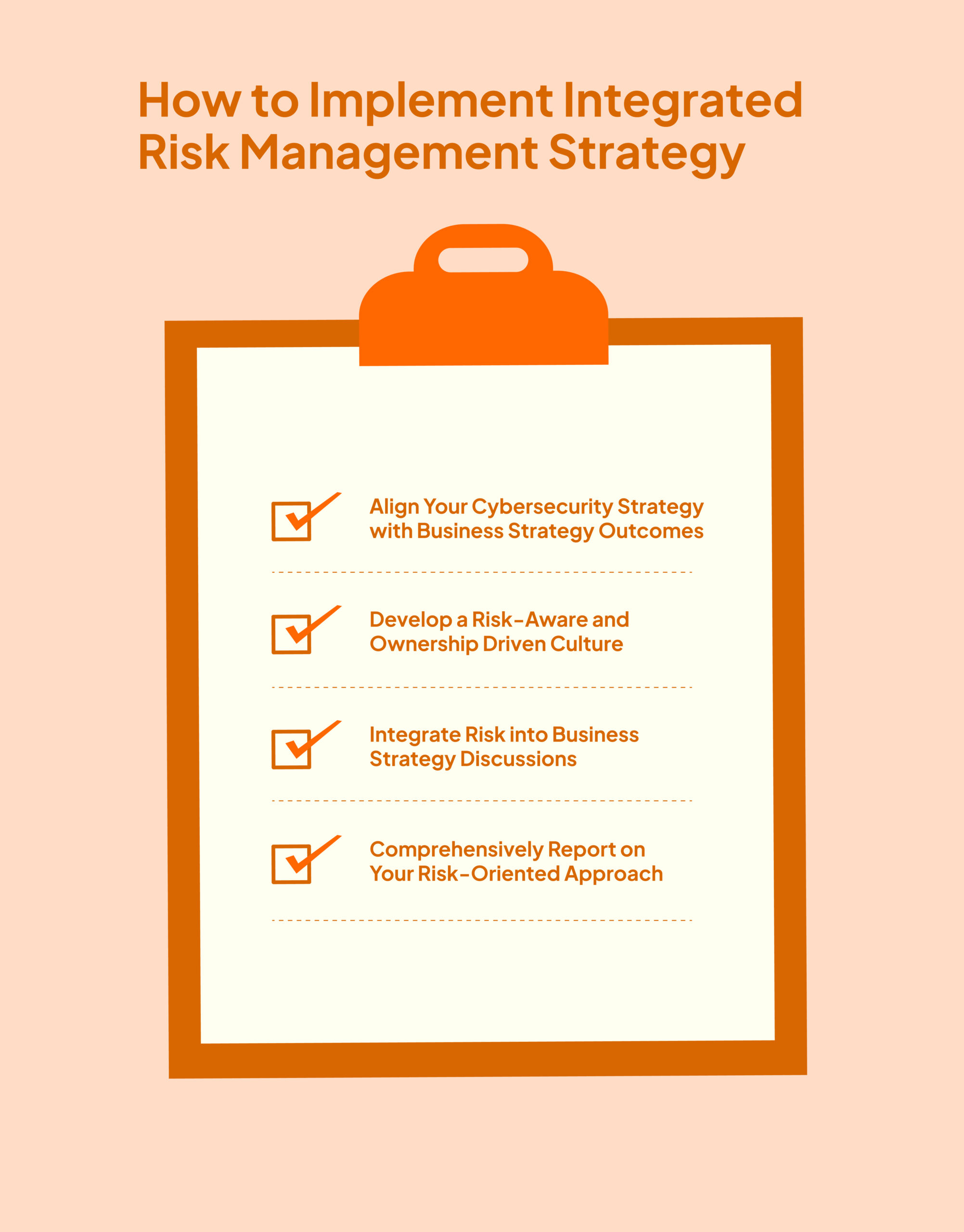
IRM implementation runs in this rough order: align first, assign ownership, build risk into decisions, then report. You don’t need all four to mature on day one, but skipping the early ones makes the later ones collapse.
Step 1: Align cybersecurity with business objectives
Start with a one-page risk appetite statement that the leadership team actually signs off on, which risks you’ll accept, mitigate, or avoid, and why. Without it, every later prioritization call becomes an argument. A signed appetite statement gives you a policy to point to instead of relitigating each decision.
Step 2: Give every risk an owner outside the security team
The fastest signal that risk is shared rather than siloed is a register where finance, product, and operations each own entries, not just IT. If security owns all of it, you have a security list, not an integrated program.
Step 3: Build risk into how decisions get made
Tie a risk check to the moments that already exist: a new vendor, a new market, a major product change. Each of these should trigger a review of its impact on your risk profile before it’s approved, so risks are caught at the decision point rather than after an incident. No new meetings required; attach it to the reviews you already run.
Step 4: Report on a live posture, not a quarterly snapshot
Pick three to five metrics leadership will actually look at (open high-severity risks, overdue treatments, control coverage) and put them on a dashboard that updates continuously. A report that’s stale the day after the board meeting can’t drive decisions.

Integrated Risk Management in practice
Clara, a leading corporate expense management platform in Latin America, offers a clear picture of integrated risk management in action. Operating in a tightly regulated space and selling to enterprise buyers, Clara needed risk, controls, vendors, and evidence to live in one place rather than scattered across documents and spreadsheets.
When VP of Engineering Raquel Hernandez joined, the company was pursuing its first PCI-DSS certification, and the process was almost entirely manual.
As Raquel describes it, “We were pretty much managing audits manually, so there was a ton of back-and-forth to build all the documentation we needed. We didn’t have a centralized system for monitoring, which made compliance reactive rather than proactive.”
Clara moved its program onto Sprinto and brought everything into a single connected view. The team set up a pre-built risk register, linked policies to controls, and integrated the platform with their cloud stack (AWS, GitHub, BambooHR, and others) so controls were monitored and evidence collected automatically. Critically, each risk was linked to the controls meant to address it, allowing the team to act on risks as they surfaced rather than discovering them at audit time. Vendor risk lived in the same system alongside vendor documentation, breach monitoring, and risk tracking, consolidated rather than run as a separate process.
That connection between risk and control is what made the program integrated rather than siloed, and it changed how quickly the team could respond. By connecting risks to controls on Sprinto, Clara increased its risk responsiveness by up to 60%.
“On Sprinto, we get real-time information about risks, so we can stay one step ahead. We address risks as soon as they pop up,” says Raquel.
The same consolidation paid off elsewhere: Clara cleared its PCI-DSS and ISO 27001 audits with zero findings and now responds to security questionnaires around 70% faster.
“Sprinto is part of our compliance backbone. Outside of helping us maintain continuous audit readiness we use the platform to manage third-party risks, align with evolving regulatory expectations, and as a driver of efficiency in compliance management.” ~ Raquel Hernandez, VP of Engineering at Clara.
Examples of Integrated Risk Management
Based on the organization’s goals and risk profiles, the IRM approach can vary from one organization to another. Some use cases/ examples of IRM implementation include:
Example 1: An organization planning to establish an enterprise-level risk management strategy will implement an IRM program that includes cybersecurity, physical security, and employee awareness to manage and mitigate risks.
Example 2: An organization looking to establish a crisis/disaster management strategy will implement a robust IRM program that lists the steps to take in the event of a disaster or a cybersecurity emergency.
Example 3: An organization focusing on business continuity will implement the IRM strategies that outline how the organization can maintain crucial business operations during a crisis/disaster.
The organization can implement multiple strategies for a holistic IRM approach. But, as the definitions suggest, no matter which strategies you implement, they will be practiced organization-wide to manage risks across the company effectively.
IRM vs ERM: What’s the difference?
The difference between IRM and ERM is scope and execution.
ERM (Enterprise Risk Management) is a top-down, board-level view of all risks that could affect the organization, including financial, strategic, and operational risks. IRM is the cross-functional discipline that connects IT, cyber, compliance, and operational risk and embeds risk management into daily workflows. ERM defines the risks your enterprise faces. IRM is how you manage them together, without silos.
| ERM | IRM | |
| Primary question | What are all our enterprise risks? | How do we manage risk together, without silos? |
| Direction | Top-down (board / CRO led) | Cross-functional and operational |
| Typical owner | Chief Risk Officer, board, execs | Risk, security, and compliance teams together |
| Centre of gravity | Risk registers, controls, periodic reviews | Connected data, technology, daily workflows |
| Scope emphasis | All enterprise risk (financial, strategic, operational) | Connecting IT/cyber, compliance, and operational risk |
“I don’t have department-wise risks or 100 risks to talk through. I talk about 15 to 20 risk scenarios that could have catastrophic impact across multiple departments, and those map to 20 to 30 controls. It’s the same risks and controls I present to an engineer, a department head, and my board.” ~ Senthil Kumar Iyyappan, CISO & Head of IT, Ocrolus, speaking on a Sprinto webinar
IRM vs GRC: Key differences
The difference between IRM and GRC lies in their orientations.
GRC (Governance, Risk, and Compliance) is compliance-focused and largely reactive, built to align the business with regulations and prove it. IRM is risk-focused and proactive, built to see and manage risk across the organization before it becomes a problem. GRC asks whether you’re meeting your obligations. IRM asks what could go wrong and how the pieces connect.
| GRC | IRM | |
| Orientation | Compliance-focused and reactive | Risk-focused and proactive |
| Primary goal | Meet regulatory and compliance obligations | Identify and manage all risks across the org |
| Approach | Traditional and standards-driven | Business-focused and forward-looking |
| Core question | Are we meeting our obligations? | What could go wrong, and how do the pieces connect? |
One area where this difference becomes practical is third-party risk. For most regulated organizations, vendor risk is now one of the largest pieces of the integrated picture, not a side process. In practice, teams score each vendor based on the data it can access, the types of data it shares, and the operational impact if that vendor fails.
High-risk vendors then trigger due diligence, such as collecting their SOC 2 report or ISO 27001 certificate, and get reassessed on a set schedule rather than once at onboarding. For a company managing a few hundred vendors, that scoring is what makes the difference between a list and a program, and it belongs in the same system as your internal risks.
As Girish Redekar, Co-founder of Sprinto, puts it: “The problem is that once the contract is signed, the visibility mostly stops. After onboarding, the buyer usually does not have a live view into what changes inside the vendor’s environment.. A cleaner analogy is that most teams check somebody’s driving record once and then hand them the keys forever.” [Speaking on the Risk Management Show podcast]
That is the shift from GRC to IRM: vendor risk is not a completed onboarding task; it is a live dependency that needs continuous visibility.
How do I pick the right IRM solution for my business?
The IRM and GRC market is crowded, and most platforms use nearly identical language to describe themselves. It is hard to tell them apart by merely scrolling through the feature list on the homepage. You need to understand how they handle the specifics of your program.
The criteria below separate a tool you’ll actually use from one that becomes shelfware. They fall into two questions: does it fit your program, and will your team actually use it?
Does it fit your program?
- Multi-framework coverage: Can one platform handle every framework you care about, including SOC 2, ISO 27001, HIPAA, GDPR, PCI DSS, and NIST, and reuse evidence across them so you’re not duplicating work per framework?
- A risk register that maps to controls, scoring, and evidence: This is the make-or-break feature. Look for a register where each risk carries a score, links to controls, owners, and treatment plans, and connects to the audit evidence that proves it, rather than a static list you maintain on the side.
- Third-party and vendor risk in the same place: If vendor risk matters to you, and for most regulated buyers it does, make sure third-party risk management lives on the same platform rather than a separate tool. Look specifically for vendor scoring based on data access and the ability to trigger and track periodic reassessments, since that is where manual vendor tracking breaks down first.
AI email assistant, Fyxer, consolidated compliance into a single always-on system on Sprinto, cutting audit preparation from five days to two hours and saving the equivalent of three to four compliance hires.
“Sprinto provides everything we need, but in a way where I don’t need to recruit three or four compliance people to keep updating documents or managing audits.” — Andy Wallace, CIO, Fyxer.
Will your team actually use it?
- Automated evidence collection and continuous monitoring: The whole point is getting off manual spreadsheets. Favor platforms that pull evidence automatically and monitor controls continuously rather than at audit time.
- Integrations with your actual stack: Check for native connections to your cloud (AWS, Azure, GCP), code (GitHub, GitLab), identity, and ticketing tools. A platform nobody can keep synced is just a more expensive spreadsheet.
- Transparent pricing and a realistic implementation timeline: Ask how pricing scales with employees and frameworks, and how long real implementation takes. Weeks versus months changes the business case.
The vendor landscape
The IRM and GRC market spans large, configurable enterprise suites and newer automation-first platforms. Enterprise and ERM-leaning options include ServiceNow, Archer, Diligent, and LogicGate, with LogicManager often cited as mid-market-friendly. Automation-first compliance and risk platforms commonly evaluated by mid-market teams include Vanta, Drata, and Sprinto.
The right fit depends on your size, regulatory footprint, and the amount of manual maintenance you can tolerate.
Where AI governance fits into IRM
AI risk has already moved beyond the emerging concern stage. In Sprinto’s AI Pulse Check survey of 103 U.S. CISOs, 52.81% of organizations said they track AI-related risks as a dedicated category, while 44.94% still group them under broader risks like third-party or data security. That split captures exactly why AI governance belongs inside integrated risk management: AI is becoming its own risk domain, but its exposure still cuts across the same teams IRM is built to connect.
The operational gap is already visible. Over 30% of organizations have experienced a major AI-related security incident in the past 12 months, yet 2 in 3 take between a week and 6 months to implement controls or policy changes in response to AI-related risks. In other words, AI tools are being adopted and changed faster than governance processes can respond.
That is where IRM becomes practical. A single AI tool introduces several risks at once:
- A vendor decision (who built it, what are their controls?)
- A data-security question (what does it touch, where does that data go?)
- A compliance obligation (ISO 42001, the EU AI Act, sector rules)
- An operational risk (what happens when it’s wrong?)
Managed separately, AI becomes one more siloed list. Pulled into the same register as your other risks, it gets scored, assigned an owner, and mapped to controls like anything else, with the added step of tracking which systems use AI, what data they touch, and which models are in play.
The regulatory side is moving just as fast. ISO 42001, the NIST AI Risk Management Framework, and the EU AI Act all provide structured approaches to governing AI risk, and they’re maturing quickly. If AI is becoming material to your business, fold it into your existing risk program rather than standing up a parallel one, and choose tooling that can extend to cover it as those standards solidify.
For AI-heavy companies, AI governance often starts with a simple question: where is AI actually being used? In recent implementation conversations, teams were not only tracking AI policies. They were mapping AI use cases, model owners, data sources, third-party models, bias-testing evidence, training records, disclaimers, and customer-facing Trust Center posture. That is exactly why AI belongs inside IRM rather than in a separate spreadsheet.
Each AI use case should be treated like a risk object:
- What AI system or feature is being used?
- Who owns it?
- What data does it touch?
- Is it internally built or powered by a third-party model?
- What controls, tests, disclaimers, and review evidence support it?
- What should customers be able to see in the Trust Center?
Once AI is captured this way, it can be scored, reviewed, assigned, monitored, and evidenced like any other material business risk.
Getting started with IRM
You don’t need to build all of this at once. Start by consolidating your risks into a single register, connecting each to its controls and an owner, and automating evidence collection so your posture stays current rather than going stale between audits. That single move, from spreadsheets to a single connected view, is what turns a static risk list into a working program.
This is the work Sprinto is built to do: the platform connects your risk register to controls, scores risks consistently, and keeps evidence audit-ready, the same setup behind the customer example above.
See it on your own stack with a quick demo.
FAQs
Author
Sucheth
Sucheth is a Content Marketer at Sprinto and holds CompTIA Security+. He helps security and GRC teams to navigate audits: what each framework requires, what auditors ask for, and what it costs to maintain.Go beyond the surface and uncover the governance, risk, and compliance insights that actually matter.


Win digital goodies for boardroom success


Explore more



research & insights curated to help you earn a seat at the table.