

Your global risk review closed last month. Hundreds of vendors assessed. Findings resolved. Executive report delivered.
In the meantime, your marketing team enabled a new AI personalization module inside your CRM. HR activated AI-driven candidate screening in one region. Your collaboration suite rolled out AI meeting summaries globally. Your cloud provider expanded a model integration layer.
No vendors were replaced, no new contracts were signed, and no onboarding review was triggered.
And yet, there has been a fair amount of vendor configuration drift, and your runtime exposure changed significantly.
Our latest report, Vendor Category Landscape, 2026, has surfaced exactly how situations like the one outlined above come about. How AI integration risk, and consequently, Runtime Control Dependencies, have expanded in vendor ecosystems. In this blog, we explore the report findings and discuss how continuous vendor risk monitoring can tackle defensibility in a dynamic environment. This blog is part 2 of a 4-part series breaking down the report’s findings.
Static reviews cannot defend dynamic exposure
For years, vendor risk governance operated on periodic review cycles—annual due diligence refreshes, quarterly reassessments, structured questionnaires, and contractual reviews. That model was built on a reasonable assumption: exposure would remain relatively stable between review windows.
The Vendor Category Landscape 2026 challenges that assumption.
Across 16 vendor categories and 201 vendors, the analysis shows that a significant portion now exhibit elevated runtime control dependency. In these categories, exposure is shaped not only by vendor governance maturity but by internal configuration, user behavior, integration depth, AI-driven automation, and evolving data ingestion patterns.
These variables do not change quarterly. They can change weekly or even daily.
Now that exposure has become runtime-dependent, the primary issue is no longer operational—it is evidentiary. Defensibility cannot be retrospective. It must reflect the current state. This shift also aligns with how modern compliance frameworks increasingly interpret operational oversight. Controls such as SOC 2 CC7, ISO 27001 A.5.22 (supplier monitoring), and DORA Article 28 all push organizations toward ongoing visibility into third-party risk rather than point-in-time assessments alone.
| If configuration changes, integration depth expands, or AI-enabled automation alters system behavior between review cycles, the evidence collected last quarter may no longer reflect how the system functions today. That creates a defensibility gap. |
What defensible vendor management looks like in current runtime conditions
Periodic, questionnaire-based assessments were never designed to capture and manage dynamic behavior by tools and users. They remain useful for validating governance maturity and contractual posture, but they cannot provide runtime visibility. In AI-embedded environments, exposure increasingly depends on how systems are configured, how integrations are structured, and how users interact with tools on an ongoing basis.
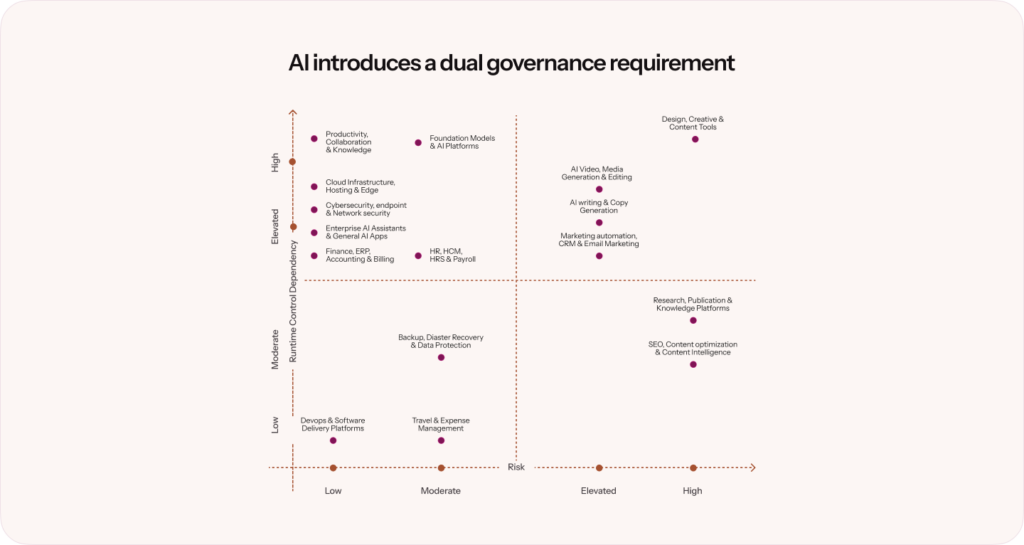
TheVendor Category Landscape, 2026 Report’s findings underscore the growing dependency on runtime control. Categories such as Enterprise AI Assistants and Foundation Models demonstrate elevated runtime dependency even when governance maturity appears stable. More importantly, several non-AI-native categories—including Marketing Automation, Productivity and Collaboration tools, HRMS, Finance and ERP platforms, and even Cloud and Cybersecurity systems—are now inheriting AI-driven exposure through integrations.
Boards, customers, and auditors increasingly expect precise, timely answers. They want to know what the organization’s exposure looks like today, what has changed recently, and how those changes are being managed. If answering those questions requires reconstructing configuration history, reconciling outdated documentation, or manually assembling evidence, confidence erodes quickly.
Defensible oversight now requires visibility into active configuration states, live integration permissions, automation logic, and data flows as they exist at runtime. It is not enough to demonstrate that controls were reviewed at a fixed point in time. Organizations must be able to demonstrate that controls remain effective as systems evolve. To do this, GRC teams need real-time vendor risk monitoring to be part of business as usual.
Context-aware vendor monitoring as an evidence engine
This is where context-aware monitoring becomes essential as an evidentiary capability. Continuous monitoring as part of vendor risk management programs enables organizations to maintain an up-to-date record of exposure-relevant signals, including configuration drift, integration changes, and runtime behavior shifts.
Manually, this level of detection might seem unrealistic. Human teams cannot reliably track configuration and integration changes across hundreds or thousands of tools without structural limitations.
Add an autonomous layer to your approach, and it seems much more doable. Autonomous systems address the scale challenge by continuously surfacing meaningful changes. Human judgment remains central, but operates at the level of prioritization, contractual enforcement, risk acceptance, and strategic oversight rather than manual sifting, follow-up and evidence assembly.
When supported by autonomous capabilities, continuous vendor risk monitoring systems go beyond detecting changes as they occur to automatically activate remediation and generate contextualized, defensible audit trails. This removes the need to determine how systemic changes impact controls and obligations, and to manually get remediation actions actioned. It also removes the need to reconstruct exposure after the fact and reduces reliance on manual evidence gathering during periods of scrutiny.
Closing the defensibility gap: From periodic review to continuous oversight
In an AI-embedded vendor ecosystem, governance credibility expands beyond having controls in place to your ability to demonstrate their effectiveness at any moment. When exposure changes daily, defensibility must be continuous as well.
The Vendor Category Landscape, 2026, identifies which vendor categories exhibit elevated runtime control dependency and therefore require this evidentiary model. As the blast radius becomes increasingly defined by runtime behavior, evidence must follow that shift.
Download the full report to explore how runtime control dependency varies across 16 vendor categories, how that calls for real-time vendor risk monitoring, and what that means for defensibility in 2026.
FAQs
Sprinto is a strong option for organizations looking to modernize TPRM for AI-era vendor risk. Its approach combines continuous monitoring, runtime visibility, evidence collection, and automated control tracking to help security and GRC teams maintain audit-ready oversight as vendor exposure changes over time.
Static vendor reviews cannot adequately capture AI vendor risk because exposure now changes continuously through integrations, permissions, runtime behavior, and AI-enabled automation. A vendor assessed as low risk during onboarding may develop materially different exposure profiles as AI capabilities evolve inside the product.
Continuous monitoring strengthens audit defensibility by maintaining current evidence of vendor configurations, integrations, permissions, and control effectiveness. Instead of relying on outdated point-in-time assessments, organizations can demonstrate how vendor risk is actively monitored and managed as runtime exposure changes.

Author
Raynah
Raynah is a content strategist at Sprinto, where she crafts stories that simplify compliance for modern businesses. Over the past two years, she’s worked across formats and functions to make security and compliance feel a little less complicated and a little more business-aligned.Go beyond the surface and uncover the governance, risk, and compliance insights that actually matter.


Win digital goodies for boardroom success


Explore more


research & insights curated to help you earn a seat at the table.