3 Reasons Your AI Governance Stack Needs to Be Always-On


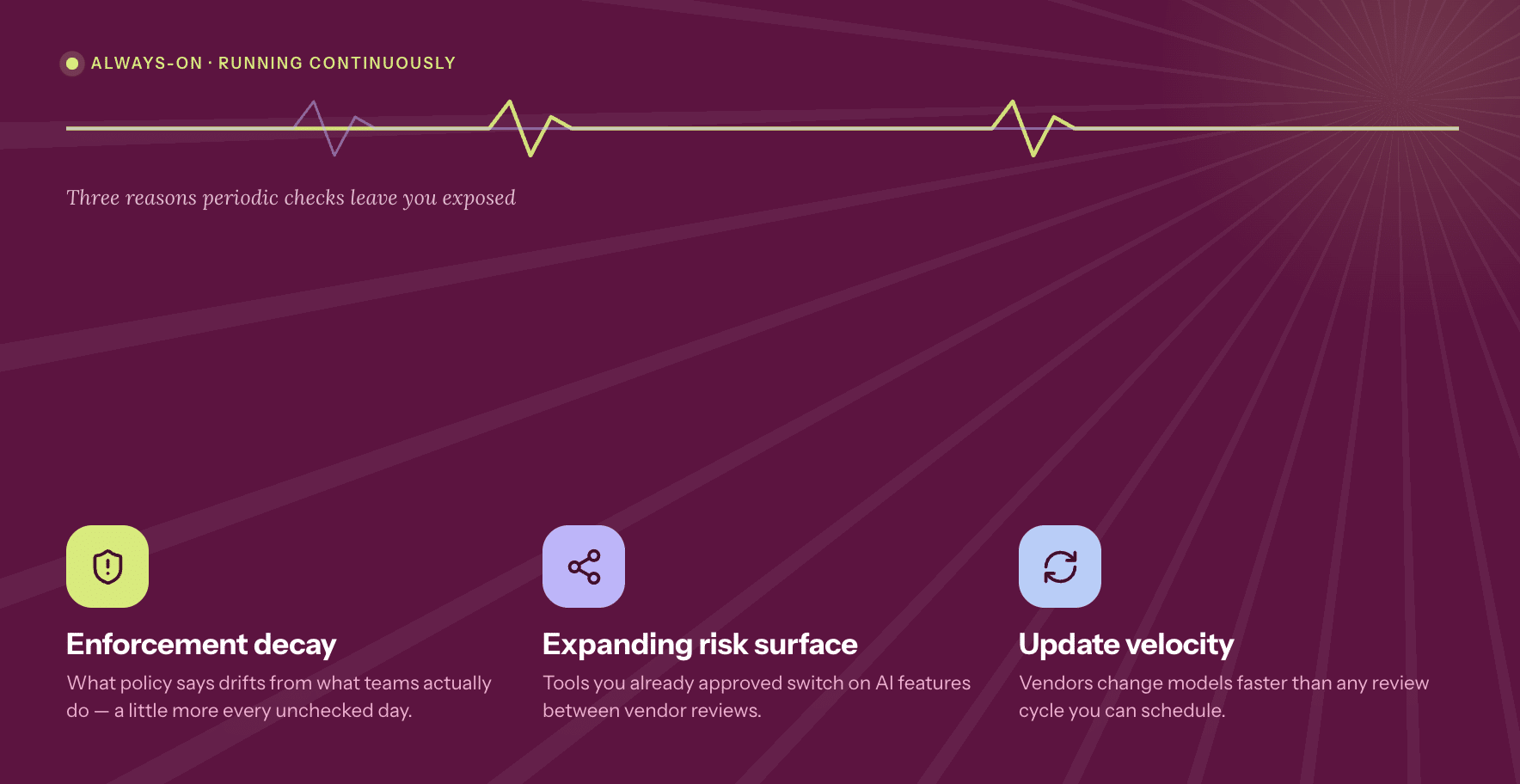
You’ve built the governance program. You have selected and customized a framework, set up the controls, and assigned owners. Most GRC and TPRM teams have. In fact, 25% of organizations describe their AI Governance as advanced, and a majority have dedicated budgets for AI governance.
If that sounds familiar, you’ve made good progress. But there is room for developing always-on, continuous AI Governance, and the numbers say it all:
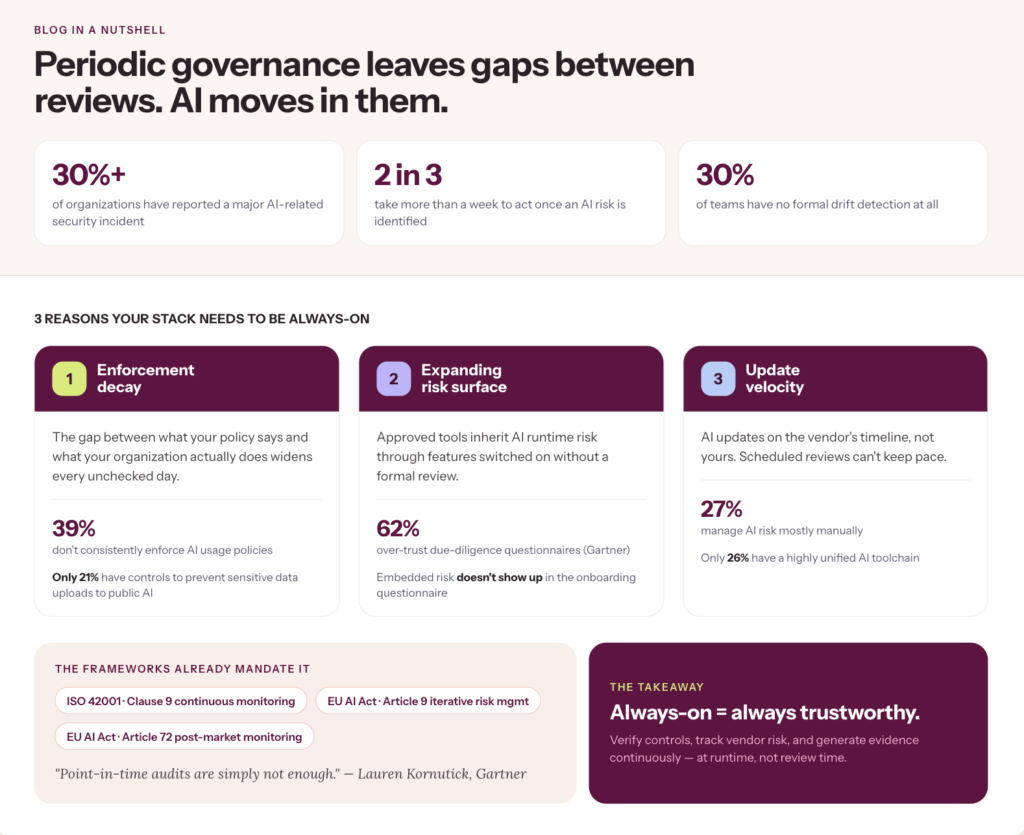
Over 30% of organizations have already reported a major AI-related security incident. Clearly, continuous AI Governance is not in place, as two in three organizations take more than a week to act once an AI risk is identified. But this likely stems from the fact that 30% of teams lack any formal drift detection. And judging by those two stats, it’s not surprising that data compromise and breach volumes have dramatically increased, with compromised records up 23%.
That’s because most organizations are still approaching AI Governance the way they approach audits: check the box, satisfy the stakeholder, and move on until the next scheduled review. That rhythm made sense for compliance programs, which governed things that stayed still. AI doesn’t stay still. It evolves—along with your exposure—every time a vendor updates a model or ships a new feature. That’s not all. Every user session could change the tool’s risk profile, depending on how your team uses it. Our study, covering 201 vendors across 16 popular categories, found that a significant portion now score highly in runtime control dependency.
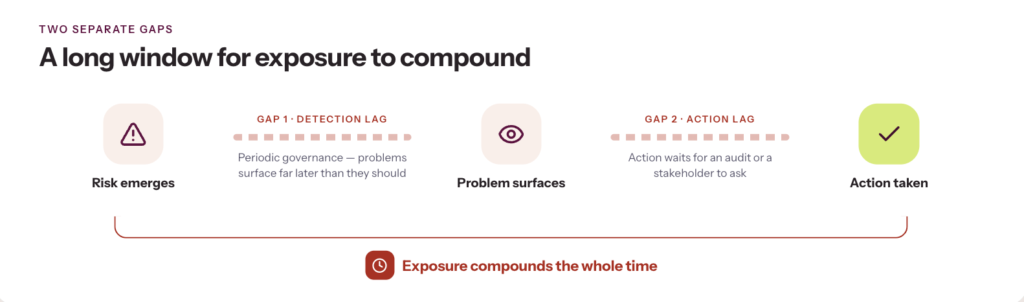
In other words, there are two separate gaps here: periodic governance means problems surface far later than they should, and even when they do surface, action waits for an audit or a stakeholder to ask. That’s a long window for exposure to compound.
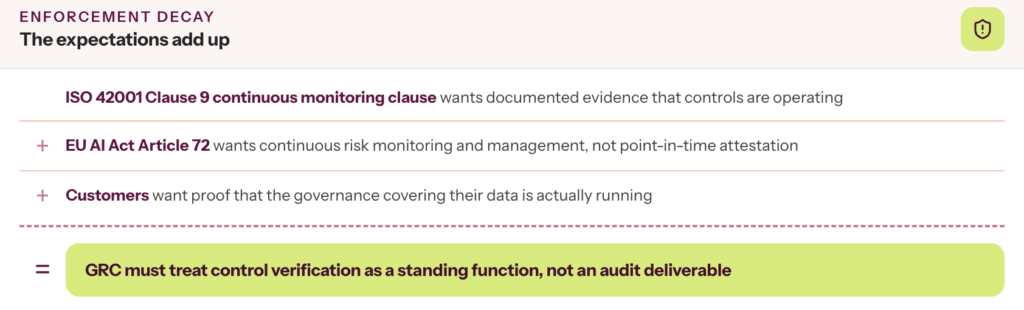
The frameworks already recognize these gaps and aim to counter them with recommendations that spell out always-on AI Governance. ISO 42001’s Clause 9 continuous monitoring requirements mandate ongoing measurement of AI systems, not scheduled audits alone. EU AI Act Article 9 requires risk management to run as an iterative process throughout the entire AI lifecycle, with documentation that reflects the current state, not the state at launch.
As Lauren Kornutick, Director Analyst at Gartner, said in a press release, “Continuous monitoring and policy enforcement at run-time is critical as AI systems increasingly make autonomous decisions and interact with sensitive data, raising the stakes for ethical and responsible use. Point-in-time audits are simply not enough.”
In this blog, we look at three reasons your AI Governance program needs to be always-on. We’ll also cover associated expectations placed on GRC and TPRM teams and what they imply for your day-to-day.
- Having a governance program and having one that runs are two different thing
- Enforcement decays, vendor surfaces expand, and models drift between reviews, all on AI’s timeline not yours. And you won’t even know
- The fix isn’t a better review cycle. It’s governance that detects, tracks, and enforces continuously whether anyone scheduled it or not
Reason 1: Continuous checks are the only way to catch enforcement decay
Enforcement decay is the gap between what your policy says and what your organization actually does, and it widens every day that nobody is actively checking. For example, a policy may prohibit uploading customer data to public AI platforms, and the control may be configured at rollout. But six months later, a sales team could be routinely pasting contract summaries into ChatGPT to speed up responses, because a CASB or DLP tool isn’t flagging the action. Similarly, a vendor contract may include a no-training clause prohibiting the vendor from using company data to train their models, and you might even have audit rights on paper. But if attestation cadences are never set up and nobody has asked the question since signing, how do you know they’re adhering to what they agreed to?
AI Governance structure is, by most measures, improving. Roughly 53% of organizations now track AI as a dedicated risk category. This is a real shift from treating AI as a subset of general IT or security risk. But this piece, that is, AI usage policy enforcement, has not kept pace. 39% of organizations do not consistently enforce AI usage policies, and only 21% have controls in place to actually prevent sensitive data from being uploaded to public AI platforms.
That’s the gap that matters: a governance program can look mature on a slide with a named owner, documented policy, and defined risk category. But the only way to know whether the policy is actually holding up every day, under real usage, by real employees, on real platforms, is to be checking continuously. Always-on AI Governance helps you achieve that.
What this means in practice
You need to be able to show that controls are actively preventing the behavior your policy prohibits, or it can become a struggle to gain the trust of customers, your board, and regulators.
What’s blocking GRC teams
Controls are verified during reviews, not between them. Evidence is collected retrospectively, which means the gap between “policy exists” and “policy is working” is only visible in hindsight, after an incident, or after a customer asks a question you can’t confidently answer.
The deeper structural issue is split ownership. IT configures the controls. Security monitors the logs. GRC owns the policy. Nobody owns the question of whether all three are aligned on any given Tuesday, and AI usage policy enforcement across functions that don’t share a single source of truth is structurally harder than writing the policy itself.
Reason 2: Your AI risk surface keeps expanding between vendor reviews
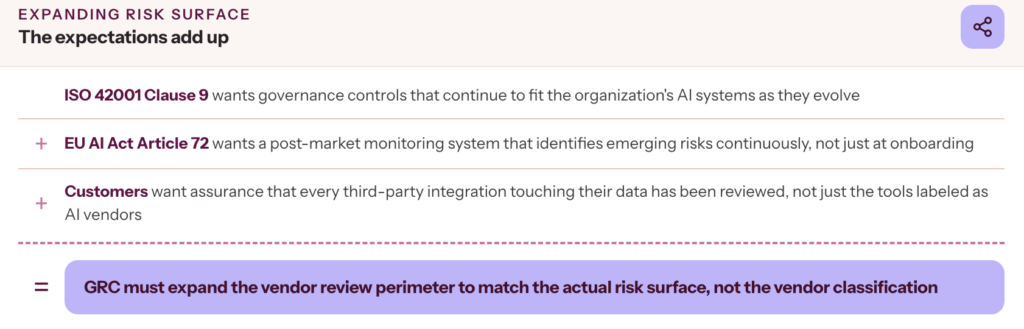
AI risk is increasingly inherited rather than native. Productivity and collaboration tools, HR and finance platforms, cybersecurity systems, and cloud infrastructure are picking up AI-related runtime risk through integrations and AI features that get switched on without a formal review. These tools you already approved are doing something they weren’t doing when you approved them.
A vendor review conducted at onboarding cannot capture a feature that is enabled 18 months later, or a model swap, a shift in data center location, a change in subprocessors, an update to data retention policies, or new training data sourcing practices that a vendor quietly makes in a product update. If no systems are keeping tabs after that initial review, the risk profile can change completely while your records still describe the vendor as it was on day one. Continuous AI risk monitoring can help fix this.
What this means in practice
Your AI vendor inventory and your AI risk surface are two different things. A vendor list can’t show you how a single vendor may power multiple use cases across different functions, and how a single use case may draw on multiple vendors or models. You need a matrix that shows which use cases depend on which vendors, models, and data sources. Categories you’ve never classified as “AI vendors” will show up in that matrix, and so will exposure you assumed was governed.
What’s blocking GRC teams
TPRM programs were designed around a vendor list rather than a risk surface. The intake process, the questionnaire, and the periodic review cadence assume you know which vendors to look at and when. Gartner found that 62% of organizations still place excessive trust in due diligence questionnaires to inform risk decisions. This is embedded AI risk, and it doesn’t show up in the questionnaire you sent them at onboarding.
Reason 3: Scheduled reviews can’t keep pace with AI’s update velocity
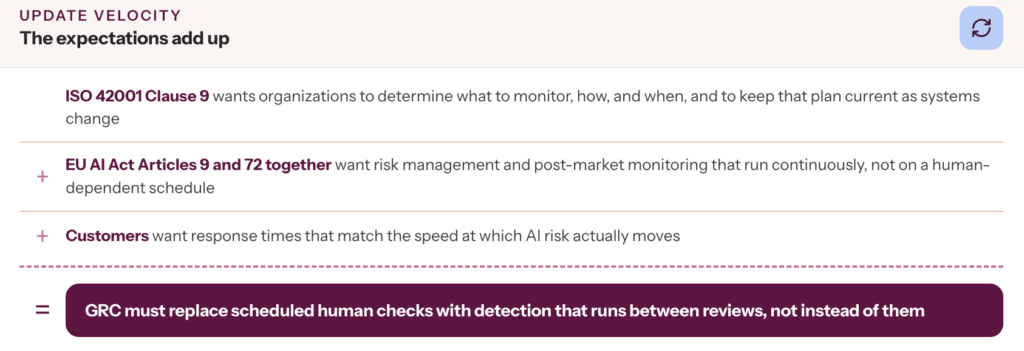
27% of organizations manage AI risk mostly manually. Manual processes share one structural trait regardless of how diligent the team running them is: they depend on someone remembering to check, on a schedule someone has to maintain, with bandwidth that competes against everything else on that person’s plate. Picture the GRC lead who owns the AI vendor review calendar. It’s a spreadsheet. Reviews are due quarterly. In Q2, they’re heads down on a SOC 2 renewal, in addition to the usual monthly quota of 200-page security questionnaires. The AI vendor review slips to Q3. In that window, a vendor quietly updates its model and changes its data retention policy. Nothing flagged it. Nobody had time to look.
Another very plausible example: A new employee joins a finance team and starts using an AI summarization tool they used at their last company. Nobody told them it wasn’t approved. Nobody found out because the only mechanism for discovering unsanctioned AI tools is the quarterly self-reporting survey, which they haven’t filled in yet.
As these examples illustrate, manual methods create a pace problem. AI systems update on the vendor’s timeline, not yours. Models get retrained, features ship, integrations change, employees adopt new tools, all on a cadence no manual review cycle is built to match. The finding we discussed earlier, that two in three organizations take more than a week to act on identified AI risks, is the direct downstream effect of governance that runs in scheduled bursts rather than continuously.
What this means in practice
If the only way your organization detects an AI governance gap is through a scheduled review or an audit, you are not running an always-on AI governance stack; you’re running a periodic one with continuous-sounding language attached. You need detection that runs independently of whether anyone scheduled it, and it should be able to catch model drift, unauthorized tool adoption, and vendor changes as they occur.
What’s blocking GRC teams
Only 26% of organizations have a highly unified AI development toolchain. Fragmented toolchains produce fragmented visibility, which makes continuous oversight structurally impossible. You’ve got a spreadsheet for the inventory, a separate platform for vendor questionnaires, email chains for evidence, and dashboards that, realistically, nobody has time to check all the time. Each touchpoint requires a human to remember to look.
Moreover, it’s hard to have formal drift detection when nothing is watching, and a human isn’t available to do so.
Operationalizing always-on AI governance without burdening teams
By now, the case for continuous AI governance is clear. The harder question is how to run it without adding a parallel workload to a team that is already stretched. Even a well-budgeted AI governance stack with a collection of automations may not give you the holistic view and workflow requirements that you need. So what does?
Lauren Kornutick, Director Analyst at Gartner, whose advice we referenced at the start of this blog, also has a tip for putting always-on AI governance into practice: “AI governance platforms help organizations stay compliant by enabling automated policy enforcement at runtime, monitoring AI systems for compliance, detecting anomalies, and preventing misuse.” The operative word is runtime. Not review time, not audit time. Runtime.
The blockers we identified across the three points we discussed in this blog share a common root: governance that depends on humans remembering to check cannot be continuous by design. What closes that gap isn’t more policy or more headcount. It’s an architecture where evidence is generated automatically, controls are verified as a standing function, and vendor risk is tracked as it changes, not as it was when the team last had bandwidth to check.
Sprinto unblocks your ability to run always-on AI governance:
Sprinto is built to address exactly the structural blockers that make always-on AI governance hard to operationalize:
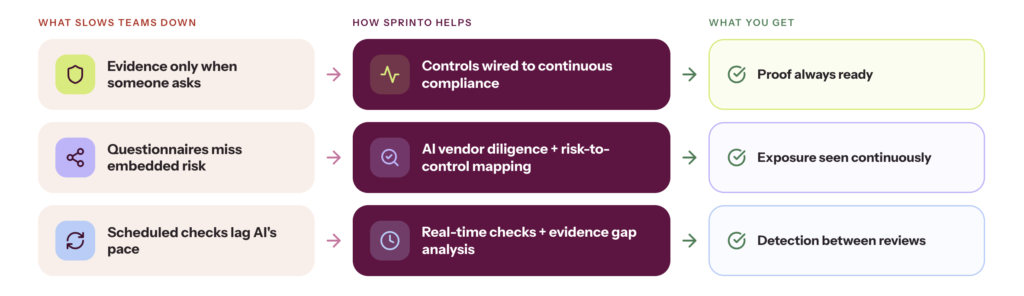
- For enforcement visibility, Sprinto connects AI-related controls, checks, and policies to a continuous compliance system, so evidence of whether controls are operating is generated as a byproduct of the governance process itself, not assembled when a customer or auditor asks.
- For vendor and risk surface coverage, Sprinto’s AI-powered vendor due diligence, security questionnaire analysis, and risk-to-control mapping give TPRM teams a way to assess third-party AI exposure beyond what a static questionnaire captures. It also lets you surface risk signals from vendor documentation continuously, rather than periodically.
- For pace (and scale), Sprinto’s control-to-check mapping links real-time system checks to controls, replacing scheduled human verification with detection that runs between reviews. Evidence gap analysis flags missing or outdated evidence as it appears, not when an auditor asks for it.
The result is that always-on governance becomes your default setting, rather than something the team has to break their backs to achieve.
Takeaway: Always on = Always trustworthy
The organizations closing the gap between policy and enforcement are the ones that treat AI governance as something that must be upheld continuously, whether anyone is actively looking at it or not. And the fact is: your customers, both new and in the pipeline, will indeed be actively looking. That’s how they evaluate if they can trust you as a vendor and partner. Building and maintaining trust means demonstrating full visibility and control over AI within your organization.
Moreover, it’s fairly easy to do so with a platform like Sprinto that continuously monitors controls rather than checking them on a schedule, tracks vendor risk as it changes rather than as it was at onboarding, and generates audit-ready evidence as a byproduct of governance running. That’s the infrastructure that makes always-on real. Make it happen at your org.
Ready to run always-on AI governance and build trust with customers, board, and regulators? Find out how from a Sprinto expert or learn the basics of architecting an always-on AI governance stack.
FAQs
An annual audit tells you whether your controls were in place at a point in time. Continuous AI governance tells you whether they’re working right now. The distinction matters because AI systems don’t stay static between reviews. Models drift, vendors update, employees adopt new tools, and integrations change. An audit captures a snapshot of a moving target. Always-on governance tracks the target as it moves. The audit still has a role, but it should confirm what continuous monitoring has already surfaced, not discover problems for the first time.
Any tool that uses AI to process, route, summarize, score, or act on data your organization owns or is responsible for. In practice, that means your productivity and collaboration platforms, HR and finance systems, cybersecurity tools, and cloud infrastructure, most of which have added AI features without requiring a formal re-review from you. The test isn’t how the vendor categorizes itself. It’s whether AI is influencing any decision, output, or data flow that touches your organization. If it is, it belongs on your risk surface regardless of how it was classified at onboarding.
In most organizations today, the honest answer is nobody, and that’s precisely the problem. GRC owns the policy, security owns the tooling, the AI team owns the models, and runtime behavior falls in the gap between all three. Always-on AI governance requires a named owner who sits within GRC or a dedicated AI risk function, with the authority to set standards and to require evidence from other functions. Security, engineering, and the AI team become stakeholders with defined responsibilities, not co-owners who can each assume someone else is watching.
Reframe it around the cost of the alternative. Over 30% of organizations have already reported a major AI-related security incident in the last twelve months, and two in three take longer than a week to act once a risk is identified. That’s not a compliance gap, it’s an operational one, and it has a price: incident response, customer trust, regulatory scrutiny, and the reputational damage that follows a breach that continuous monitoring would have caught earlier. The conversation that lands with leadership isn’t about frameworks or obligations. It’s about which of our AI systems could cause us material harm if they fail, and whether we have anything in place to watch for that right now. Always-on governance is the infrastructure that makes that question answerable.
Start with discovery and monitoring before you perfect everything else. You cannot govern what you haven’t found, and you cannot catch drift without something continuously watching for it. A partial stack that is actually running is more defensible than a complete AI governance stack that exists only on paper. In practice, that means: a live inventory of AI use cases and the vendors powering them, defined performance baselines for your highest-risk systems, and named ownership of monitoring with clear escalation paths. Build out model validation, integration governance, and evidence collection progressively alongside live operations. The goal isn’t a perfect program on day one. It’s a program where problems surface through controls rather than through incidents.
Drift rarely announces itself. It shows up as model outputs that gradually shift outside the performance baselines set at deployment, input distributions that change as user behavior evolves, vendor configurations that update silently, or controls that were verified at onboarding but haven’t been checked since. In practice, the earliest signals are often subtle: a customer-facing AI tool producing responses outside its intended tone or scope, a fraud detection model whose false positive rate has quietly crept up, an employee querying a model in ways the original use case never anticipated. The only way to catch these signals before they become incidents is to have defined thresholds that automatically trigger a review, not a human who notices something feels off.
Author
Raynah
Raynah is a content strategist at Sprinto, where she crafts stories that simplify compliance for modern businesses. Over the past two years, she’s worked across formats and functions to make security and compliance feel a little less complicated and a little more business-aligned.Go beyond the surface and uncover the governance, risk, and compliance insights that actually matter.


Win digital goodies for boardroom success


Explore more


research & insights curated to help you earn a seat at the table.