Compliance vs Risk Management: Key Differences & Similarities


TL,DR:
| Compliance follows defined laws, regulations, and standards; risk management prepares for potential threats. |
| Compliance is narrower and requirement-led, while risk management covers wider business exposure. |
| The article compares approach, outcomes, timeframe, risk tolerance, crisis management, and tool categories. |
A report by Bloomsberg states that companies are spending 6-10% of their revenue solely on compliance! Furthermore, over 50% of executives see cybercrime as a top five risk now and in the next three years, with concerns rising.
The above statistics are pieces of evidence that in the absence of compliance, you can lose money for your business and customer confidence. Are regulatory body’s requirements for compliance enough? No. You have to understand potential risks and how to approach them too.
Therefore, this article will delve into depth about compliance and risk management, their differences, and how you can manage both effectively with a holistic approach.
What is compliance?
Compliance is the process by which an organization consistently follows the rules, laws, and standards applicable to its business processes. It determines if a company abides by regulations set by national and international bodies.
Why is compliance important?
Compliance allows businesses to extend their reach into larger markets where they may target security-conscious customers. More trust can also be gained, and thus attract more mature clients.
Consequently, through being compliant an organization can minimize financial fines; and damage the brand’s reputation; among other things that come as a result of data breaches or non-compliance.
What is risk management?
Risk management is a continuous process that identifies evaluates controls and predicts potential threats or opportunities that could pose any danger to your business. It finds ways to mitigate such risks and shares knowledge about its impact on your organization.
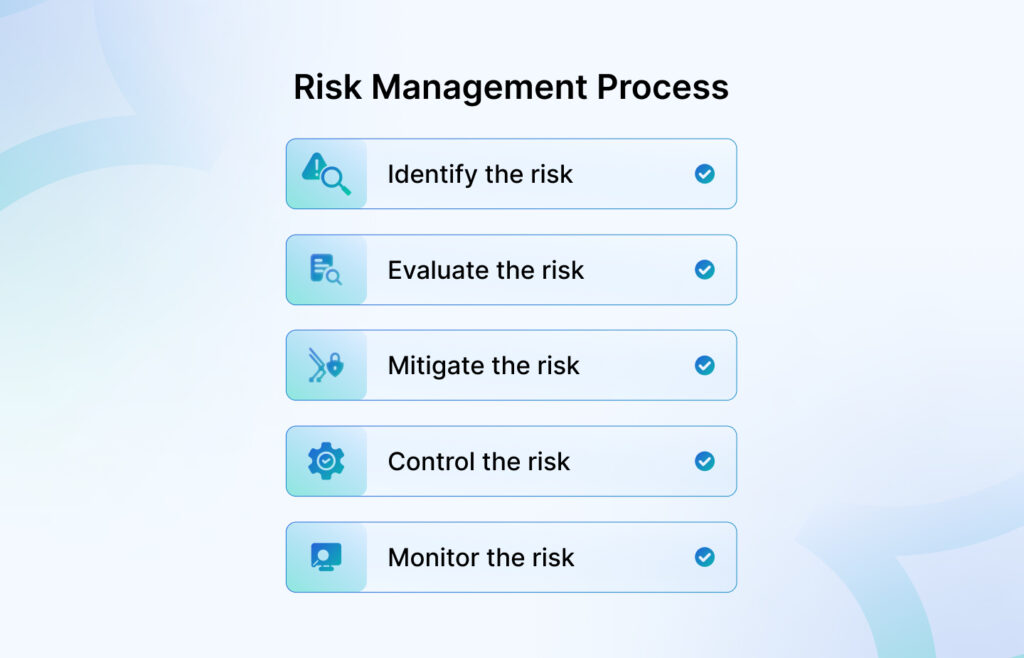
The process of risk management includes five key steps:
- Identify the risk
- Evaluate the risk
- Mitigate the risk
- Control the risk
- Monitor the risk
Why is risk management important?
Risk management is important for any company as it protects finances, keeps operations running smoothly, and safeguards your reputation. It works by predicting and analyzing risks for the future and identifies problems even before they occur.
Risk activities should be conducted throughout the lifecycle of any project in a business to find threats in their early stages and mitigate them. The organization’s compliance posture surfaces the same reputational and financial considerations from a different angle, since regulators and customers increasingly evaluate companies on demonstrated control maturity rather than promised future safeguards.
Compliance vs Risk Management: Key Differences
Let’s understand the fundamental differences between compliance and risk management with a table.
| Factor | Compliance | Risk Management |
| Focus | Adhere to established standards. | Identify, analyze, and mitigate future risks |
| Goal | Showcase trustworthiness to customers. | Mitigate and minimize the impact of future risks. |
| Scope | Particular: Pre-defined regulations | Broad: All possible risks |
| Strategic Approach | Reactive: response to updates | Proactive: preparing for future events |
| Timeframe | Prescribed | Predictive |
| Risk Tolerance | Risk-averse | Evaluates risk |
| Crisis Management | Limited (only legal aspects) | Central (minimizing impact) |
1. Compliance vs. Risk Management: Approach
While compliance follows external mandates and often triggers action only after requirements are defined, risk management prepares ahead — designing controls and safeguards even when no regulation demands it.
2. Compliance vs. Risk Management: Outcome
Compliance is about checking existing boxes to meet obligations. Whereas risk management is about building strategic resilience and competitive advantage by controlling potential vulnerabilities.
3. Compliance vs. Risk Management: Timeframe
The time required by a company to comply with a specific framework is usually prescribed and fixed beforehand in the given guidelines. The same is not true for risk management. The timeframe of a risk management process is mostly predictive and gives an approximate account.
4. Compliance vs. Risk Management: Risk Tolerance
Compliance often treats requirements as pass/fail, while risk management documents risk appetite, residual risk, and treatment decisions.
5. Compliance vs. Risk Management: Crisis Management
While compliance can support crisis management from a legal defense angle, risk management owns the full scope. It coordinates people, processes, and resources to minimize damage and accelerate recovery.
When a compliance gap should become a risk-management item
Most compliance gaps are just tasks: a control is failing, someone fixes it, and the task closes. But some gaps don’t belong only on the compliance side of the house. The test is simple, if the gap could affect security, operations, customer trust, or your audit outcome, and it can’t simply be fixed and forgotten, it needs to be tracked as a risk, not just a to-do.
The distinction is one of decision-making, not severity labels. Compliance tells you what requirement is failing. Risk management decides what to do about it: who owns it, how bad it actually is, whether you mitigate it or consciously accept it, and how often you’ll revisit it. A failing control with a same-day fix remains a compliance task. A failing control you can’t fully close, or have decided to live with for now, is a risk because someone has to own that decision and stand behind it at audit.
In practice, the moment a gap needs any of the following, it should move to the risk register:
- An owner: Not just an assignee to fix it, but a person accountable for the decision about it. On risk teams, the risk owner is the one who can choose to accept or mitigate, and who takes the lead on any project to reduce it. It is a different role from the one who closes a Jira ticket.
- Impact scoring: A judgment about how much this actually matters. It could be about which access or data is exposed and the operational impact if it goes wrong. That score is subjective by nature, which is exactly why it needs to be recorded and owned rather than left implicit in a compliance dashboard’s red status.
- A residual-risk view: If a control is only partly effective — running at, say, 86% rather than fully — the gap isn’t binary. The residual risk that remains after the control does its imperfect job is a risk-management question, not a pass/fail compliance one.
- A treatment decision: Mitigate, accept, or escalate. A gap you’ve decided to accept is no longer a compliance failure to chase; it’s an accepted risk that needs to sit on the register with a rationale, so the next auditor understands why.
- Management sign-off: When a gap falls outside your risk appetite, the decision is no longer the practitioner’s to make alone. It escalates to a portfolio or business owner, and that escalation only happens if the gap is on the risk register in the first place.
What this looks like in the wild
A few common gaps that should cross over from compliance task to risk item:
- Accepted penetration-test or VAPT findings: A finding you’ve chosen not to remediate immediately isn’t closed; it’s an accepted risk. It needs a documented rationale and a review date, or it quietly becomes the thing an auditor flags next cycle.
- Recurring access-review failures: A one-off access exception is a task. The same access review failing every quarter is a pattern that signals a bigger risk, such as broken provisioning and unclear ownership, and the recurrence is the signal to escalate it off the task list and onto the register.
- Incomplete vendor evidence: When a third party can’t produce the evidence you need, that’s not just a missing document. The exposure depends on what access the vendor has and what data you share with them, which is a risk-scoring exercise, not a checkbox.
- Emerging AI and privacy obligations: New regulations like the EU AI Act often appear as risk-register entries before any formal compliance program exists. A flag that says “this system touches the new rule” while the requirements are still taking shape. Risk is where tomorrow’s compliance gap gets tracked today.
- Anything needing senior sign-off: If closing or accepting the gap requires someone above the practitioner to put their name to it, it’s a risk decision by definition, and the register is where that decision lives.
A compliance gap becomes a risk-management item the moment it requires a decision rather than just a fix. Compliance surfaces the gap. Risk management owns what you do with it.
Top 3 compliance management tools
Compliance management tools consist of software that helps organizations reach their compliance requirements through automated controls and dashboards. Furthermore, such tools help businesses maintain compliance through efficient workflows.
Here are the three best compliance tools:
1. Sprinto
Sprinto is a GRC automation tool that helps tech companies stay continuously compliant and complete security audits quickly and successfully. Built on a smart, scalable architecture, it helps businesses stay compliant at each growth phase. A few of the top features of Sprinto are:
- Dedicated auditor-friendly dashboard
- Integrated trust center
- Ready-to-use policy templates
- Built-in training modules for security
- 200+ Integrations
- Role-based compliance management
Continuous Compliance for 24/7 Peace of Mind
2. Auditboard
AuditBoard is a compliance automation platform designed to streamline and centralize various aspects of compliance management. It helps businesses with automated workflows and report generation to ensure consistency in compliance management.
The platform facilitates communication and collaboration between teams involved in compliance activities. This fosters transparency and allows for real-time tracking of progress on compliance goals.
3. Libryo
Libryo is a regulatory compliance management software that helps businesses understand what frameworks are necessary for a certain geographic location. It adheres to legal regulations and helps with faster management decisions.
The platform provides compliance training programs for the whole organization or specific departments. They also help with traditional on-site audits, remote audits, and area-specific audits.
Top 3 risk management tools
Risk management tools use automation and algorithms to identify risks, track them and their likelihood, and how severely they can affect your business. Since the cost of not tracking your risks is so high, having such a tool handy is a good option.
Here are the three best risk management tools:
1. Sprinto
Sprinto’s software is designed to streamline and strengthen your company’s risk management activities, especially in terms of information security risks.
Sprinto helps you stay ahead of security risks by analyzing your cloud environment and industry trends. It prioritizes threats, suggests solutions, and integrates compliance requirements, all to empower smarter security decisions.
It does not just tell you that there is a risk, but it also tells you how to tackle it and avert it from happening again. Plus, it is designed for companies of all sizes!
Comprehensive Risk Monitoring & Mitigation
2. Resolver
Resolver provides enterprise risk management with a comprehensive range of tools. It helps identify and assess risks and allows you to prioritize risks effectively. It also deals with incident management and helps identify any gaps present in your risk management framework.
As a bonus, take control of incidents with ease using our Sample Incident Management Policy Template.
Simplify incident response with our Sample Incident Management Policy Template
Resolver goes beyond basic risk management by providing advanced analytics. It helps you understand the interconnectedness of risks and identify emerging threats before they become major problems.
3. nTask
If you are a small team that is new to the concept of risk management, nTask can be a good option as it offers a more user-friendly approach to risk activities.
nTask makes risk management a team effort. It’s like a central hub where you can easily spot risks, assign risk owners, and track progress on solutions.
Unifying compliance and risk management
Compliance and risk management go hand in hand. In fact, compliance is a subset of risk management. It is usually more effective when organizations take a more holistic approach when dealing with these two entities.
Compliance deals with specific rules you must follow, while risk management looks at the bigger picture of anything that could harm your business. Compliance controls can reduce some known risks when they are implemented, monitored, and kept current. A practical IT compliance checklist gives this holistic approach a concrete starting point, listing the specific control families that most regulated organizations need to evidence regardless of which exact framework set ends up applying.
A single shared platform for both
Having a single platform for both compliance and risk management frees you from data silos and allows you to have a more integrated approach. This saves time and effort for your business.
Generating compliance reports and risk reports on two different platforms would take double the time. But having them united could create a holistic view of your business allowing you to gain deeper insights.
Here’s some help: Cut out busy work for compliance and risk teams with Sprinto. Help your team focus on more important things while Sprinto takes over manual tasks with clear and well-organized assessments.
Stay Ahead with Automated Continuous Compliance
Bridging the gap
Compliance and risk management are like two sides of the same coin, both crucial for a healthy business strategy. However, while they work together, their approaches differ significantly.
By following compliance regulations, you automatically address certain risks. However, a strong risk management program goes beyond just ticking compliance boxes. It delves deeper to identify and address other potential threats that might not be explicitly covered by regulations.
The best approach combines both compliance and risk management. Having a robust compliance program ensures you’re operating within the legal boundaries. However, a forward-thinking risk management strategy takes it a step further, proactively protecting your business and creating a more secure foundation for future success.
FAQs
Through controls. Every risk starts at an inherent level, and how bad it would be with nothing in place. A compliance control (say, enforced MFA or SOC 2 or ISO 27001 access reviews) sits on top of that risk and reduces it. What’s left after the control is doing its job is the residual risk. So when the article says compliance reduces certain risks, the mechanism is: a control mapped to a risk, scored on how effectively it’s actually running, lowers that risk from its inherent level to a residual level. This is also why compliance is a subset of risk management rather than the same thing: controls cover the risks a framework addresses, leaving the rest to your risk program.
In risk management, each risk has an owner who chooses either to mitigate it (put controls or a project in place to reduce it) or to accept it (acknowledge it and consciously live with it, usually because the cost of fixing it outweighs the exposure). Organizations define a risk appetite — a threshold of severity they’re willing to tolerate — and only risks that fall outside that appetite escalate to leadership for a decision. Compliance doesn’t work this way: you can’t “accept” not meeting a requirement. That contrast is the heart of the risk-tolerance difference between the two.
No, and conflating the two is a common and costly mistake. Compliance confirms you met a defined set of requirements at a point in time; it says nothing about the threats those requirements don’t cover. Practitioners often describe compliance work as “checking the box” — necessary, but not the same as actually reducing the threat. A company can pass an audit while real risks sit unaddressed because no framework has been put in place to cover them. That’s the gap risk management fills: it looks at the full picture of what could harm the business, including threats that regulation has yet to catch up to. Compliance is a strong floor, not a complete security program.
No. Minor one-off evidence gaps can usually stay as compliance tasks. Add a gap to the risk register when it has a business impact, repeats across review cycles, requires formal acceptance, needs mitigation tracking, or could affect audit results, customer trust, security posture, or regulatory exposure.
Yes. When compliance and risk live in separate systems, the controls that reduce your risks sit in one place, and the risks themselves sit in another, so the connection between them has to be maintained manually. A shared platform lets you map a compliance control directly to the risk it mitigates and use that control’s live effectiveness to automatically calculate residual risk.
Author
Pansy
Pansy is an ISC2 Certified in Cybersecurity content marketer with a background in Computer Science engineering. Lately, she has been exploring the world of marketing through the lens of GRC (Governance, risk & compliance) with Sprinto. When she’s not working, she’s either deeply engrossed in political fiction or honing her culinary skills. You may also find her sunbathing on a beach or hiking through a dense forest.Go beyond the surface and uncover the governance, risk, and compliance insights that actually matter.


Win digital goodies for boardroom success


Explore more




research & insights curated to help you earn a seat at the table.