TL,DR:
| Compliance costs include direct spend on audits, staffing, technology, training, and indirect productivity losses. |
| Expenses rise with stricter enforcement, privacy expectations, talent shortages, and industry-specific requirements. |
| The article explains how risk-based planning, automation, monitoring, and scalable processes reduce wasted spend. |
Compliance cost is unavoidable, whether you do it right or neglect it. In today’s hyperconnected world, cutting corners isn’t viable. What is changing is how you spend that budget. Teams are shifting from manual spreadsheet and screenshot work to automation and AI‑powered platforms that keep you audit‑ready with less effort.
If you know where your compliance costs actually accrue, and which tasks you can automate, you can turn compliance from a margin drag into measurable efficiency, faster sales cycles, and a competitive edge. This blog breaks down cost drivers across industries and shows how modern automation and AI cut spending without weakening your security posture or risking non-compliance.

What Are Compliance Costs?
Compliance costs refer to the direct and indirect expenses a business incurs to adhere to applicable laws and industry requirements, including audit costs, compliance staff salaries, training and education costs, and time and resources diverted from core production to compliance activities.
The mistake many businesses make is counting only the visible invoices. In practice, compliance costs also include the internal hours spent collecting evidence, chasing control owners, fixing audit gaps, answering customer questionnaires, and keeping teams continuously audit-ready.
Types of compliance costs
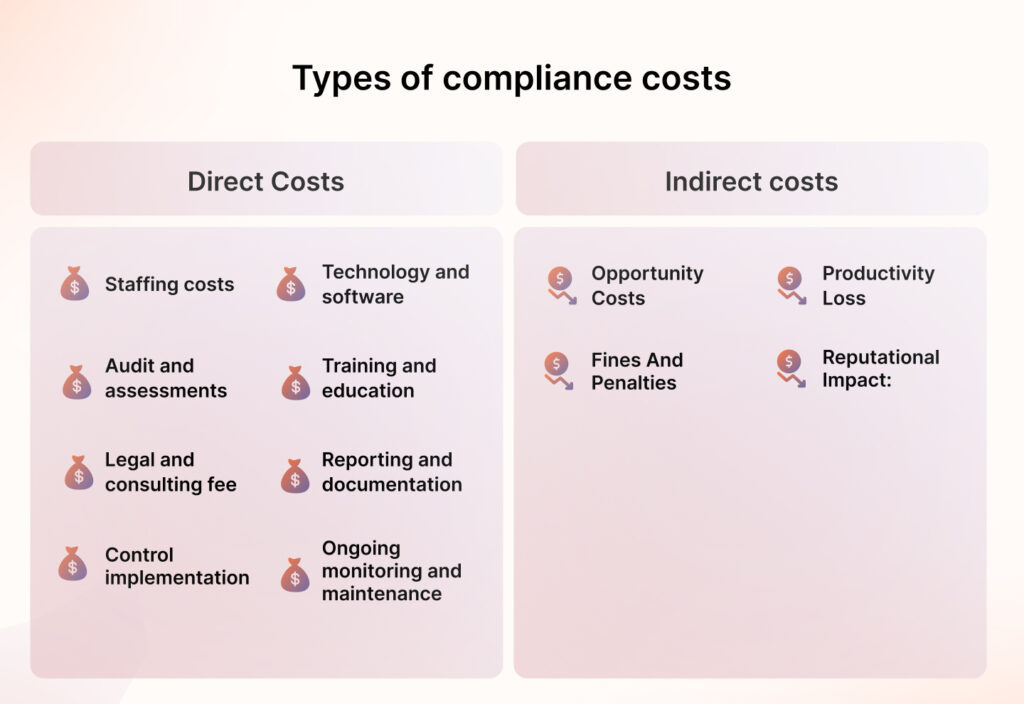
Compliance costs are broadly divided into direct and indirect. Direct costs can be directly attributed to compliance activities, while indirect costs are usually hidden and may be overlooked by businesses.
Let’s have a look at both the types:
Direct Costs
- Staffing costs: Compensation for compliance staff, risk managers, and other dedicated personnel
- Technology and software: Costs of compliance management software, security solutions such as firewalls and encryption, and other automation tools
- Audit and assessments: Costs of internal and external audits, auditor fees, and any third-party assessments
- Training and education: Expenses on employee training and awareness programs
- Legal and consulting fee: Payment to legal advisors, compliance consultants, and other industry experts
- Reporting and documentation: Costs of record-keeping, documentation, and preparing and submitting reports
- Control implementation: Expenditure on control implementation and enforcement of policies
- Ongoing monitoring and maintenance: Costs of ongoing monitoring and maintaining compliance
Indirect costs
- Opportunity costs: Loss of resources diverted from core business activities to compliance
- Productivity loss: Time spent by employees on activities such as training instead of revenue-generating tasks
- Fines and penalties: Potential costs of non-compliance
- Reputational impact: Damage to reputation due to non-compliance or data breaches
The hidden costs usually show up in day-to-day execution. Teams spend hours collecting screenshots, chasing evidence owners, reconciling spreadsheets, remapping the same controls across frameworks, answering repeated security questionnaires, and fixing audit gaps late in the process. These costs may not appear as a vendor invoice, but they affect audit timelines, employee bandwidth, sales cycles, and readiness for future frameworks.
Average cost of compliance platforms for enterprises
The cost of a compliance platform varies widely depending on the size of the organization, number of frameworks, user count, integrations, automation depth, support model, and audit requirements. There is no universal average that applies to every enterprise.
At the lower end, lightweight compliance or GRC tools may start at a few hundred dollars per month. More comprehensive mid-market and enterprise GRC platforms can cost tens of thousands of dollars per year, especially when implementation services, integrations, migration, premium modules, or advisory support are included.
For example, public pricing pages show entry-level compliance software starting around $400 per month, while broader GRC platforms may list annual platform costs in the $24,500 to $34,000+ range for a single use case, with services billed separately. Larger enterprise deployments are usually custom-quoted because they involve more entities, workflows, integrations, data migration, permissions, reporting, and support.
When budgeting for a compliance platform, account for:
- Platform subscription fees
- Audit fees
- Implementation or onboarding services
- Integrations and data migration
- Additional frameworks or modules
- User or employee count increases
- Vendor risk, risk management, or AI governance add-ons
- Training and internal administration time
- Renewal pricing and contract expansion
The cheapest tool is not always the lowest-cost option. A low subscription price can still become expensive if teams continue collecting evidence manually, depend heavily on consultants, pay separately for audit coordination, or need to buy additional tools to manage security questionnaires, vendor reviews, or continuous monitoring.
A better approach is to compare the total cost of ownership against the amount of manual work, audit rework, consultant dependency, and sales friction the platform helps reduce.
Compliance cost based on industries
Compliance costs vary by industry because certain businesses handle sensitive data, require frequent audits, and have high compliance penalties.
Here are some industry-wise compliance cost estimates:
Financial
The finance sector has stringent laws to minimize financial crime, such as Anti-money laundering (AML), and standards to protect cardholder data, such as the PCI DSS, which make it a high-cost industry. The financial crime compliance costs in Canada and the United States alone total$61 billion due to the increasing use of AI and crypto technology for illegal activities.
Global banks with over 20000 employees are spending $200 million in compliance annually.
Healthcare
Healthcare regulations such as HIPAA require organizations to implement robust data protection measures that can cost between $50000 and $150000+.
Cloud
Cloud compliance costs include expenses on certifications or reports such as SOC 2, GDPR or ISO 27001. While these costs vary based on factors such as size, complexity, choice of tool/consultancy and more, here’s an idea of what they can really cost:
- A SOC 2 Type 2 can range anywhere from $7000-$50000
- ISO 27001 can cost $30000-$60000
- GDPR can cost anywhere from $20000-$100000+
Pharmaceuticals
Even the pharmaceutical industry has high compliance costs because of the testing, documentation, and quality assurance required. The average cost of compliance in the industry is $5.47 million.
Technology
Tech is a medium-compliance-cost industry with data protection and privacy regulations such as GDPR and CCPA. The average cost for GDPR ranges from $20500 to $102500.
Manufacturing
Manufacturing is yet another low- to medium-compliance cost industry, with small manufacturers and 20 employees spending an average of $1 million annually.
Sprinto can help you control these costs and even slash them by half with automated workflows, in-built tools, readymade policy templates, training modules and much more. Talk to an expert to learn how.
See how Sprinto AI slashes your compliance cost.
Why are compliance costs rising?
Compliance costs are rising by double digits for most firms due to evolving requirements and increasing regulatory expectations. Moreover, customers today seek assurance about their data security and expect compliance certifications as proof of best practices before entering into contracts.
Here are the key reasons for increasing compliance costs:
Increasing compliance complexity
The key driving factor for compliance costs has always been the rising complexity of regulations. New laws and standards are introduced daily, the existing ones are frequently updated, and industry-specific requirements are only getting more challenging. On top of that, as businesses go global, they are subject to laws from multiple jurisdictions, further complicating the efforts.
Changing privacy expectations
As consumers become more aware of their rights, privacy expectations worldwide are constantly growing. Regulators have started emphasizing data privacy and protection laws such as GDPR, CCPA, and PIPEDA, focusing on implementing robust security measures and enhancing transparency in data handling. The need to adapt to these frameworks and ensure privacy by design drives up compliance costs.
Stricter enforcement
Regulators enforce stricter compliance measures, and non-compliance carries financial and reputational repercussions. Increased scrutiny, frequent and comprehensive audits, and the public disclosure of data breaches have pressured businesses to invest more in compliance to avoid such consequences.
Technological advancements
As businesses adopt new technologies such as AI, ML, and cloud computing, they are tasked with ensuring the security and compliance of new tools. The EU has already introduced the AI Act, and keeping up with such changes requires investments in new resources, which can make compliance costly.
Talent shortage
The industry has a talent shortage, especially in cybersecurity, risk management, and knowledge of evolving regulations. This burdens the organization with paying more salaries to the existing staff for retention and skill gap compensation and continuously investing in their training to stay ahead of the curve. Now, AI compliance companies are increasingly stepping into this gap, automating the parts of compliance work that previously required hiring more analysts and freeing the existing team to focus on the judgment-heavy decisions that automation cannot replace.
Compliance cost Vs. Compliance ROI
We’ve seen that compliance costs include direct and indirect costs and can reach millions of dollars depending on industry, size, compliance complexity, and other factors. But what about compliance ROI?
Most compliance professionals struggle to present an ROI case when seeking budget approval from top management. The Compliance Return on Investment is the value generated by compliance activities, demonstrating that it is not a cost center.
Compliance offers both tangible and intangible benefits, and while it can be difficult to quantify every benefit, you can make some judgments for estimation.
Let’s have a look:
Examples of tangible benefits
- Avoiding fines and penalties: Reduced potential regulatory fines of $400000 through robust compliance
- Efficiency gains: 500 hours saved due to compliance automation, equivalent to $50k labor costs
- Cost savings from risk reduction: Achieved savings of $2 million on remediation efforts by minimizing the risk of a data breach
- Lowered insurance premiums: Achieved 20% lower insurance premium due to efficient compliance practices
- Revenue growth due to new opportunities: Won a $5 million enterprise deal because the company was ISO 27001 compliant
Examples of intangible benefits
- Enhanced reputation and trust: Achieved 10% customer retention rate due to enhanced trust translating into $2M additional revenue
- Improved employee morale due to a better culture: Achieved a 5% reduction in employee turnover, saving $500k in hiring and training costs
Note that these are just examples, and the quantification can be difficult because some benefits are visible in the long term. Moreover, these benefits also overlap with other activities, and it can be challenging to isolate the impact of compliance.
However, in essence, compliance is a business enabler, not a cost center.
Read how Kodif achieved enterprise-readiness with compliance.
Cost-benefit of using a compliance monitoring platform
The value of a compliance monitoring platform should not be measured only by comparing subscription fees. The real question is whether the platform reduces the total cost of staying compliant.
A compliance monitoring platform can improve cost-benefit when it helps teams:
- Automate evidence collection
- Monitor controls continuously
- Reuse evidence across multiple frameworks
- Assign and track control ownership
- Reduce last-minute audit preparation
- Identify gaps before the auditor does
- Answer customer security reviews faster
- Reduce dependence on spreadsheets and screenshots
- Lower repeated consultant involvement
- Support additional frameworks without duplicating work
A practical way to evaluate ROI is:
Compliance platform ROI = (recovered team hours + avoided rework + reduced audit effort + revenue enabled + risk reduction) – platform and implementation cost
For example, if a company is preparing for SOC 2 and ISO 27001, many controls overlap. Without a monitoring platform, teams may collect similar evidence twice, answer similar questions twice, and manage two audit workflows separately. With the right platform, the same control, owner, and evidence trail can often support multiple frameworks.
The benefit becomes even clearer when compliance affects revenue. If a customer requires SOC 2, ISO 27001, HIPAA, PCI DSS, or GDPR evidence before signing, delayed compliance can slow down procurement. In that situation, the cost of compliance is not just the audit fee or platform fee. It is also the cost of the deal being delayed or lost.
The best compliance monitoring platforms reduce both visible and hidden costs. They help teams stay audit-ready throughout the year, reduce recurring manual work, and give security, IT, legal, finance, and sales teams a shared source of truth for compliance evidence.
Strategies to manage compliance costs
Managing compliance costs requires a shift from a reactive to a proactive approach, a change in mindset, and adopting the right technologies.
The key strategies for managing compliance costs include:
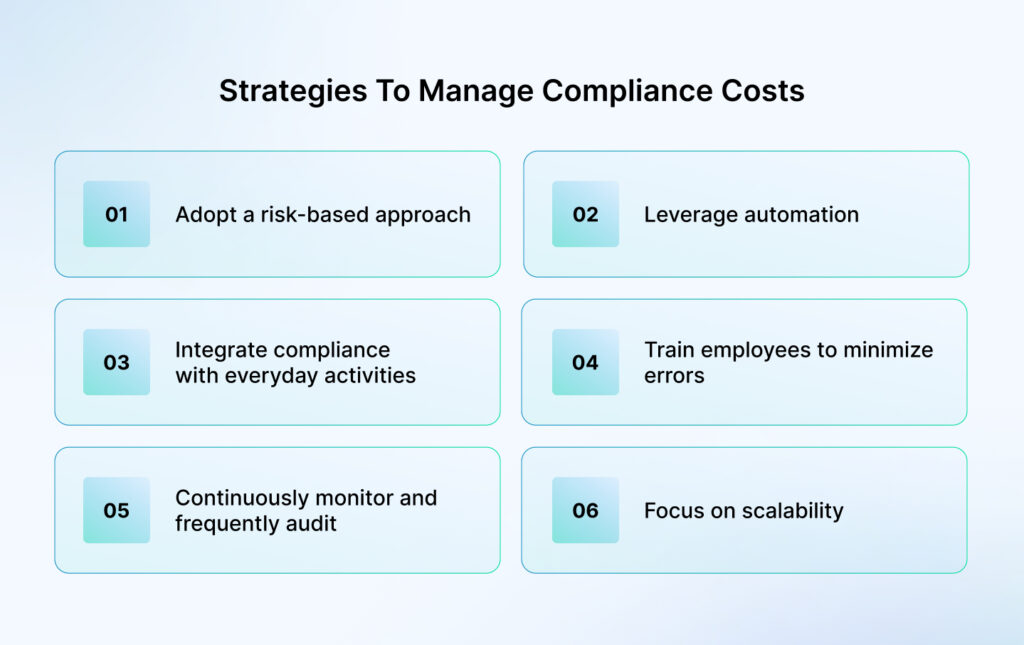
Adopt a risk-based approach
A risk-based approach ensures that the organization stays proactive in addressing high-risk areas with higher compliance ROI. It involves conducting risk assessments and assigning risk scores to prioritize controls instead of applying the same effort across all regions.
Leverage automation
Using compliance management tools minimizes compliance effort while maximizing output. These automated solutions help centralize compliance activities, manage policy enforcement, automate evidence collection, and continuously monitor controls in real-time. They also help save labor costs, reduce rework and human error, and enhance efficiency and speed.
Integrate compliance with everyday activities
Seeing compliance as a siloed function increases adherence friction. Embedding compliance into everyday operations ensures seamless workflows and enhances cross-functional collaboration. This, in turn, reduces duplicative efforts to save costs while aligning compliance with overall business goals.
Train employees to minimize errors
Human error accounts for 80% of compliance and security misses, and training can make a difference. Tailoring training programs based on roles and phishing simulations and exercises reinforce compliance’s importance and raises awareness of attacker tactics. This proactive approach helps prevent costly violations and minimize risks.
Continuously monitor and frequently audit
Using real-time dashboards to track compliance status across multiple regulations continuously helps you stay ahead on pending tasks. This, combined with frequent audits, ensures that you fix potential gaps before they become havoc-causing incidents. It also provides data-driven insights to refine strategies and save costs on redundant activities.
Focus on scalability
Reworking compliance efforts for each framework will only increase costs and effort. Choose a scalable approach by mapping commonalities across multiple frameworks and reusing the same evidence for different requirements. Leverage tools that facilitate this process and accelerate audit readiness.
The costs of non-compliance
The average cost of non-compliance is more than $14 billion, including fines, penalties, revenue loss, business disruptions, and reputational damage. Since 2011, the price has risen by 45%.
Fines and penalties
Regulatory bodies charge hefty fines and penalties for non-compliance to ensure stricter enforcement. For example, in the case of GDPR, the penalties can go up to €20 million or 4% of global turnover.
Operational disruptions
Non-compliance can result in increased scrutiny and investigations, disrupting the natural flow of operations and leading to delayed projects or downtime.
Lawsuits
In certain cases, lawsuits from regulators, customers, or stakeholders may also occur. This can increase the non-compliance costs, which can include attorney fees and settlements or damages paid to affected parties.
Reputational damage
Data breaches put you in the headlines for all the wrong reasons. The resulting reputational damage erodes customer trust and can slow the sales cycle for an extended period.
Remediation costs
Once a violation is identified, the organization must implement corrective actions such as policy changes or compliance program upgrades, which can be expensive.
Revenue loss
Non-compliance can also lead to terminated partnerships and contracts due to loss of credibility and cause revenue loss.
Ensure continuous compliance with Sprinto
How will compliance management change in the future?
As compliance becomes a strategic enabler and a key requirement for businesses expanding globally, compliance management will undergo significant changes. We are at an inflection point, and the future of compliance looks far more systematic and streamlined.
Here’s what the future holds for compliance management:
Increased automation and AI integration
Compliance software is on track to become as standard as project management or CRM tools. Over time, every company will have it in place. Teams are already transitioning to modern GRC tools like Sprinto, and AI will further accelerate this shift by enabling continuous monitoring, identifying issues earlier, and keeping you up to date with new regulations in real-time.
While companies are already adopting next-gen like Sprinto, the future will see even more businesses embrace AI technology for continuous monitoring, predictive analysis, and real-time regulatory updates.
Predictive risk analysis
Many companies still use the traditional root cause analysis approach to flag potential risks. However, the future will see more data-driven and predictive risk analysis, where advanced analytics will help forecast risks, making things more forward-looking.
Embedded compliance guidance
Gartner predicts that by 2030, employee guidance will be more ‘embedded’ in employee workflows instead of delivering standalone training sessions. This shift will reduce employee burden, as they will no longer need to recall compliance instructions separately; instead, guidance will become a natural part of their responsibilities.
Stronger third-party and supply chain compliance
As risk exposure from third-party vendors and supply chains increases, vendor compliance is expected to evolve further. Regulatory pressure for enhanced due diligence and supply chain transparency has already intensified, and new measures and penalties may be imposed for full-fledged enforcement
Sourced local compliance teams
This is yet another prediction by Gartner. As companies grapple with multi-region regulations, managing all requirements from a centralized place becomes difficult. In the future, the number of remote jobs for sourcing local compliance teams will increase to support efficient compliance management.
Sprinto also offers compliance by zones to make it easy for different business units to manage compliance.
How can Sprinto help with compliance management?
We’ve already discussed how automation can be a game-changer in managing compliance costs by reducing manual effort, minimizing audit preparation time, and streamlining workflows. Now, let’s discuss why Sprinto is the number one choice for businesses looking to get compliant across multiple frameworks without significant costs.
The platform can help you stay continuously compliant while minimizing fatigue and costs in the following ways:
- AI playground (custom actions): Build no‑code actions to summarize policies, generate remediation plans, or extract risks from vendor questionnaires, then run them with a click.
- Common control mapping: Auto‑link controls to criteria, checks, policies, and risks across frameworks to enable continuous monitoring without multiplying workload.
- Evidence gap analysis: Flag missing or outdated evidence during uploads so you can fix issues early, before auditors find them.
- Security questionnaires: Generate suggested answers from your policies and past responses, and autofill portal questionnaires with multilingual support.
- Ask AI (contextual assistant): Ask natural‑language questions inside any record and get instant, context-aware answers without digging through documents or tickets.
Paired with prebuilt policies and training, vendor risk reviews, and real‑time control monitoring and reporting, Sprinto helps you achieve smoother operations, faster audits, and clearer visibility without burning out your team.
Take a platform tour to see the product and manage compliance effortlessly.
Frequently asked questions

Author
Payal Wadhwa
Payal is your friendly neighborhood compliance whiz who is also ISC2 certified! She turns perplexing compliance lingo into actionable advice about keeping your digital business safe and savvy. When she isn’t saving virtual worlds, she’s penning down poetic musings or lighting up local open mics. Cyber savvy by day, poet by night!Go beyond the surface and uncover the governance, risk, and compliance insights that actually matter.


Win digital goodies for boardroom success



Explore more





research & insights curated to help you earn a seat at the table.