The Real Story Behind GRC Engineering (From Someone Who Lived It)


Five years ago, “GRC engineer” wasn’t a title most compliance leaders would have recognized. Today, it’s everywhere. On job boards, on conference tracks, and in the org charts of companies that take security seriously.
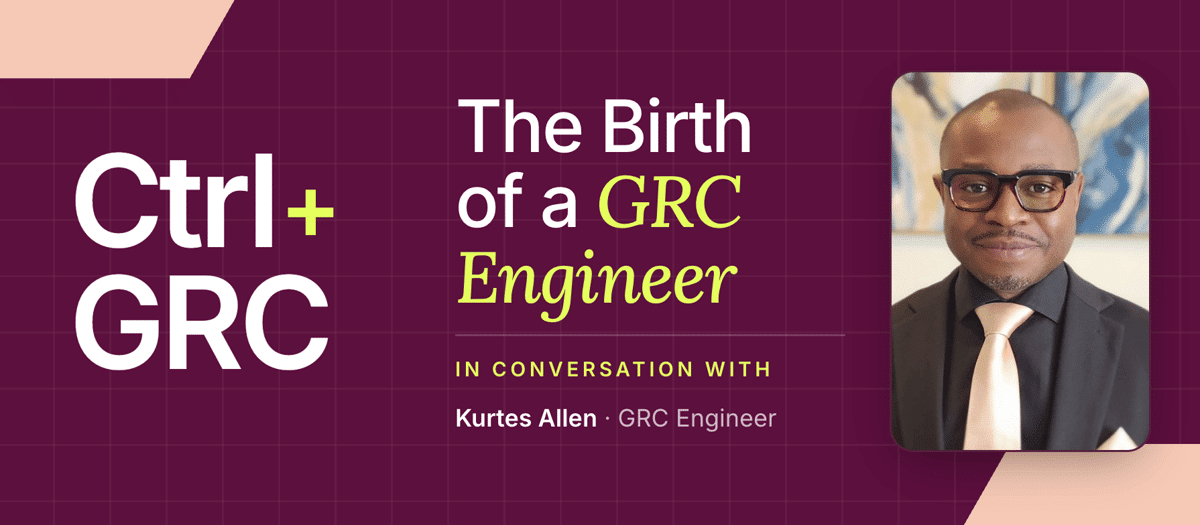
This is the story of how that happened, told through the lens of Kurtes Allen, a GRC engineer whose path into the field tracked the same pressures that reshaped the discipline at large.
A practitioner who almost walked away

Kurtes came into cybersecurity through the most hands-on door there is. He built his first computer before he took a class on how to build one, landed an IT lab tech job out of high school, and eventually went to university to study telecommunications before switching to cybersecurity.
Then he got to the GRC module, and he hated it. It felt dry, full of frameworks, and far removed from the systems he actually wanted to work with. The instructor did not help either.
“I just wanted to pass the course and get rid of him. I had no intention to look back on GRC.”
So he passed the course and went back to the parts of security that let him get his hands dirty.
But that reaction wasn’t unusual. It was, in fact, the reaction most of the industry was having to compliance work at the time. And understanding why is the beginning of understanding why GRC engineering had to be invented.
The pressures that broke the old model
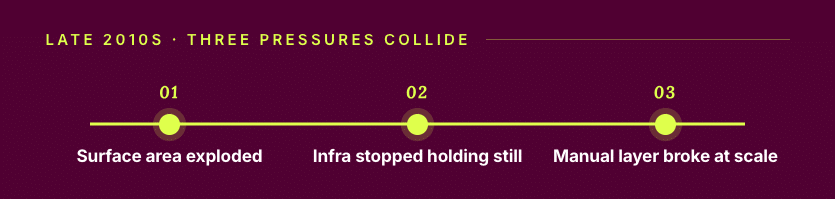
By the late 2010s, compliance was failing on three fronts at once.
Surface area exploded. A company operating across regions, customer tiers, and industries could easily find itself mapped against a bunch of frameworks, from SOC 2 and ISO 27001 to HIPAA, PCI, and GDPR. The overlap between them was real, often 60 to 70 percent, but the mapping itself became a full-time job.
At the same time, infrastructure stopped holding still. In a world of continuous deployment, the system that an auditor certified in March was structurally different by June. So, evidence captured at a point in time said less and less about whether controls actually held.
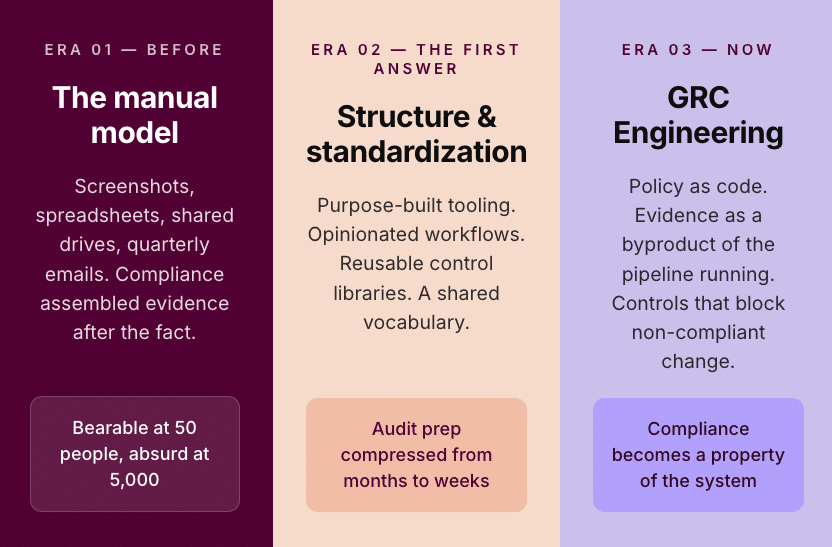
And then the scale broke the manual layer. The work of collecting screenshots, maintaining spreadsheets, chasing people down shared drives, and quarterly email threads was bearable at fifty people and absurd at five thousand.
Any one of these pressures might have been absorbed. Together, however, they forced a rethink.
Meanwhile, Kurtes had graduated and started freelancing. Small businesses kept asking him for help with their systems, and those systems kept running into compliance issues. So he relearned GRC, this time from an instructor who was genuinely passionate about it, and the second exposure clicked. What pulled him back was the thing about to reshape the industry: you can’t actually separate compliance from the systems it governs.
The first answer was structure and standardization
The first real shift was standardization. Teams started bringing order to the chaos with structured workflows, reusable control libraries, and a shared language. This meant they no longer had to rebuild the same compliance processes from scratch every time. For a while, this worked well. Audit prep became faster, and evidence collection was more organized and less manual.
But standardization has its limits. It can help organize what needs to be checked, but it cannot always pull the real state of systems on its own. Someone still had to go in, gather the data, and verify what was actually happening.
So as GRC matured, teams began filling that gap themselves. They wrote scripts to pull configurations from cloud providers, collect logs, and connect systems that were not covered by standard workflows. Over time, this added up. The compliance function slowly started to look more like a software function, even if no one had named it yet.
This was the work Kurtes was already doing. Python was his language. He wrote collectors, built templates, and automated the tedious parts, not because he was following a trend, but because the work itself demanded it.
How GRC Engineering emerged
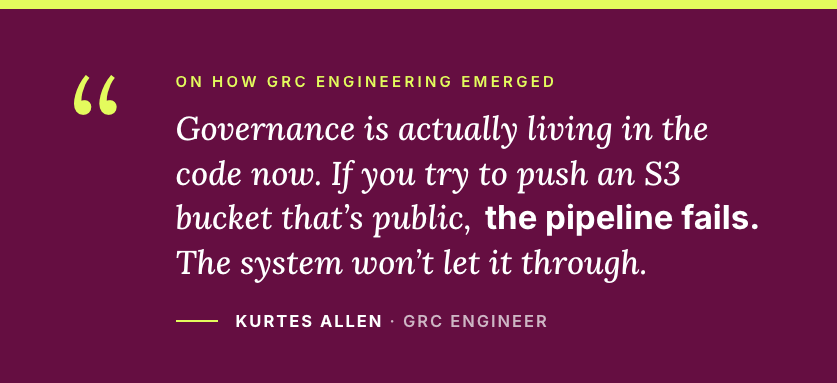
The actual emergence of GRC Engineering came from looking sideways at DevOps. Because DevOps had faced a structurally identical problem a decade earlier, and solved it with a set of principles: infrastructure as code, pipelines as the source of truth, quality as a property of the delivery process rather than a phase bolted on afterward.
GRC started to follow the same path. Policies were written as code, so they lived inside the systems they applied to. Evidence was generated automatically as systems ran, instead of being collected later. Controls also moved into the deployment process, where they could stop a non compliant change before it went live.
Instead of checking compliance after the fact, it became part of how systems were built and shipped.
In the old model, compliance assembled evidence after the fact. In the new model, however, it emits evidence as a byproduct of the system working correctly. The person who designed that emission layer was doing work that didn’t exist before, and the market needed a word for it. The word became GRC engineer.
What it actually is: a mindset shift
From the outside, GRC engineering looks like a tooling story. People see the pipelines and the policy-as-code, and they assume the whole discipline is purely technical and code-driven.
But it isn’t.
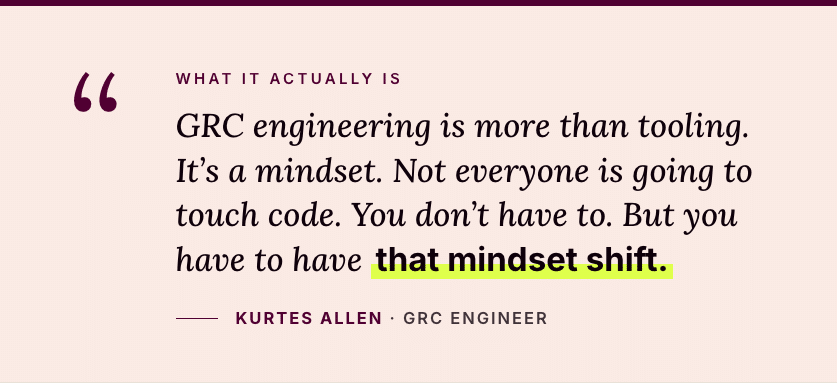
The shift, in plain terms, is this. The focus moves from manually collecting evidence to building systems that produce evidence on their own. Compliance is no longer a separate process that runs alongside engineering. It becomes a built-in part of how systems are designed and operated.
This way of thinking is open to any practitioner, whether they write code or not. The mindset comes first. The tools come after. This is how GRC engineering emerged. Through the work of practitioners like Kurtes, who adapted before the role even had a name. Today, that way of working is no longer on the edges. It is moving to the center. And as technology continues to move faster, this shift is opening up to anyone willing to make it. The future of GRC is already taking shape.
Subscribe to our newsletter for full access to the content

Author
Srikar Sai
As a Senior Content Marketer at Sprinto, Srikar Sai believes good content should be bookmark-worthy by default. He writes about cybersecurity and GRC, aiming to move the needle with every piece. He’s also an ISO 27001-certified Lead Auditor.Go beyond the surface and uncover the governance, risk, and compliance insights that actually matter.


Win digital goodies for boardroom success


Explore more






research & insights curated to help you earn a seat at the table.