The GitHub breach: your most trusted tools are now the attack vector


On the morning of May 19, a GitHub engineer opened their laptop, and a VS Code extension they had installed months ago auto-updated in the background. Within minutes, malicious code was reading credentials from memory and sending them to an attacker. And within a few hours, that attacker was inside GitHub’s infrastructure, cloning internal repositories with the developer’s credentials. By the time it was over, roughly 3,800 of those repositories were listed for sale on a criminal forum by a group calling itself TeamPCP.
GitHub’s disclosure was textbook: fast, measured, and contained. No customer data affected, and no production impact. However, if you sit on a GRC team, this should be quietly unsettling. The entry point was not a zero-day, nor was it a phishing campaign. Instead, it was a popular developer tool, from a verified publisher, doing exactly what it was supposed to do.
The eleven-minute window
GitHub is one of the most security-mature engineering organizations in the world. So the question is not what they missed. Rather, it is what the attack was targeting that their controls were not built to defend.
At the center sat one extension: Nx Console. It has 2.2 million installs, a verified publisher badge, and a long maintenance history. So the attacker did not breach the Marketplace. Instead, they stole a maintainer’s credentials from an earlier upstream compromise, used them to publish a poisoned version under the legitimate publisher’s name, and waited for auto-update.
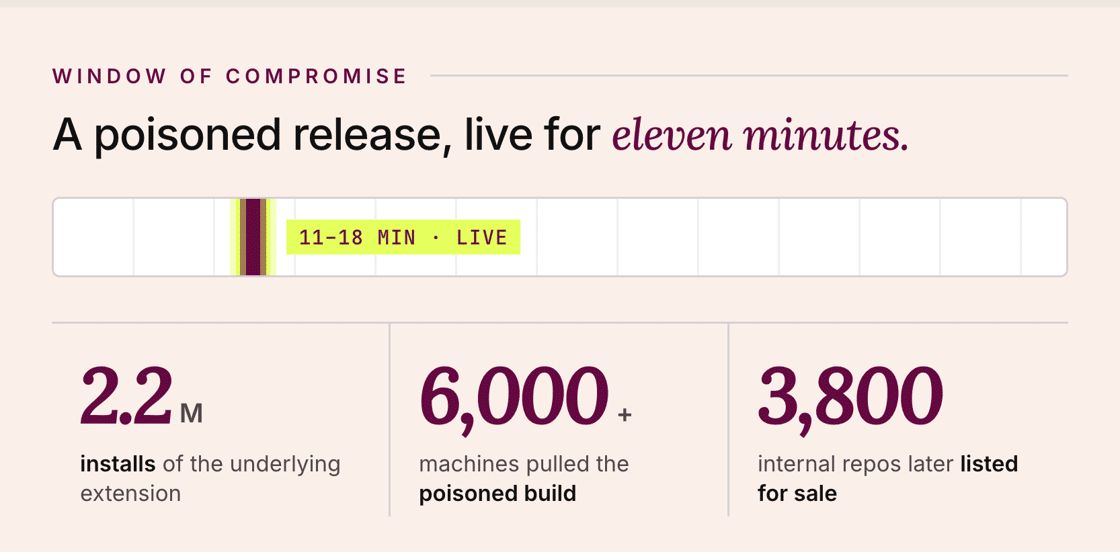
The poisoned version was live for eleven to eighteen minutes before Nx maintainers caught the anomalous publish and pulled it. Microsoft initially reported 28 installs. However, Nx’s telemetry later showed the real number was above 6,000. And one of those installs landed on a GitHub developer’s machine.
The moment the developer opened a workspace, the malicious code harvested session credentials, SSH keys, and cloud secrets and then exfiltrated them.
Why standard frameworks didn’t catch this
Every mainstream control framework already requires what GitHub had. SOC 2 mandates access controls and endpoint protection. ISO 27001 covers secure development and supplier management. And NIST 800-53 covers configuration management and supply chain risk. So GitHub almost certainly had clean reports against all of them.
The problem, therefore, is not that the frameworks are wrong. Rather, they were written around a trust model that the attackers have learned to invert. And the assumption that breaks first is that developer endpoints are ordinary corporate devices. They are not.
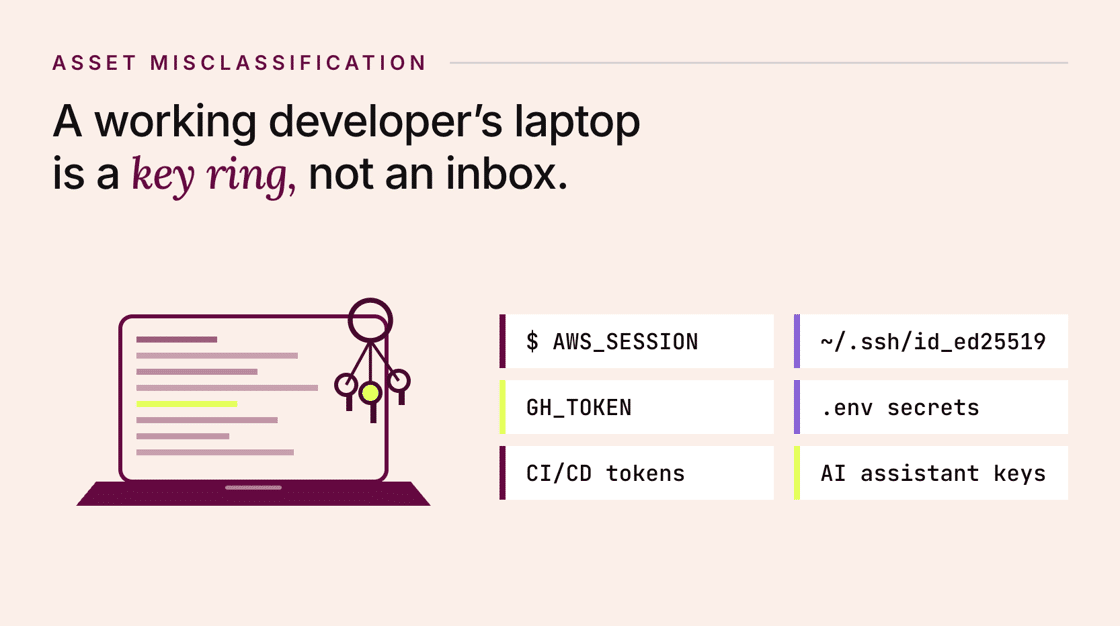
A working developer’s machine stores active cloud sessions, SSH keys, Git credentials, environment-variable secrets, CI/CD tokens, and API keys for AI coding assistants. So a single compromised laptop is a key ring for everything downstream. Yet most asset classification schemes still place these endpoints in the same tier as a finance manager’s Outlook. So that mismatch is where the governance gap lives, and closing it is a GRC problem before it is a security one.
A new edge of the trust chain is under attack
GitHub is not a standout in this story. Rather, there is a larger pattern, and GitHub is just the most visible organization right now.
The software supply chain has always had a trust chain running through it. In other words, a developer trusts an extension, the extension trusts a maintainer, the maintainer trusts a registry, and the registry trusts a publisher credential sitting in an environment variable on someone else’s laptop. So every link assumes the one behind it is intact.
Over the last few months, TeamPCP has launched industrialized attacks on the developer trust surface, hiding malware in more than 500 open-source packages across roughly 20 waves. OpenAI, Mercor, and Mistral AI are confirmed casualties. But the long tail of undisclosed breaches is larger.
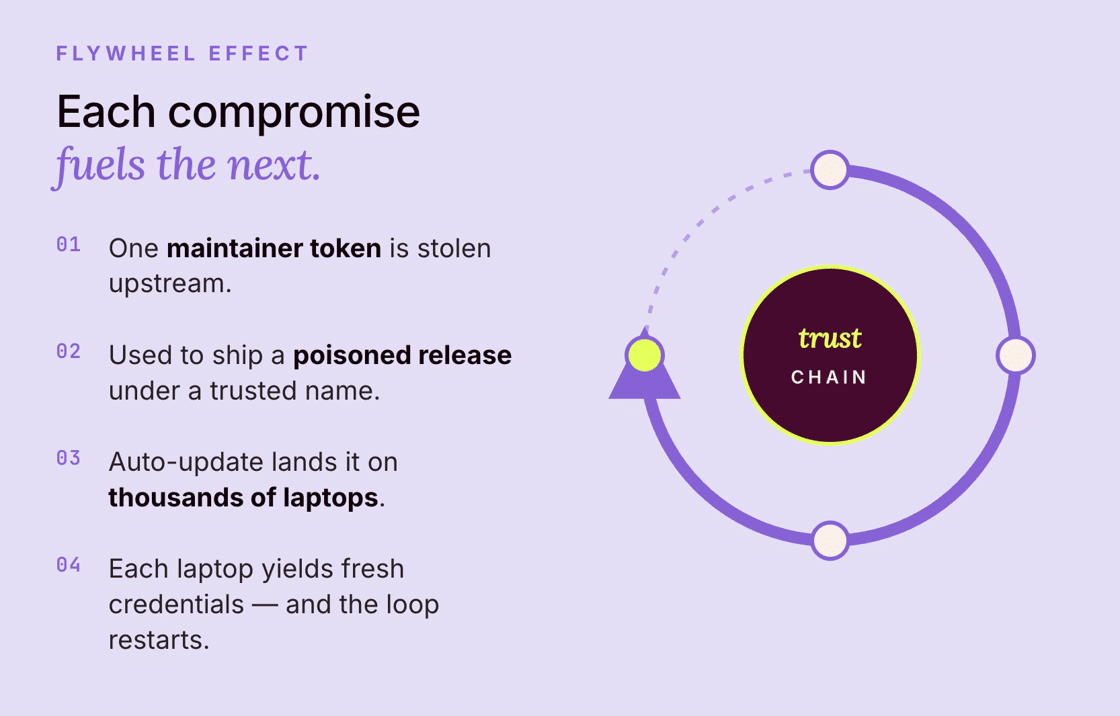
TeamPCP’s modus operandi, therefore, is to attack the chain itself rather than any single link. The Nx Console compromise started with a maintainer token harvested from an earlier TanStack compromise. And that is the whole move. The Nx Console extension was already approved. It was already installed. It was already sitting inside the developer’s IDE with permission to run.
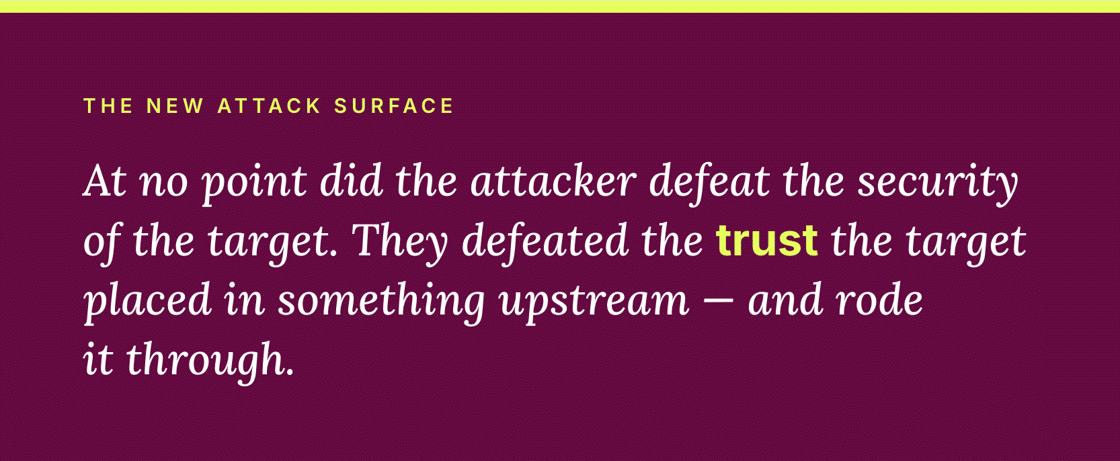
So the attacker did not have to get past any of that. They just had to compromise the thing the developer was already trusting, and the trust did the rest of the work for them.
What this means for the next vendor review
If the trust chain is the thing under attack, then the practical question is which links in your own chain currently sit outside your governance perimeter.
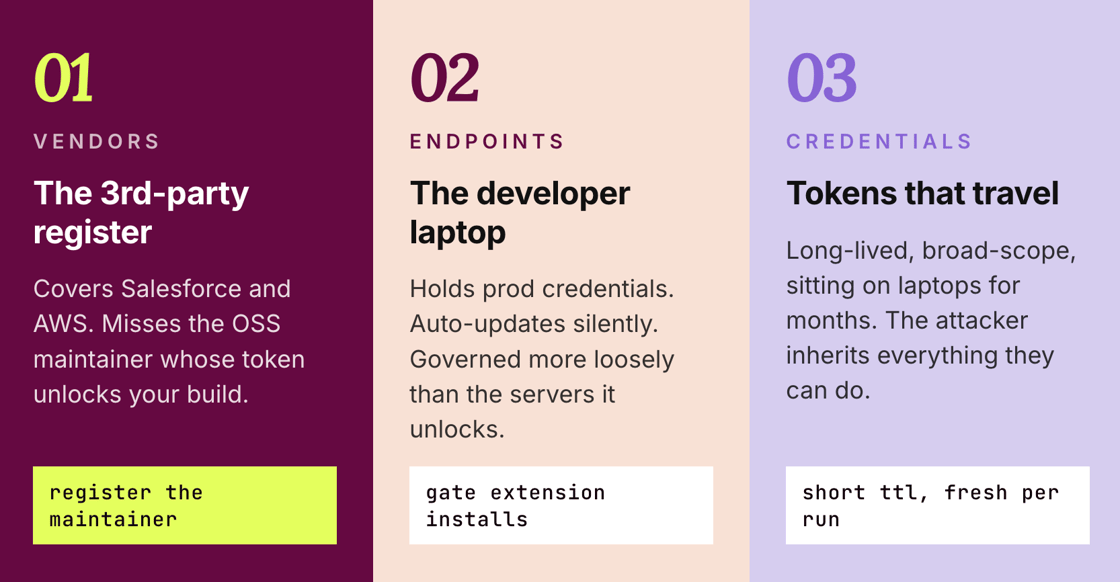
Start with the third-party risk register, the list of outside vendors your organization formally tracks. Most cover Salesforce, AWS, and anyone with a contract. But they miss the small developer tools your engineers install themselves, the public code libraries those tools depend on, and the maintainers behind them. None go through procurement. And yet all execute code on machines that hold keys to production. So they need to be governed like vendors, at least for anything touching credentials or build pipelines. The Nx maintainer whose token was stolen had no contract with GitHub. But in effect, he was a vendor to every company running his extension.
Next, the developer endpoint controls the rules for what a developer’s laptop is allowed to do. Can engineers install any extension they want, or only an approved set? Does a new version install itself silently? And when something suspicious happens on that laptop, do your security tools monitor it as closely as they do a production server? At most companies, the answer to all three is no. So the laptops holding the most powerful credentials are governed more loosely than the servers those credentials unlock.
Then, credentials, the keys, and tokens that prove a system is allowed to act. Most live too long and travel too freely. A token issued to a laptop can sit there for months, and if the laptop is compromised, the attacker inherits everything it can do. So the fix is to shorten lifetimes and limit reach: tokens that expire in hours, build systems that fetch fresh credentials per run, and keys held in secure hardware on the device. None of this is exotic. But all of it requires someone to own the migration, and that is where the conversation stalls.
GitHub is one of the most security-mature engineering organizations in the world, and yet the attacker still got in. So the next name on the list will not have GitHub’s detection, response speed, or communications discipline. The trust surface TeamPCP is industrializing sits almost entirely outside what conventional governance was designed to cover. So that is the gap, and it is closing in one direction.

Subscribe to our newsletter for full access to the content

Author
Raynah
Raynah is a content strategist at Sprinto, where she crafts stories that simplify compliance for modern businesses. Over the past two years, she’s worked across formats and functions to make security and compliance feel a little less complicated and a little more business-aligned.Go beyond the surface and uncover the governance, risk, and compliance insights that actually matter.


Win digital goodies for boardroom success


Explore more




research & insights curated to help you earn a seat at the table.