The AI tool your team approved is now making decisions


Chatting with us at the start of her day, Guensie Fisher, TPRM Lead at GitHub, worries about what every TPRM owner worries about: There’s a LOT more to be done.
“Requests are coming in from every department, and the pressure is high, not just on us but on the stakeholders asking for these tools too. Sometimes, they may not be fully aware of what a tool can do, but they’re keen to start using it because orgs want their people to use AI,” she says.
What’s driving the explosion of TPRM tasks?
Vastly expanded risk surface compounded by greater urgency
TPRM teams know they may not have visibility into AI plug-ins and integrations down the line, so intake assessments tend to be more stringent. “Earlier, a team could onboard a tool, and we knew exactly what it was connected to, but today, we have to account for that no longer being apparent to us because people may be connecting their Chatbot and their CLI, and information can flow to all sorts of places,” Guensie points out.
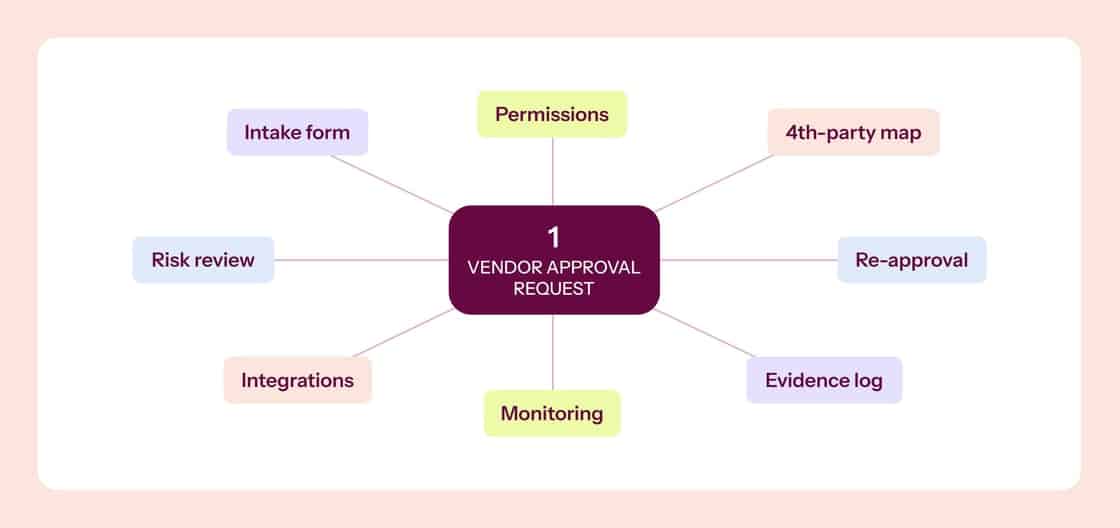
That is a justifiable reason for a deeper evaluation, but time is not a luxury GRC teams have. Today’s TPRM teams are inundated with new vendor approval requests, and each one can feel like a minor project with 200-question assessment spreadsheets that take over two weeks to come back from the vendor, and another few weeks for TPRM teams to review. In the meantime, teams might face a time crunch to get things going.
Extended approval timelines create not only delays but also another long-term risk. “Teams might look for ways to bypass the assessment process in the future,” she says, voicing every GRC team’s worry about shadow AI.
Compounding the problem is the fact that seemingly innocuous tool categories now carry a higher risk. Guensie calls out Sales and Marketing tools, Communication/ Collaboration tools, and Finance, Contracting & ERP tools as “Unexpected categories showing more risk due to AI connections.”
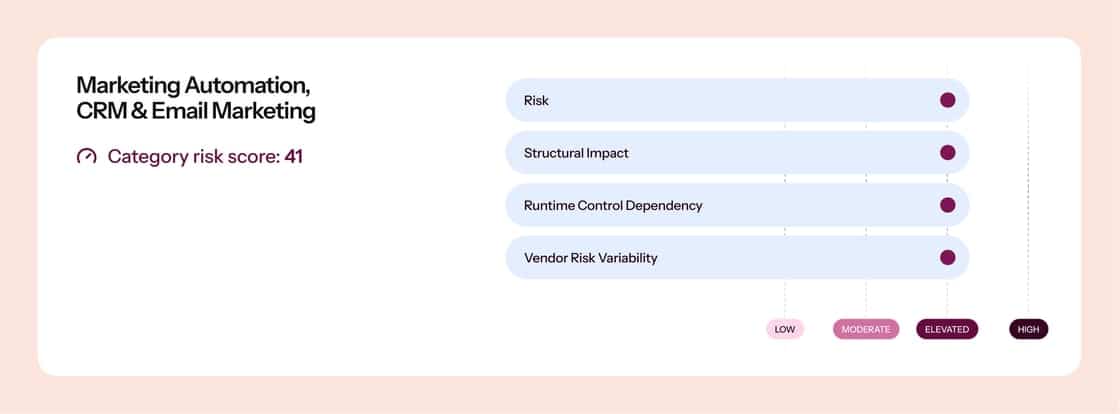
CRM tools contain sensitive customer conversations and data. Consequences can be devastating if data is extracted using LLM integrations. These tools need special procurement oversight because they not only score high on vendor risk and runtime risk but also carry high structural impact (which means downtime, breaches, and rollbacks might affect operations), and high vendor risk variance (which means each vendor needs to be evaluated especially carefully).
Source: Vendor Category Landscape, 2026. Download Now to read the whole report
Teams may not see why these previously lower-risk vendor categories need GRC approval, but the risk is real.
For example, organizations have both internal and external users in Slack, Microsoft Teams, and other communication tools, and ungoverned AI integrations could inadvertently override access restrictions. “If you have external parties able to pull the conversations from communication tools into LLMs for context, you should be thinking about the risk possibilities around the external party getting compromised or disgruntled,” Guensie explains.
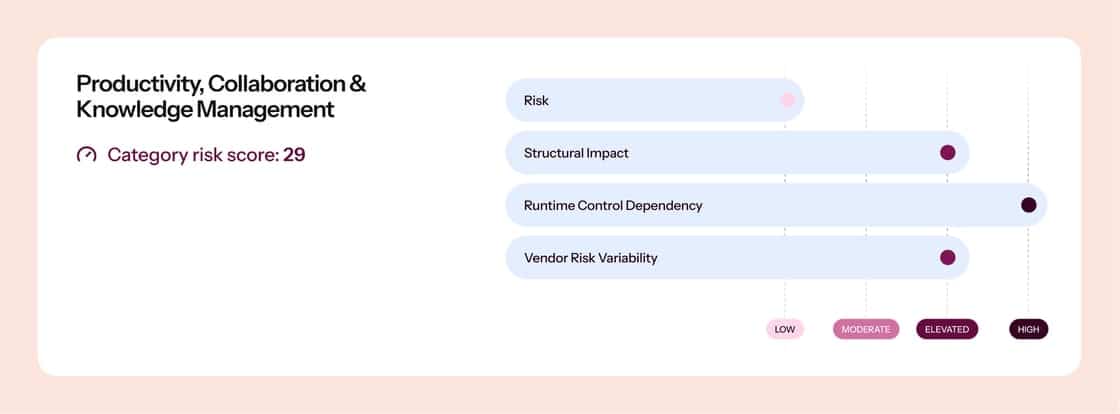
While well-governed, collaboration tools show high runtime control dependency because conversations can be accessed and extracted with connected LLMs
Black-box logic is another threat. In some cases, people do not know why a tool is performing an action or recommending a particular course of action, and may also shy away from asking. As a consequence, eliminating black-box logic risks gets added to GRC task lists. This is also why TPRM owners in GRC teams need to evaluate tools for sufficient human-in-the-loop control. Imagine a procurement or contracting tool that uses AI to draft or review contracts. There’s always a risk that contracts overpromise or underdeliver compared to their original intent if sufficient human review is skipped or actions can’t be explained.
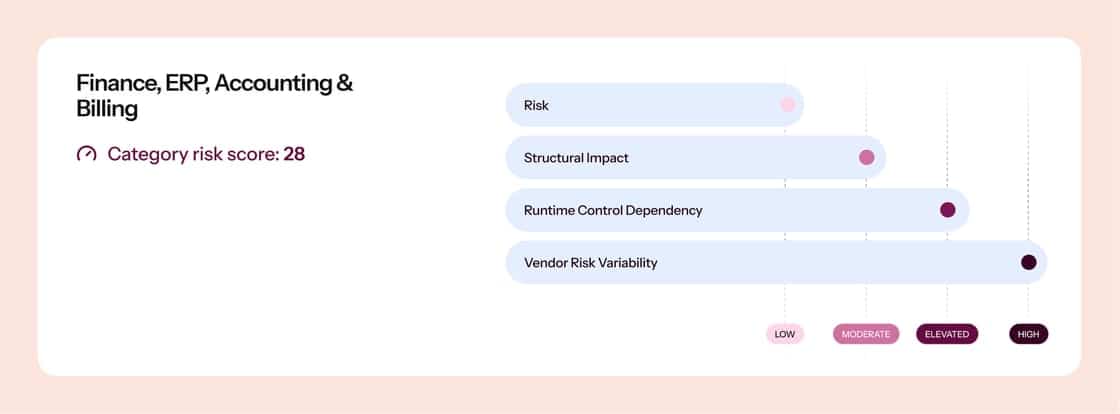
Any tool that touches contracting, including finance, billing, subscription management, and ERP tools, can affect commercial commitments if AI-generated actions or recommendations bypass human review. Runtime controls help TPRM teams see where those actions happen, whether approvals are enforced, and what changes after review.
2. Vendor assessments have become vendor ecosystem evaluations
TPRM teams also find themselves needing to evaluate vendors more deeply. “We’re looking at fourth parties and the overall vendor ecosystem risk. You need to understand what models your vendors are relying on.”
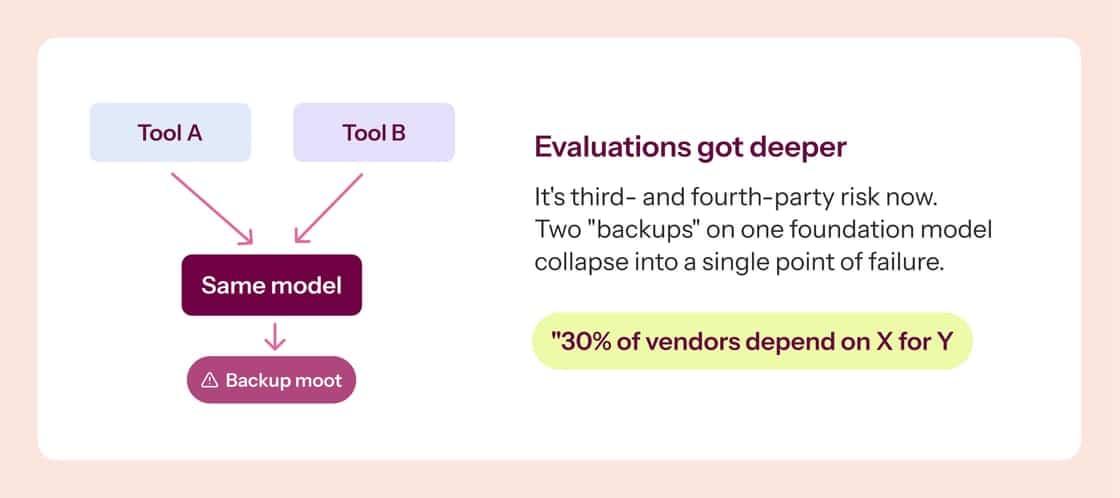
She illustrates with an example. Imagine you have critical systems and therefore, use two different tools that perform a similar functionality as a backup mechanism. But if they’re both relying on the same data center or the same foundation model to provide that functionality, your backup becomes moot.
These new risks require additional reporting for leadership. If critical systems eventually rely on the same fourth party, that’s definitely something that leaders should be made aware of. “They don’t want details, but something like ‘30% of our vendors depend on X vendor for Y’ is crucial for making leadership aware of dependencies and blast radius.”
“This is especially true as vendors diversify the foundation models that they rely on, moving beyond the frontier labs like OpenAI, to smaller players,” Guensie says.
She also points to a potential logic flaw regarding frontier labs themselves: Many people might think of OpenAI and Anthropic as comparably proven and reliable vendors to Azure and AWS, but it’s too early in the game for that confidence in the first place. TPRM teams are responsible for educating leaders on how this creates business risk.
What’s making third-party risk harder to control?
Procurement has become decentralized. A non-AI SaaS tool can become an AI tool with real access to your data with just a click from a non-technical employee who may or may not be aware of what permissions they just granted, and what the consequences of those permissions might be. Guensie’s even got a post about it on her LinkedIn page.
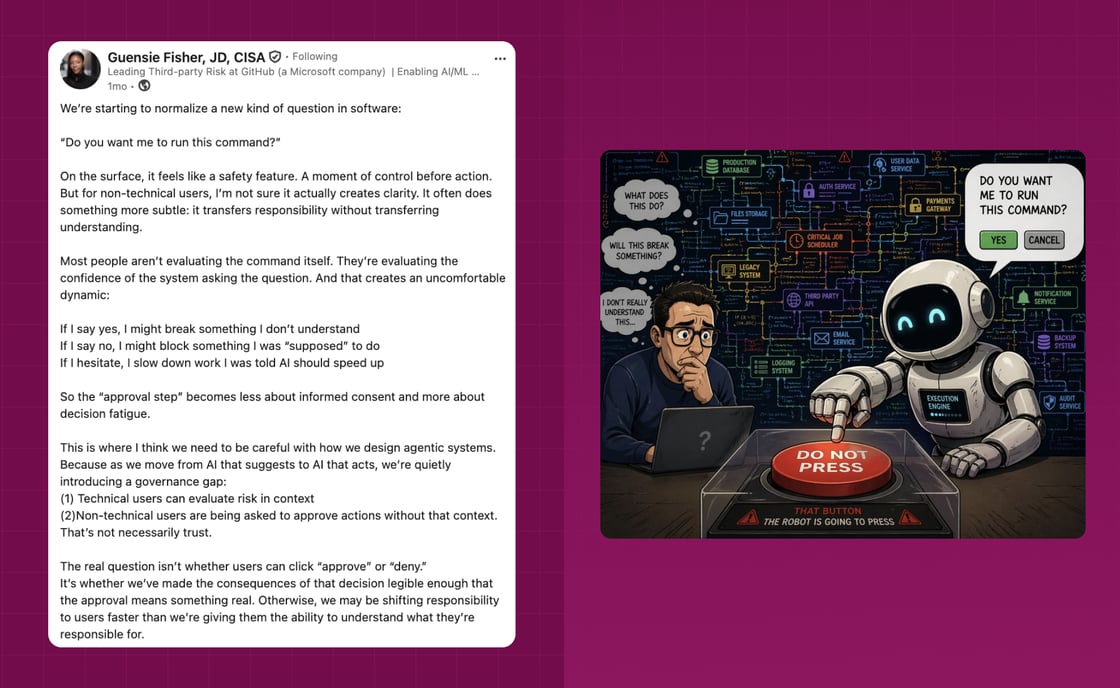
Better vendor diligence is crucial here. ‘Do you want me to run this command?’ should always be accompanied by a ‘Read more’ that explains downstream implications in natural language. Right now, even as procurement becomes decentralized, the language still speaks to engineers rather than to the actual non-technical users.
The way Guensie sees it, labeling AI integration and other actions by risk level is, at the very least, a good place to start.
How TPRM teams can get ahead of the chaos
1. Tackle time-crunch impatience empathically
Overcoming “I need a couple of weeks to evaluate this” or, worse, “No, you can’t use this tool” friction is crucial to maintaining the team’s trust, confidence, and patience, which, in turn, are crucial to preventing shadow IT. Guensie has found that empathic communication works best.
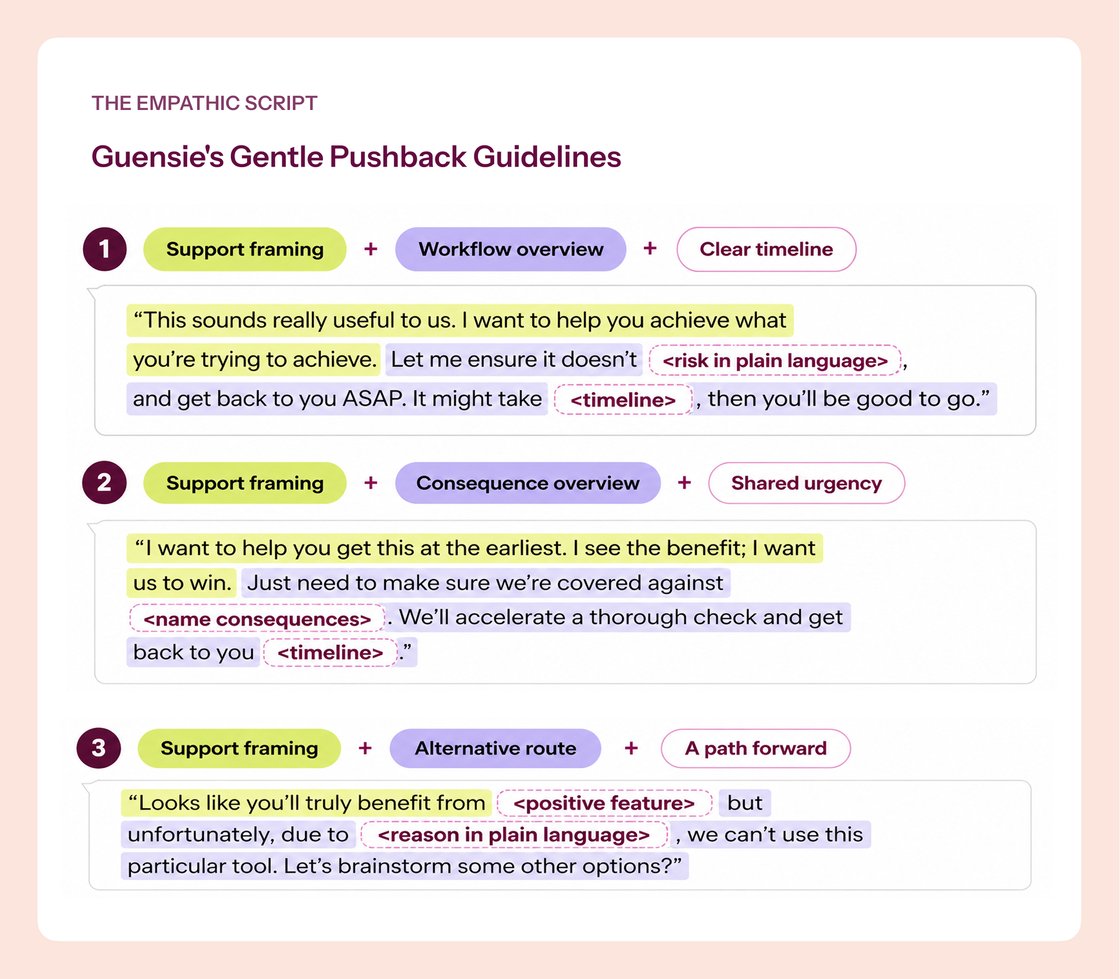
Guensie recommends using more “I” in these conversations to underscore personal investment and to help reduce the tension and frustration teams feel when organizations want them to use AI tools but then make it hard for them to do so. Moreover, showing personal investment in solutioning, especially when a vendor is a no-go, is important. “People often have a second tool in mind, or even other solutions like ‘our engineer had a workaround so we don’t use XYZ problematic permission’,” she says. Often, it’s just about talking through things with genuine presence.
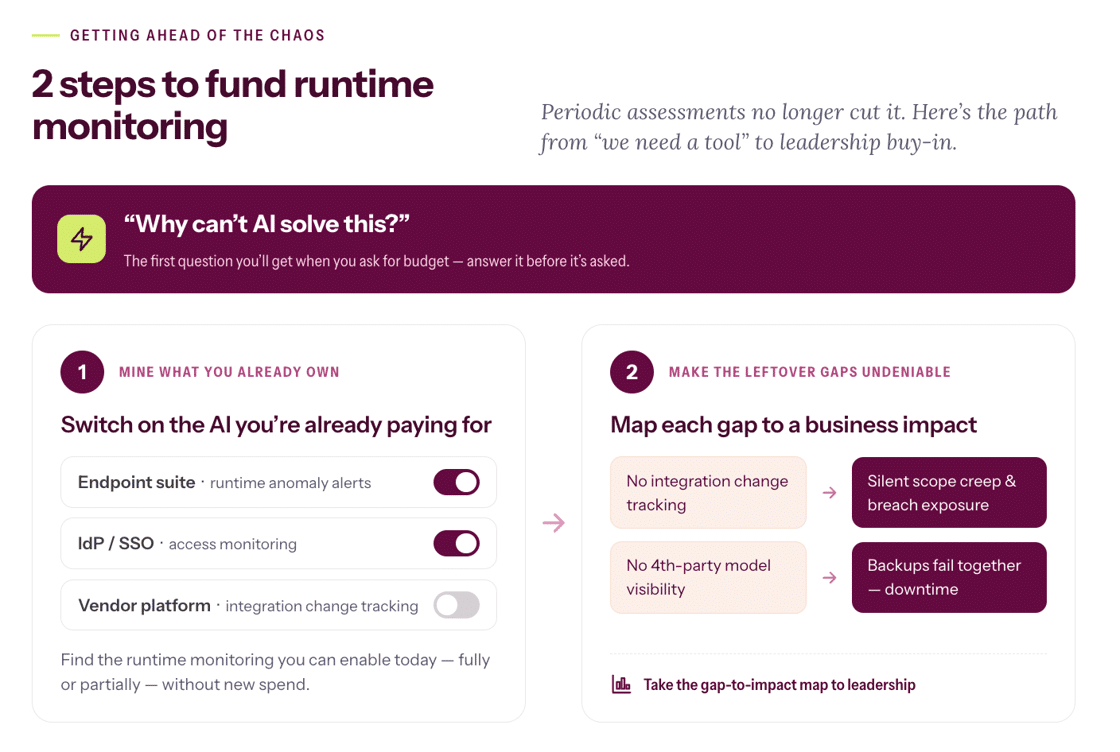
2. Continuous runtime monitoring tools
If we look at some of the trends we’ve covered today, we see that TPRM teams are dealing with: Decentralized procurement, integration risk, and overprivileged access for AI agents, vendor-side model choice, training and data retention changes, and risks like prompt injection, downtime, and malicious intent.
In this context, periodic assessments are no longer realistic. Vendors may not be contractually obligated to notify you of changes on their end. In addition, if your employee plugs in that tool and uses it irresponsibly, the vendor’s efforts may prove insufficient.
The problem is no longer just whether a vendor passed review once. It is whether their systems, integrations, permissions, and usage patterns change after review.
Guensie underscores the need that most TPRM teams feel in their bones. The need to shift to a more ongoing monitoring type of model: “Service change and integration reviews are the baseline, along with changing the necessary technical controls on our side in response to changes.”
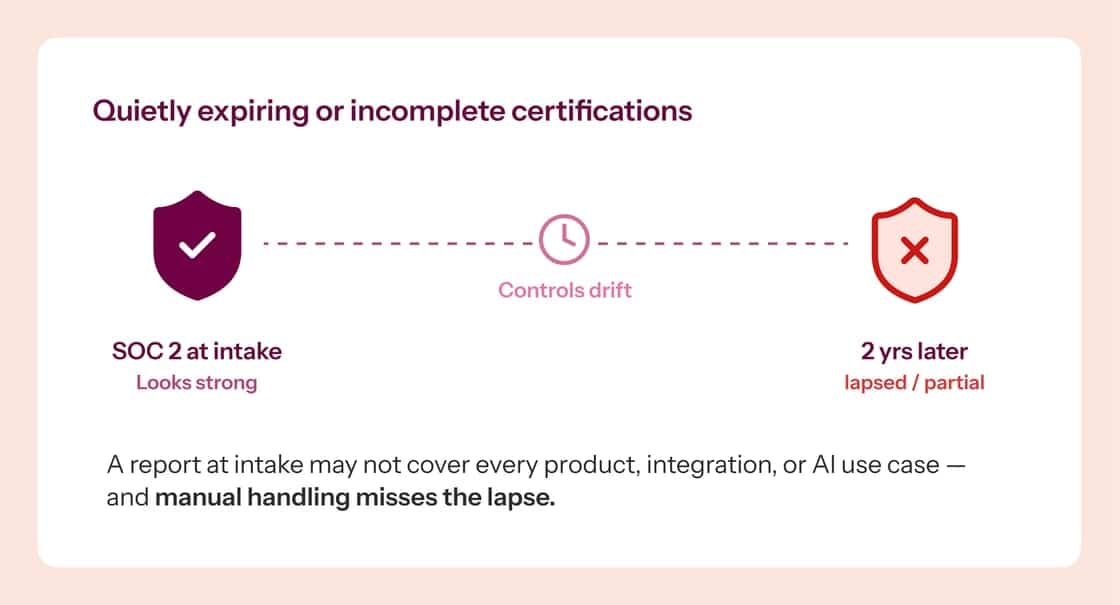
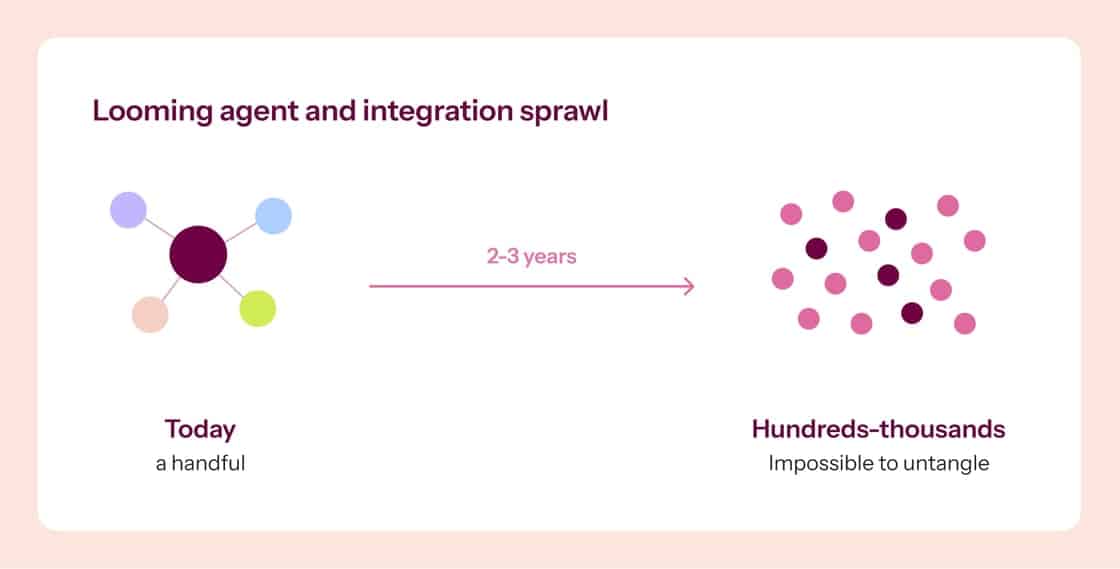
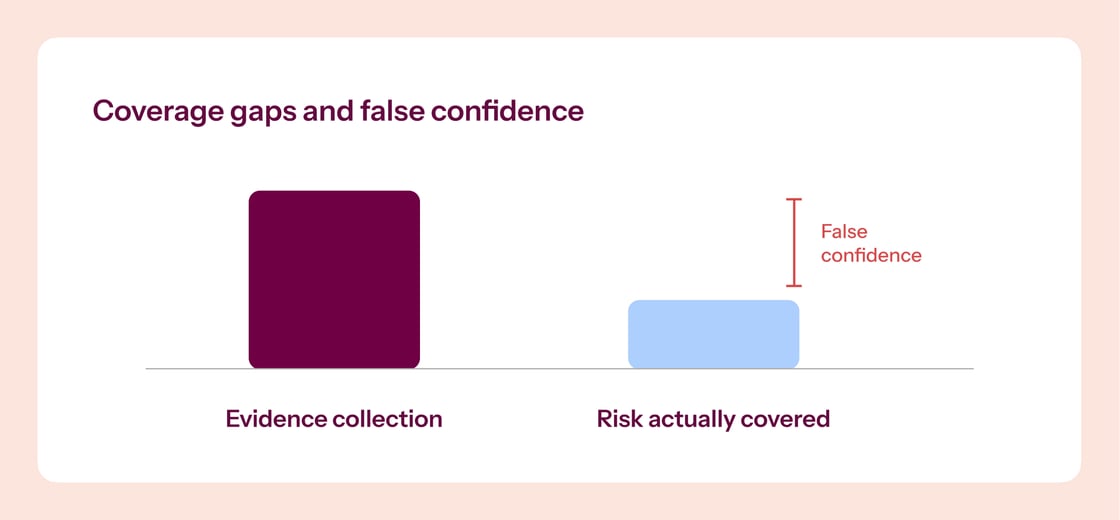
But trying to track everything manually is impossible. “Tracking hundreds to thousands of vendors manually can get risky in addition to being cumbersome because it leaves you with several points of breakdown,” she says.
Examples of this potential breakdown include quietly expiring or incomplete certifications, and looming agent and integration sprawl that can easily result in coverage gaps and false confidence.
3. Better ownership cadences
Even before AI, the first step toward stronger TPRM has always been inventory management, but inventorying becomes impossible when ownership is scattered across people, tools, and processes.
If a vendor is onboarded by one person, reviewed in another system, discussed in Slack, and tracked in a spreadsheet, the process starts breaking down the moment the original owner moves teams or leaves. Multiply this at the pace of AI tool intake, and the gap becomes even riskier because tools, permissions, integrations, and downstream dependencies can change after onboarding.
TPRM teams need a centralized system to capture who owns each vendor, who is responsible for reassessment, when the next review is due, and how ownership should be reassigned when things change.
“Tooling helps steps 2 and 3 because it takes away the manual work, which also gives us more time to spend on analysis—there’s still so much to be thought through,” Guensie says. GRC teams are still lean, typically comprising 3 people and contractors. The expectation is for the function to achieve more with less. All this considered, tooling is definitely a better option than adding headcount.
Takeaway: One change that will keep TPRM teams afloat
Over and above all the smart strategies that TPRM teams can adopt to manage AI-introduced risk, we discussed above, there’s one attitudinal shift that ties it all together. “There’s so much uncertainty, and the landscape is shifting so fast it’s hard to be totally prepared for every change, all the time. The best way for us to prepare is to stay adaptable,” Guensie says.
Subscribe to our newsletter for full access to the content

Author
Srikar Sai
As a Senior Content Marketer at Sprinto, Srikar Sai believes good content should be bookmark-worthy by default. He writes about cybersecurity and GRC, aiming to move the needle with every piece. He’s also an ISO 27001-certified Lead Auditor.Go beyond the surface and uncover the governance, risk, and compliance insights that actually matter.


Win digital goodies for boardroom success


Explore more


research & insights curated to help you earn a seat at the table.