

HITRUST (Health Information Trust Alliance) Certification serves as a key benchmark for data protection in healthcare. According to the 2025 HITRUST Trust Report, organizations with HITRUST certifications reported an incident rate of only 0.59% in 2024, meaning 99.41% remained breach-free.
Given the massive volume of sensitive data healthcare organizations handle, robust safeguards are critical. To address this, the HITRUST Alliance developed the Common Security Framework (CSF), enabling providers and covered entities to certify their cybersecurity posture.
This blog examines the requirements, costs, and challenges associated with achieving HITRUST certification.
📋 Quick Summary in 60 Seconds
Why HITRUST Certification Matters:
- Recognized as the gold standard for healthcare data protection and compliance.
- Demonstrates alignment with HIPAA, NIST, ISO 27001, and other frameworks.
- Boosts patient trust, credibility, and vendor acceptance.
Key Challenges:
- Complex control mapping and documentation requirements.
- Lengthy and resource-intensive audit process.
How Sprinto Simplifies HITRUST:
- Automates control implementation, monitoring, and AI-driven evidence collection gaps.
- Provides real-time contextual guidance and expert-backed support
- Strengthen your healthcare compliance posture and streamline HITRUST certification — book a demo.
What is HITRUST Certification?
HITRUST Certification is a formal validation that an organization meets the data protection and compliance requirements outlined in the HITRUST Common Security Framework (CSF), which integrates multiple standards and regulations, including HIPAA, ISO 27001, NIST, PCI DSS, and GDPR, into a single, comprehensive framework for managing information security.
HITRUST a certifiable security and privacy framework ensures the information security for Health Information Networks through an independent assessment. HITRUST Certification offers three levels of assurance which includes self-assessment, CSF validated, and CSF-certified, with the highest level meeting all certification requirements. FedRAMP aligns with HITRUST, but achieving FedRAMP Certification requires separate consideration.
This HITRUST CSF acts as a comprehensive solution that helps healthcare organizations comply with HIPAA and other relevant regulatory compliance. Although the government does not enforce the healthcare adopts it as the gold standard for data security.
Related reading: The difference between HIPAA and HITRUST
Why do you need to get HITRUST Certification?
You need HITRUST CSF certification to demonstrate that your organization meets the highest standards of data protection, privacy, and risk management. It builds trust with customers and partners, reduces audit fatigue by combining multiple frameworks, and strengthens your ability to safeguard sensitive information.
Here’s why you need to get HITRUST CSF certification:

- HITRUST is a widely accepted security framework in the U.S., and the HITRUST CSF certification (r2 validated assessment especially) is considered the gold standard for information protection. This is due to the comprehensiveness and depth of review it provides. While it is often mentioned alongside HIPAA, the two serve different purposes within the compliance landscape. A key difference between HIPAA and HITRUST is that while HIPAA defines what needs to be protected, HITRUST provides a clear roadmap for achieving and maintaining that protection through detailed, prescriptive controls.
- HITRUST integrates requirements from authoritative sources, including NIST, ISO 27001, and PCI, to incorporate approximately 2,000 controls into a single framework. CSF implementation can, therefore, build an effective information protection program.
- HITRUST continually updates its policies and programs to stay ahead of emerging threats and evolving regulatory requirements. This ensures that you stay current with the changing digital landscape.
- The assessment submitted by the external assessor undergoes 150 automated quality checks followed by five independent quality reviews. This rigorous assessment process demonstrates that obtaining certification is no easy feat and fosters a solid public perception.
HITRUST Certification Requirements: Controls, Domains, and Levels
The HITRUST certification requirements are organized into control categories, grouped into domains, and further defined through tiered implementation levels that scale based on an organization’s risk environment. Together, these elements guide organizations in preparing for, adopting, and demonstrating the controls necessary to achieve HITRUST certification.
HITRUST CSF Controls and Domains
The HITRUST CSF defines a structured set of controls that outline the security, privacy, and compliance measures organizations must implement. Each control includes detailed implementation requirements that describe the specific technical and procedural actions expected during certification.
These controls are organized into domains that group related requirements under broader security functions such as access control, network protection, configuration management, incident response, and risk management. This structure enables organizations to understand how individual requirements align with broader security capabilities and collectively contribute to a robust compliance posture.
HITRUST Implementation Levels
HITRUST assigns each requirement one of three implementation levels.
Level 1 captures the minimum expectations for most environments.
Level 2 adds additional requirements for organizations with moderate risk or broader regulatory exposure.
Level 3 includes all prior requirements with enhanced rigor for higher-risk environments or complex regulatory demands.
These levels are determined by organizational factors including system size, data sensitivity, regulatory obligations, and the type of HITRUST assessment being conducted. This tiered approach ensures that requirements scale appropriately and remain proportional to the organization’s risk profile.
How to get HITRUST certification: A step-by-step guide
To get a HITRUST certification, perform a readiness assessment, fix compliance gaps, undergo an evaluation validated by a HITRUST Authorized External Assessor, and submit it to HITRUST for certification approval. This process of getting HITRUST certified can take up to 18 months, depending on organisation size and requirements.
Here are the 5 stages to get HITRUST certified:
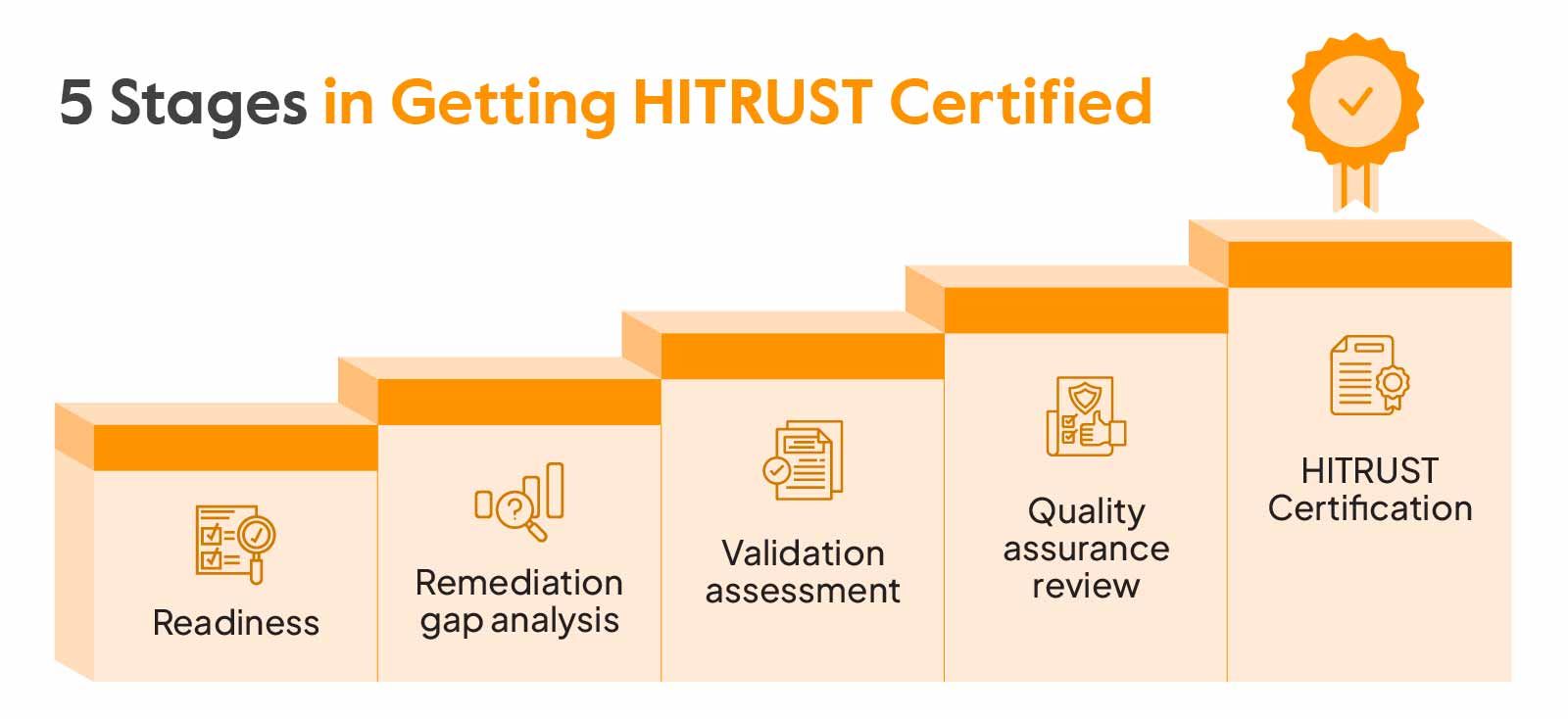
Step 1: Readiness Assessment
The Readiness Assessment, now known as the HITRUST Basic, Current-State (bC) Assessment, is the initial phase of HITRUST certification. It helps organizations evaluate their security and compliance posture using the HITRUST framework.
- The bC Assessment leverages HITRUST CSF tools and methodologies as part of the HITRUST CSF Assurance Program to assess and strengthen operational processes.
- Organizations can partner with HITRUST-approved external reviewers to facilitate the process and receive expert guidance toward achieving certification readiness.
Step 2: Remediation gap analysis
After completing the readiness assessment, the project coordinator or a HITRUST Authorized External Assessor recommends improvement strategies to stay current with evolving HITRUST requirements.
- Regular assessments and gap analyses help bridge security gaps by identifying outdated operational procedures, policies, access controls, and documentation.
- The gap analysis uses an assessment questionnaire to define the scope, pinpoint deficiencies, and outline corrective action plans aligned with current HITRUST CSF requirements.
Experience the Sprinto Advantage: Our smart compliance automation solution helps you uncover any security gaps and assists you in getting ready with an action plan to address them.
Step 3: Validation assessment
During this phase of the certification process, the assessor tests and validates the defined controls within each designated category through an on-site risk assessment.
- The assessment includes interviews with key personnel, a review of supporting documents and security measures, sampling, penetration testing, and vulnerability scans to evaluate the effectiveness of controls.
- Each requirement is scored based on attributes such as Policy, Process/Procedure, and Implementation, determining whether controls are entirely, partially, or non-compliant. Once validated by authorized personnel, the final scores are submitted to HITRUST for approval.
Step 4: Quality assurance review
Once the validated assessment is submitted, HITRUST conducts a Quality Assurance Review using various testing techniques to confirm that security controls are properly implemented. This process typically takes 4 to 8 weeks.
- The HITRUST Quality Assurance Review provides an added layer of reliability for organizations relying on certified entities’ assurances.
- After the review, HITRUST issues the final CSF Validated Assessment Report, which either grants certification or outlines areas needing improvement, depending on the results.
Step 5: HITRUST Certification
Once the entity completes the review and meets all HITRUST framework control requirements, it becomes eligible for certification.
- The HITRUST External Assessor oversees the scoring and validation of all assessments to ensure accuracy and compliance.
- After verification, HITRUST reviews and approves the results, officially granting certification to the organization.
How long does it take to get HITRUST certified?
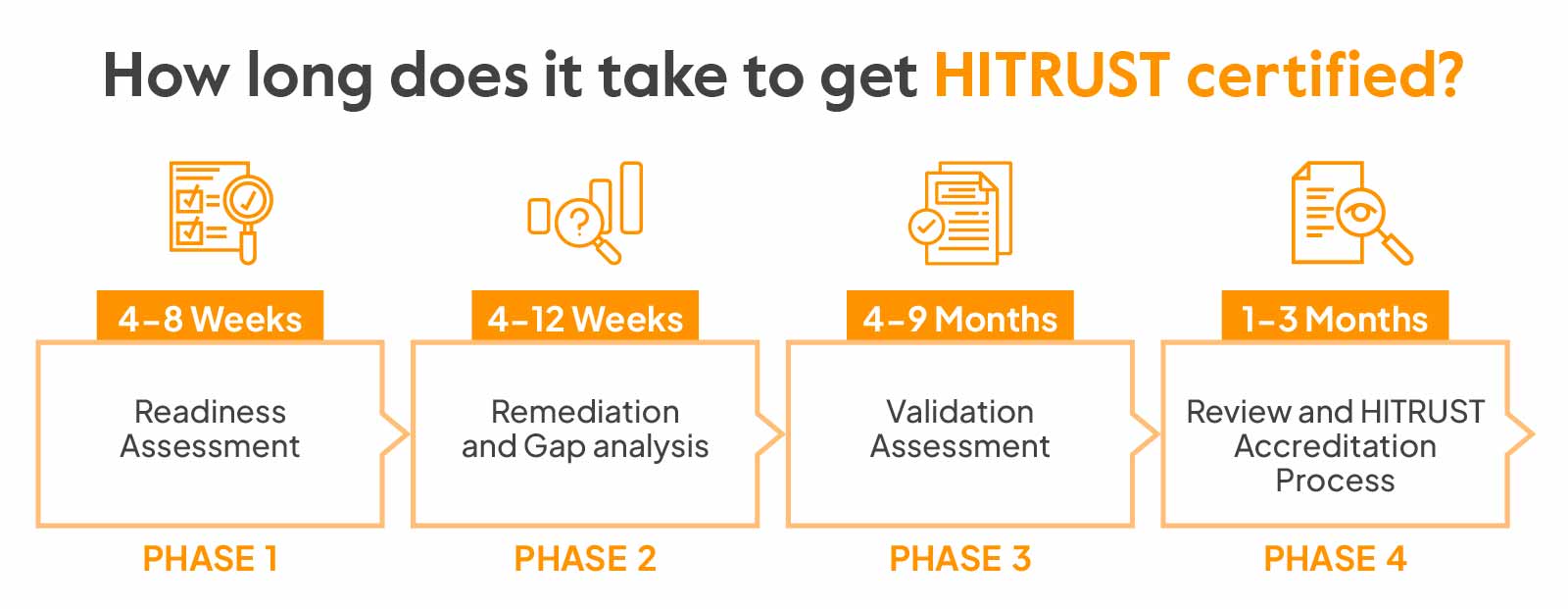
It can take up to 18 months to get HITRUST Certified, based on your organization’s size and complexity. Here is the breakdown of the certification process:
Phase 1 Readiness Assessment: 4-8 weeks
Phase 2 Remediation and Gap analysis: 4-12 weeks
Phase 3 Validation Assessment: 4-9 months
Phase 4 Review and HITRUST Accreditation Process: 1-3 month
Sprinto Advantage: Sprinto is an AI-native compliance automation platform that supports healthcare frameworks like HIPAA. With real-time monitoring, AI-driven gap detection, and a unified health dashboard that surfaces your compliance posture instantly, Sprinto helps healthcare organizations stay continuously secure and audit-ready.
Learn how you can get HITRUST-certified in a week
How much does HITRUST Certification Cost?
At the lower end, the direct costs of HITRUST CSF certification can start from $30000, but the overall costs can exceed $160000. This is because the costs depend on several factors: organizational size, security maturity, level of compliance and more.
Direct costs for certification include access to the MyCSF corporate portal, gap analysis, readiness assessment, validation testing, and consultation costs if required.
Indirect costs include internal resource costs, technological deployments, ongoing compliance costs, remediation efforts, etc.
Other factors such as the complexity of IT systems and the extent of the utilization of sensitive data influence the risk level and total cost. The readiness assessment allows the assessor to estimate the cost specific to the organization’s unique risks and helps the organization budget appropriately for the entire HITRUST certification process.
Challenges in HITRUST Certification and ways to overcome
HITRUST certification is one of the most rigorous security attestations out there. While it provides strong assurance to customers and partners, obtaining certification isn’t simple. Most organizations struggle with the time, effort, and coordination required to meet HITRUST’s maturity-driven requirements.
Here are some of the biggest challenges you can expect, along with practical ways to overcome them.
1. A massive amount of prep work is required
HITRUST requires detailed scoping, control mapping, and readiness work to be completed before the assessment begins. This upfront lift can overwhelm teams quickly.
How to overcome:
- Run a HITRUST readiness or gap assessment to get clarity early
- Narrow your scope to what is necessary instead of applying controls everywhere
- Use automation to eliminate repetitive prep work and accelerate evidence readiness
2. Documentation takes significant time and effort
The framework requires deep, measurable documentation for policies, procedures, system descriptions, and operational evidence. Most organizations do not maintain this level of detail by default.
How to overcome:
- Standardize documentation using HITRUST-aligned templates
- Centralize policies and procedures so teams aren’t searching for files
- Maintain version control to simplify updates during recertification
3. Addressing assessment findings can be complex
Assessors may uncover gaps such as missing controls, weak processes, or inconsistent implementations. Remediation often requires coordination across multiple teams and departments.
How to overcome:
- Prioritize findings based on risk, impact, and feasibility
- Build a clear remediation plan with owners and deadlines
- Track and validate fixes in a single source of truth
4. Implementing new systems and policies can be expensive
Achieving HITRUST compliance may require the implementation of new tools, process changes, monitoring systems, or architectural updates. These changes create pressure on budgets and resources.
How to overcome:
- Use a risk-based approach instead of over-engineering solutions
- Adopt scalable cloud native tools instead of custom builds
- Implement changes in phases to distribute effort and expense
5. Large organizations struggle with coordination
With multiple systems, teams, and business units, orchestrating HITRUST activities becomes difficult. Misalignment is one of the main reasons timelines slip.
How to overcome:
- Form a cross-functional HITRUST working group
- Use a centralized platform for tasks, evidence, and workflows
- Maintain a predictable cadence of syncs to unblock progress
6. Staying certified requires ongoing upkeep
HITRUST is not a one-time exercise. Maintaining certification requires regular assessments, ongoing monitoring, and staying current with framework updates.
How to overcome:
- Shift to a continuous compliance model
- Automate evidence collection and control monitoring
- Train internal teams to maintain an audit-ready posture year-round
7. Getting leadership buy-in is not always easy
HITRUST is resource-intensive. Without strong leadership sponsorship, budgets may slip, timelines extend, and teams can struggle to prioritize the work.
How to overcome:
- Tie HITRUST to business outcomes such as market access and enterprise deal requirements
- Highlight the cost of non-compliance and competitive disadvantage
- Share regular progress updates to keep leadership engaged
Conclusion
The HITRUST certification offers unparalleled risk management and overall cybersecurity while making compliance requirements more straightforward to follow. However, taking care of all the requirements can get hectic. Luckily, there is a smart way to breeze past the complex compliance process—Sprinto.
Sprinto helps you streamline compliance workflows and accelerate your HITRUST certification with automated control mapping, continuous monitoring, and real-time alerts. Its AI-driven control mapping aligns HITRUST with frameworks like HIPAA, so you never start from scratch. Your team gains full visibility into control health, with Sprinto AI flagging gaps early and keeping your security posture continuously compliant.
Read about how Sprinto made Neurosynaptic achieve HIPAA certification in weeks.
FAQs
No HITRUST is not only for healthcare. Though initially created to ensure data security in the healthcare industry, today, the framework has expanded to encompass security standards in all domains.
The primary difference between the two regulatory standards is that HIPAA is a US law that governs the healthcare industry requirements for protecting PHI. At the same time, HITRUST is a global risk and security management framework that covers many HIPAA-mandated security Controls. Hence, getting HITRUST certification will ease your compliance with HIPAA.
The purpose of HITRUST is to help organizations safeguard sensitive data, manage information risks, and achieve compliance by following all regulatory requirements effectively.
Firstly, after implementing the HITRUST requirements and controls, you can obtain HITRUST certification, and that’s not the case with NIST. Also, to achieve NIST compliance, there are a total of 108 security controls, whereas HITRUST encompasses 1800 security controls.
Any organization that deals with sensitive information must obtain HITRUST certification. This includes healthcare providers such as hospitals, clinics and pharmaceuticals, telemedicine providers etc. It also includes other businesses dealing with critical information that must address risk and compliance management.
HITRUST certification (r2) is valid for 24 months and requires an interim assessment after 12 months. The interim assessment is an assurance of the ongoing effectiveness of implemented controls.
No, it does not. HITRUST certification requirements can lay the foundation for implementing HIPAA controls but it cannot replace HIPAA compliance.
HITRUST has 19 domains which are further divided into controls followed by 3 levels of implementation.

Gowsika
Gowsika is an avid reader and storyteller who untangles the knotty world of compliance and cybersecurity with a dash of charming wit! While she’s not decoding cryptic compliance jargon, she’s oceanside, melody in ears, pondering life’s big (and small) questions. Your guide through cyber jungles, with a serene soul and a sharp pen!
Go beyond the surface and uncover the governance, risk, and compliance insights that actually matter.


Win digital goodies for boardroom success


Explore more







research & insights curated to help you earn a seat at the table.