


Proactive risk management stops minor issues from escalating into business-wide crises.
In February 2024, ransomware actors compromised Change Healthcare via stolen credentials for a remote access portal lacking multi-factor authentication. The consequences rippled far beyond an internal incident, immediately disrupting healthcare operations across the U.S. This high-visibility crisis is a stark warning: Every gap, no matter how small, can rapidly escalate into major disruptions.
If a single control failure can cascade into an ecosystem-wide crisis, small and mid-sized businesses face urgent, heightened exposure unless they proactively manage risks. Immediate, continuous identification, prioritization, and resolution of risks is essential to avoid preventable incidents.
This article will help you understand what proactive risk management is, how it differs from a reactive approach, why it matters, and how to implement it in practice.
- Proactive risk management involves identifying and addressing potential risks before they can cause damage.
- Proactive risk management helps to actively reduce the possibility of security breaches, comply with regulations, gain customer trust, and ensure business continuity.
- To develop a proactive risk program, develop an employee training program, develop a risk treatment plan, communicate with your stakeholders, continuously monitor, and use automation tools.
What is proactive risk management?
Proactive risk management is the practice of detecting and addressing risks before they become incidents. It identifies patterns of anomalous behavior, conducts frequent risk assessments, analyzes incident history, evaluates risk trends, and continuously monitors a business’s IT infrastructure.
The proactive approach to risk management aims to ensure long term sustainability, reduces the costs to mitigate a data breach, and helps teams keep their operations up and running after a compromise.
Some examples of proactive risk management are employee training, implementing detective and preventive security controls, and vulnerability management.
“If you don’t invest in risk management, it doesn’t matter what business you’re in, it’s a risky business.” – Gary Cohn, Director of the U.S National Economic Council
Proactive vs reactive risk management
Proactive risk management aggressively reduces the likelihood and impact of incidents by urgently identifying and addressing weaknesses early. In contrast, reactive risk management only engages after incidents occur, focusing on containment and recovery, often when it’s too late to prevent major damage.
| Factor | Proactive risk management | Reactive risk management |
| When you act | Acts before an incident (prevent + reduce likelihood). | Acts during/after an incident (contain + recover). |
| Main objective | Eliminate or reduce exposures early, so incidents are less likely (and smaller). | Limit downtime, data loss, and business impact once something breaks. |
| Signals you rely on | Leading indicators—control drift, missing MFA, risky access changes, vulnerability exposure, vendor posture changes. | Lagging indicators—alerts from a live incident, audit findings, user complaints, outages. |
| Typical workflows | Risk assessments tied to change, owners per risk, treatment plans, continuous monitoring, automated remediation tickets. | Incident response playbooks, emergency patching, post-mortems, after-the-fact reporting. |
| Cost pattern | Higher upfront effort, lower long-term loss (fewer “surprise” events). | Lower upfront effort, higher incident-driven cost and disruption. |
| Best fit | Growing teams, regulated environments, vendor-heavy stacks, boards asking for risk posture. | Low-risk environments—or as a fallback when a brand-new threat emerges. |
Proactive action is crucial to reducing the odds of a major crisis. Reactive tactics, while important, can only limit damage after it’s done and can’t reverse the consequences of a preventable failure.
See how Sprinto connects risks to controls, updates risk posture continuously, and routes remediation to owners.
Benefits of Proactive Risk Management
Most businesses are resistant to adopting reactive approaches until disaster hits. Management and decision makers are generally reluctant to allocate a budget for risk management as it is seen as a burden. In theory, it is a good practice.
In reality, it is the door to losing customer/ stakeholder trust, operational impediments, bleeding engineering bandwidth, and most importantly, a serious toll on your bottom line.
Let’s break these down and understand how the proactive way is key to risk efficiency
1. Strike it down before it strikes you
A common misconception around the proactive way is having to do everything under the sun. That, however, is not the case. It is a bottom up practice that helps you significantly reduce the possibility of a disaster and its aftermath.
It empowers you to prevent these issues by giving you more control over risk posture. Proactive measures and technologies such as predictive analytics, pattern analysis tools, and advanced detection capabilities equip you with predictive powers.
This way, you know what control to implement and where to allocate resources instead of groping in the dark. Ultimately, this puts the ball in your court – and empowers you to strike down the risks before it strikes your systems.
2. Don’t lose prospects to security concerns
As more cases of security breaches are making headlines, data privacy and security concerns are growing. B2B prospects have a long checklist to filter out service providers – and one item keeps popping up in almost every checklist is – are you SOC 2 / ISO / X regulation compliant?
This translates to…do you have the right controls/ measures in place to proactively secure my data against breaches? Can I trust you to process my sensitive information? What this means for your business is the need to adopt proactive measures before it becomes a sales blocker.
3. Avoid the headaches of reactive responses
Reactive techniques work, but only to a limited extent and in specific environments like businesses who deploy their data in on-premise systems.
As outlined earlier, reactive measures impact your bottom line harder. When you have little insight into the risk events, it leaves you scrambling for ways to patch things up and restore normalcy. Sometimes, teams are left with no option but take the blow – a situation you don’t want to find yourself in.
A research by IBM and Ponemon Institute found that proactive threat hunting is one of the key amplifiers that positively influences the cost of a data breach. It also found that organizations with proactive vulnerability management techniques experienced a lower number of breaches.
Stay in control of third-party risks
5 essential tips for proactive risk management
Proactive risk management works best when you review risks on a set cadence and on every major change (new systems, vendors, or data flows), and you track remediation with clear owners and deadlines. The goal is simple: make risk visible early (through people, process, and technology signals), assign clear ownership, and close gaps before they turn into incidents.
The five tips below show you how to consistently identify, prioritize, and close risks before they escalate.
- Strengthen your first line of defense with role-based security training
- Assess your risk environment whenever systems, vendors, or processes change
- Build a risk treatment plan (accept, avoid, transfer, or mitigate)
- Report risk decisions and progress regularly to stakeholders
- Continuously monitor controls and automate remediation workflows
Next, we’ll break down each tip with the specific actions to take, who should own them, and what to track so progress stays measurable and defensible over time.
1. Strengthen your first line of defense
No matter how advanced and efficient your tech stack is, the people accessing sensitive systems are accountable for their safety. Though tools and technologies play a pivotal role in preventing successful breaches, if humans interacting with these systems lack the required knowledge to use them properly, it introduces vulnerabilities.
Every individual with access to these systems – employees, third party service providers, external consultants, guest account credential holders should understand risk objectives and security compliance obligations.
Develop a training program and include it in your onboarding process for both internal and external stakeholders.
Girish Redekar, Co-Founder at Sprinto
2. Understand your risk environment
An end-to-end proactive risk management involves the use of a suite of tools and controls. To select the appropriate tools and controls, you should know where to focus by identifying the gaps through a risk assessment.
Proactive risk assessment means evaluating your risk posture whenever new processes, tools, and systems are introduced or changed. This is because changing a component of your workflow impacts the environment around it and change = uncertainties and uncertainties = possible risks.
3. Develop a remediation plan
Ideally, you should reduce all your risks to a zero. But practically, this is not a feasible solution as risk mitigation is time consuming and expensive; especially for startups and small to medium sized businesses.
The results of your risk assessment are used to determine the mitigation strategies – accept, transfer, avoid, or mitigate. You can determine this based on the score against each risk. Use a risk quantification method to score them against the probability of occurring and its impact on your business assets and operations.
4. Regularly report your risk management practices
Your stakeholders should be on the same page as you for critical decisions. Document, communicate, and update your risk management policies and strategies whenever you adopt a new process or change existing ones.
This helps to improve transparency across, enhance collaboration between concerned parties, and ensure no friction in the future. Involving everyone across the board is a crucial part of compliance risk reporting and management as it helps to raise awareness, include all possible angles, and facilitate informed decision making.
5. Continuously monitor your risk environment
To proactively mitigate risks, you must proactively identify them. To identify gaps without missing a beat, implement a system that continuously monitors your data assets, networks, code repositories, and other critical infrastructure components.
Continuous monitoring involves assessing your environment on a regular basis. This helps to identify security gaps and non-compliant activities so that no minor gaps become a risk and the risk into an event. The monitoring process should be aligned with your regulatory obligations.
6. Use automation to avoid risk failures
Effective proactive risk management requires evaluating risks within the business context and against common benchmarks and regulatory requirements. It is a complex process and the smallest miss can escalate into your biggest challenge.
When you manage risks manually based on intuition, it is filled with assumptions and disconnected from reality. This results in a weak risk register, poor resource allocation, and misguided decisions, ultimately defeating the purpose of proactive risk management.
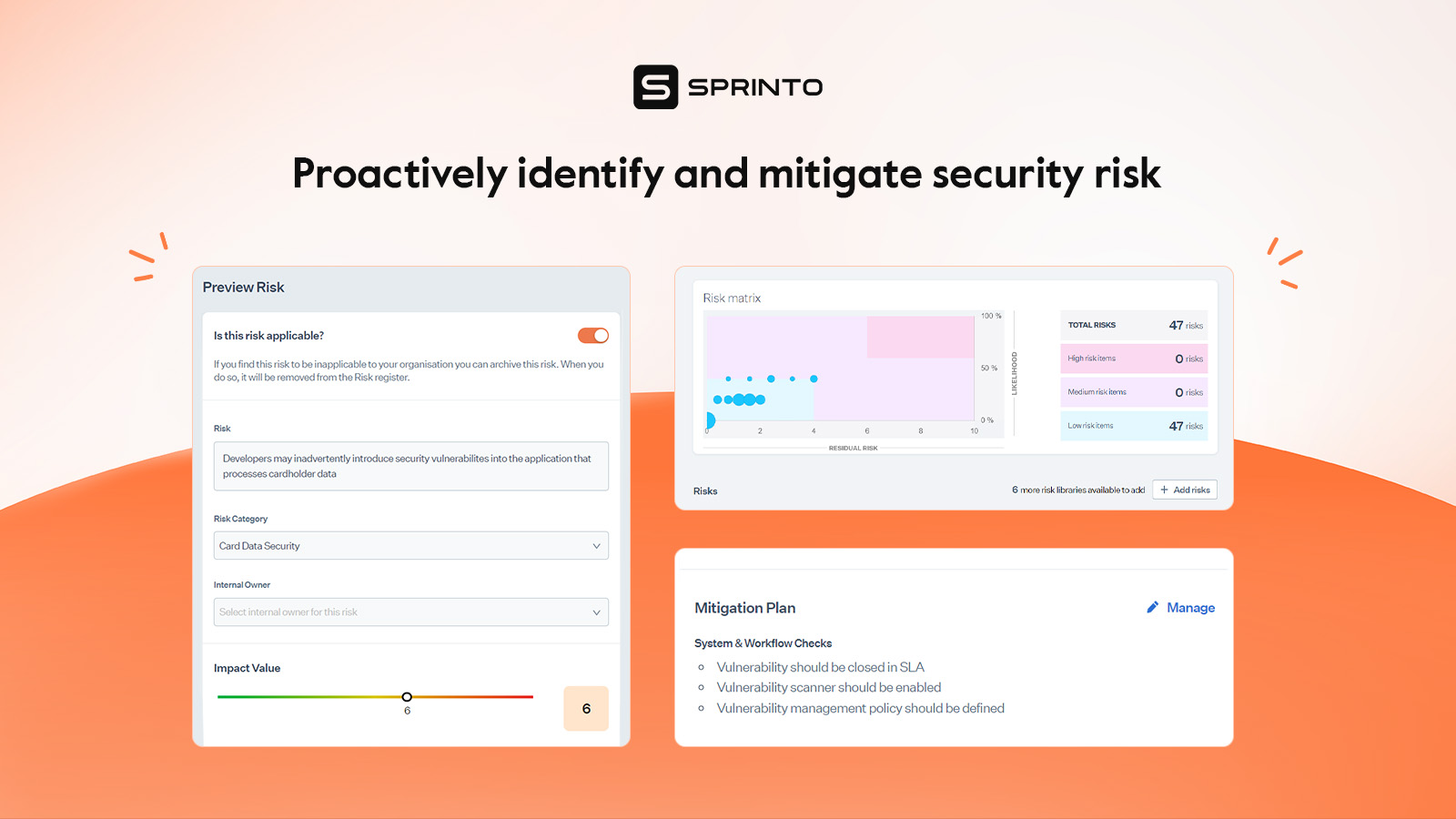
GRC solutions like Sprinto interpret risks and assess impacts, enabling you to act with precision. By connecting natively with your cloud stack, it quickly identifies misconfigurations and vulnerabilities. You can use this tool to:
- Build a comprehensive risk register and score risks using trusted industry benchmarks to avoid intuitive risk assessment.
- Use the risk library to scope out security risks across your assets and processes. Add custom risks, assign impact scores, and update as you grow to maintain an accurate risk register.
- Automatically map risks to compliance criteria, launch automated checks, and track the overall risk posture in a single dashboard.
- Trigger alerts and remediation workflows for anomalies to ensure timely resolution.
- Centralize risk scores, likelihood of impact, risk owners, controls, and treatment plans.
- Continuously and correctly consolidate risk and controls to determine the severity and treatment so you can manage risks from a single source of truth
Want to see Sprinto in action? Let our experts guide you.
Examples of proactive risk management
Examples of proactive risk management are repeatable actions that surface risk early and reduce the chance that a control gap becomes an incident. It may include things like:
- Continuous control monitoring that flags access changes or misconfigurations as they happen, not at audit time
- Risk scoring that updates when control health changes, so teams can prioritize what matters most
- Vendor risk monitoring that tracks expirations, breach signals, and overdue reviews in real time
- Change risk reviews (new cloud services, new data flows, new vendors) built into the rollout process
- Role-based training and policy acknowledgement that prevent recurring human-error risks
The common thread is signal choice: proactive programs rely on leading indicators (control drift, risky access changes, vendor posture shifts), whereas reactive programs rely on lagging indicators (alerts, outages, audit findings, and post-incident reports).
Common challenges in proactive risk management
A proactive risk management program may seem solid on paper but can still fail in daily practice. The challenges below are specific, each with a clear symptom you can spot and a direct solution you can apply.
| Challenge | Quick symptom | Practical fix |
| Ownership gaps | No owner and no due date | Assign an owner, due date, treatment decision, and evidence link for every material risk. |
| Alert fatigue | Too many findings, no priority | Use a simple scoring rule (impact × likelihood) and add SLAs for high-risk items; suppress duplicates. |
| Siloed evidence | Status is scattered/stale | Set one source of truth for risk/control status and link every item to a ticket/report and last-updated date. |
| Vendor blind spots | Reviews happen only annually | Keep a vendor inventory and trigger reassessments on changes (new access, new data, report expiry, breach notice). |
| Exec reporting friction | Snapshot reporting, no drill-down | Standardize a small set of metrics (top risks, overdue high risks, time-to-remediate) with evidence behind each. |
A practical way to reduce all five failure modes is to keep risks, controls, vendors, and remediation workflows connected (either in one platform or via reliable integrations), so risk posture stays current and remediation remains traceable end-to-end.
Proactive risk management with sprinto
A proactive risk approach simplifies risk handling and fosters a risk-aware culture within your organization. An effective risk management program relies on two essential pillars: the right strategy and the right technology stack.
If you need assistance in implementing an IRM strategy for your team, we can automate up to 80% of the process. Sprinto places your compliance program on autopilot, enabling regular monitoring of risk controls. Schedule a demo to discover how Sprinto can help you achieve risk readiness with ease!
FAQs on proactive risk management
The key difference between proactive and predictive risk management is that predictive risk management uses data and analytics to forecast potential risks, while proactive risk management involves preemptive actions to prevent risks from occurring.
An example of proactive risk management is the implementation of regular security audits to identify and address vulnerabilities is an example of proactive risk mitigation. Routine examination of risks helps you fix potential security issues before they are exploited to minimize the likelihood of cyber threats.
Yes, you can manage unknown risks proactively by implementing continuous monitoring systems, fostering a risk-first, using predictive data analytics, and conducting risk assessments.
Proactive risk management reduces breaches, downtime, audit scrambles, and sales blockers. It also improves trust, because customers and stakeholders can see evidence of controls and risk posture over time, not just at renewal or audit season.
Common tools include a risk register, vulnerability management, security monitoring, access management, vendor risk workflows, and continuous control monitoring. Many teams also use a GRC platform to connect risks to controls and automate evidence and remediation workflows.
The purpose of proactive risk management is to reduce the likelihood and impact of incidents by identifying, prioritizing, and addressing risks before they become real events. It shifts teams from firefighting to prevention, with clear ownership and measurable progress.

Anwita
Anwita is a cybersecurity enthusiast and veteran blogger all rolled into one. Her love for everything cybersecurity started her journey into the world compliance. With multiple certifications on cybersecurity under her belt, she aims to simplify complex security related topics for all audiences. She loves to read nonfiction, listen to progressive rock, and watches sitcoms on the weekends.
Go beyond the surface and uncover the governance, risk, and compliance insights that actually matter.


Win digital goodies for boardroom success


Explore more



research & insights curated to help you earn a seat at the table.