Las auditorías internas no son solo un trabajo preparatorio para la validación externa. Son una herramienta estratégica que ayuda a las organizaciones a descubrir puntos ciegos en operaciones, seguridad, finanzas y cumplimiento normativo, antes de que lo hagan los auditores externos, los reguladores o, peor aún, los atacantes.
Según Deloitte, el 82% de las funciones de auditoría interna han aumentado su impacto en los últimos tres años, pero solo el 14% considera que han alcanzado su máximo potencial.
Para cualquier empresa que busque certificaciones como SOC 2, ISO 27001 o que se someta a auditorías de informes financieros, las auditorías internas son el ensayo general que garantiza que no se fracase bajo presión.
| TL; DR Las auditorías internas se centran en el cumplimiento normativo, los procesos de gobernanza, la gestión de riesgos, la eficiencia operativa y la detección y prevención del fraude. A diferencia de las auditorías externas, las auditorías internas son continuas y prospectivas. Incluyen evaluaciones de riesgos, pruebas de control, análisis de riesgos, elaboración de informes, etc. Las 5 C de la auditoría interna son condición, criterio, causa, consecuencia y acción correctiva. |
¿Qué es una auditoría interna?
La auditoría interna es una revisión independiente que evalúa y mejora los procesos internos de una organización en torno a la gestión de riesgos, el entorno de control y la gobernanza.
El objetivo de una auditoría interna es evaluar de forma proactiva el buen funcionamiento de los sistemas, controles y flujos de trabajo de su organización, e identificar las debilidades antes de que se conviertan en problemas costosos.
Esto podría implicar la identificación de políticas de acceso obsoletas, transacciones financieras no supervisadas, prácticas de contraseñas débiles o procesos con bajo rendimiento que podrían descarrilar las iniciativas estratégicas.
Las áreas de enfoque clave incluyen:
- Procesos de gobernanza: Si sus estructuras de liderazgo, derechos de decisión y mecanismos de supervisión funcionan según lo previsto.
- Cumplimiento normativo: Si su organización cumple con leyes y estándares como SOC 2, ISO 27001, HIPAA o GDPR, no solo en la política, sino también en la ejecución diaria.
- Gestión de riesgos: Qué tan bien su empresa identifica, monitorea y mitiga los riesgos en las áreas de operaciones, TI, finanzas y proveedores externos.
- Eficiencia operacional: Ya sea que los flujos de trabajo, los sistemas y los equipos internos estén brindando resultados óptimos o que estén desperdiciando tiempo y dinero debido a procesos obsoletos.
- Detección y prevención del fraude: Si los controles internos son lo suficientemente sólidos como para detectar irregularidades, accesos no autorizados o malversación de fondos antes de que se agraven.
Auditorías internas frente a auditorías externas
Estas son las principales diferencias entre las auditorías internas y externas:
| Elemento | De Auditoría Interna | Auditoría externa |
| Propósito | Mejorar los procesos internos y la gestión de riesgos. | Proporcionar garantías independientes a las partes interesadas externas. |
| Interpretado por | Equipo interno o auditores internos subcontratados | auditores externos independientes |
| <b></b><b></b> | Más amplio (operaciones, cumplimiento normativo, TI, etc.) | Centrado en verificar el cumplimiento, la eficacia de los controles y la precisión de los informes para las partes interesadas. |
| Frecuencia | Continuo/regular | Generalmente anual |
| Enfócate | Con visión de futuro y mejora continua | Evaluación independiente del cumplimiento y la exactitud del control interno |
¿Por qué es importante una auditoría interna?
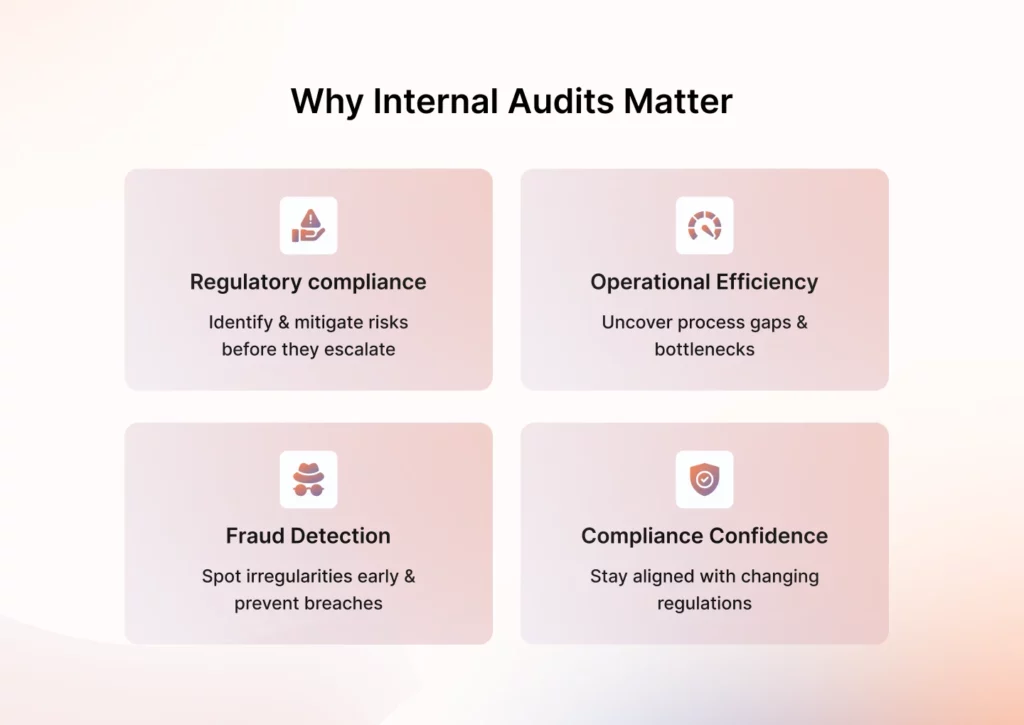
Las auditorías internas son esenciales para las organizaciones porque permiten identificar qué funciona bien, qué necesita mejorar y dónde pueden existir riesgos. Al detectar ineficiencias, deficiencias en el cumplimiento normativo y posibles amenazas de forma temprana, facilitan una mejor toma de decisiones, optimizan el rendimiento operativo y fortalecen la confianza de las partes interesadas.
He aquí por qué debería importarle realizar una auditoría interna:
- La reducción de riesgos: Identificar los riesgos en todos los departamentos, ya sean operativos, financieros o regulatorios, y mitigarlos antes de que se agraven.
- Eficiencia operacional: Descubre las deficiencias en los procesos, los cuellos de botella y las ineficiencias que están ralentizando tu negocio.
- Detección de fraudeDetectar irregularidades a tiempo e implementar medidas de seguridad para prevenir el fraude y las filtraciones de datos.
- Confianza en el cumplimiento: Mantenga su empresa alineada con las regulaciones en constante cambio (SOC 2, ISO 27001,, GDPR(lo que sea).
¿Cuál es el propósito de una auditoría interna?
El objetivo principal de las auditorías internas es fortalecer la integridad, la eficiencia y la gestión de riesgos de una organización. Al ofrecer una perspectiva independiente sobre el funcionamiento de los procesos de gobernanza, control y gestión de riesgos, las auditorías contribuyen a garantizar que la organización se mantenga alineada con sus objetivos y esté mejor preparada para proteger sus activos.
Los propósitos clave incluyen:
- Evaluar los controles internos: Analice la eficacia de los controles de su organización para mitigar los riesgos.
- Garantizar el cumplimiento: Confirmar que la empresa cumple con todos los requisitos legales, reglamentarios y de política interna.
- Evaluar la gestión de riesgosCompruebe si sus estrategias de identificación y mitigación de riesgos son sólidas y proactivas.
- Optimizar operaciones: Identificar ineficiencias o redundancias y recomendar mejoras para optimizar los procesos.
- Salvaguardar los activos: Asegúrese de que tanto los activos digitales como los físicos estén debidamente protegidos.
- Apoyar las decisiones estratégicasProporcionar a los ejecutivos información fiable que les permita tomar decisiones empresariales más inteligentes.
- Mejorar la rendición de cuentasMantener a todos los departamentos y partes interesadas alineados y responsables de sus responsabilidades en materia de riesgos y cumplimiento normativo.
¿Cómo funciona una auditoría interna? (Con plantilla)
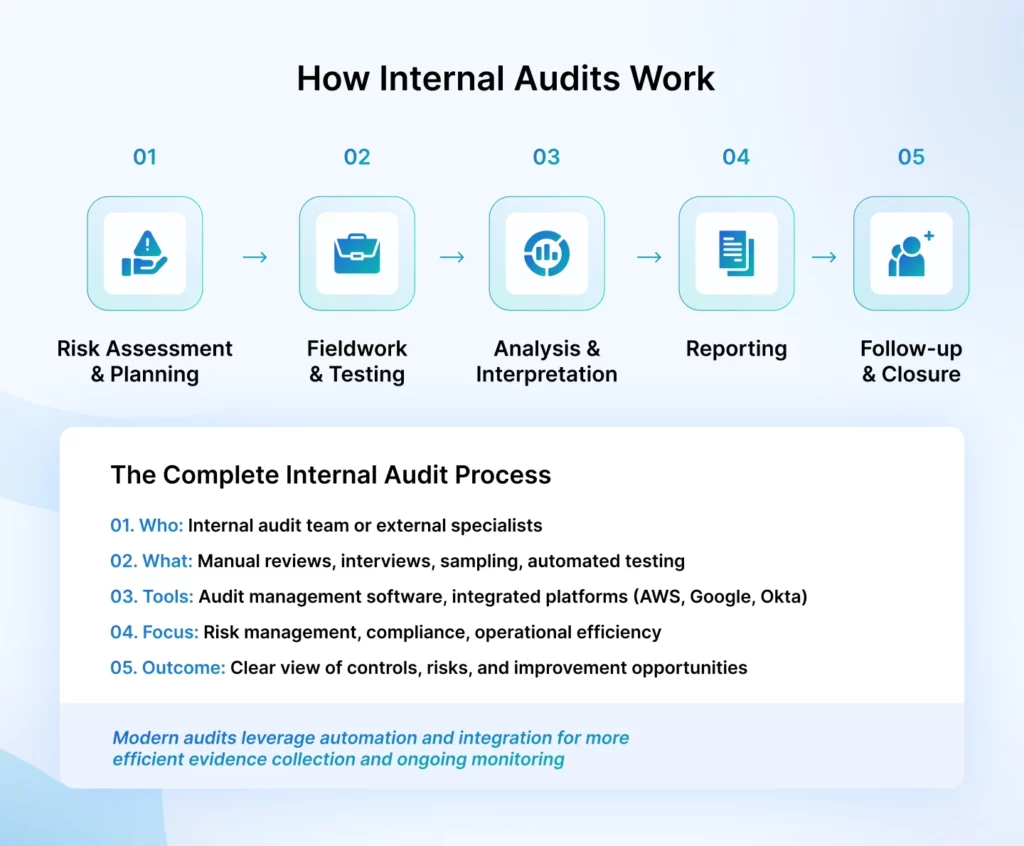
Las auditorías internas suelen ser realizadas por un equipo de auditoría interno (a menudo dirigido por un auditor interno), pero también pueden subcontratarse a empresas de auditoría interna especializadas para garantizar la independencia o cuando la experiencia interna es limitada.
Para llevar a cabo el proceso se utiliza una combinación de revisiones manuales, entrevistas, técnicas de muestreo y herramientas de gestión de auditorías. Las organizaciones modernas están adoptando cada vez más software de auditoría interna que se integra con sistemas como AWS, Google Workspace, Okta y plataformas financieras para automatizar la recopilación de evidencia, las pruebas de control y la elaboración de informes.
Descargue la plantilla de auditoría interna ISO 27001.
Aquí se ofrece un análisis detallado de cada fase de una auditoría interna.
1. Evaluación de riesgos y planificación de auditorías
El proceso de auditoría interna siempre comienza con una evaluación de riesgos, que constituye la base del plan de auditoría. En esta etapa, el equipo de auditoría define el universo de auditoría: todas las unidades de negocio, sistemas, procesos o departamentos que podrían ser auditados, y los clasifica según su perfil de riesgo.
Se priorizan las áreas de alto riesgo, como la seguridad informática, el control de acceso, las finanzas o la gestión de proveedores externos. El objetivo es identificar dónde la organización está más expuesta y dónde los controles internos son más importantes.
A partir de aquí, se desarrolla el plan de auditoría. Esto incluye definir los objetivos de la auditoría (por ejemplo, evaluar el control de acceso para SOC 2 o la validación de procesos financieros para SOX), delimitar el alcance, determinar qué marcos o políticas se aplican y asignar recursos.
Esta fase suele concluir con una reunión inicial formal en la que participan las partes interesadas clave, donde se comunican los plazos, las responsabilidades y los resultados esperados. Generalmente, se programan puntos de control durante la auditoría para garantizar la alineación, el seguimiento del progreso y la transparencia.
2. Trabajo de campo y pruebas
El trabajo de campo suele comenzar con la revisión de documentos: los auditores examinan políticas, registros de acceso, registros de cambios, inventarios de activos, informes de incidentes y matrices de control para comprender cómo se supone que funcionan los sistemas. Realizan recorridos, siguiendo un proceso o transacción de principio a fin (por ejemplo, desde la incorporación de empleados hasta la asignación de acceso y la baja) para verificar la práctica real.
Pero la cosa no termina ahí. Los auditores realizan entrevistas con los empleados para descubrir cómo se implementan los procesos en la práctica, en comparación con cómo están escritos en papel. Esto ayuda a determinar si el personal está capacitado, si las políticas son claras y si los controles son realistas.
Lo más importante es que los auditores realizan muestreos y pruebas de control. Por ejemplo, pueden comprobar si a todos los empleados despedidos en los últimos 3 meses se les revocó el acceso dentro del plazo requerido, o si las conciliaciones mensuales se aprobaron correctamente.
Esta fase también incluye observaciones in situ, inspecciones de procesos y, en algunos casos, pruebas de penetración o evaluaciones de vulnerabilidad (para auditorías centradas en TI).
3. Análisis e interpretación de riesgos
Una vez recopiladas las pruebas, el equipo de auditoría pasa a la fase de análisis, donde los hallazgos brutos se convierten en información útil para la toma de decisiones.
En primer lugar, los auditores comparan las prácticas reales con los criterios definidos: políticas internas, normativas externas (como ISO 27001 o SOC 2) y mejores prácticas. Identifican fallos en los controles, inconsistencias y averías en los procesos.
Luego viene el análisis de la causa raíz, la parte del pensamiento crítico de la auditoría. Los auditores se preguntan: ¿Por qué sucedió esto? ¿Es un incidente aislado o un problema sistémico? ¿La causa fue técnica (por ejemplo, una automatización fallida), procedimental (por ejemplo, una política obsoleta) o cultural (por ejemplo, falta de rendición de cuentas)?
4. Informes
El informe de auditoría está estructurado para brindar a la dirección una visión estratégica general de los hallazgos, seguida de directrices prácticas y específicas para cada departamento. Por lo general, incluye:
- Resumen ejecutivo: Cuestiones de alto riesgo, sus causas fundamentales y su posible impacto en el negocio.
- Hallazgos detallados: Un desglose de cada fallo o problema de control, con pruebas, equipos responsables y referencias normativas.
- Puntuación de riesgo: Cada hallazgo se clasifica como de riesgo alto, medio o bajo, a menudo con una puntuación de impacto/probabilidad.
- Recomendaciones: Acciones correctivas específicas y priorizadas, con plazos, responsables sugeridos y pasos para su implementación.
- Respuestas de la dirección: Cada departamento o responsable de control proporciona comentarios iniciales, confirma la titularidad o impugna las conclusiones (si fuera necesario).
5. Seguimiento y cierre de la auditoría
El seguimiento es lo que distingue una buena auditoría de un mero trámite burocrático. En esta etapa, el equipo de auditoría trabaja con los responsables de cada departamento para supervisar la implementación de las medidas correctivas.
Esto podría implicar:
- Revisión de políticas nuevas o revisadas
- Repetición de las pruebas de control tras la remediación.
- Verificar que se haya realizado la capacitación de los empleados.
- Confirmar que se han implementado herramientas automatizadas o correcciones de gestión de acceso.
En muchas organizaciones, este proceso de seguimiento está automatizado mediante herramientas de gobernanza y cumplimiento que supervisan el desempeño de los controles continuos e indican si vuelve a surgir algún problema.
Herramientas automatizadas (como Sprinto) pueden tomar el control para garantizar que los controles sigan siendo efectivos a lo largo del tiempo.

Desde los hallazgos hasta el plan de acción, automatice de principio a fin.
8 tipos de auditorías internas
Las auditorías internas no son iguales para todas las empresas. Los diferentes tipos se centran en distintos objetivos y áreas del negocio. Analicemos los ocho tipos principales de auditorías internas:
1. Auditorías de cumplimiento
Las auditorías de cumplimiento evalúan si su empresa cumple con los requisitos reglamentarios, las obligaciones legales y las políticas internas. Evalúan la eficacia de sus procesos de cumplimiento, identifican deficiencias en la aplicación de la normativa y señalan la documentación obsoleta o faltante.
2. Auditorías de penetración
Las auditorías de penetración simulan ciberataques reales para identificar vulnerabilidades de seguridad en su infraestructura. Estas auditorías van más allá de las comprobaciones de configuración y explotan activamente las debilidades en sistemas, redes y aplicaciones.
El objetivo es revelar cómo un atacante podría acceder, moverse lateralmente y comprometer datos o sistemas. Las pruebas de penetración requieren muchos recursos, pero son fundamentales para las empresas que manejan datos confidenciales o que operan en entornos de alto riesgo.
3. Auditorías de evaluación de riesgos
Las auditorías de evaluación de riesgos se centran en identificar posibles amenazas antes de que se materialicen. Implican mapear los riesgos en todos los departamentos, calificarlos según su probabilidad e impacto, y evaluar si los controles existentes son adecuados.
Estas auditorías ayudan a priorizar las medidas correctivas y a garantizar que las estrategias de mitigación de riesgos sean proporcionales a la exposición. Su eficacia depende de la precisión de los datos y de un análisis imparcial.
4. Auditorías de TI
Las auditorías de TI evalúan la infraestructura tecnológica, las prácticas de seguridad, las políticas de datos y los controles de acceso de su organización. Determinan si los sistemas son seguros, cumplen con la normativa y son capaces de respaldar las operaciones comerciales sin riesgos innecesarios.
La auditoría abarca áreas como la arquitectura del sistema, el acceso basado en roles, los protocolos de cifrado, la preparación para la respuesta ante incidentes y los procedimientos de recuperación ante desastres.
5. Auditorías de investigación
Las auditorías de investigación se inician en respuesta a sospechas de fraude, manipulación de datos, violaciones de políticas o mala conducta financiera.
Estas auditorías buscan descubrir la verdad mediante la revisión de registros, transacciones, comunicaciones y actividad de los usuarios. El enfoque principal es la rendición de cuentas: identificar quién hizo qué, cuándo y si los controles internos fallaron o fueron eludidos.
6. Auditorías de desempeño
Las auditorías de desempeño analizan si los recursos (presupuesto, personal, sistemas) se utilizan de manera eficiente y si se obtienen los resultados previstos. Asimismo, evalúan si los procesos empresariales están optimizados y alineados con los objetivos de la organización.
Estas auditorías se utilizan a menudo para validar la eficacia de las iniciativas estratégicas, los esfuerzos de reducción de costes o las inversiones en tecnología.
7. Auditorías integradas
Las auditorías integradas combinan múltiples ámbitos de auditoría —como TI, cumplimiento normativo, finanzas y operaciones— en una sola revisión. Son útiles para evaluar controles interdependientes y áreas de riesgo superpuestas.
Por ejemplo, evaluar si sus políticas de control de acceso cumplen con los estándares de ciberseguridad y los requisitos de cumplimiento normativo. Estas auditorías ofrecen una visión más amplia de la exposición al riesgo y la eficacia de los controles.
8. Auditorías ambientales
Las auditorías ambientales evalúan cómo su organización gestiona sus responsabilidades ambientales. Esto incluye la revisión de la eliminación de residuos, las emisiones, el consumo de energía, el manejo de materiales peligrosos y las prácticas de sostenibilidad de la cadena de suministro.
Estas auditorías ayudan a garantizar el cumplimiento de las leyes ambientales y los objetivos internos de sostenibilidad, especialmente para las empresas sujetas al escrutinio ESG.
¿Cuáles son las 5 C de una auditoría interna?
Las 5 C de la auditoría interna son un marco de informes estructurado que utilizan los auditores internos para comunicar claramente no solo qué salió mal, sino también por qué sucedió, qué significa y cómo solucionarlo.
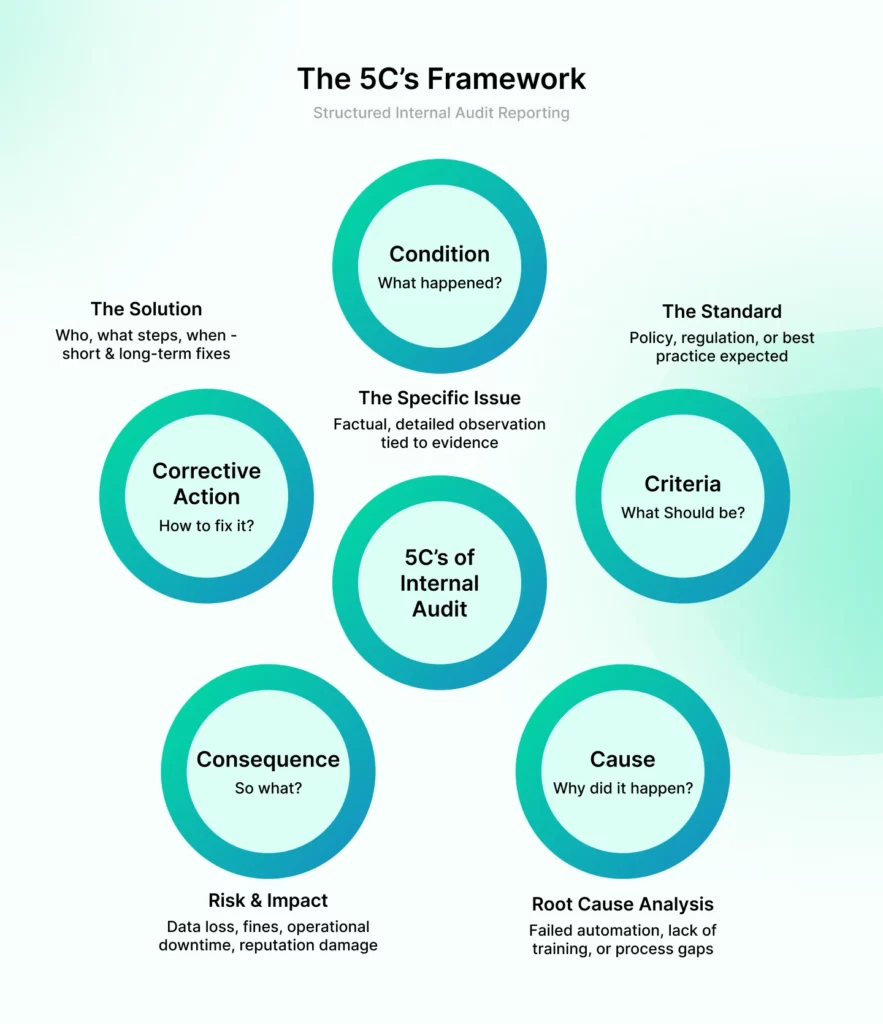
Analicemos cada "C" y lo que debería ofrecer.
1. Condición
La afección describe el problema específico observado durante la auditoría. Debe ser objetiva, detallada y estar respaldada por evidencia, no contener generalizaciones vagas.
Por ejemplo, no diga: «Los controles de acceso son débiles». Diga: «En 3 de cada 10 casos analizados, los usuarios dados de baja mantuvieron el acceso a sistemas financieros críticos durante más de 7 días después de la baja».
2. Criterio
Los criterios explican el estándar que se esperaba que la organización cumpliera y lo que debería haber sucedido. Esto podría ser una política interna, una normativa externa (como SOC 2, ISO 27001 o SOX), un acuerdo de nivel de servicio o incluso una buena práctica adoptada formalmente.
3 Porque
La sección de Causas identifica el motivo del problema. Esta suele ser la parte más descuidada en los informes de auditoría interna y la que más preocupa a los directivos. Un análisis de causas exhaustivo va más allá de los síntomas y se centra en las causas fundamentales.
¿Fue un fallo en la automatización? ¿Falta de capacitación? ¿Una política existente que nadie aplica? ¿O tal vez un equipo sobrecargado de trabajo que gestiona manualmente procesos que deberían estar automatizados?
4. Consecuencia
La sección de Consecuencias describe el riesgo o impacto asociado a la situación. Aquí es donde se responde a la pregunta: "¿Y qué?". Una buena sección de consecuencias va más allá de términos generales como "riesgo de seguridad" y vincula el hallazgo con impactos reales, como la pérdida de datos, la exposición financiera, las multas regulatorias, el daño a la reputación o incluso la interrupción de las operaciones.
5. Acción correctiva
La acción correctiva define cómo se abordará el problema: quién es responsable de la solución, qué medidas se tomarán y cuándo. Debe incluir tanto medidas correctivas a corto plazo (por ejemplo, deshabilitar el acceso para los usuarios dados de baja) como medidas preventivas a largo plazo (por ejemplo, automatizar el proceso de desaprovisionamiento y reforzar la aplicación de las políticas).
Managing internal audits with Sprinto
Para muchas pequeñas empresas, startups y compañías medianas, las auditorías internas aún se gestionan mediante hojas de cálculo, unidades compartidas y correos electrónicos. Lo que comienza como un proceso estructurado se convierte rápidamente en una carrera contrarreloj, buscando pruebas, coordinando a las partes interesadas y actualizando listas de verificación de auditoría del año anterior que ya no reflejan los riesgos actuales.
Pero esta es la verdad: una gestión de auditoría sólida no se trata de hacer más trabajo, sino de hacerlo de forma más inteligente. Eso significa construir un sistema que sea:
- Proactivo, no reactivo
- Integrado en sus programas de riesgo y cumplimiento.
- Repetible y escalable a medida que crece tu negocio.
Caso en punto: Cuando CertPro CPA LLC, a leading audit firm, partnered with Sprinto to conduct audits across multiple businesses, the impact was immediate and measurable. Using Sprinto’s integrated audit environment, they were able to:
- Reduzca el tiempo de auditoría en un 90%.
- Acceda a registros de auditoría en tiempo real sin necesidad de solicitar documentación adicional.
- Reducir significativamente la comunicación de ida y vuelta con los clientes.

Consigue un compañero para todas tus auditorías.
Preguntas frecuentes
1. ¿Qué es un software de gestión de auditoría interna y cómo mejora el cumplimiento normativo?
El software de gestión de auditoría interna estandariza el ciclo de vida de la auditoría, desde la planificación y la evaluación de riesgos hasta la ejecución y la elaboración de informes. Mejora el cumplimiento normativo al automatizar tareas rutinarias, reducir errores manuales y garantizar que los controles se supervisen y prueben de forma constante. Estas plataformas suelen incluir marcos de trabajo integrados, recordatorios automatizados y registros de auditoría, lo que facilita la demostración del cumplimiento durante las revisiones externas o los procesos de certificación.
2. ¿Cómo gestiona el software de gestión de auditoría interna la documentación y la recopilación de pruebas?
El software de auditoría interna centraliza todos los datos relacionados con la auditoría en una plataforma única y segura. Las evidencias, como registros, capturas de pantalla, documentos de políticas e informes de acceso, se pueden vincular directamente al control o proceso auditado. Esto garantiza que todo esté organizado, con control de versiones y disponible bajo demanda.
3. ¿Cuál es el papel de la dirección en la auditoría interna?
La dirección desempeña un papel fundamental en la auditoría interna, tanto como sujeto como impulsor. Por un lado, los equipos de auditoría evalúan la eficacia con la que la dirección gestiona los riesgos, la gobernanza y las obligaciones de cumplimiento. Por otro lado, la dirección es responsable de facilitar el proceso de auditoría, garantizar la transparencia y, sobre todo, actuar en función de las conclusiones de la auditoría.
4. ¿Con qué frecuencia deben realizarse las auditorías internas?
No existe una regla universal, pero la frecuencia de las auditorías debe basarse en el perfil de riesgo y las obligaciones regulatorias de su organización. Para áreas de alto riesgo (como la seguridad de los datos o la información financiera), las auditorías trimestrales suelen ser la mejor práctica. Para funciones de menor riesgo, las auditorías semestrales o anuales pueden ser suficientes. Los marcos de referencia como ISO 27001 y SOC 2 generalmente requieren al menos una auditoría interna formal al año.

Autor
Pensamiento
Pansy es una especialista en marketing de contenidos certificada por ISC2 en ciberseguridad, con formación en ingeniería informática. Últimamente, ha estado explorando el mundo del marketing desde la perspectiva de GRC (Gobierno, riesgo y cumplimiento) con SprintoCuando no está trabajando, se dedica a leer novelas políticas o a perfeccionar sus habilidades culinarias. También es posible encontrarla tomando el sol en la playa o haciendo senderismo por un bosque frondoso.Vaya más allá de la superficie y descubra los aspectos clave sobre gobernanza, riesgo y cumplimiento que realmente importan.


Gana premios digitales por tu éxito en la sala de juntas.


Explora más



Investigaciones y análisis seleccionados para ayudarte a ganarte un lugar en la mesa.